


Here's a sobering fact: over 70% of retail traders lose money.

Daniel Harrington
İçerik Editörü
☕ 14 dk okuma
Neler öğreneceksiniz:
- 1What is Forex Grid Trading? (The Simple Truth)
- 2Singapore Rules & Broker Policies: What You Must Know
- 3Building Your First Grid: A Step-by-Step Walkthrough
- 4The Real Costs & The Hidden Dangers Nobody Talks About
- 5Picking Your Pair & Broker in Singapore
- 6My Grid Trading Journal: Two Costly Mistakes
- 7Leveling Up: Advanced Tips & Automation
- 8Final Verdict: Is Grid Trading Right for You in Singapore?
Here's a sobering fact: over 70% of retail traders lose money. Yet, in Singapore's $1.5 trillion-a-day forex market, a quiet, mechanical strategy called grid trading keeps drawing people in with the promise of 'set and forget' profits. I've run grids for years, and let me tell you, it's not the easy money it's painted to be. It's a game of patience, precision, and brutal risk management, especially under MAS rules. This guide isn't theory. It's my trading journal opened up, showing you what worked, what blew up my account, and how to navigate grid trading right here in SG.
Forget the complex definitions. In practice, forex grid trading is placing a series of buy and sell orders at fixed price intervals above and below a starting point, creating a 'grid' or lattice across the chart. The core idea is beautifully simple: capture profit from the market's natural ups and downs, regardless of which direction it goes.
You're not trying to predict a big trend. You're betting on oscillation. Each time price hits a level in your grid, an order triggers. If it moves back the other way, you close that trade for a small profit. Rinse and repeat. It feels brilliant in a ranging market - like collecting rent from every little price swing.
But here's the first hard lesson. The strategy has a fatal flaw everyone glosses over: it assumes the market will always swing back. In a strong, sustained trend, your grid gets 'blown out.' All your orders on one side of the market get triggered, and without a reversal, you're left holding a massive, losing position. I learned this the expensive way during the 2015 Swiss Franc event. A grid on EUR/CHF didn't just lose; it would have caused a margin call so fast it'd make your head spin if I hadn't had strict disaster stops in place. That's the reality check.

Warning: Grid trading is often marketed as low-risk or passive. It is not. It's a high-risk strategy that can accumulate hidden, correlated losses during strong trends. Never treat it as a 'fire and forget' system.
Trading in Singapore means playing by MAS rules. They don't regulate the grid strategy itself, but they strictly govern who can offer you the tools to do it. This framework is your first layer of protection.
The MAS Safety Net
Brokers here need a Capital Markets Services (CMS) license. This isn't just paperwork. It means they must segregate your funds from their own (so your money isn't used for their office party), provide negative balance protection (you can't owe more than you deposited), and adhere to strict capital requirements. There's no government compensation scheme if a broker fails, but these rules make that scenario far less likely. For us traders, the most tangible rule is use. MAS expects brokers to set sensible limits, especially for retail clients. You'll commonly see caps of 50:1 for majors and 20:1 for minors. This is a good thing. High use is a grid trader's silent killer, amplifying losses when a grid goes wrong. I never use more than 20:1 for a grid system.
The Broker Hurdle
Here's the tricky part. Even if a broker is MAS-regulated, like IG or OANDA, they might not allow automated grid trading on their platform. Or, they might frown upon it if it generates excessive 'mini-scalps' that could be seen as price exploitation. You must check their terms of service. Some international brokers popular with algorithmic traders, like Pepperstone or IC Markets, are more grid-friendly but may not hold a direct MAS license for SG clients. It's a trade-off: platform flexibility versus regulatory proximity. My rule? If I'm testing a new grid EA, I use a small account with an international broker. For my main, long-term grids, I stick with MAS-regulated entities for peace of mind.

Example: Let's talk taxes, because everyone asks. Singapore has no capital gains tax. If you're trading as an individual investor, your forex profits are generally not taxable. However, if you're trading with such frequency, volume, and organization that it looks like a business, the IRAS might take a different view. Keep clean records. When in doubt, consult a tax professional, not a trading forum.

💡 Winston'ın İpucu
A grid's profit is made in the ranging market, but its survival is decided by how you handle the trend. Always have a plan for the breakout before you place the first order.
“Grid trading creates a psychological illusion of safety. You see many small green trades piling up. It feels easy. This lulls you into increasing your lot size without adjusting your overall risk.”
Let's get practical. I'll walk you through setting up a manual grid on a pair like AUD/USD, which often has nice, tradable ranges.
Step 1: Find the Range. Don't just slap a grid anywhere. Use the weekly and daily charts to identify a clear consolidation zone. Look for a period where price has been bouncing between a clear support and resistance for weeks. That's your grid's playground. Placing a grid in a trending market is asking for trouble.
Step 2: Define Your Parameters.
- Grid Center: I usually start the grid in the middle of the identified range.
- Grid Spacing: This is the distance between each order, measured in pips. Too tight (5 pips), and you'll get whipsawed by spread and noise. Too wide (50 pips), and you'll miss too many movements. For AUD/USD, I've found 20-25 pips to be a sweet spot.
- Number of Levels: How many buy and sell orders? Start small. 3 levels above and 3 below your center (7 orders total) is a safe start. This defines the 'width' of your grid.
- Order Size: This is CRITICAL. Use a position size calculator. Your risk isn't on one trade; it's on the entire grid being taken out. I size so that the total potential loss from the entire grid being triggered would not exceed 2% of my account. If that means 0.01 lots per order, so be it.
Step 3: Place the Orders. Manually, you'd set a buy limit and a sell limit at your center price. Then, another set at center + spacing, and another at center - spacing. Repeat until you've placed all your orders. Every buy order has a take-profit target at the next grid level up. Every sell order has a take-profit at the next grid level down. Stop losses? This is the debate. Classic grid trading often omits them, which I think is madness. I always attach a hard stop loss to the entire grid system, not individual orders, based on the edge of the identified range.
Step 4: Manage and Monitor. This isn't passive. You need to watch for a breakout. If price breaks convincingly above your top grid level or below your bottom one, the market is telling you your range is over. It's time to manually close all opposing positions and consider shutting the grid down. Hanging on hoping for a reversal is how small losses become account-ending ones.
Brokers love grid traders. We generate consistent, small trades. But those 'small' costs add up fast and can completely erase your theoretical profits.
The Cost Killers:
- Spread: You're opening and closing trades constantly. If the spread on your pair is 2 pips, and your grid profit target is only 15 pips, you're giving up over 13% of your profit on every round turn. This is why grids on exotics or minor pairs often fail. Stick to majors with razor-thin spreads.
- Commission: If you're on a commission-based account (like a raw spread account), you pay per lot, per trade. A grid generating 100 micro-trades a month can rack up hundreds in fees. You must factor this into your profit target. I once backtested a beautiful grid strategy that showed a 5% monthly return. When I added realistic commission costs, it became a 0.5% loss.
- Swap/Rollover: If your grid holds positions overnight (and it will), you'll pay or receive swap fees. If you're net long a currency with a lower interest rate than the one you're short, you'll have a negative carry, slowly bleeding your account.
The Psychological Danger: The biggest risk isn't market risk. It's you. Grid trading creates a psychological illusion of safety. You see many small green trades piling up. It feels easy. This lulls you into increasing your lot size or widening your grid without adjusting your overall risk. You become a frog in slowly boiling water. Then, when the trend hits, you're cooked. I've been that frog. In 2018, after 3 months of steady grid profits on EUR/USD, I doubled my position size, arrogant. A subsequent directional move wiped out those 3 months of profits in 48 hours. The loss wasn't from the strategy failing; it was from my own greed distorting the system.

Pro Tip: Before you run a live grid, model all costs in a spreadsheet. For each trade, deduct the spread and commission. Then see if your net profit is still positive. If it's not, your grid spacing is too tight or your pair is too expensive to trade.
“The biggest risk isn't market risk. It's *you*.”
Your choice of currency pair and platform will make or break your grid trading journey.
The Best Pairs for Grids
You want pairs that range, not trend. You also want low spreads. Here’s my shortlist based on years of screen time:
| Currency Pair | Why It Works for Grids | My Typical Grid Spacing |
|---|---|---|
| EUR/USD | The world's most liquid pair. Tends to cycle in well-defined ranges for long periods. Ultra-low spreads. | 15-20 pips |
| USD/CHF | Often exhibits slow, rhythmic oscillations. Good for wider, slower grids. | 25-30 pips |
| AUD/USD | As mentioned, a classic range-trading pair, especially during Asian session hours. | 20-25 pips |
| EUR/GBP | Can get choppy, but often consolidates in tight bands. Requires careful spacing. | 15-20 pips |
I avoid pairs like GBP/JPY (too volatile) and most exotics (spreads are murder). The USD/SGD pair is interesting for local sentiment, but its trends can be persistent. It requires a very wide grid and careful monitoring.
Broker Considerations in SG
You need a broker that allows the strategy, has tight spreads, and offers strong platforms like MetaTrader 4 or 5 for automation. Among MAS-regulated brokers, check if their platform supports Expert Advisors (EAs) for automated grids. Some, like Saxo or CMC, have powerful platforms but may not support custom MT4/5 EAs the way you need.
For manual grids, any good broker works. For automated grids, many traders I know (myself included for testing) use brokers like IC Markets or Pepperstone for their MT4/5 support and EA-friendly environment, even if they access them via their global entities. Always, always verify they accept Singaporean clients and understand the regulatory implications.
The platform is key. Manually managing 20+ orders with individual take-profits is a nightmare. You need a terminal that can help you visualize and manage the grid as a single system.
💡 Winston'ın İpucu
Test your grid strategy with a 'costs-on' demo account for at least three months. If it's not profitable after factoring in spreads and commissions, it's a loser in live markets.
Theory is cheap. Let me show you two real, painful entries from my trading log.
Mistake 1: The Over-optimized Gold Grid. In 2020, I set a grid on XAU/USD (gold). Backtesting a period of low volatility showed amazing results with a 7-pip grid spacing. I ignored the fact that gold's spread is often $0.50 (5 pips). I placed the grid. For a week, it clicked beautifully, making $15 here, $20 there. Then, a US inflation report hit. Gold spiked $30 in minutes. My tight grid got saturated with buy orders on the way up. When price stalled and dipped just 10 pips, it closed a few for profit, but the bulk of my buys were now deep underwater. The reversal didn't come. I was forced to close the entire grid at a $1,200 loss. The lesson? My grid spacing was smaller than the asset's normal volatility and spread. I was trading noise, not a range.
Mistake 2: Ignoring the Higher Timeframe Trend. This is the most common error. In July 2022, the daily chart for EUR/USD was in a clear downtrend. But the 4-hour chart showed a nice, two-week consolidation. I got greedy and placed a grid inside that 4-hour range, thinking I could scalp the bounce. I was right for three days. Then, the downtrend resumed. Price sliced through the bottom of my grid like it wasn't there. All my buy orders were triggered, and the sell-offs couldn't keep up. The loss wasn't catastrophic because my position size was small, but it was 100% avoidable. I violated the cardinal rule: never place a grid against the higher timeframe trend. It's like trying to collect seashells as the tide is going out. Eventually, you're just stranded.
These mistakes taught me that grid trading isn't about being clever with entries. It's about discipline in three areas: position sizing, choosing the right market phase, and having an iron-clad exit plan for when you're wrong.
“Your job isn't to predict the market's next move, but to ensure that no matter what it does, your account lives to trade another day.”
Once you've mastered a basic manual grid, you can explore ways to improve efficiency and manage risk.
Dynamic Grid Adjustments
A static grid is vulnerable. An adaptive grid adjusts to market conditions. One method I use is volatility-based spacing. I set my grid spacing as a multiple of the Average True Range (ATR). If the ATR expands (market gets volatile), I widen my grid spacing automatically to avoid being whipsawed. If the ATR contracts, I might tighten it slightly. This keeps the strategy aligned with current market 'noise.'
The Holy Grail: Partial Grid Closure
This was a game-changer for me. Instead of letting a trending market trigger every single order on one side of the grid, I program my system to close a portion of the losing positions if the grid reaches a certain level of imbalance. For example, if 70% of my active trades are sells (because price is falling), I automatically close 30% of those oldest sell positions at a small loss. This frees up margin and reduces the portfolio's directional bias, giving the grid room to breathe if a reversal comes. It turns a potential catastrophic loss into a managed drawdown.
Automation is Non-Negotiable
Manually managing a grid beyond 5 orders is a full-time job. You need an Expert Advisor (EA) for MetaTrader. You can code one yourself (if you have the skills) or purchase a reputable one. The EA should handle order placement, take-profit/stop-loss management, and ideally, the dynamic adjustments and partial closures mentioned above. It removes emotion and ensures flawless execution.
However, automation requires a powerful trading terminal. Managing multiple orders, partial closures, and trailing stops across a grid manually on standard MT5 is clunky and error-prone.
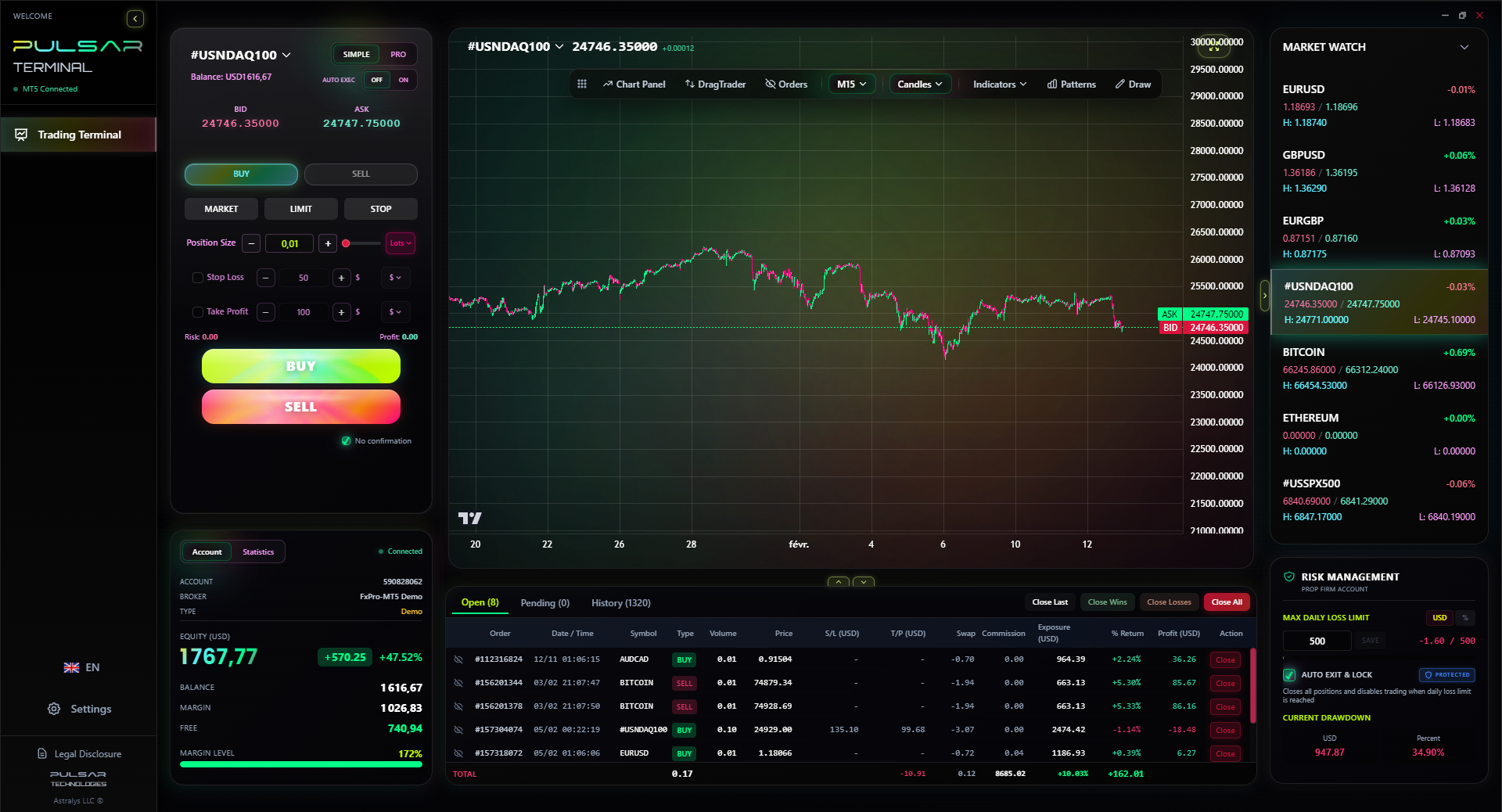
Managing a complex grid with multiple take-profit levels and partial closures is where a tool like Pulsar Terminal shines, turning MT5 into a powerful system-trading platform.
Pulsar Terminal
Hepsi bir arada MT5 aracı: sürükle-bırak emirler, çoklu TP/SL, trailing stop, grid trading, Volume Profile ve prop firm koruması. Her gün 1.000'den fazla trader tarafından kullanılıyor.
So, after all this, should you try forex grid trading?
Consider grid trading if:
- You have a patient, systematic personality.
- You understand and can carefully calculate transaction costs.
- You have the discipline to stick to small position sizes and not override the system.
- You're comfortable with technology and automation.
- You're trading in a well-regulated environment like Singapore and understand the broker landscape.
Avoid grid trading if:
- You're looking for a 'get rich quick' scheme or passive income with no oversight.
- You can't stomach watching a series of small losses accumulate during a trend.
- You're prone to tinkering and over-optimizing systems.
- You have a small account. The margin requirements for a safe, properly sized grid can be significant.
For me, grid trading is a specialized tool in my toolbox. I might allocate 10-15% of my capital to a well-defined grid setup in a ranging market, but it's never my primary strategy. It's a complement to my core swing trading approaches.
The Singapore market, with its high liquidity and strong regulation, is a good place to implement such strategies if you're careful. Just remember, the grid doesn't think. It just executes. You are the risk manager. Your job isn't to predict the market's next move, but to ensure that no matter what it does, your account lives to trade another day. That's the only lesson that truly matters.
FAQ
Q1Is forex grid trading legal in Singapore?
Yes, absolutely. Forex trading is legal, and grid trading is a strategy, not a regulated product. The legality comes from using a broker licensed by the Monetary Authority of Singapore (MAS). The strategy itself is just a method of placing orders.
Q2What's the biggest mistake new grid traders make?
Ignoring transaction costs and using too much use. They see the theoretical profit from price swings but forget that the spread and commissions on every single trade can turn a winning system into a loser. Combine that with high use, and a small adverse move can trigger a margin call.
Q3Can I use grid trading with a prop firm challenge?
Extremely carefully, if at all. Most prop firms have strict rules on drawdown and daily loss limits. A grid can quietly accumulate a large, hidden floating loss that suddenly realizes if the market gaps. This can blow your daily loss limit in seconds. The strategy's risk profile is often incompatible with prop firm rules.
Q4Do I need an Expert Advisor (EA) to grid trade?
For anything beyond a very simple 3-5 order grid, yes, you practically do. Managing dozens of orders, take-profits, and potential adjustments manually is impossible and guarantees errors. An EA automates the entire process consistently.
Q5Which forex pair is best for grid trading in Singapore?
EUR/USD is typically the best starting point due to its high liquidity, tendency to range, and very low spreads. For local context, USD/SGD can be used, but it requires wider grid spacing and closer monitoring as it can trend more persistently.
Q6How much capital do I need to start grid trading?
More than you think. Because your risk is spread across multiple potential positions, you need enough capital to withstand the drawdown of the entire grid being activated without hitting margin limits. For a conservative grid on a major pair, I wouldn't start with less than $5,000, and even then, you'd be trading micro lots (0.01).
Q7Should I use stop losses on my grid orders?
This is debated. Pure grid theory often omits them. I always use a system-wide stop loss. I don't put a stop on each individual order, but I have a hard stop level for the entire grid system based on the technical boundaries of the range I'm trading. Letting losses run infinitely is a recipe for disaster.
Prof. Winston'ın Dersi
Önemli Noktalar:
- ✓Grid spacing must exceed the spread + normal volatility.
- ✓Never grid against the higher timeframe trend.
- ✓Size for the total grid risk, not a single trade.
- ✓Automate or fail - manual grid management is error-prone.
Bu makale ne kadar faydalıydı?
Bir yıldıza tıklayın
Haftalık Trading Analizleri
Ücretsiz haftalık analiz ve stratejiler. Spam yok.
Yazar hakkında
Daniel Harrington
İçerik Editörü
The Trading Mentor içerik direktörü. Karmaşık ticaret kavramlarını anlaşılır kılma tutkusuna sahip deneyimli trader. Küresel konuları, stratejileri ve platform rehberlerini kapsar.
Yorumlar
Risk Uyarısı
Finansal araçlarla işlem yapmak önemli riskler taşır ve tüm yatırımcılar için uygun olmayabilir. Geçmiş performans gelecekteki sonuçları garanti etmez. Bu içerik yalnızca eğitim amaçlıdır ve yatırım tavsiyesi olarak değerlendirilmemelidir. İşlem yapmadan önce her zaman kendi araştırmanızı yapın.
Bunları da beğenebilirsiniz

Cara Trading Forex Sukses: 7 Prinsip dari Trader Profesional
Cara trading forex sukses dengan 7 prinsip trader pro: manajemen modal, disiplin, journal trading, backtest. Data nyata, bukan janji profit palsu.
Jam Trading Forex Terbaik untuk Trader Indonesia: Panduan Lengkap dengan Tabel Waktu
Panduan jam trading forex untuk trader Indonesia. Tabel 4 sesi dunia, jam emas 20:00-00:00, sesi mana yang harus dihindari. Data akurat + tips dari trader berpengalaman.
Top 5 Sàn Forex Uy Tín Nhất 2026: Review Jujur dari Trader Indonesia
Top 5 sàn forex uy tín 2026 untuk trader Indonesia. Review jujur: spread, deposit, withdraw, dukungan lokal. Exness, XM, IC Markets & lebih.
Pulsar Terminal'ı Edinin
Tüm bu hesaplayıcılar MT5 hesabınızdan gerçek zamanlı verilerle Pulsar Terminal'e entegredir.
Pulsar Terminal'ı Edinin