


Most new traders think the forex market is just about buying low and selling high on a chart.

David van der Merwe
Gelişen Piyasalar Yatırımcısı ·  South Africa
☕ 11 dk okuma
Neler öğreneceksiniz:
- 1What is Forex and Who Actually Moves the Price?
- 2The South African Rulebook: FSCA, SARB, and Your Money
- 3Currency Pairs, Pips, and the ZAR's Wild Ride
- 4From Your Click to the Market: How a Trade Actually Works
- 5The Real Costs: Spreads, Commissions, and SA Broker Reality
- 6How the Forex Market Punishes SA Trader Mistakes
- 7Building a Approach That Works With the Market, Not Against It
Most new traders think the forex market is just about buying low and selling high on a chart. They're wrong. They get chewed up because they don't understand the actual machinery: who's moving the price, how their broker fits in, and what the FSCA's 30:1 use rule really means for their Rands. I've seen too many 'students' blow accounts trading USD/ZAR without knowing the first thing about how this market functions. Let's set the record straight.
Forex, or foreign exchange, is the global marketplace for trading national currencies against one another. It's not a single building on Wall Street. It's a 24-hour, decentralized network of banks, corporations, governments, and speculators. The turnover is insane. Globally, it's about $7.5 trillion a day. For South Africa, the daily volume is around $16 billion. That's where your opportunity, and your risk, comes from.
The Real Players (It's Not You)
Forget the YouTube ads showing a guy on a beach. The real market movers are:
- Central Banks & Governments: The South African Reserve Bank (SARB) is a giant here. When they intervene to support or weaken the Rand, your retail trade is a speck of dust in the hurricane. Their policy announcements on interest rates move USD/ZAR by hundreds of pips in minutes.
- Commercial & Investment Banks: Standard Bank, Absa, FNB. They trade for clients, hedge risk, and speculate for their own books. The interbank market between these giants sets the baseline prices you see.
- Multinational Corporations: Think Sasol or a mining company like Anglo American. They trade massive amounts to convert profits from overseas operations back into ZAR or to pay for imports. This creates constant, predictable flows.
- Retail Traders (That's You and Me): We're the smallest fish. Our collective volume has grown, but we're still price takers, not price makers. Your broker aggregates your tiny order with thousands of others to interact with the bigger pools of liquidity.

Warning: If you think you're competing with other retail traders on your broker's platform, you're mistaken. You're competing against the banks and algos mentioned above. Your edge comes from understanding their behavior, not outsmarting the guy next to you.
The key takeaway? The forex market works on a hierarchy. News and flows from the top tier (governments, banks) filter down to the retail level. Your job is to read those flows. I learned this the hard way early on, trying to scalp the EUR/USD against obvious institutional buying. I was right on the trend, but my 5-pip stop-loss was laughable to them. They shook me out three times before the price rocketed in my original direction.
Trading in South Africa isn't the wild west. We have a solid, if sometimes frustrating, regulatory framework. The main sheriff is the Financial Sector Conduct Authority (FSCA). They took over from the FSB a few years back.
Here’s what their rules mean for you:
- Licensing is Everything: A legit broker serving South Africans must have an FSP license number. You can and must check this on the FSCA's public register. Don't just trust the logo on their website.
- The 30:1 use Cap: This is a big one. Since 2021, the max use for retail clients is 30:1 on major forex pairs. For a standard lot ($100,000), that means a margin requirement of about $3,333. Some moan about this, but honestly, it probably saved your account. I used 100:1 back in the day and watched a $5,000 account vanish on a single USD/ZAR trade gone wrong. The cap forces better position size discipline.
- Segregated Accounts: FSCA-regulated brokers must keep your trading capital separate from their company funds. If the broker goes bankrupt (it happens), your money should be safe. This is non-negotiable.
- The SARB's Role: The South African Reserve Bank governs cross-border financial flows. It's why you have to declare foreign investments. They also set monetary policy, which is the single biggest driver for the Rand's value.
You can use international brokers like IC Markets or Pepperstone, and many do for their raw spreads. But know the trade-off: if you have a dispute with an offshore broker, the FSCA might not be able to help you. It's a choice between potentially lower costs and local regulatory protection.

💡 Winston'ın İpucu
The market's primary job is to find your stop-loss. Place it where it makes sense for the chart, not where it's convenient for your account balance.
“You're competing against banks and algos, not the guy next to you on the broker platform.”
You don't buy 'forex.' You trade a pair. It's a relative value game: the value of one currency against another.
Major Pairs: These involve the USD and other major currencies (EUR/USD, GBP/USD). They're the most liquid, meaning tight spreads. ZAR Crosses: This is our home game. USD/ZAR, EUR/ZAR, GBP/ZAR. These are more volatile and have wider spreads. That's your cost of trading the Rand's drama.
A pip is the smallest price move. For most pairs, it's 0.0001. For USD/ZAR, it's usually 0.0001 (or 0.01c). But here's the kicker: because the ZAR is worth less, the monetary value of a pip in USD/ZAR is different.
📊 Example: Let's say you buy 1 standard lot (100,000 units) of USD/ZAR at 18.5000. One pip is 0.0010. Pip Value = (0.0010 / 18.5000) * 100,000 = ~ZAR 5.41 If the pair moves to 18.6000, that's a 100 pip gain, or about ZAR 541.
See how the exchange rate itself affects the pip value? This is critical for risk management. A 50-pip stop-loss on EUR/USD is very different from a 50-pip stop-loss on USD/ZAR in Rand terms. I once made the rookie error of setting the same pip stop on both. A ZAR spike blew through my stop, and the loss was nearly double what I'd calculated for my EUR trade. My risk was a mess.
You click 'buy' on USD/ZAR. What happens in the next millisecond? This is where most traders are clueless, and it costs them.
- Your Order: You send an order to your broker's server.
- Broker's Choice: This is the crucial part. Does your broker act as the counterparty (taking the other side of your trade in a 'dealing desk' model), or do they route it directly to liquidity providers (banks) in an 'ECN/STP' model?
- Execution & Spread: Your order is filled at the available price. The difference between the buy and sell price is the spread. This is the broker's primary fee. An ECN broker might charge a small commission but give you a raw 0.0 pip spread from the bank. A market maker broker bakes their profit into a wider, fixed spread.
- In Your Account: The position appears, live and breathing, with a floating P/L.

Pro Tip: If you're a scalping strategy trader, those fractional pip differences in execution and spread matter enormously. You need a true ECN broker. For longer-term swing trading, a slightly wider spread on a reliable platform matters less than overnight swap rates and stability.
Here’s a real example from my trading log. I used a market-maker broker years ago. I placed a limit buy order on GBP/JPY ahead of news. The news hit, price spiked down to my level and instantly bounced. My platform showed my order was 'filled' at the exact price, but then the trade immediately went 5 pips into negative territory. Slippage? No. The broker's quote feed had a momentary 'spike' low that didn't exist in the broader interbank market. They filled me at their artificial price. I switched to an ECN broker (Exness for a while, then others) and that phantom spike problem vanished. You need to know what model your broker uses.
💡 Winston'ın İpucu
If you can't explain your trade's thesis in one sentence, you don't have one. You have a hope. The market feeds on hope.
“A margin call isn't a warning, it's an autopsy.”
Talking about profits is fun. Let's talk about costs, because that's what determines if you're profitable at all. For a South African trader, costs come in three main forms:
1. The Spread: The most obvious cost. It's the gap between the bid and ask price. You start a trade in the red by this amount. 2. Commissions: Charged per lot, per side (open and close). Common on ECN accounts. 3. Swap/Overnight Financing: The interest you pay or earn for holding a position past 5pm New York time. For ZAR pairs, this can be significant due to South Africa's interest rate.
Let's look at some real numbers for South African traders. The table below shows effective costs for a 1 standard lot (100k) trade on EUR/USD, rounded for clarity.
| Broker Type | Avg. Spread (EUR/USD) | Commission (per lot, rt) | Effective Cost | Good For... |
|---|---|---|---|---|
| Premium ECN (e.g., IC Markets) | 0.0 pips | $7.00 | $7.00 (0.7 pips) | Scalpers, high-volume traders. Raw prices. |
| Standard ECN | 0.2 pips | $5.00 | $9.00 (~0.9 pips) | Most active traders. Good balance. |
| Commission-Free (e.g., XM) | 0.8 pips | $0.00 | $8.00 (0.8 pips) | Beginners, lower-frequency traders. Simpler cost structure. |
| Typical Market Maker | 1.5 pips | $0.00 | $15.00 (1.5 pips) | Not much these days. Avoid for serious trading. |
Note: $1 per pip is a standard approximation for a 1-lot EUR/USD trade.
For USD/ZAR, expect spreads to be wider. A good spread might be 40-80 pips during active hours. Why so wide? Lower liquidity and higher volatility. That means your effective cost to enter a ZAR trade is immediately R200-R400 on a standard lot, before the market even moves. This is why you can't use the same tight stop-losses you might on EUR/USD. The market's natural noise will eat you alive.
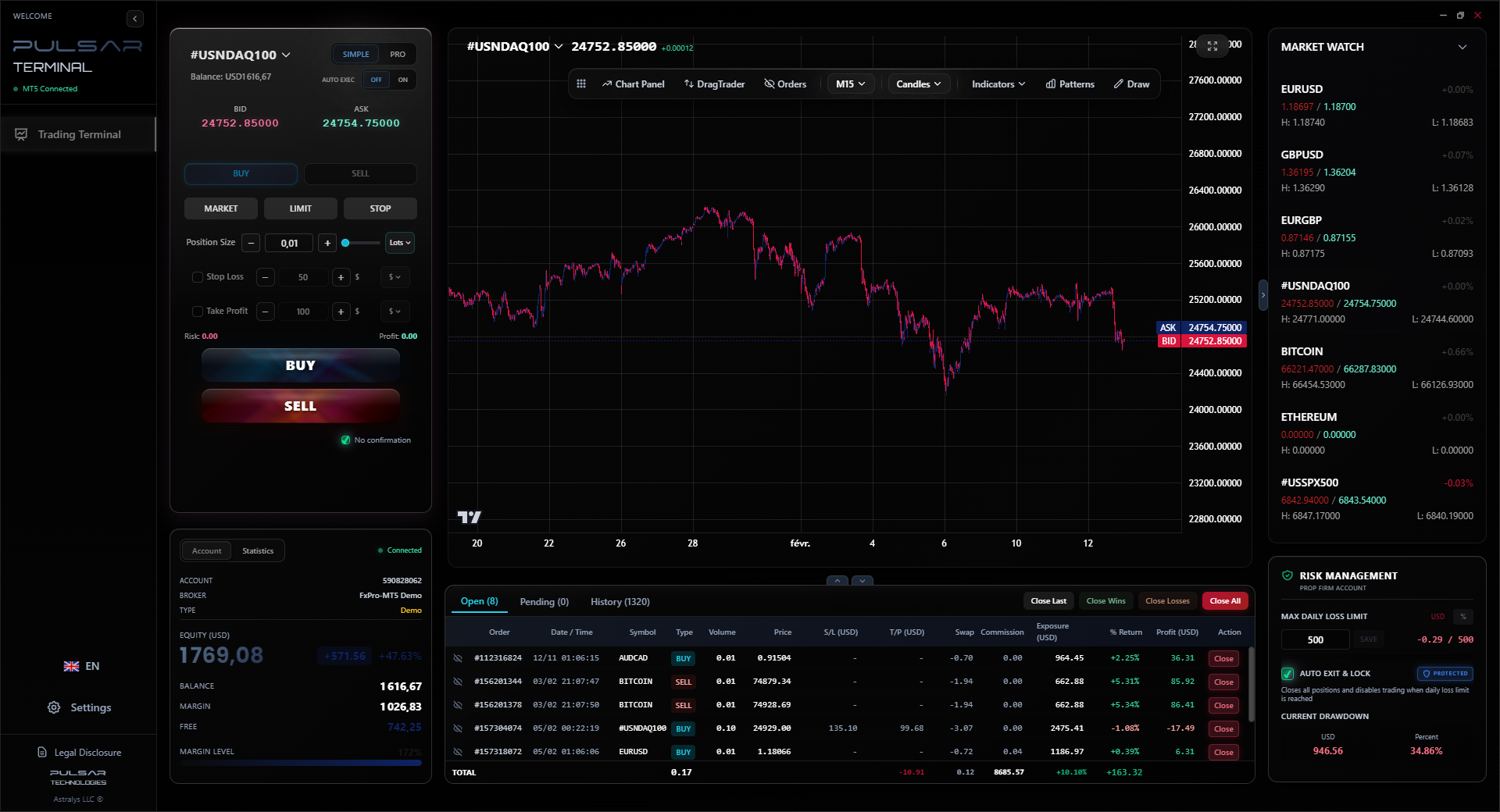
Managing the volatile spreads and precise entries on ZAR pairs requires sharp tools; Pulsar Terminal's drag-and-drop orders and multi-take-profit levels let you execute complex strategies on MT5 without hesitation.
Pulsar Terminal
Hepsi bir arada MT5 aracı: sürükle-bırak emirler, çoklu TP/SL, trailing stop, grid trading, Volume Profile ve prop firm koruması. Her gün 1.000'den fazla trader tarafından kullanılıyor.
The market isn't malicious. It's just a mechanism that efficiently transfers money from the unprepared to the prepared. Here’s how it works to wipe out retail traders, especially with ZAR volatility.
Mistake 1: Ignoring use & Margin. You deposit R10,000. With 30:1 use, you can control R300,000 worth of USD/ZAR. A 3.33% move against you wipes your entire deposit. That's a common daily range for that pair. The market provides the rope (use), and most traders hang themselves with it. A margin call isn't a warning, it's an autopsy.
Mistake 2: Chasing News on ZAR Pairs. SARB announces a 50bps rate hike. USD/ZAR drops 150 pips in 10 seconds. You see it moving, FOMO kicks in, you hit 'sell.' You get filled after the big move. Then it reverses 80 pips on profit-taking (the 'buy the rumor, sell the news' play). You're stopped out. The market absorbed the news in milliseconds, and you paid to be the liquidity for the smart money exiting.
Mistake 3: Trading Without a Clear Edge. This is the big one. An edge is a statistical advantage. Maybe it's a specific RSI indicator divergence setup on the 4-hour chart, or a MACD indicator crossover confirmed by a key level. Most traders have a vague 'feeling.' The market systematically grinds down vagueness. My own early edge was terrible. I'd see a 'double top' and short. No volume confirmation, no understanding of the higher timeframe trend. I was right about 45% of the time, and the losses from the 55% wiped out all gains and then some. That's how the market works: it turns a sub-50% strategy into a guaranteed loser, especially after costs.
💡 Winston'ın İpucu
Your first profit target should always be to break even. Move your stop to entry once you're up a sensible amount. A trade that can't pay for itself doesn't deserve to run.
“The weeks I make the most money are often the most boring.”
So how do you not get eaten? You align your actions with how the forex market actually functions.
1. Respect the Hierarchy. Use economic calendars. Know when SARB, the Fed, and the ECB speak. Don't trade major ZAR pairs 15 minutes before and after high-impact news unless you're a seasoned pro (and even then, be careful).
2. Choose Your Broker Wisely. Match your broker to your style. If you're testing a high-frequency strategy, you need an ECN broker with tight spreads and fast execution. Don't try to scalp on a commission-free broker with 2-pip spreads; the math will kill you.
3. Risk Management is Your Prime Directive. This isn't a suggestion. It's the only thing that keeps you in the game long enough to learn. Use a position size calculator for every single trade. Never risk more than 1-2% of your capital on one idea. On a volatile pair like USD/ZAR, that might mean a wider stop and a smaller lot size. That's fine.
4. Find a Real Edge and Test It. Backtest. Forward test on a demo. Then trade small live sizes. Your edge should have a logical reason rooted in market mechanics (e.g., price tends to bounce at previous swing highs where stops are clustered, or volatility expands after a period of compression).
The forex market works on probabilities, not certainties. Your job is to manage the uncertainties (risk) so that when your probabilistic edge plays out, you make money over a series of trades. It's a marathon of disciplined execution, not a lottery. I've been doing this for over a decade, and the weeks I make the most money are often the most boring. Just following a plan, taking my 1:2 risk-reward setups, and letting the market come to me.
FAQ
Q1Is forex trading legal and safe in South Africa?
Yes, it's legal. Its safety depends entirely on you and your broker. Trading with an FSCA-licensed broker provides legal protection, including segregated client funds. The trading itself is high-risk, so 'safe' isn't the right word. 'Regulated' and 'informed' is what you should aim for.
Q2What is the maximum use I can use in South Africa?
For retail traders, the FSCA caps use at 30:1 on major currency pairs. This has been in effect since 2021. Some brokers may offer lower use on exotic pairs like ZAR crosses. Professional clients can apply for higher use, but the criteria are strict.
Q3Do I pay tax on my forex trading profits in South Africa?
Absolutely yes. The South African Revenue Service (SARS) views forex trading profits as taxable income. You must declare your net profits (total gains minus total losses and costs) in your annual tax return, even if you trade with an offshore broker. Keep detailed records of all your trades.
Q4Why are the spreads on USD/ZAR so much wider than on EUR/USD?
Liquidity and volatility. EUR/USD is the most traded pair in the world, with massive volume from banks and institutions. USD/ZAR has much lower volume and is more sensitive to local political and economic news. The wider spread is the market's price for providing liquidity in a less-traded, riskier instrument.
Q5Can I trade forex with a small account, like R1000?
Technically, yes. Many brokers have minimum deposits around that. But practically, it's very difficult. With R1000 and 30:1 use, you control R30,000. A 3.4% move against you wipes you out. You'd have to trade micro lots (1,000 units) to have any sensible risk management, and even then, costs (spreads) eat a larger percentage of your capital. It's an uphill battle.
Q6What's the difference between a market maker and an ECN/STP broker?
A market maker often acts as the counterparty to your trade, setting their own prices. An ECN (Electronic Communication Network) or STP (Straight Through Processing) broker routes your order to multiple liquidity providers (banks). ECNs typically offer raw spreads plus a commission, leading to lower total costs for active traders. Market makers profit from the spread and your losses.
Q7What time does the forex market open and close in South Africa?
The forex market is open 24 hours a day, 5 days a week. It starts in Sydney on Monday morning (around 00:00 SAST), moves to Tokyo, then London, and finally New York before closing on Friday evening (around 23:00 SAST). The most volatile overlap for ZAR pairs is during the London session (10:00-19:00 SAST).
Prof. Winston'ın Dersi
Önemli Noktalar:
- ✓Verify your broker's FSCA license. Every time.
- ✓30:1 use is a protective cap, not a limit to be maxed out.
- ✓A USD/ZAR spread of 50 pips is normal. Plan your stops accordingly.
- ✓Your trading profits are taxable income. Report them to SARS.
- ✓Trade the ZAR during London hours for the best liquidity.
Bu makale ne kadar faydalıydı?
Bir yıldıza tıklayın
Haftalık Trading Analizleri
Ücretsiz haftalık analiz ve stratejiler. Spam yok.
Yazar hakkında
David van der Merwe
Gelişen Piyasalar Yatırımcısı
Johannesburg merkezli, gelişmekte olan piyasa dövizlerinde 11 yıllık deneyime sahip trader. ZAR pariteleri, FSCA düzenlemeli ticaret ve Güney Afrika piyasa analizi uzmanı.
Yorumlar
Risk Uyarısı
Finansal araçlarla işlem yapmak önemli riskler taşır ve tüm yatırımcılar için uygun olmayabilir. Geçmiş performans gelecekteki sonuçları garanti etmez. Bu içerik yalnızca eğitim amaçlıdır ve yatırım tavsiyesi olarak değerlendirilmemelidir. İşlem yapmadan önce her zaman kendi araştırmanızı yapın.
Bunları da beğenebilirsiniz

Cara Trading Forex Sukses: 7 Prinsip dari Trader Profesional
Cara trading forex sukses dengan 7 prinsip trader pro: manajemen modal, disiplin, journal trading, backtest. Data nyata, bukan janji profit palsu.
Jam Trading Forex Terbaik untuk Trader Indonesia: Panduan Lengkap dengan Tabel Waktu
Panduan jam trading forex untuk trader Indonesia. Tabel 4 sesi dunia, jam emas 20:00-00:00, sesi mana yang harus dihindari. Data akurat + tips dari trader berpengalaman.
Top 5 Sàn Forex Uy Tín Nhất 2026: Review Jujur dari Trader Indonesia
Top 5 sàn forex uy tín 2026 untuk trader Indonesia. Review jujur: spread, deposit, withdraw, dukungan lokal. Exness, XM, IC Markets & lebih.
Pulsar Terminal'ı Edinin
Tüm bu hesaplayıcılar MT5 hesabınızdan gerçek zamanlı verilerle Pulsar Terminal'e entegredir.
Pulsar Terminal'ı Edinin