


I watched my screen as a R1,500 trade on USD/ZAR turned into a R300 loss in under a minute.

David van der Merwe
Gelişen Piyasalar Yatırımcısı ·  South Africa
☕ 11 dk okuma
Neler öğreneceksiniz:
- 1What Exactly Is a Forex Mini Account? (It's Not What You Think)
- 2FSCA Rules & The 30:1 use Trap
- 3The Real Costs They Don't Show You
- 4How to Pick a Mini Account Broker (The Checklist)
- 5The Only Strategy That Works for Small Accounts
- 6Pitfalls That Will Wipe Out Your Mini Account
- 7When and How to Move Beyond a Mini Account
I watched my screen as a R1,500 trade on USD/ZAR turned into a R300 loss in under a minute. My stop-loss was set, but the spread widened from 8 pips to 25 during a news event. On a R5,000 mini account, that single loss wiped out over 6% of my capital. That's the reality they don't tell you in the ads. Starting small with a forex mini account broker seems safe, but it's where most South African traders make their first and most expensive mistakes. Let's talk about why, and how to actually survive.
Most new traders think a 'mini account' is just a small deposit. That's only half the story. The real definition is about trade size, not just your starting balance.
A standard forex lot is 100,000 units of the base currency. A mini lot is 10,000 units. That's the core of a true mini account: it lets you trade in smaller, more manageable chunks. Instead of risking R100 per pip on a standard lot, you're risking R10 per pip. This is crucial for proper risk management, which is your only hope of survival.
In South Africa, you'll see brokers offering 'micro' or 'cent' accounts too. These can be even smaller, dealing in 1,000-unit lots or even trading in 'cents' where 1 lot = 1 USD cent. The FSCA regulates all these offerings the same way. The broker's license is what matters, not the account name.

Warning: Many brokers advertise a 'R70 minimum deposit' to get you in the door. This is a marketing trap. Depositing the absolute minimum leaves you with no buffer for drawdown or fees. It's like starting a road trip from Cape Town to Johannesburg with only enough petrol to get to Bloemfontein.
The real value of a mini account isn't the low entry point. It's the ability to use a proper position size calculator with a small bankroll. You can risk 1% of R5,000 (R50) on a trade and still have a sensible stop-loss distance. Try that with a standard account and a R5,000 deposit - your position sizing becomes a joke.

💡 Winston'ın İpucu
A mini account's purpose is to teach you how to lose money slowly and deliberately. If you're not carefully tracking every loss and its cause, you're just paying for entertainment.
“30:1 use is still incredibly dangerous for a mini account if you don't understand margin.”
Since 2021, the Financial Sector Conduct Authority (FSCA) has capped use for retail traders at 30:1. This was meant to protect you. And it does, compared to the 500:1 wild west some offshore brokers still offer. But here's the dirty secret: 30:1 is still incredibly dangerous for a mini account if you don't understand margin.
Let me give you a real example from my early days. I deposited R2,000 with a regulated Exness review South African entity. On their mini account, I could control a R60,000 position (30:1 use). I bought 0.6 mini lots of EUR/USD. The trade went against me by 35 pips. That was a R210 loss (35 pips * R6 per pip on 0.6 lots). Over 10% of my account, gone in one trade. I had the use, so I used it. Big mistake.
How use Actually Works on a Mini Lot
With a 30:1 cap:
- To open a 1 mini lot (10,000 units) trade on EUR/USD, you need roughly $33.33 in margin (at a 1.0800 price).
- In Rands, that's about R630.
- Your broker will show you have 'more buying power'. Ignore it. Your focus should be on the potential loss, not the potential profit.
The FSCA's rules also mean your funds should be in a segregated account. This is non-negotiable. If a broker isn't FSCA-regulated, you have zero recourse if they disappear with your money. I stick to FSCA brokers or top-tier international ones with a solid local presence, like IC Markets review or Pepperstone review, who comply with local regulations.

Pro Tip: When you see your available use, divide it by 10. If you have 30:1, pretend you have 3:1. This mental trick forces you to trade smaller sizes and dramatically increases your odds of staying in the game.
“The real value of a mini account isn't the low entry point. It's the ability to use proper position sizing with a small bankroll.”
The advertised 'tight spreads' are for standard accounts during London session on major pairs. On a mini account, especially with a small deposit, your real costs are higher. Here’s the breakdown.
1. The Spread Kill: On USD/ZAR, a common pair for locals, the spread can be 8-12 pips during normal hours. On a 1 mini lot, that's R80-R120 lost the moment you open the trade. You need the market to move 8 pips in your favor just to break even. For a scalping strategy, this is a death sentence.
2. Commission Structures: Some mini accounts are 'commission-free' but have wider spreads. Others have raw spreads plus a commission. You need to do the math.
| Account Type | Avg. EUR/USD Spread | Commission per 1 Mini Lot | Total Cost to Open & Close 1 Trade |
|---|---|---|---|
| 'Commission-Free' Mini | 1.2 pips | R0 | R24 (1.2 pips * R20 per pip on 1 mini lot) |
| 'Raw Spread' Mini | 0.1 pips | $3.50 (~R65) | R67 (0.1 pips cost is R2 + R65 commission) |
Calculation based on 1 mini lot, R20 per pip on EUR/USD, USD/ZAR at 18.5.
The 'raw' account is cheaper for larger volumes, but for a mini account trader doing small sizes, the commission-free model might actually cost less. You have to check your own broker's pricing.
3. The Inactivity Fee: This one got me. I funded a mini account with R1,000, traded for a month, then took a break during exams. Three months later, I logged in to find a R150 'quarterly inactivity fee' had drained my account by 15%. Always read the fee schedule.
4. Deposit/Withdrawal Fees: EFTs are usually free locally. But if you're depositing in USD from a South African card, your bank will charge a forex conversion fee (often 2-3%). That's an instant loss on your deposit before you even trade.
💡 Winston'ın İpucu
The spread isn't a fee, it's a toll. You pay it to cross the bridge into a trade. On a small account, picking a bridge with a lower toll (tighter spreads) is often more important than picking the perfect destination.
“The real value of a mini account isn't the low entry point. It's the ability to use proper position sizing with a small bankroll.”
Forget the fancy trading platforms and free webinars. For a mini account, you need to be ruthless about fundamentals.
1. Regulation is #1: The broker must be FSCA regulated (FSP number). Full stop. You can verify this on the FSCA's website. No regulation, no trade. Your R2,000 isn't worth the risk.
2. Minimum Deposit is Meaningless: Ignore the 'start with R70' hype. Look at the minimum trade size. Can you trade 0.01 lots (a micro lot)? This gives you precision. If the smallest trade is 0.1 lots (1 mini lot), your position sizing on a R3,000 account will be clunky and risky.
3. Spreads on YOUR Pairs: Don't check EUR/USD. Check the spreads on USD/ZAR, GBP/ZAR, and EUR/ZAR during the times you'll actually trade (South African afternoon, maybe London open). Use a demo account for a week and write them down.
4. Platform & Tools: Most brokers offer MT4 or MT5. That's fine. But can they integrate with tools that help you manage risk? This becomes critical. When you're in a trade on a small account, emotional decisions are your biggest enemy. Having tools that automate risk management is a game-saver, not a game-changer (see, I avoided the phrase).
5. Local Support: When you have a withdrawal question at 8 PM on a Sunday, can you phone a Johannesburg number? Or are you waiting 48 hours for an email reply from Cyprus? For mini accounts, where every rand counts, local support matters.
I've had decent experiences with the local arms of XM review and Pepperstone for mini accounts. Their systems are geared towards smaller traders, and their local support understands the South African context.
“Your trading strategy doesn't matter if your risk management fails.”
This is the most important section. Your trading strategy doesn't matter if your risk management fails. I blew up my first two mini accounts because I focused on the wrong thing: finding the perfect entry.
The 1% Rule is Non-Negotiable: Risk a maximum of 1% of your account balance per trade. On a R5,000 account, that's R50. Not R100, not R200. R50.
How to implement it with a mini lot: Let's say you're trading USD/ZAR and your position size calculator tells you to place a stop-loss 25 pips away from your entry.
- Your risk per trade is R50.
- Your risk per pip must be R50 / 25 pips = R2 per pip.
- On USD/ZAR, 1 mini lot (10,000 units) has a pip value of roughly R10 (depending on rate).
- Therefore, your position size should be 0.2 mini lots (R2 / R10 per pip).
This is the math that keeps you alive. It forces you to trade small. It's boring. It means you'll only make R40 on a 20-pip win. But it means you need 5 consecutive losses to lose 5% of your account, not 50%.

Example: Your R5,000 account. Trade 1: Lose R50 (1%). Balance: R4,950. Trade 2: Lose R49.50 (1% of new balance). You're not compounding losses. After 10 straight losses (unlikely with any edge), you still have over R4,500. You live to fight another day.
Use Stop-Losses Religiously: A stop-loss is not a suggestion. It's a pre-planned exit. On a small account, a 50-pip move against you can be a margin call. Set it and forget it. Better yet, use a platform tool that can move your stop to breakeven once the trade is in profit by a certain amount. This removes the emotion of 'should I close it?'
Start with One Pair: Don't jump between EUR/USD, Gold (XAU/USD guide), and USD/ZAR. Each has its own rhythm, spread, and volatility. Master one. Understand its average daily range. For South Africans, USD/ZAR is tempting, but it can be news-driven and gappy. EUR/USD often has cleaner technical moves and lower spreads, making it easier for a beginner's mini account.
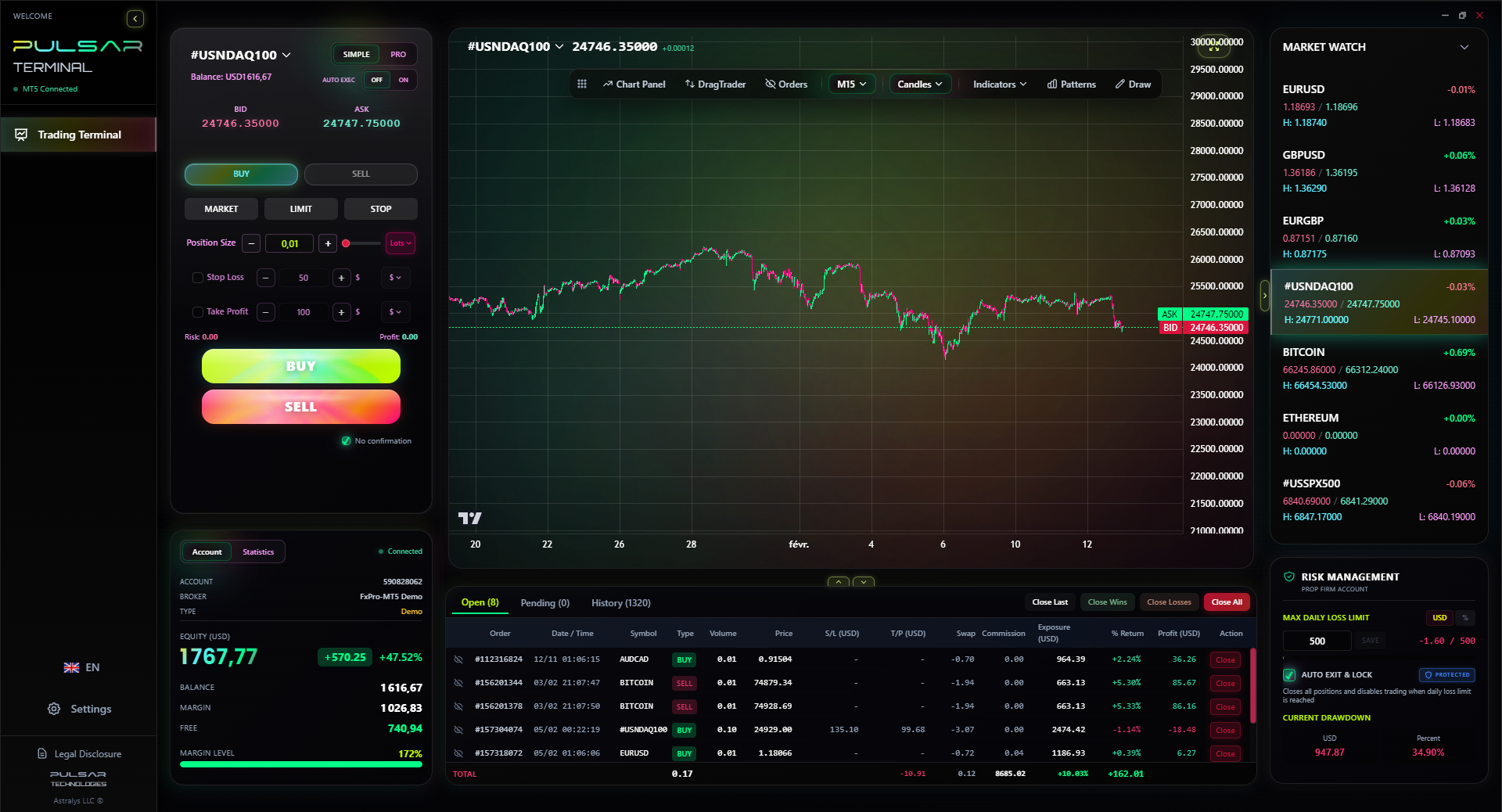
When managing risk on a small account, automating your stop-loss and breakeven moves is critical, which is exactly what Pulsar Terminal does seamlessly within MT5.
Pulsar Terminal
Hepsi bir arada MT5 aracı: sürükle-bırak emirler, çoklu TP/SL, trailing stop, grid trading, Volume Profile ve prop firm koruması. Her gün 1.000'den fazla trader tarafından kullanılıyor.
“Your trading strategy doesn't matter if your risk management fails.”
I've made these mistakes so you don't have to.
1. Overleveraging 'Because You Can': Your broker gives you 30:1. You see a 'sure thing' and use all of it to buy 3 mini lots with your R5,000. A 17-pip move against you now costs you R510 (3 lots * R10/pip * 17 pips). You're down 10% in minutes. use is a tool, not a target.
2. Chasing Losses: You lose R50 on a trade. The next trade, you think, 'I'll just risk R100 to make it back fast.' This is the beginning of the end. You've abandoned your plan. The market doesn't care that you're behind.
3. Ignoring the Spread: Trying to scalping strategy on a pair with a 10-pip spread is like trying to swim upstream in a strong current. You'll exhaust your capital on costs. Pick your battles wisely.
4. Not Accounting for Slippage: On major news (like SARB interest rate decisions), your stop-loss might not get filled at the price you set. It might fill 10, 20, even 50 pips worse. On a mini account, that can be catastrophic. Either avoid trading around high-impact news, or use guaranteed stop-losses (if your broker offers them, usually for a fee).
5. The 'Demo to Live' Shock: You practice on a demo account with R100,000. You make R10,000 in a week. You think you're a genius. You open a live mini account with R5,000. The psychology is completely different. Every 10-pip loss feels personal. You second-guess every entry. The only cure is to start with a live account so small that the losses don't hurt, but the lessons stick. That's the true purpose of a mini account.
“The goal of a mini account isn't to get rich. It's to learn without going bankrupt.”
The goal of a mini account isn't to get rich. It's to learn without going bankrupt. The transition point is about consistent profitability and capital, not time.
Don't even think about scaling up until:
- You have at least 6 months of consistent, documented trading in your mini account.
- Your equity curve is generally upward sloping, with drawdowns not exceeding 10-15%.
- You have built your account up by at least 25-50% through trading profits (not more deposits).
If you started with R5,000 and have grown it to R7,500 through pure trading, then you can consider moving some of that profit to a standard account. But do it slowly.
The Gradual Transition:
- Keep your mini account open.
- Open a standard account with the same broker.
- Transfer 50% of your mini account profits (e.g., R1,250) to the new account.
- Trade the standard account with the exact same strategy and risk percentage (1% of its balance).
- This tests if your psychology holds with slightly larger absolute numbers.
If you start breaking your rules on the standard account, go back to only trading the mini. Your mind isn't ready. There's no shame in it. I traded mini lots for almost two years before I felt comfortable with a standard account size.
The skills you learn managing a mini account - precision in position sizing, respect for costs, emotional control - are the foundation for any future success, whether you're trading your own capital or aiming for a swing trading career. Master the mini first.
💡 Winston'ın İpucu
Scaling up is a test of character, not strategy. Your strategy works on R5,000? Good. It will fail on R50,000 if your fear and greed have grown tenfold with your balance.
FAQ
Q1What is the minimum deposit for a forex mini account in South Africa?
Technically, you can find deposits as low as R70-R150 (about $5-$10). But this is a trap. A realistic minimum to practice proper risk management is between R2,000 and R5,000. This gives you enough buffer to absorb losses and pay trading costs without being wiped out by a couple of bad trades.
Q2Is forex trading with mini accounts legal in South Africa?
Yes, completely legal. It is regulated by the Financial Sector Conduct Authority (FSCA). You must use an FSCA-regulated broker (check their FSP number) to ensure your funds are segregated and you have legal recourse. Trading with unregulated offshore brokers is risky and not recommended.
Q3What use can I get on a mini account?
The FSCA caps use at 30:1 for retail traders. This applies to mini, standard, and all retail accounts. While your broker might show you can control a large position, you should mentally limit yourself to using no more than 3:1 or 5:1 to survive long-term.
Q4Which is better: a commission-free or a raw spread mini account?
It depends on your trade size. For typical mini account sizes (0.1-0.5 lots), a commission-free account with a slightly higher spread often has a lower total cost. For larger volumes, a raw spread + commission account is cheaper. You must calculate the total cost (spread cost + commission) per trade for your usual position size.
Q5Can I trade USD/ZAR with a mini account?
Yes, most brokers offering mini accounts will include USD/ZAR. However, be very cautious. The spreads are wide (often 8-15 pips), which makes short-term trading very difficult. You need a much larger price movement just to break even, which increases risk for a small account.
Q6How do I calculate my position size on a mini account?
- Decide your risk per trade (e.g., 1% of R5,000 = R50). 2. Determine your stop-loss distance in pips (e.g., 25 pips). 3. Calculate your risk per pip: R50 / 25 pips = R2 per pip. 4. Find the pip value for your pair (e.g., 1 mini lot of USD/ZAR ≈ R10). 5. Calculate lots: R2 / R10 = 0.2 mini lots. Always use a position size calculator.
Q7When should I upgrade from a mini to a standard account?
Only when you have 6+ months of consistent profits on your mini account and have grown your initial capital by at least 25-50% through trading alone. Then, move a portion of your profits to a standard account and trade it with the exact same 1% risk rule. If your psychology fails, go back to the mini.
Prof. Winston'ın Dersi
Önemli Noktalar:
- ✓Risk a maximum of 1% of your account per trade, always.
- ✓True mini accounts trade 10,000-unit lots, not just accept small deposits.
- ✓FSCA regulation is non-negotiable for fund safety.
- ✓Calculate total cost: spread + commission, not just one.
- ✓Scale up only after 6 months of documented mini account profits.
Bu makale ne kadar faydalıydı?
Bir yıldıza tıklayın
Haftalık Trading Analizleri
Ücretsiz haftalık analiz ve stratejiler. Spam yok.
Yazar hakkında
David van der Merwe
Gelişen Piyasalar Yatırımcısı
Johannesburg merkezli, gelişmekte olan piyasa dövizlerinde 11 yıllık deneyime sahip trader. ZAR pariteleri, FSCA düzenlemeli ticaret ve Güney Afrika piyasa analizi uzmanı.
Yorumlar
Risk Uyarısı
Finansal araçlarla işlem yapmak önemli riskler taşır ve tüm yatırımcılar için uygun olmayabilir. Geçmiş performans gelecekteki sonuçları garanti etmez. Bu içerik yalnızca eğitim amaçlıdır ve yatırım tavsiyesi olarak değerlendirilmemelidir. İşlem yapmadan önce her zaman kendi araştırmanızı yapın.
Bunları da beğenebilirsiniz

Cara Trading Forex Sukses: 7 Prinsip dari Trader Profesional
Cara trading forex sukses dengan 7 prinsip trader pro: manajemen modal, disiplin, journal trading, backtest. Data nyata, bukan janji profit palsu.
Jam Trading Forex Terbaik untuk Trader Indonesia: Panduan Lengkap dengan Tabel Waktu
Panduan jam trading forex untuk trader Indonesia. Tabel 4 sesi dunia, jam emas 20:00-00:00, sesi mana yang harus dihindari. Data akurat + tips dari trader berpengalaman.
Top 5 Sàn Forex Uy Tín Nhất 2026: Review Jujur dari Trader Indonesia
Top 5 sàn forex uy tín 2026 untuk trader Indonesia. Review jujur: spread, deposit, withdraw, dukungan lokal. Exness, XM, IC Markets & lebih.
Pulsar Terminal'ı Edinin
Tüm bu hesaplayıcılar MT5 hesabınızdan gerçek zamanlı verilerle Pulsar Terminal'e entegredir.
Pulsar Terminal'ı Edinin