


Here's a hard truth most trading gurus won't tell you: over 80% of retail traders lose money during major news events.

Olumide Adeyemi
Batı Afrika Yatırım Öncüsü ·  Nigeria
☕ 12 dk okuma
Neler öğreneceksiniz:
- 1What Exactly Is a Forex News Forecast? (It's Not What You Think)
- 2The Nigerian Trader's Economic Calendar: What Actually Moves Your Pairs
- 3The 3-Step Forecasting Method (No Crystal Ball Needed)
- 4Risk Management When the Market Goes Crazy
- 5Practical Tools & Resources for the Nigerian Trader
- 6The 5 Biggest Mistakes Nigerian Traders Make (And How to Avoid Them)
- 7Putting It All Together: Your Weekly News Trading Plan
Here's a hard truth most trading gurus won't tell you: over 80% of retail traders lose money during major news events. They see the headlines, make a rushed decision, and watch their account evaporate in seconds. I've been there. Back in 2019, I lost ₦450,000 on a single US Non-Farm Payrolls report because I didn't understand how to properly forecast and trade the news. This guide isn't about predicting the future. It's about preparing for it. We'll break down exactly how to use a forex news forecast to your advantage, manage the insane volatility, and turn economic chaos into opportunity.
When Nigerian traders hear 'forex news forecast,' they often imagine some guru predicting exact price movements. That's a fantasy. A real forex news forecast is a two-part process: first, understanding what economic data is coming out (like US inflation or our own CBN rate decisions), and second, more importantly, gauging how the market might react based on expectations versus reality.
The magic isn't in the headline number itself. It's in the 'deviation.' Let me give you a real example. In January 2023, the US CPI (Consumer Price Index) was forecast to come in at 6.5%. The actual number was 6.4%. That's a tiny miss, right? Just 0.1%. Yet, the USD/JPY dropped over 80 pips in minutes. Why? Because the entire market was positioned for a hotter number. The forecast set the expectation, and the slight miss triggered a massive repositioning.
For us trading from Nigeria, this is critical. We're not just trading the news; we're trading the market's emotional response to it. A good broker like Exness or IC Markets will provide an economic calendar with these consensus forecasts. Your job is to watch for the gap between the forecast and the actual result. That gap is where the money is made (or lost).

Warning: Never, ever place a trade right before a high-impact news event unless you're specifically scalping the volatility with a defined, tiny risk. The spreads can widen to 20-30 pips on even major pairs like EUR/USD, instantly putting you in a deep hole.
“A real forex news forecast is about gauging how the market might react based on expectations versus reality.”
You can't watch every news event globally. You'll go mad. As a Nigerian trader, you need to focus on the events that directly impact the currencies you're likely trading. Most of us are trading USD pairs (USD/NGN isn't directly tradable on most retail platforms, so we use proxies).
High-Impact Events You Must Watch
- US Economic Data: This is non-negotiable. The US Dollar is the world's reserve currency.
- Non-Farm Payrolls (NFP): First Friday of every month. This jobs report causes chaos. I've seen GBP/USD swing 150 pips in 10 seconds on a big surprise.
- Consumer Price Index (CPI) & Federal Reserve Rate Decisions: Directly drive USD strength. When the Fed is hawkish, the USD usually rallies.
- Retail Sales and GDP: Gauge the health of the US consumer and economy.
-
European Central Bank (ECB) and Bank of England (BoE) Decisions: Major drivers for the Euro and Pound. If you're trading EUR/USD, you need to know when Christine Lagarde is speaking.
-
Commodity Prices (Oil!): This is huge for us. Nigeria is an oil producer. When crude oil prices (XTI/USD) make a big move, it can affect the Naira's perceived stability and flows. Watch OPEC meetings and US inventory data (EIA Crude Oil Inventories).
-
Central Bank of Nigeria (CBN) Announcements: While you can't trade the Naira directly on most international brokers, CBN decisions on interest rates or forex policies create sentiment. A rate hike to defend the Naira can cause risk-off sentiment that hits other emerging market currencies you might be trading.

Example: Let's say the forecast for US CPI is 3.1%. You check your broker's calendar (most have them built-in). You decide not to hold any USD positions 5 minutes before the release. The actual number prints at 3.4%. That's a significant beat. You wait for the initial 60-second spike and consolidation, then look for a continuation trade in the direction of the surprise (USD strength). You're not guessing; you're reacting to a confirmed market shock.

💡 Winston'ın İpucu
The market's reaction to news tells you more about its mood than the news itself. A small miss on data causing a huge sell-off means the market was nervous and looking for an excuse to run. Read the reaction, not just the headline.
“The magic isn't in the headline number itself. It's in the 'deviation.'”
This is the process I use before every major news event. It took me years and many losses to develop this discipline.
Step 1: The Pre-News Analysis (The Setup) This happens hours or days before the event. Look at the price chart. Is the pair in a strong uptrend, downtrend, or stuck in a range? For instance, if GBP/USD has been grinding higher for a week into a high-impact news event, the market might be 'pricing in' good news. Any disappointment could cause a sharp reversal. I use the MACD indicator and RSI indicator here to gauge momentum and overbought/oversold conditions. I mark key support and resistance levels on my chart. These are the zones where price is likely to bounce or break after the news.
Step 2: The Waiting Game (The Most Important Step) When the news is about to drop, you close all charts. Seriously. The 5 minutes before and 5 minutes after the release are emotional tsunamis. The price action is wild, illiquid, and unpredictable. My rule: no entries during this window. I am only watching. I'm looking to see:
- Does price spike and immediately reverse? (A 'fakeout')
- Does it spike and hold? (A genuine breakout)
- What is the trading volume doing?
Step 3: The Post-News Trade (The Execution) After the initial volatility settles (usually 5-15 minutes later), I assess. Did price break a key level and close above/below it on a 5-minute or 15-minute chart? If yes, that's a potential trade signal in the direction of the break. My stop-loss is always placed on the other side of the recent consolidation range. This isn't scalping; it's more like momentum-based swing trading on a shorter timeframe.

Pro Tip: Use a demo account to practice this 3-step method for at least 10 major news events before risking real Naira. Write down your plan for each one: What's the forecast? What's your expected reaction? What key level will you watch? Review your trades afterward. This practice is priceless.
“You're not trading the news; you're trading the market's emotional response to it.”
This is where Nigerian traders get wiped out. You see a big move, FOMO kicks in, you jump in with your usual position size, and a 10-pip reversal liquidates you. News trading requires different math.
1. Halve Your Position Size: If your normal risk is 1% of your account per trade, make it 0.5% for news trades. The volatility is double or triple, so your position size should be smaller to compensate. I use a position size calculator every single time, and I manually input a wider stop-loss distance to account for the increased volatility.
2. Widen Your Stop-Loss: In calm markets, a 20-pip stop on EUR/USD might be fine. During news, that can get taken out by mere noise. Place your stop based on technical levels, not an arbitrary pip amount. If the nearest solid support is 50 pips away, your stop needs to be beyond it.
3. Understand Slippage and Requotes: Your order might not get filled at the price you see. During news, liquidity is low. You might click 'buy' at 1.0850, but your order fills at 1.0865. That's 15 pips of 'slippage' gone before the trade even starts. Brokers with good execution like Pepperstone or XM minimize this, but it can still happen. Factor it into your risk.
4. The Golden Rule: Never Add to a Losing News Trade. If you're wrong on the direction, you're wrong. The market has spoken. Adding more 'to average down' is a surefire path to a margin call. I learned this the hard way with a gold trade. XAU/USD spiked on news, I shorted it, it kept going up, I added more shorts thinking it had to reverse. It didn't. I lost two weeks of profits in 30 minutes.
Let me share a painful personal number. In 2021, I risked ₦25,000 on a pre-news USD/CAD trade. The spread widened from 1.2 pips to 18 pips at the moment of my market order entry. I was down ₦4,500 the second my trade opened. The market then went my way, but I was so shaken by the initial loss I closed early for a net loss. The spread, a cost I often ignored, was the real killer.
💡 Winston'ın İpucu
Your pre-news analysis is your anchor. When the volatility hits and your heart races, your prepared plan is the only thing that will keep you from making an emotional, expensive mistake. Trust your preparation, not your panic.
“You're not trading the news; you're trading the market's emotional response to it.”
You don't need expensive software. You need the right free tools and the discipline to use them.
Free Economic Calendars:
- ForexFactory.com: The classic. It's free, color-codes event impact (red for high), and shows the forecast, previous number, and actual result. Set your timezone to WAT (West Africa Time).
- Your Broker's Calendar: Built into MT4/MT5 platforms or on the broker's website. Often more tailored to the instruments they offer.
Broker Choice is Critical: You need a broker that offers stable execution during news. Look for ones with:
- No Dealing Desk (NDD) or ECN Execution: This generally means faster execution and less conflict of interest. Brokers like IC Markets and Pepperstone excel here.
- Local NGN Accounts: To avoid bank conversion fees. FXTM and others offer this. Deposit ₦50,000, trade with ₦50,000, not $33 after a bad bank conversion rate.
- Negative Balance Protection: This is a safety net. It ensures you can't lose more than the money in your account, even if a news gap blows through your stop.
Charting Tools: Beyond the basic MT4/MT5, consider tools that help you visualize order flow. Understanding where large buy and sell orders sit (Volume Profile) can show you where price might stall or accelerate after news. This is where advanced platforms add value.
Mindset Resource: Your own trading journal. After every news trade, answer these questions: Did I follow my 3-step plan? What was the forecast vs. actual? How wide was the spread? What was my emotional state? This self-analysis is the most valuable resource you have.
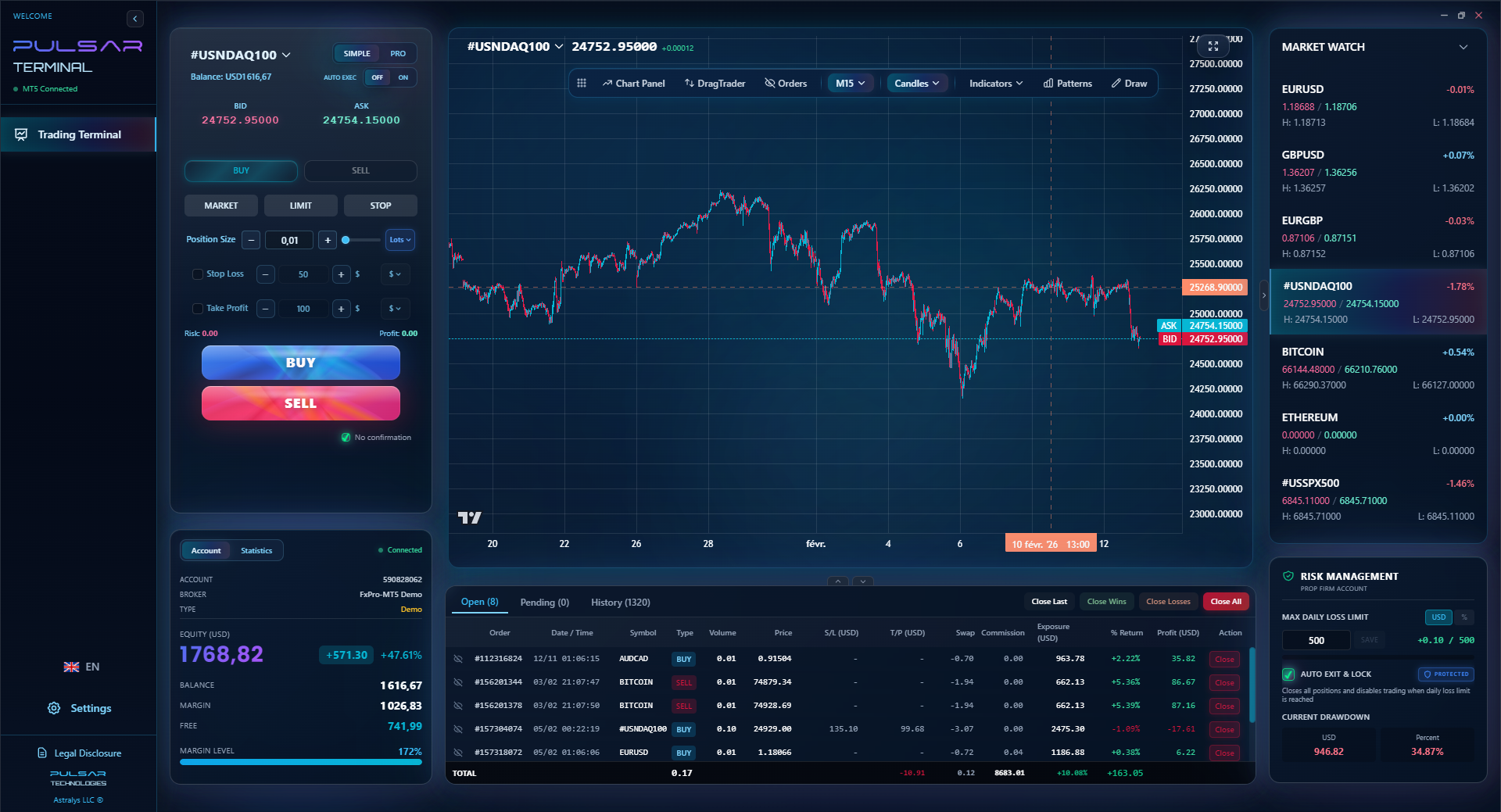
When trading news, having tools that let you quickly place and manage orders based on key levels is non-negotiable, which is why platforms like Pulsar Terminal that integrate directly with MT5 are so valuable.
Pulsar Terminal
Hepsi bir arada MT5 aracı: sürükle-bırak emirler, çoklu TP/SL, trailing stop, grid trading, Volume Profile ve prop firm koruması. Her gün 1.000'den fazla trader tarafından kullanılıyor.
“Halve your position size for news trades. The volatility is double, so your risk should be half.”
I've made most of these. Let's save you the tuition fees.
-
Trading the Rumor, Then the News: You buy EUR/USD because you 'feel' the news will be good. Then the good news comes out, and it sells off ('buy the rumor, sell the news'). You get caught in both the pre-news dip and the post-news sell-off. Fix: Have no position before high-impact news. Be a reactionary trader, not a predictive one.
-
Chasing the Initial Spike: Price rockets 40 pips in 2 seconds. You panic-buy, fearing you'll miss the move. You buy at the very top, and it instantly reverses 30 pips. Fix: Remember Step 2 of our method: Wait. Let the market show you its hand. The first move is often a trap.
-
Ignoring the Underlying Trend: A bullish news item for the USD in a strong USD downtrend often just creates a 'dead cat bounce' - a temporary rally before the downtrend resumes. Fix: Always align your news trades with the higher timeframe trend. It's easier to swim with the current.
-
Not Accounting for the Spread: As I shared earlier, that widening spread is a silent killer. A 20-pip spread means your trade needs to move 20 pips in your favor just to break even. Fix: Know your broker's typical spread widening for major news. If it's usually 10+ pips, you need a much bigger target to make the trade worthwhile.
-
Confusing High Frequency with High Importance: Not every news event matters for your trade. A medium-impact German Factory Orders report is not worth adjusting your entire week's plan for if you're trading USD/JPY. Fix: Filter your calendar. Only mark the red/high-impact events for the currencies in your portfolio.
💡 Winston'ın İpucu
The most profitable news trade you'll ever make is the one you skip. If the price action after the release is messy, unclear, or choppy, the correct move is to do nothing. Preserving capital is a win.
“The most profitable news trade you'll ever make is the one you skip.”
Let's make this actionable. Here’s a template you can use every Sunday night.
1. Calendar Scan: Open ForexFactory. Look at the coming week. Circle only the RED events for USD, EUR, GBP, and any commodity news if you trade oil or gold (XAU/USD guide).
2. Pair Selection: Decide, "This week, I will only trade news on EUR/USD and Gold." Don't try to watch 8 pairs. You can't.
3. Pre-News Analysis (Day Before or Morning Of): For each circled event:
- What is the consensus forecast? (e.g., US Retail Sales forecast: 0.8%)
- What is the current trend on the 1-hour and 4-hour chart for my pair?
- Mark key support/resistance levels on a 15-minute chart.
- Write down your game plan: "If actual > 0.8% and price breaks above 1.0750 on the 5-min chart after volatility, I may go long. Stop below 1.0720. Target 1.0800. Max risk: 0.5% of account."
4. Execution Day:
- 30 mins before: Check charts one last time. Set an alarm for 2 minutes before the release.
- 5 mins before: Close all charts. Do nothing.
- News Release: Watch the price action on a blank chart. No trading.
- 5-15 mins after: Has price made a clear, sustained break? If yes, and it matches your plan, execute with your pre-defined risk. If not, you walk away. No trade is a good trade.
5. Post-Trade Review: Win or lose, journal it. Did the market react as forecast? What did you do well? What would you change?
This process turns chaotic news events into a structured, boring routine. And in trading, boring is profitable. The forex news forecast isn't about being a prophet. It's about being a prepared, disciplined soldier who knows the battle plan before the first shot is fired.
FAQ
Q1What's the best time for a Nigerian trader to trade forex news?
The most volatile sessions overlap with European and US market hours. High-impact US news (like NFP or CPI) typically drops between 1:30 PM and 3:00 PM WAT (West Africa Time). This is when liquidity and volatility peak. It's the most dangerous and potentially rewarding time to be active.
Q2Can I use a forex news forecast to trade USD/NGN?
Directly, no. Retail forex brokers don't offer USD/NGN as a tradable pair due to CBN restrictions. However, you can use forecasts for USD strength and general emerging market sentiment to inform trades on other pairs like USD/ZAR or USD/MXN, which often move in correlation with broader EM FX flows affecting the Naira.
Q3Why does the price sometimes go down on good news?
This is the 'buy the rumor, sell the news' effect. If the market has spent weeks expecting a fantastic number and pricing it in, even a 'good' actual result can be a disappointment if it doesn't meet the inflated expectations. The price had already risen on the 'rumor' (expectation), so traders sell to take profits when the 'news' finally arrives.
Q4How much money do I need to start trading news?
More than you think. Due to the need for wider stops and the reality of slippage, you need a buffer. With brokers like Exness offering a $10 minimum, you can technically start, but you'll be wiped out by one spread-widening event. I'd strongly suggest a minimum of $200-500 (roughly ₦300,000 - ₦750,000 depending on the rate) to properly manage risk across a few trades, and always use a position size calculator.
Q5Is it better to trade before or after the news release?
For 99% of traders, it is categorically better to trade AFTER. Trading before is pure gambling on an outcome. Trading after is a reaction to a confirmed market event and price action. The initial direction after the news settles is far more reliable than trying to predict the headline.
Q6What's the single most important news event for forex?
The US Non-Farm Payrolls (NFP) report, released the first Friday of each month at 1:30 PM WAT. It consistently creates the largest short-term volatility across all major USD pairs. Treat it with extreme respect - it's a market monster.
Prof. Winston'ın Dersi
Önemli Noktalar:
- ✓Trade the deviation, not the headline.
- ✓Wait 5-15 minutes after news before entering.
- ✓Always widen stops for news volatility.
- ✓Use only 0.5% risk per news trade.
Bu makale ne kadar faydalıydı?
Bir yıldıza tıklayın
Haftalık Trading Analizleri
Ücretsiz haftalık analiz ve stratejiler. Spam yok.
Yazar hakkında
Olumide Adeyemi
Batı Afrika Yatırım Öncüsü
Nijerya'nın en aktif forex eğitmenlerinden biri. Lagos'tan 8 yıllık ticaret deneyimi. Afrika'lı trader'lar için düşük sermaye stratejileri ve prop firma yarışmaları uzmanı.
Yorumlar
Risk Uyarısı
Finansal araçlarla işlem yapmak önemli riskler taşır ve tüm yatırımcılar için uygun olmayabilir. Geçmiş performans gelecekteki sonuçları garanti etmez. Bu içerik yalnızca eğitim amaçlıdır ve yatırım tavsiyesi olarak değerlendirilmemelidir. İşlem yapmadan önce her zaman kendi araştırmanızı yapın.
Bunları da beğenebilirsiniz

Cara Trading Forex Sukses: 7 Prinsip dari Trader Profesional
Cara trading forex sukses dengan 7 prinsip trader pro: manajemen modal, disiplin, journal trading, backtest. Data nyata, bukan janji profit palsu.
Jam Trading Forex Terbaik untuk Trader Indonesia: Panduan Lengkap dengan Tabel Waktu
Panduan jam trading forex untuk trader Indonesia. Tabel 4 sesi dunia, jam emas 20:00-00:00, sesi mana yang harus dihindari. Data akurat + tips dari trader berpengalaman.
Top 5 Sàn Forex Uy Tín Nhất 2026: Review Jujur dari Trader Indonesia
Top 5 sàn forex uy tín 2026 untuk trader Indonesia. Review jujur: spread, deposit, withdraw, dukungan lokal. Exness, XM, IC Markets & lebih.
Pulsar Terminal'ı Edinin
Tüm bu hesaplayıcılar MT5 hesabınızdan gerçek zamanlı verilerle Pulsar Terminal'e entegredir.
Pulsar Terminal'ı Edinin