


I was staring at my screen in 2021, watching GBP/JPY rip through my stop loss.

Olumide Adeyemi
Batı Afrika Yatırım Öncüsü ·  Nigeria
☕ 13 dk okuma
Neler öğreneceksiniz:
- 1Major, Minor, Exotic: What's the Actual Difference?
- 2Picking the Right Pair for Your Nigerian Account
- 3The Real Costs: Spreads, Swaps, and Slippage
- 4The Most Traded Pairs (And Why It Matters to You)
- 5Correlation: The Secret Risk Multiplier
- 6Trading Pairs Around News and Market Sessions
- 7Common Mistakes Nigerian Traders Make (I Made Them All)
- 8Building Your First Pair Watchlist
I was staring at my screen in 2021, watching GBP/JPY rip through my stop loss. The spread had widened to 12 pips during the London open - something my backtests never showed. I lost $450 on a single trade, not because my analysis was wrong, but because I picked the wrong pair for my strategy. That's the thing about forex pairs: they're not just ticker symbols. They're living, breathing markets with personalities, quirks, and costs that can make or break you before the trade even starts. In Nigeria, where every pip counts against the Naira, choosing the right pair isn't a suggestion - it's survival.
Brokers love to categorize pairs, but these labels mean more than just a fancy filter on your trading platform. They're a cheat sheet for liquidity, cost, and volatility.
Majors are the big seven: EUR/USD, USD/JPY, GBP/USD, USD/CHF, AUD/USD, USD/CAD, NZD/USD. Notice a pattern? They all contain the US Dollar. That's why they're liquid. On a good day with a broker like Exness or IC Markets, you can get spreads on EUR/USD as low as 0.0-0.1 pips. That's cheap to trade. The catch? Because everyone and their uncle is trading them, finding a unique edge is harder. The moves can be efficient and fast, but they're also heavily scrutinized by every bank and algo on the planet.
Minors (or Crosses) are major currencies paired against each other, excluding the USD. Think EUR/GBP, AUD/JPY, GBP/CAD. This is where things get interesting for a strategic trader. The spreads are wider - expect 1-3 pips typically - but the price action can be cleaner. Fewer massive institutional orders cluttering the chart. I've had more consistent success swing trading EUR/GBP than EUR/USD because the trends tend to persist without constant Fed-speak interference.
Exotics pair a major currency with one from a developing economy. USD/NGN, USD/TRY, EUR/PLN. Here in Nigeria, you might be tempted by USD/NGN. Don't be. Unless you're a financial institution with a direct line to the CBN, the retail broker version of this pair is a trap. The spreads are criminal, often 50-100 pips or more. The liquidity is terrible. It's not a trading instrument; it's a revenue generator for the broker.

Warning: Never trade exotic pairs through a standard retail broker account. The spread alone will guarantee you lose money over time. If you want exposure to the Naira, look at other asset classes.
The real cost isn't just the spread. It's the swap rate (overnight financing). For a pair like AUD/JPY, which has a big interest rate differential, holding a position overnight can cost you or pay you a significant amount. You must check this in your platform's "Specification" window. A long-term swing trade can be gutted by negative swap.
Your trading style, account size, and even your deposit method should influence your pair selection. This isn't theoretical - it's practical money management.
For Scalpers (The 5-Minute Chart Warriors)
You live and die by the spread. Your profit target might only be 5-10 pips, so a 2-pip spread on a minor pair eats 20-40% of your potential gain immediately. You must stick to the most liquid majors. EUR/USD, USD/JPY, and GBP/USD (during London/N.Y. overlap) are your bread and butter. I used to scalp USD/JPY on a 1-minute chart. My average win was 7 pips. Using a broker with a 0.3 pip average spread versus a 1.0 pip spread was the difference between a profitable month and a breakeven one. Check our scalping strategy guide for more on this high-wire act.
For Swing Traders (The Patient Planners)
You have more flexibility. You're aiming for 100-300 pip moves, so a 2-pip spread is a rounding error. This is where minors and some majors shine. Look for pairs with strong, clear trends and consider the swap rates. Back in 2022, I swung long on AUD/JPY for 14 days. My entry was 91.50, exit at 93.80 (230 pips). The positive swap actually added an extra $12 to my profit. That's free money for holding.
The NGN Account Consideration
Many brokers like FXTM and HFM now offer NGN-denominated accounts. This is fantastic - it removes USD/NGN conversion risk from your deposits and withdrawals. But remember: the underlying pair is still priced in its base currencies. Trading EUR/USD in a NGN account just means your profit/loss is converted to Naira at the broker's rate. It doesn't change the pair's behavior. The real benefit is psychological and practical; you see your balance in Naira, and local bank transfers are easier.

Pro Tip: Match your pair's volatility to your position size. A volatile pair like GBP/JPY needs a smaller position than stable EUR/USD for the same risk in Naira. Always use a position size calculator.
Your account size dictates everything. With a $500 account, trading exotic pairs or even some minors is mathematically foolish. The spread as a percentage of your capital is too high. Stick to majors until you grow your capital.

💡 Winston'ın İpucu
Stop looking for the 'hot' pair. Find the boring one that respects its levels consistently - that's where the real money is made, quietly.
“In Nigeria, where every pip counts against the Naira, your choice of pair isn't a suggestion - it's a survival decision.”
Let's talk about where your money actually goes. The ticket price is a lie.
Spreads: This is the broker's cut. It's the difference between the buy (ask) and sell (bid) price. For Nigerian traders, this is the most critical number after your entry price.
| Pair | Typical Spread (Standard Account) | Typical Spread (Raw/Pro Account) |
|---|---|---|
| EUR/USD | 0.6 - 1.2 pips | 0.0 - 0.3 pips + commission |
| GBP/USD | 0.9 - 1.5 pips | 0.2 - 0.5 pips + commission |
| USD/JPY | 0.7 - 1.3 pips | 0.1 - 0.4 pips + commission |
| EUR/GBP | 1.2 - 2.5 pips | 0.5 - 1.2 pips + commission |
| AUD/JPY | 1.5 - 3.0 pips | 0.8 - 1.8 pips + commission |
A "commission" is often better than a wide spread. Why? It's transparent. You pay $3.50 per lot, per side, but the spread is 0.1. Your total cost is known upfront. With a wide variable spread, your cost can double during news events. Brokers like Pepperstone and IC Markets excel with these raw spread accounts.
Swap Rates: This is the interest you pay or receive for holding a position overnight. It's calculated based on the interbank interest rates of the two currencies. If you're long a currency with a higher interest rate than the one you're short, you earn positive swap. It's crucial for swing trading. Check your platform every Wednesday - swap is usually tripled to account for the weekend.
Slippage: This is when you get a different price than you clicked. It happens during high volatility (news events, market opens). On NFP Friday, trying to enter a market order on GBP/USD might give you 5 pips of slippage. That's an instant loss. Use limit orders during these times.
Here's a personal mistake: I once entered a long trade on USD/CAD right before the BOC rate statement. My intended entry was 1.2650. My filled price was 1.2685. I had 35 pips of negative slippage on a trade where my target was only 50 pips away. I never recovered. Lesson: don't market order around major news unless you're intentionally gambling.
EUR/USD isn't popular because it's easy. It's popular because it's efficient. It accounts for roughly 25% of all global forex volume. That volume means something: tighter spreads, less manipulation (relatively), and mountains of available analysis. For a new trader in Nigeria, this is where you should start. Not because it's "safe" - no pair is safe - but because the costs are lowest and the educational resources are vast. We have a dedicated EUR/USD guide that breaks down its unique rhythms.
USD/JPY is the other giant. It's a risk sentiment gauge. When global investors are scared, they buy JPY (sell USD/JPY). When they're greedy, they sell JPY (buy USD/JPY). It's beautifully technical and respects key levels like few other pairs. I've made more money trading simple support/resistance on USD/JPY than any fancy strategy on other pairs.
GBP/USD ("Cable") is the wild child. It's volatile, news-driven, and can gap like crazy. It's rewarding but punishing. You need a wider stop loss, which means a smaller position size.
Commodity pairs (AUD/USD, USD/CAD, NZD/USD) are tied to their respective economies. AUD/USD moves with iron ore prices and Chinese demand. USD/CAD is joined at the hip to oil prices. This gives you a fundamental edge if you follow those markets. Trading USD/CAD without glancing at the WTI crude chart is like driving blindfolded.

Example: In July 2023, oil jumped 8% in a week. USD/CAD fell from 1.3250 to 1.3100 (150 pips). That was a clearer, more fundamental move than any indecisive chop in EUR/USD during the same period.
“Trading USD/NGN through a retail broker isn't trading; it's donating to the broker's bonus pool with extra steps.”
This is the most common way Nigerian traders blow up their accounts, and they don't even know it. They think they're diversifying by opening three different trades. But if those trades are all on correlated pairs, they've just tripled their risk.
Correlation measures how often two pairs move in the same direction. A correlation of +0.85 means they move together 85% of the time. -0.85 means they move opposite 85% of the time.
The Dangerous Trio: EUR/USD, GBP/USD, and AUD/USD are often highly positively correlated. Why? They're all "Dollar pairs" where the USD is the quote currency. If the US Dollar gets strong, they all tend to go down together. If you're long EUR/USD and also long GBP/USD, you're not hedged. You're double-long the same idea.
I learned this the hard way early on. I was bullish on Europe, so I went long EUR/USD. I was also bullish on the UK economy, so I went long GBP/USD. Then some US data came out hot. The Dollar rallied. Both my trades hit stop loss within minutes of each other. Two losses for one bad idea. My risk per trade was 1%, but my actual account risk was 2% on a single market event.
How to Use It:
- Check a correlation matrix (free ones are online). Look at the 1-month and 3-month readings.
- Don't open multiple positions on pairs with a correlation above +0.7 or below -0.7 unless you're intentionally doubling down or hedging.
- True diversification might mean trading EUR/USD and USD/CHF (often negatively correlated) or mixing in a non-correlated asset like XAU/USD (Gold).
Managing this manually is a headache. This is where tools that visualize and manage aggregate risk across all your charts become useful.
💡 Winston'ın İpucu
Your first 100 trades should be on one pair only. Master its rhythm. Diversification is for capitalists with established edge, not gamblers searching for one.
The forex market never sleeps, but its personality changes with the sun. And different pairs wake up at different times.
Asian Session (Tokyo): USD/JPY, AUD/USD, NZD/USD are most active. EUR/USD is often dead, ranging in a 20-pip band. It's a good time to analyze or trade Yen crosses.
London Session: The big kahuna. Over 30% of all volume hits here. All majors come alive, especially GBP pairs. EUR/GBP, GBP/USD, EUR/USD. Spreads are tightest, moves are strongest. This is your main trading window if you're in Nigeria (it's afternoon for us).
London/N.Y. Overlap (1 PM - 4 PM GMT): The most volatile period. This is when I avoid entering new trades unless I'm already in a strong trend. Slippage is highest. But if you're in a profitable trade, this is often when it runs to your target.
News Events: Know which pair belongs to which data. Don't trade GBP/USD during US CPI. Don't trade USD/CAD during Australian employment data. It seems obvious, but you'd be surprised.
- US Data (NFP, CPI, Fed): Impacts all USD pairs (EUR/USD, USD/JPY, etc.)
- ECB News: Impacts EUR pairs (EUR/USD, EUR/GBP)
- BOE News: Impacts GBP pairs (GBP/USD, EUR/GBP) My rule: I don't hold a position through a high-impact news event for that pair unless my stop is breakeven and I'm willing to lose the profit potential. The spread widening alone can trigger your stop.
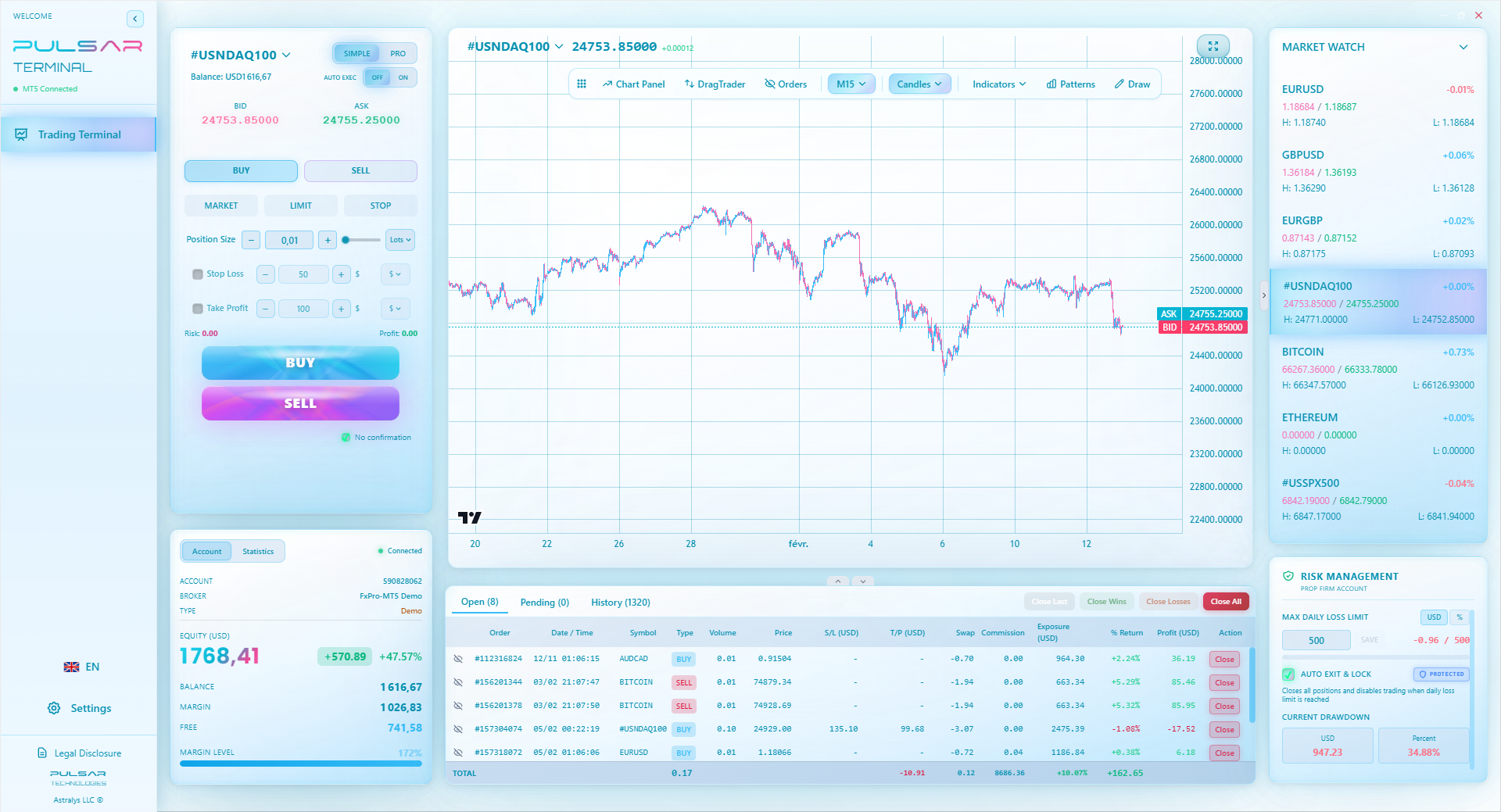
Manually tracking correlation and risk across multiple pairs is a full-time job; Pulsar Terminal's aggregate risk view shows your total exposure across all charts in real-time, directly on your MT5 platform.
Pulsar Terminal
Hepsi bir arada MT5 aracı: sürükle-bırak emirler, çoklu TP/SL, trailing stop, grid trading, Volume Profile ve prop firm koruması. Her gün 1.000'den fazla trader tarafından kullanılıyor.
“Master one or two pairs. Knowing one market intimately is the difference between being a gambler and being a trader.”
Let's get honest. We all screw up. Here's how to avoid the classic errors.
1. Chasing Exotics for 'Big Moves': USD/ZAR, USD/TRY, USD/NGN. The charts look like they move 1000 pips in a day! What a opportunity! It's a trap. The spread is 80 pips. The slippage is horrific. The broker can re-quote you or reject your order at will. You are not trading; you are donating.
2. Ignoring Swap on Long-Term Trades: You find a beautiful multi-week setup on AUD/JPY. You go short. Three weeks later, the trade is 40 pips in profit, but your swap charges have eaten 35 of those pips. You made 5 pips for three weeks of risk. Calculate the swap first.
3. Overleveraging on Volatile Pairs: You get 1:500 use from a broker like Exness or HFM. You use it all on a GBP/JPY trade. A normal 50-pip move against you triggers a margin call. GBP/JPY can move 50 pips before you finish your cup of tea. use is a tool, not a target.
4. Trading Too Many Pairs: You have EUR/USD, GBP/USD, AUD/USD, USD/CAD, and NZD/USD on your screen. You can't possibly understand the individual dynamics of all of them. You become a reactionary mess. Master one or two pairs. Know their average daily range, their common session times, their key levels. I traded only EUR/USD and USD/JPY for my first two profitable years.
5. Not Adapting Strategy to Pair: Your RSI indicator scalping strategy works great on EUR/USD in the London session. You try the same exact setup on EUR/GBP during Asia. It fails repeatedly. Why? Lower liquidity, wider spreads, different volatility profile. Each pair needs its own strategy tweaks.
💡 Winston'ın İpucu
If you can't instantly recite the average daily range and typical spread cost of your favorite pair, you're not ready to trade it with real money. This is homework, not optional.
Start small. You don't need 28 pairs. You need 2 or 3 you understand better than anyone.
For the Absolute Beginner in Nigeria:
- EUR/USD: Your training wheels. Lowest cost, most predictable behavior, endless learning material. Learn support/resistance, trend lines, and basic MACD indicator divergences here.
- USD/JPY: Your introduction to risk sentiment and clean technicals. Learn to trade with the broader market mood.
For the Intermediate Trader:
- GBP/USD: Add this for learning to handle volatility and trade news. Use wider stops.
- AUD/USD or USD/CAD: Pick one commodity pair to learn how fundamentals (iron ore/oil) drive technicals.
How to Study a Pair:
- What is its average daily range (ADR)? (e.g., EUR/USD ~70 pips, GBP/JPY ~150 pips). This tells you realistic profit targets.
- What are its key trading sessions?
- What are its typical spread costs on your broker?
- What are its swap rates for long and short positions?
- Plot its weekly support and resistance from the past 3 months.
Do this for one pair. Write it down. That's your edge. When you understand one market intimately, you stop being a gambler and start being a trader. From there, you can explore tools that help you execute complex multi-trade plans on these pairs efficiently, turning your deep knowledge into precise action.
FAQ
Q1Which forex pair is best for beginners in Nigeria?
EUR/USD, no contest. It has the tightest spreads (often under 1 pip), high liquidity meaning less slippage, and moves in a relatively predictable manner compared to wild pairs like GBP/JPY. It's the most analyzed pair in the world, so you'll find plenty of educational resources tailored to it. Start here, master it, then branch out.
Q2Is it legal to trade forex pairs in Nigeria?
Yes, it is legal for individuals to trade forex with international brokers. The new Investments and Securities Act (ISA) 2025 is bringing online platforms under the SEC's regulation for better oversight. However, you are trading global markets, not the official Naira rate. Always use reputable, internationally regulated brokers like those with FCA or ASIC licenses that accept Nigerian clients.
Q3Why should I avoid trading USD/NGN with my broker?
The USD/NGN pair offered by retail brokers is a derivative with massive spreads (often 50-100 pips) and terrible liquidity. It does not directly reflect the interbank or official CBN rate. It's designed for brokers to profit from the spread, not for you to trade effectively. It's one of the fastest ways to lose money.
Q4What does a 'pip' mean and how much is it worth?
A pip is the smallest price move a currency pair can make. For most pairs, it's 0.0001. So a move from 1.1050 to 1.1051 in EUR/USD is one pip. Its value in Naira depends on your trade size. On a standard lot (100,000 units), one pip in EUR/USD is roughly $10, which is then converted to Naira. Check our full pip definition for the detailed math.
Q5Can I trade with a NGN-denominated account?
Yes, many brokers like FXTM, HFM, and Exness offer NGN accounts. This lets you deposit and withdraw in Naira and see your balance in Naira, removing USD/NGN conversion fees from your banking. Crucially, you're still trading the global EUR/USD or GBP/JPY market; your profit/loss is just converted at the broker's rate.
Q6How much money do I need to start trading forex pairs?
You can start with very little. Brokers like XM have a $5 minimum, and many offer accounts from $10-$100. However, with a small account, your focus must be on survival and learning, not getting rich. Trade micro lots (0.01) to keep risk minimal. A realistic starting point for active learning is $200-$500, allowing for proper position sizing without being wiped out by a few losses.
Q7What's more important: low spreads or good regulation?
Good regulation, always. A broker with a license from the FCA, ASIC, or CySEC must segregate client funds and adhere to strict financial standards. A super-low spread is useless if the broker disappears with your money. Find a well-regulated broker that also offers competitive spreads, like IC Markets or Pepperstone.
Prof. Winston'ın Dersi
Önemli Noktalar:
- ✓Start with EUR/USD: <1 pip spreads are your best friend.
- ✓Avoid exotic pairs: 50-pip spreads guarantee long-term loss.
- ✓Check correlation: 3 correlated trades = 3x your risk.
- ✓Know your costs: Swap can turn a 100-pip win into 20.
- ✓Match pair volatility to position size every single time.
Bu makale ne kadar faydalıydı?
Bir yıldıza tıklayın
Haftalık Trading Analizleri
Ücretsiz haftalık analiz ve stratejiler. Spam yok.
Yazar hakkında
Olumide Adeyemi
Batı Afrika Yatırım Öncüsü
Nijerya'nın en aktif forex eğitmenlerinden biri. Lagos'tan 8 yıllık ticaret deneyimi. Afrika'lı trader'lar için düşük sermaye stratejileri ve prop firma yarışmaları uzmanı.
Yorumlar
Risk Uyarısı
Finansal araçlarla işlem yapmak önemli riskler taşır ve tüm yatırımcılar için uygun olmayabilir. Geçmiş performans gelecekteki sonuçları garanti etmez. Bu içerik yalnızca eğitim amaçlıdır ve yatırım tavsiyesi olarak değerlendirilmemelidir. İşlem yapmadan önce her zaman kendi araştırmanızı yapın.
Bunları da beğenebilirsiniz

Cara Trading Forex Sukses: 7 Prinsip dari Trader Profesional
Cara trading forex sukses dengan 7 prinsip trader pro: manajemen modal, disiplin, journal trading, backtest. Data nyata, bukan janji profit palsu.
Jam Trading Forex Terbaik untuk Trader Indonesia: Panduan Lengkap dengan Tabel Waktu
Panduan jam trading forex untuk trader Indonesia. Tabel 4 sesi dunia, jam emas 20:00-00:00, sesi mana yang harus dihindari. Data akurat + tips dari trader berpengalaman.
Top 5 Sàn Forex Uy Tín Nhất 2026: Review Jujur dari Trader Indonesia
Top 5 sàn forex uy tín 2026 untuk trader Indonesia. Review jujur: spread, deposit, withdraw, dukungan lokal. Exness, XM, IC Markets & lebih.
Pulsar Terminal'ı Edinin
Tüm bu hesaplayıcılar MT5 hesabınızdan gerçek zamanlı verilerle Pulsar Terminal'e entegredir.
Pulsar Terminal'ı Edinin