


I remember my first big loss on USD/ZAR like it was yesterday.

David van der Merwe
Gelişen Piyasalar Yatırımcısı ·  South Africa
☕ 9 dk okuma
Neler öğreneceksiniz:
I remember my first big loss on USD/ZAR like it was yesterday. I'd seen the Rand weaken for days and jumped in long on the dollar at 18.45, convinced it was going to 19.00. I didn't account for a surprise SARB rate hike. The news hit, and the Rand ripped higher. I was stopped out at 18.15 within an hour, down R8,000 on a single trade. That painful lesson taught me that trading the forex rand dollar isn't just about charts; it's about understanding a uniquely volatile, locally-driven market. Let's talk about how to trade it properly.
The USD/ZAR pair, what we call the rand dollar, is an exotic currency pair. That's a fancy term meaning it's less liquid and more volatile than majors like EUR/USD. This isn't the Euro or the Yen. The Rand is an emerging market currency, and it feels every tremor in local politics, commodity prices, and global risk sentiment.
Trading volume is huge here. South Africa is Africa's biggest forex market, with a daily turnover pushing $21 billion. But don't let that big number fool you. Liquidity can dry up fast around local news or during off-hours for London and New York, causing those nasty spreads to widen. You're not just trading a currency pair; you're trading South Africa's economic heartbeat.
Why It Moves
The Rand is a 'risk-on, risk-off' currency. When global investors are feeling brave, money flows into markets like ours, strengthening the Rand (USD/ZAR goes down). When panic hits, they pull money out fast, and the Rand tanks (USD/ZAR spikes up). It's also a commodity currency. Strong platinum, gold, and coal prices often help the Rand, while weak prices hurt it.

Warning: Never forget local politics. A cabinet reshuffle, a worrying budget speech, or even Eskom load-shedding news can move the pair 100-200 pips in a session. I've seen it happen too many times to ignore.

First thing's first: you need to trade with a broker regulated by the Financial Sector Conduct Authority (FSCA). This is non-negotiable. It's your main layer of protection. Brokers like Exness, IC Markets, and XM have FSCA licenses. Always check their registration status on the FSCA website before you deposit a cent.
Now, let's talk about the real cost of doing business. Forget the advertised 'from 0.0 pip' spreads you see on EUR/USD. For USD/ZAR, you're in a different world.
| Cost Type | Typical Range for USD/ZAR | What It Means For You |
|---|---|---|
| Spread | 5 - 15 pips | Your trade starts in a hole. A 10-pip spread means USD/ZAR must move 10 pips in your favor just to break even. |
| Commission | $5 - $10 per lot (if charged) | Some ECN brokers charge this but offer tighter raw spreads (maybe 2-3 pips). |
| Overnight Swap | Variable, can be high | Holding a position overnight costs or earns you interest. Check your broker's swap rates. |
Here's a real example from my trading. I use a broker with a 7-pip spread on USD/ZAR. If I buy 1 standard lot (100,000 units) at 18.5000, the price needs to hit 18.5007 just for me to be at zero. That's R70 gone before the market even moves. This makes scalping very difficult and expensive. It forces you to aim for bigger moves, which suits a swing trading style much better.

Example: Let's say you go long USD/ZAR at 18.5000 with a 1-lot position. With a 7-pip spread, your break-even is 18.5007. If your profit target is 18.5200, you're actually aiming for a 193-pip move from your entry, not 200. Always calculate your real target after the spread.

💡 Winston'ın İpucu
The spread on exotics like USD/ZAR isn't a fee, it's a toll bridge. You must know its exact cost before you journey into a trade.
“Forget trying to scalp 5-pip moves on USD/ZAR. The spread will eat you alive.”
Your broker is your gateway. For us in South Africa, I look for three things: FSCA regulation, competitive USD/ZAR spreads, and a reliable platform. MetaTrader 4 or 5 (MT5) is the standard here. Everyone uses it, and most local trading communities discuss strategies for it.
Look at the specific USD/ZAR spread, not just the EUR/USD marketing. A broker might advertise 0.1 pips on the Euro but have a 12-pip spread on the Rand. I made that mistake early on. I signed up with a flashy international broker, only to find their ZAR spreads were horrific. I switched to an FSCA-regulated broker like Pepperstone which consistently offered spreads around 5-6 pips on USD/ZAR, saving me a fortune in the long run.
Deposit methods are usually easy: EFT, credit card, even some local e-wallets. Minimum deposits can be as low as R0 (with XTB, for example) or up to around R4,600. Start small. You don't need R50,000 to learn. Open a demo account first, get a feel for the platform and the pair's movement, then fund a live account with an amount you can afford to lose completely.
A good platform is useless without sound risk management. Before you even think about a trade, use a position size calculator. With the Rand's volatility, risking more than 1-2% of your account on a single trade is a recipe for a margin call.
Forget trying to scalp 5-pip moves on USD/ZAR. The spread will eat you alive. This pair demands patience and a focus on the bigger picture.
I've had the most success with swing trading, holding positions for days or even weeks. I look for key technical levels on the daily or 4-hour chart - major support and resistance zones where the price has reversed before. Combine that with fundamental catalysts.
A Strategy That Clicked for Me
I wait for USD/ZAR to approach a clear support level (say, 18.00) during a period of global risk-on sentiment. I then look for a shift. Maybe US inflation data comes in hot, or there's political uncertainty here at home. If the price holds at that support and the RSI indicator shows it's oversold, I might look for a long entry, targeting a move back to a previous resistance area 300-400 pips higher. My stop-loss is always placed below the support level, respecting the volatility.
Another tool I use is the MACD indicator on the daily chart. A bullish crossover near a key support zone can be a powerful confirmation signal for a long swing trade.
Here's a real trade from last year: USD/ZAR had been falling to 17.80. SARB was talking tough on inflation. I bought at 17.85, with a stop at 17.65 (200 pips risk). My thesis was that global risk sentiment was turning sour. I used a trailing stop as it moved up. The pair ran to 18.90 over three weeks, and my trailing stop caught me out at 18.72. That was an 870-pip gain, minus the spread. The key was the wide stop. You must give this pair room to breathe.

Pro Tip: Align your trades with the 'carry'. Check the swap rates. Sometimes, simply holding a USD/ZAR position overnight (if you're long USD and short ZAR) can earn you a small daily interest credit. Over a long swing trade, this can add up to a nice bonus.
💡 Winston'ın İpucu
Your best analysis tool for the Rand isn't an indicator, it's a calendar. Mark the SARB meetings and budget speech dates. Then, don't trade 30 minutes before or after.
“The biggest pitfall is emotional trading. The chart doesn't care about your feelings.”
This is the most important section. The rand dollar is a wild animal. You don't tame it; you learn to respect it.
Your number one job is to protect your capital. That means strict position sizing. If you have a R100,000 account, risking 1% means you can only lose R1,000 on a trade. With USD/ZAR's volatility, your stop-loss might need to be 200 pips away. To risk only R1,000, you need to calculate your position size accordingly. (This is where that position size calculator is essential).
Never, ever add to a losing trade hoping it will turn around. I did that early in my career on a EUR/ZAR trade. I averaged down twice, turning a small loss into a catastrophic one that wiped out two months of profits. It was a brutal lesson in ego versus discipline.
Use stop-losses religiously. And consider using a trailing stop to lock in profits when a big move goes your way. Managing a winning trade is often harder than entering one. You need a plan for when to move your stop to breakeven and when to trail it.
News is your biggest risk and opportunity. South African budget speeches, US Non-Farm Payrolls, and SARB interest rate decisions can cause gaps and massive spikes. Either trade the volatility with a clear plan (and wider stops) or stay out of the market until the dust settles. There's no shame in sitting on the sidelines.
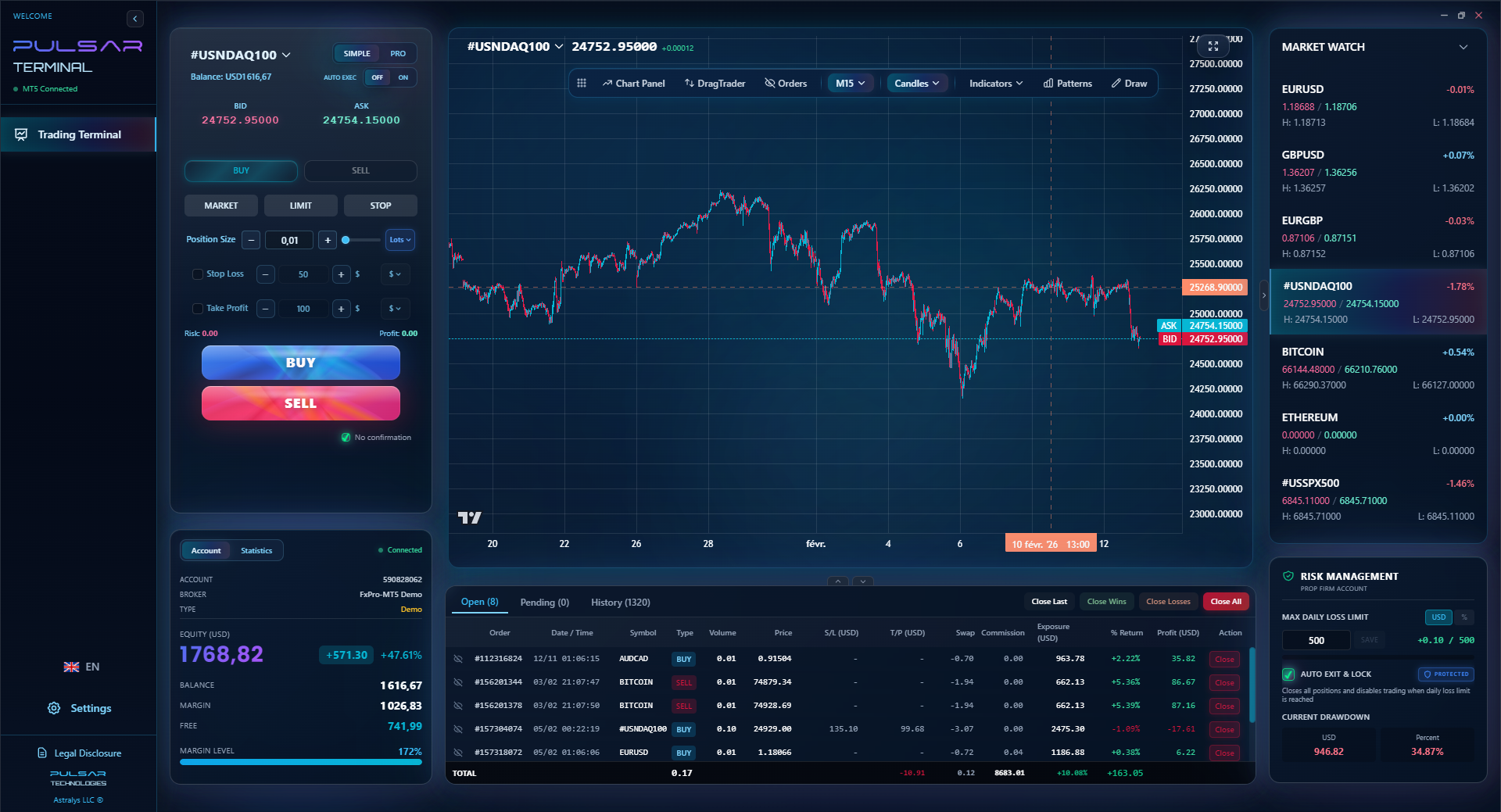
Managing volatile swings on USD/ZAR is easier when you can set multi-level take-profits and automated trailing stops, features that Pulsar Terminal builds directly into your MT5 platform.
Pulsar Terminal
Hepsi bir arada MT5 aracı: sürükle-bırak emirler, çoklu TP/SL, trailing stop, grid trading, Volume Profile ve prop firm koruması. Her gün 1.000'den fazla trader tarafından kullanılıyor.
Let me save you some money and heartache by listing the mistakes I see all the time (and have made myself).
- Trading Around Major News Without a Plan: Jumping into USD/ZAR 5 minutes before a SARB announcement is gambling, not trading. The spreads will widen massively, and you can get filled at a terrible price.
- Ignoring the Spread: Thinking of a 200-pip target without deducting the 7-10 pip spread first. That's a quick way to see your 'winning' trade hit target but still not be profitable.
- Overleveraging: Because minimum deposits can be low, brokers offer high use like 1:500. This is a trap for new traders. use of 1:30 or 1:50 is more than enough. High use + volatile pair = blown account.
- Chasing the Market: The Rand gaps open on Sundays or after news. Don't chase it. Wait for it to settle and show you a new level to trade from.
- Not Accounting for Tax: Remember, your profits are taxable income in South Africa. Keep a detailed trade journal. Some brokers provide tax reports, but it's your responsibility to declare it to SARS.
The biggest pitfall is emotional trading. The Rand can be personal. We live with its strength or weakness every day. Don't let national pride or frustration cloud your judgment. The chart doesn't care about your feelings.
FAQ
Q1Is forex trading legal in South Africa?
Yes, it is completely legal. However, you must use a broker that is regulated by the Financial Sector Conduct Authority (FSCA) to ensure you are protected under South African law.
Q2What is a typical spread for USD/ZAR?
Expect spreads between 5 and 15 pips for USD/ZAR. This is much wider than major pairs due to lower liquidity. Always check the live spread on your broker's platform before placing a trade.
Q3How much money do I need to start trading the Rand Dollar?
You can start with very little. Some brokers allow accounts with a R0 minimum deposit. However, to trade responsibly with proper risk management (e.g., using sensible stop-losses on volatile USD/ZAR), having at least R5,000 - R10,000 in trading capital is a more realistic starting point.
Q4What moves the USD/ZAR exchange rate?
Three main things: 1) Global risk sentiment (fear weakens the Rand), 2) Commodity prices (strong gold/platinum prices often strengthen the Rand), and 3) Local South African factors like politics, SARB interest rate decisions, and economic data like GDP or unemployment figures.
Q5Do I pay tax on my forex trading profits?
Yes. In South Africa, profits from forex trading are considered taxable income. You are required to declare them to SARS. Keep an accurate record of all your trades, including entries, exits, and profits/losses.
Q6Is MetaTrader 4 or 5 better for trading?
Both are excellent. MT4 is simpler and hugely popular. MT5 has more timeframes, built-in economic calendars, and more order types. For most retail traders starting with forex rand dollar trading, MT4 is perfectly sufficient. The broker's conditions (spreads, execution) are more important than the platform version.
Q7Can I make a living trading USD/ZAR?
It's possible, but extremely difficult and risky. The high volatility can generate large gains but also large losses. Most successful traders treat it as a supplemental income source for years before even considering going full-time. Never risk capital you need for living expenses.
Prof. Winston'ın Dersi
Önemli Noktalar:
- ✓USD/ZAR spreads are 5-15 pips: factor this into every target.
- ✓Use a position size calculator. Always. No exceptions.
- ✓Swing trade, don't scalp. Aim for 300+ pip moves.
- ✓SARB news can cause 200-pip swings. Have a plan or stay out.
Bu makale ne kadar faydalıydı?
Bir yıldıza tıklayın
Haftalık Trading Analizleri
Ücretsiz haftalık analiz ve stratejiler. Spam yok.
Yazar hakkında
David van der Merwe
Gelişen Piyasalar Yatırımcısı
Johannesburg merkezli, gelişmekte olan piyasa dövizlerinde 11 yıllık deneyime sahip trader. ZAR pariteleri, FSCA düzenlemeli ticaret ve Güney Afrika piyasa analizi uzmanı.
Yorumlar
Risk Uyarısı
Finansal araçlarla işlem yapmak önemli riskler taşır ve tüm yatırımcılar için uygun olmayabilir. Geçmiş performans gelecekteki sonuçları garanti etmez. Bu içerik yalnızca eğitim amaçlıdır ve yatırım tavsiyesi olarak değerlendirilmemelidir. İşlem yapmadan önce her zaman kendi araştırmanızı yapın.
Bunları da beğenebilirsiniz

Cara Trading Forex Sukses: 7 Prinsip dari Trader Profesional
Cara trading forex sukses dengan 7 prinsip trader pro: manajemen modal, disiplin, journal trading, backtest. Data nyata, bukan janji profit palsu.
Jam Trading Forex Terbaik untuk Trader Indonesia: Panduan Lengkap dengan Tabel Waktu
Panduan jam trading forex untuk trader Indonesia. Tabel 4 sesi dunia, jam emas 20:00-00:00, sesi mana yang harus dihindari. Data akurat + tips dari trader berpengalaman.
Top 5 Sàn Forex Uy Tín Nhất 2026: Review Jujur dari Trader Indonesia
Top 5 sàn forex uy tín 2026 untuk trader Indonesia. Review jujur: spread, deposit, withdraw, dukungan lokal. Exness, XM, IC Markets & lebih.
Pulsar Terminal'ı Edinin
Tüm bu hesaplayıcılar MT5 hesabınızdan gerçek zamanlı verilerle Pulsar Terminal'e entegredir.
Pulsar Terminal'ı Edinin