


I remember staring at my screen, convinced the USD/ZAR was about to break through resistance at R18.45.

David van der Merwe
Gelişen Piyasalar Yatırımcısı ·  South Africa
☕ 11 dk okuma
Neler öğreneceksiniz:
- 1What Live Technical Analysis Actually Means (It's Not Just Charts)
- 2The Essential Toolkit for a South African Trader
- 3Reading Live Price Action on ZAR Pairs
- 4Using Indicators in Real-Time, Not in Hindsight
- 5Live Execution and Risk Management: Where the Battle is Won
- 6Pitfalls I've Fallen Into (So You Don't Have To)
- 7Building Your Daily Live Trading Routine
I remember staring at my screen, convinced the USD/ZAR was about to break through resistance at R18.45. My chart looked perfect: a clean bounce off the 200-day moving average, RSI showing bullish divergence. I went all in. Two hours later, a surprise SARB statement about inflation concerns hit the wires. The pair didn't just reject the level, it crashed through my stop loss at R18.32, wiping out R4,200 in minutes. That trade taught me a brutal lesson: static analysis is a history book. Real trading happens in the live market, where news, liquidity, and pure emotion move prices. This guide is about bridging that gap.
When we talk about forex technical analysis live, most beginners picture someone drawing lines on a chart. That's part of it, but it's like saying driving is just steering. The 'live' part is everything happening around the chart. It's watching the bid/ask spread on your broker's platform widen from 5 pips to 18 pips on USD/ZAR during London open, knowing liquidity is thin. It's seeing a huge sell order flash on the depth of market (if your platform shows it) right at a key Fibonacci level. It's the feeling in your gut when price is hovering at support, and you're deciding whether to trust the bounce or anticipate the break.
For us in South Africa, this has extra layers. You're not just watching EUR/USD. You're watching how Dollar/Rand movements impact your margin on that Gold (XAU/USD) position you're holding. You're aware that news from Eskom or a major mining report can send ZAR pairs gapping when you log in at 9 AM. Live analysis is a state of continuous, contextual awareness. I made the mistake early on of treating my evening analysis as a fixed plan. Now, I treat it as a hypothesis that gets tested and adjusted every minute the market is open.

Warning: A beautifully set up chart from the daily timeframe means nothing if you're trying to scalp the 5-minute chart during a major news event. The lower your timeframe, the more 'live' and reactive your analysis needs to be.

💡 Winston'ın İpucu
The market's job is to make the most people wrong. If a technical level is glaringly obvious on every free website, assume it will be tested and likely broken before the real move begins.
“Live analysis is a state of continuous, contextual awareness, not a fixed plan from the night before.”
You don't need a Bloomberg terminal, but you do need more than a basic MT4 chart. Here’s my non-negotiable setup, built for cost-effectiveness and clarity.
The Core Platform: MetaTrader 5 (MT5) is my base. Most FSCA-regulated brokers like IC Markets or Exness offer it. Why MT5 over MT4? Better timeframes (like the 2-hour chart I love), more indicators, and a superior market depth window. It's just a more modern engine.
The Charting Powerhouse: I run TradingView in a browser tab right next to my MT5 platform. I use MT5 to execute trades (its order execution is solid), but I use TradingView for my primary chart analysis. Their drawing tools are smoother, the community scripts are incredible, and the ability to quickly switch between ideas is unmatched. It's free for basic use, which is plenty to start.
The News Feed: You need a reliable, fast news source. I use ForexFactory's economic calendar and their real-time news feed. It's free. For South African-specific news, I have alerts set up for SARB, National Treasury, and Stats SA announcements on a news app. The moment a CPI print or a SARB repo rate decision hits, you need to know.
The Reality Check: Your broker's own platform. Log into the web or mobile version of your broker (like XM or Pepperstone). Why? To see the actual spreads you're being quoted, not just the generic 'from 0.0 pips' marketing. On USD/ZAR, I've seen the spread sit at a decent 5 pips with Pepperstone, then balloon to 25 pips during off-hours. If you don't see this, you're trading blind.
A Note on Costs
With use capped at 30:1 for retail traders by the FSCA, your margin is tighter. This makes low trading costs critical. Look for brokers with tight spreads on the pairs you trade. On EUR/USD, under 0.5 pips is good. On USD/ZAR, anything consistently under 8 pips during active hours is decent for an exotic. Remember, a wider spread means the price has to move further just for you to break even.

Pro Tip: Set up a 'demo drill'. For one week, treat a demo account like live money. Have your MT5, TradingView, and news feed open. Practice entering, exiting, and modifying orders based on live price action. The goal isn't profit, it's building the muscle memory of your workflow.
“Trading USD/ZAR is a different beast to the major pairs. The technicals still work, but they play out with more volatility and less predictability.”
Trading USD/ZAR or EUR/ZAR is a different beast to the major pairs. The technicals still work, but they play out with more volatility and less predictability. Here's what to watch for live.
Liquidity Tells: ZAR pairs are less liquid. This means:
- Slippage is common, especially on market orders during news. A 10-pip slippage on a 2-lot position can be a R200 surprise (10 pips x 2 lots x ~R10 per pip on USD/ZAR).
- Spreads are your first indicator. A suddenly widening spread often precedes a big move, as market makers pull back. If the USD/ZAR spread jumps from 6 to 15 pips for no apparent reason, tighten your stops or step aside.
- False breaks are frequent. Price will often spike beyond a technical level (a 'stop hunt') before reversing sharply. I got caught by this on EUR/ZAR at R19.80. Price spiked 20 pips above the resistance, took my buy stop order, then reversed and fell 80 pips. Nasty.
Session Awareness: The most reliable moves for ZAR often happen during overlapping London and Johannesburg hours (9 AM - 12 PM SAST). When Asia is in control, price can drift aimlessly with wide spreads. New York session can bring volatility from Dollar flows. I do most of my analysis and planning for ZAR pairs during the London/JHB overlap.
Correlation Check: USD/ZAR doesn't trade in a vacuum. Live, I always have a chart of USD/MXN (another liquid emerging market currency) and DXY (the US Dollar Index) up. If the Dollar is strengthening globally, a bullish setup on USD/ZAR has more conviction. If DXY is falling but USD/ZAR is rising, that's a sign of specific Rand weakness - maybe local news.

Example: Let's say you're watching USD/ZAR. It's approaching a key daily resistance at R18.70. Your live checklist: 1) Is the spread normal (<8 pips)? 2) Is DXY also rising, confirming Dollar strength? 3) Any major SA news in the next hour? If all three align, the resistance test has higher odds of breaking. If not, expect a rejection.
“Trading USD/ZAR is a different beast to the major pairs. The technicals still work, but they play out with more volatility and less predictability.”
Indicators lag. That's the first truth. Your job in live analysis is to interpret what they're telling you now, not what they clearly showed yesterday. I use a maximum of three on my main chart.
My Live Trio:
- Volume: Not the fake tick volume, but if your platform offers better volume data. In MT5, I use the 'Volumes' indicator. A breakout with rising volume has conviction. A breakout on thin volume is suspect and often fails. I once ignored this and bought a GBP/ZAR breakout that immediately reversed. The volume bar was tiny.
- Moving Averages (21 & 55 EMA): I don't use them for crossovers. I use them as dynamic support/resistance and to gauge trend intensity. In a strong uptrend, price will pull back to the 21 EMA and bounce. In live trading, I watch the angle of the MAs and how price reacts to them on smaller timeframes. A steeply rising 21 EMA shows strong momentum.
- RSI (Relative Strength Index): I use it purely for divergence. When USD/ZAR makes a new high but the RSI makes a lower high (bearish divergence), that's a live warning of weakening momentum. I don't trade off overbought/oversold levels alone - in a strong trend, RSI can stay extreme for ages.
The MACD is great for hindsight. For live action, I keep it on a separate chart below to check for histogram momentum, but it's not my primary trigger.
The key is simplicity. With 5 indicators on your chart, by the time they all align, the move is often over. I want one or two to give me a signal, and the price action (candlestick patterns, order flow) to confirm it.
💡 Winston'ın İpucu
Your first loss is often your smallest loss. The R500 you're hesitating to cut can easily become a R2,500 problem if you 'wait for it to come back'. Respect your stop.
“Your analysis can be perfect, but poor execution will kill you. The pre-trade risk calculation is non-negotiable.”
This is it. Your analysis can be perfect, but poor execution will kill you. Here’s my live drill for every single trade.
1. Pre-Check with the Position Size Calculator: Before I even draw a trendline, I know my risk. With a R20,000 account and a 1% risk rule, I can lose R200 on this trade. If my stop loss is 25 pips away on USD/ZAR, my position size is: R200 / (25 pips * ~R10 per pip) = 0.8 lots. I round down to 0.7 lots. This math is non-negotiable and done before I get emotionally attached to the trade.
2. Order Types are Your Friends: I almost never use market orders. A limit order to enter at a better price, or a stop order to enter on a breakout, gives you control. But remember: on exotic pairs, your limit order might not get filled if price doesn't touch it exactly.
3. The Trailing Stop Dilemma: A trailing stop locks in profits but can get you shaken out of a trend on a minor pullback. My solution? I trail manually. If I'm long and price moves 50 pips in my favor, I might manually move my stop loss to breakeven. At 100 pips profit, I might move it to +50 pips. It's more work, but it respects the volatility of ZAR pairs.
4. The Mental Stop Loss: Sometimes, a technical level is obvious to everyone. Placing your hard stop loss just below it is an invitation to get hunted. I often use a mental stop level that's a bit wider, and if price hits it on a 1-minute candle close, I exit manually. This requires discipline, but it saves me from those obvious spikes.
Warning: The FSCA's 30:1 use limit is there for a reason. It feels restrictive, but it saves you from yourself. I once used 100:1 on an offshore account years ago. A 1% move against me wiped out 100% of my margin. It happened in seconds. The 30:1 cap forces you to use sensible position sizing. Don't try to circumvent it.
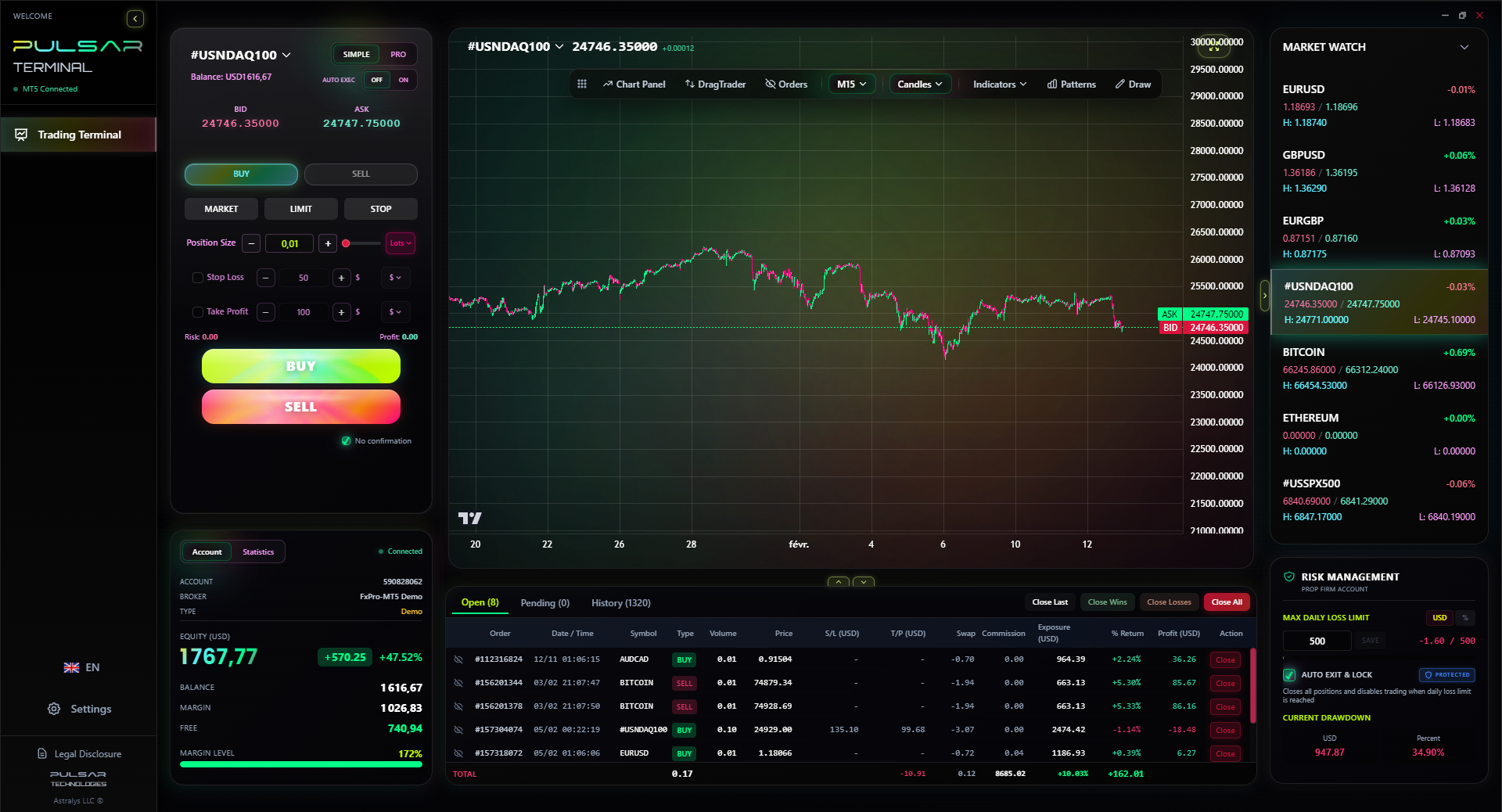
Manually trailing stops and managing multiple orders across volatile ZAR pairs is stressful and slow; Pulsar Terminal automates this with one-click trailing stops and partial closures directly on your MT5 charts.
Pulsar Terminal
Hepsi bir arada MT5 aracı: sürükle-bırak emirler, çoklu TP/SL, trailing stop, grid trading, Volume Profile ve prop firm koruması. Her gün 1.000'den fazla trader tarafından kullanılıyor.
“Your analysis can be perfect, but poor execution will kill you. The pre-trade risk calculation is non-negotiable.”
Let's get real. You will make mistakes. Here are the expensive ones I've paid for, in Rands.
Chasing the News: When SARB hiked rates by 75bps in 2022, USD/ZAR plummeted. I saw it dropping and jumped in with a sell order... after it had already moved 150 pips. I was chasing. It then reversed and rallied 200 pips, stopping me out. I lost R1,500 trying to catch a train that had left the station. If you miss the initial news spike, wait for the consolidation and the second move.
Overtrading in Thin Markets: Trying to scalp USD/ZAR between 5 AM and 7 AM SAST is a recipe for frustration. The spreads are wide, the moves are choppy, and you'll pay more in spread costs than you'll make in profit. I learned this the hard way, turning a R500 profit into a R300 loss over a week just from bad fills.
Ignoring Your Own Rules: You set a 2% daily loss limit. You hit it at 11 AM on a Tuesday. The temptation to 'just make one more trade to get back to even' is overwhelming. I've done it. Every single time, I've lost more. Now, when I hit my limit, I close the platform and go for a walk. The market will be there tomorrow.
Analysis Paralysis: You have 8 charts open, 3 conflicting indicators, and you're watching a YouTube analyst at the same time. You see 5 potential trades and take none. Or worse, you take all of them in a panic. Simplify. Have one primary chart, one trade idea at a time. Live forex technical analysis is about decisive action on a clear plan, not academic debate.
💡 Winston'ın İpucu
A quiet chart is often a chart that's about to speak loudly. Periods of low volatility and tightening ranges (like a coiled spring) frequently precede the biggest moves. Be patient, not bored.
“Consistency beats brilliance every time. A boring, disciplined routine is the foundation of profitable trading.”
Consistency beats brilliance every time. Here's the routine that took me from haphazard to disciplined.
Pre-Market (Before 8 AM SAST):
- Review the economic calendar. Note SA and major global events.
- Do a quick scan of the daily charts on my 5 main pairs (including USD/ZAR, EUR/USD). Identify key levels.
- Check overnight price action. Did anything gap? Why?
Trading Session (8:30 AM - 12 PM SAST):
- This is my active window. I'm focused, phone on silent.
- I look for setups that align with my pre-market analysis.
- I execute, set stops, and walk away from the screen. I don't watch the candle-by-candle torture.
- I might check in once an hour to adjust trailing stops or manage positions.
Post-Session Review (After 5 PM):
- This is the most important part. I journal every trade. Entry, exit, why I took it, what I felt.
- I review the trades I didn't take. Were they winners? Why did I hesitate?
- I look at my charts without any positions. What did I miss?
This routine turns live trading from a chaotic reaction into a professional process. It removes emotion and installs structure. It’s boring, but boring is profitable.
FAQ
Q1What's the best free platform for live forex technical analysis in South Africa?
For charting, TradingView's free plan is unbeatable. For actual trade execution, you need a broker platform. Most FSCA brokers offer MT4/MT5 for free. Use TradingView for your deep analysis and drawing, and MT5 to place your orders. It's the combo I and many pros use.
Q2Why are the spreads on USD/ZAR so much higher than on EUR/USD?
Liquidity. EUR/USD is the most traded pair in the world, with billions traded daily. USD/ZAR is an exotic pair with far less trading volume. Market makers (the ones providing the prices) take on more risk with less liquid pairs, so they charge a wider spread (the difference between buy and sell price) to compensate. It's a cost of trading emerging market currencies.
Q3Can I use automated trading (Expert Advisors) with live technical analysis?
You can, but be very careful. An EA is just a set of rules. It can't adapt to a sudden change in context, like a SARB governor's unexpected comment. I've tried EAs on ZAR pairs, and they often get shredded by volatility and widening spreads. If you use one, it must have incredibly strong risk management rules and you must monitor it, especially around SA news times.
Q4How do I know if my live chart data is fast enough?
If you're seeing consistent, large slippage on your orders compared to your intended price, that's a sign. Also, compare the price on your trading platform with a known fast source like TradingView or Investing.com. If there's a persistent delay of more than a second or two during fast markets, talk to your broker or consider a VPS (Virtual Private Server).
Q5Is it better to trade major pairs or ZAR pairs as a South African beginner?
Start with the majors, specifically EUR/USD. The spreads are tighter, the liquidity is immense, and the technical patterns play out more cleanly. It's a better environment to learn live price action and risk management without the added complexity of exotic pair volatility. Once you're consistently managing trades on EUR/USD, then cautiously explore USD/ZAR with a smaller position size.
Q6How do I handle the tax on my forex trading profits with SARS?
Keep careful records. Your broker's statements are key. SARS views frequent trading profits as income, taxed at your marginal rate. You can deduct certain expenses (platform fees, data costs, a portion of home office if you trade professionally). It's complex. I highly recommend consulting with a tax practitioner who understands trading. Don't wait until tax season; set up your record-keeping from day one.
Q7What's the single biggest difference between demo and live trading?
Emotion and slippage. On demo, a 20-pip slippage is a number. On a live account with real money, it feels like a punch. The fear of loss and the greed for profit will distort your decision-making. That's why live forex technical analysis requires not just chart skill, but immense emotional discipline. The demo is for learning the platform; a small live account is for learning yourself.
Prof. Winston'ın Dersi
Önemli Noktalar:
- ✓Live trading is 30% analysis, 70% psychology and execution.
- ✓Always calculate your [position size](/en/calculators) before you feel the trade's emotion.
- ✓Wider spreads on ZAR pairs are a cost, not a conspiracy. Factor them in.
- ✓The FSCA's 30:1 use is a protective cage, not a limitation.
- ✓Your daily review is more important than your daily profit.
Bu makale ne kadar faydalıydı?
Bir yıldıza tıklayın
Haftalık Trading Analizleri
Ücretsiz haftalık analiz ve stratejiler. Spam yok.
Yazar hakkında
David van der Merwe
Gelişen Piyasalar Yatırımcısı
Johannesburg merkezli, gelişmekte olan piyasa dövizlerinde 11 yıllık deneyime sahip trader. ZAR pariteleri, FSCA düzenlemeli ticaret ve Güney Afrika piyasa analizi uzmanı.
Yorumlar
Risk Uyarısı
Finansal araçlarla işlem yapmak önemli riskler taşır ve tüm yatırımcılar için uygun olmayabilir. Geçmiş performans gelecekteki sonuçları garanti etmez. Bu içerik yalnızca eğitim amaçlıdır ve yatırım tavsiyesi olarak değerlendirilmemelidir. İşlem yapmadan önce her zaman kendi araştırmanızı yapın.
Bunları da beğenebilirsiniz

Cara Trading Forex Sukses: 7 Prinsip dari Trader Profesional
Cara trading forex sukses dengan 7 prinsip trader pro: manajemen modal, disiplin, journal trading, backtest. Data nyata, bukan janji profit palsu.
Jam Trading Forex Terbaik untuk Trader Indonesia: Panduan Lengkap dengan Tabel Waktu
Panduan jam trading forex untuk trader Indonesia. Tabel 4 sesi dunia, jam emas 20:00-00:00, sesi mana yang harus dihindari. Data akurat + tips dari trader berpengalaman.
Top 5 Sàn Forex Uy Tín Nhất 2026: Review Jujur dari Trader Indonesia
Top 5 sàn forex uy tín 2026 untuk trader Indonesia. Review jujur: spread, deposit, withdraw, dukungan lokal. Exness, XM, IC Markets & lebih.
Pulsar Terminal'ı Edinin
Tüm bu hesaplayıcılar MT5 hesabınızdan gerçek zamanlı verilerle Pulsar Terminal'e entegredir.
Pulsar Terminal'ı Edinin