


So you're looking for forex trading books in Hindi? I get it.

Rajesh Sharma
Kıdemli Forex Analisti ·  India
India
☕ 9 dk okuma
Neler öğreneceksiniz:
- 1The Legal Minefield You Have to Understand First
- 2Reviewing the Hindi Books & Resources (The Real Story)
- 3What the Books Can't Teach You: The Indian Market's Quirks
- 4Building Your Education Beyond Books
- 5Common Pitfalls & My Costly Mistakes
- 6A Practical Path for the Absolute Beginner
- 7The Future of Resources & Regulation
So you're looking for forex trading books in Hindi? I get it. You want to learn in your own language, from resources that understand the unique challenges of trading from India. The good news is, there are more options now than ever. The bad news? A lot of them are pure rubbish, and even the good ones won't help you if you don't understand the legal minefield you're stepping into. Let's cut through the noise. I'll tell you which Hindi resources might be worth your time, but more importantly, I'll explain the real-world rules you need to know before you even think about placing a trade.
Before we talk about a single book, we need to talk about the law. This is the most important chapter, and most Hindi trading guides gloss over it. Trading forex in India isn't like trading it from London or Singapore. We have the Reserve Bank of India (RBI) and SEBI watching closely, and they've built a wall around the Indian Rupee (INR).
Here’s the absolute rule: As a retail trader in India, you are only legally allowed to trade currency pairs where the Indian Rupee is one of the currencies. That means USD/INR, EUR/INR, GBP/INR, and JPY/INR on SEBI-regulated exchanges like the NSE or BSE. That's it.
Thinking of opening an account with an international broker like Exness or IC Markets to trade EUR/USD? That's a direct violation of the Foreign Exchange Management Act (FEMA). The RBI even publishes an 'Alert List' of unauthorized platforms. I've seen friends get their bank accounts flagged for trying to fund these offshore accounts. The penalties are no joke.

Warning: Using the Liberalised Remittance Scheme (LRS) to send money abroad for speculative forex trading is explicitly prohibited by the RBI. Don't let any broker or 'guru' tell you otherwise. The only legal exception for using LRS in trading is to fund an account with a broker registered in GIFT City to trade global securities.
Why am I hammering this point? Because the best trading education in the world is useless if your strategy is illegal. Any Hindi resource that doesn't start with this stark reality is doing you a disservice.
Okay, with the legal framework clear, let's look at what's actually available in Hindi. You'll find two main categories: physical book combos and digital PDFs.
The '35 Books' Package & Similar Combos You might see ads for packages like the "FOREX PACKAGES 35 HINDI BOOKS BASIC TO ADVANCE." My take? Be very skeptical. I bought a similar mega-pack early in my career. What you often get is 35 thin booklets, not proper books. The content is frequently just poorly translated, generic information from free English websites, stretched out to fill pages. The 'advanced' strategies are usually just basic explanations of common indicators like the RSI indicator or MACD indicator. It's rarely the deep, contextual market wisdom you need.
Specific Strategy Books More promising are focused books like the "Price Action Trading + Harmonic Trading" combo by Sunil Gurjar and Rohan Shah. These target specific methodologies. The value here depends entirely on the author's actual trading pedigree. Does the author trade the live markets with their own capital? Or are they just selling educational content? It's hard to tell from the cover.
Online PDFs and Free Content This is where many start. A simple search for "Forex Trading Basics in Hindi PDF" will yield results. These are great for grasping absolute fundamentals: what is a pip definition, what is a spread definition, what is use. They explain the basic mechanics. Think of them as your driver's manual. It teaches you what the pedals do, but it won't teach you how to handle a car in heavy Mumbai rain.

Pro Tip: Use free Hindi PDFs for learning basic terminology and mechanics. But for actual strategy and market psychology, you will almost certainly need to graduate to higher-quality English materials or find a mentor with proven, verifiable results in the Indian derivative markets.

💡 Winston'ın İpucu
A book can give you a map, but the market is the territory. The map is never the territory. Spend 20% of your time reading, 80% observing the price action on your charts.
“The best trading education in the world is useless if your strategy is illegal in India.”
Here's the gap most Hindi trading books leave wide open. Trading USD/INR futures on the NSE is a different beast from trading EUR/USD on an international platform.
Liquidity and Timing The most liquid session for USD/INR is during Indian market hours (9 AM to 5 PM). The market can get very quiet after that. A scalping strategy that works on the volatile London session for GBP/JPY might fall flat here. Your books need to address session-specific strategies.
Brokerage and Costs Your profit calculations must include Indian brokerage models. On Zerodha, for example, you pay ₹20 per executed order for currency futures (or 0.03%, whichever is lower). If you're placing 10 trades a day, that's ₹200 gone before you've made a single rupee. This directly impacts which strategies are viable. A strategy that aims for 5-point profits might be eaten alive by costs. Always use a position size calculator that includes your specific brokerage fees.
The RBI Wildcard The RBI can and does intervene in the forex market. They issue new circulars, like the ones in April 2026 that tightened rules on derivatives and capped banks' open positions. These events can cause sudden, sharp moves that no technical analysis book prepared you for. You need to follow financial news. A book from 2023 won't know about the 2026 rule changes.
Books are a foundation, not the whole building. Here’s how I built my knowledge after the initial book phase.
1. Paper Trading on Indian Platforms Open a demo account with a SEBI-regulated broker. Don't practice on an MT4 demo trading EUR/USD. Practice on the actual platform (like Kite) trading USD/INR. Get a feel for the real liquidity, the tick sizes, and the order interface. This is non-negotiable.
2. Specialize in One Pair First Start with USD/INR. It's the most liquid. Learn everything about it. What drives it? (Oil prices, FDI flows, RBI policy, US Fed policy). Chart its behavior during the budget speech, during RBI MPC announcements. I spent my first six months only on USD/INR. It taught me more than any 35-book package.
3. Learn from English Resources (Selectively) The highest-quality market analysis and advanced concepts are still predominantly in English. Don't limit yourself. Learn to read charts and economic calendars in English. Resources on instruments like XAU/USD guide teach universal charting principles that apply to USD/INR, even if you can't trade gold.
4. Find a Community (Carefully) Look for communities focused on NSE currency derivatives. Be wary of Telegram groups promising 'sure-shot signals.' The good groups discuss RBI policy, interpret economic data, and share chart analysis. The bad ones will blow up your account.
💡 Winston'ın İpucu
Your first goal isn't to be profitable. It's to be durable. Survive long enough to learn the lessons the market is trying to teach you. That means risk management is your primary study.
“INR pairs require patience, not brute force. A 20-pip move can trigger a margin call if you're over-leveraged.”
Let me save you some money by sharing where I went wrong. I wish a book had been this blunt.
Mistake 1: Over-Leveraging on Small Moves The INR moves in small increments compared to something like GBP/JPY. In my early days, frustrated by small moves, I used excessive use to amplify gains. I once took a 10-lot position in USD/INR (that's USD 10,000 notional) with far too little capital. A 20-pip move against me, which is nothing for that pair, triggered a margin call and wiped out 30% of my account. The lesson? INR pairs require patience, not brute force. Position sizing is everything.
Mistake 2: Ignoring Event Risk I got caught holding a long USD/INR position into a surprise RBI intervention announcement. The pair gapped down 40 pips at open. My stop-loss was useless. I lost ₹8,000 overnight. Books teach you to place stops, but they don't always stress that you should reduce position size or stay out before major event risks like RBI meetings or the Union Budget.
Mistake 3: Chasing 'Strategies' Without Understanding Costs I tried a high-frequency scalping method I read about. Aiming for 5-10 pip profits. With ₹20 per trade brokerage, I needed to win over 75% of my trades just to break even. I didn't. The math killed me. Always model your strategy's profitability after all costs.
A tool that would have saved me from several of these errors is one that helps manage risk systematically across all trades, not just on a single chart.
Managing multiple trades and strict risk rules, like avoiding margin calls, is far easier with a tool that lets you set and automate advanced order types across all your charts from one place.
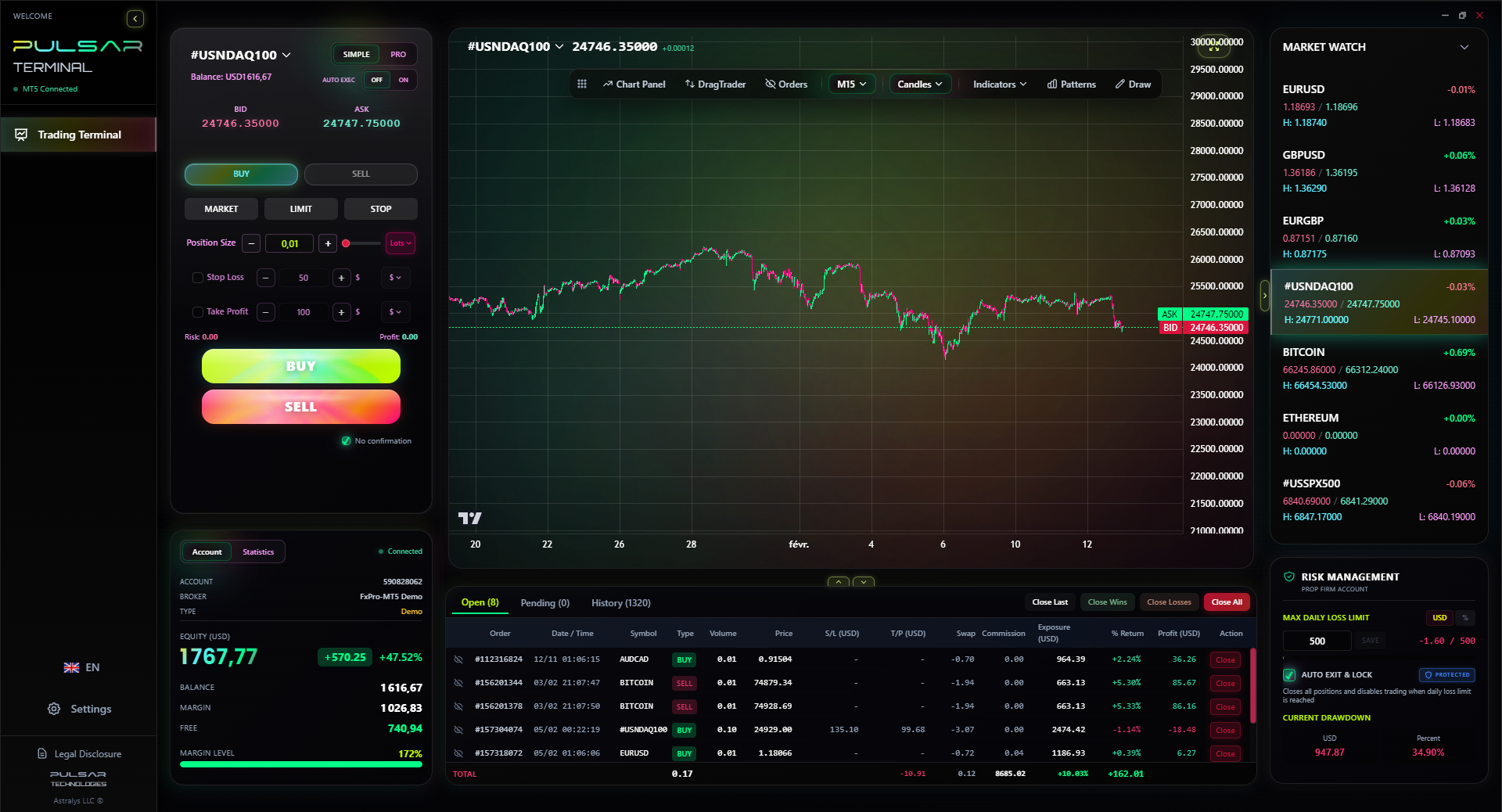
Pulsar Terminal
Hepsi bir arada MT5 aracı: sürükle-bırak emirler, çoklu TP/SL, trailing stop, grid trading, Volume Profile ve prop firm koruması. Her gün 1.000'den fazla trader tarafından kullanılıyor.
Feeling overwhelmed? Here's a step-by-step path I'd recommend to a friend today.
Month 1-2: Foundation
- Read a free 'Forex Basics in Hindi' PDF. Learn the glossary.
- Open a demo account with Zerodha or Angel One.
- Watch tutorials on how to place orders, set stops, and read the basic candlestick chart on their platform. Don't trade yet. Just learn the software.
Month 3-4: Market Mechanics
- Pick up one focused Hindi book on a single approach, like price action.
- On your demo, start observing USD/INR. Don't predict, just observe. Note its average daily range. See how it reacts at 9:15 AM open.
- Learn about the economic calendar. What is CPI? What is the Fed Funds Rate? How did USD/INR move after the last RBI rate hike?
Month 5-6: Strategy & Psychology
- By now, you'll know if you prefer quick trades or holding for days. Explore a scalping strategy or swing trading framework in more depth.
- Start paper trading a simple rule-based strategy. Keep a journal. Note your emotions.
- This is when you might start carefully exploring advanced English resources or tools that can help you execute and manage trades more efficiently than a basic platform allows.
💡 Winston'ın İpucu
The difference between a theory and a strategy is a set of clear, written rules for entry, exit, and position size. If you can't write it down, you don't have a strategy. You have a hope.
“Your first goal isn't to be profitable. It's to be durable. Survive long enough to learn.”
The landscape is slowly improving. The market itself is growing - projected to nearly double from 2025 to 2034. With growth comes better education.
We're starting to see more nuanced Hindi content from traders who actually navigate the NSE currency markets. The 2024-2026 RBI regulations, while restrictive, have also clarified the boundaries. This clarity helps legitimate educators create more relevant content.
I hope to see more Hindi resources that:
- Are written by active traders of USD/INR futures.
- Include real trade examples with entry/exit prices, brokerage, and P&L calculations in INR.
- Discuss the integration of global events (like the Fed) with local RBI policy.
Until then, your education will be a hybrid model: Hindi for comfort and basics, English for advanced concepts, and your own screen time for the priceless, unwritten lessons of the Indian currency market.
FAQ
Q1Is trading forex with international brokers like XM or Pepperstone legal in India?
No, it is not legal for retail traders to trade non-INR currency pairs (like EUR/USD) through international brokers. This violates FEMA rules. You can only trade INR pairs (USD/INR, EUR/INR, etc.) through SEBI-regulated brokers on Indian exchanges like the NSE. Brokers like XM or Pepperstone are on the RBI's Alert List for unauthorized forex trading.
Q2What is the best forex trading book in Hindi for beginners?
There's no single 'best' book. Start with free online PDFs covering 'Forex Trading Basics in Hindi' to learn terminology. For strategy, look for recent books by authors with a verifiable track record in Indian markets. Be wary of massive packages promising everything; focused books on one topic (like price action) are often better.
Q3Can I use trading strategies from English books on the USD/INR pair?
Yes, but you must adapt them. Core technical analysis principles apply. However, you must account for lower volatility, specific Indian market hours, and transaction costs (like ₹20 per order brokerage). A strategy designed for the volatile London session on GBP/JPY may need significant adjustment to work on USD/INR during Indian hours.
Q4What is the minimum amount needed to start trading forex legally in India?
With SEBI-regulated brokers, you can start with a few thousand rupees. Some brokers allow you to start trading a single USD/INR futures contract (which has a smaller contract size) with ₹10,000-₹20,000 as margin. Never commit your entire capital; only use risk capital you can afford to lose.
Q5Do the Hindi trading books explain the RBI's role and regulations?
Most don't, or they gloss over it. This is a major shortcoming. Understanding RBI regulations, intervention risks, and FEMA rules is more critical to your survival than any candlestick pattern. You must supplement any book with direct reading of RBI circulars and financial news.
Q6Is learning about gold (XAU/USD) or EUR/USD useful if I can only trade INR pairs?
Yes, indirectly. Studying instruments like XAU/USD or EUR/USD teaches you universal technical analysis, chart patterns, and how global risk sentiment works. Since USD/INR is heavily influenced by the US Dollar's global strength, understanding EUR/USD dynamics can give you context for your USD/INR trades.
Prof. Winston'ın Dersi
Önemli Noktalar:
- ✓Trade only RBI-approved INR pairs (USD/INR, EUR/INR).
- ✓Factor in ₹20 per trade brokerage; it kills scalping.
- ✓RBI intervention is a real, non-technical risk factor.
- ✓Use demo accounts on Indian platforms, not MT4 for EUR/USD.
Bu makale ne kadar faydalıydı?
Bir yıldıza tıklayın
Haftalık Trading Analizleri
Ücretsiz haftalık analiz ve stratejiler. Spam yok.
Yazar hakkında
Rajesh Sharma
Kıdemli Forex Analisti
Hindistan ve Güney Asya piyasalarında 10 yılı aşkın deneyim. NSE döviz türevleriyle başlayıp uluslararası forex'e geçiş yaptı. USD/INR ve gelişmekte olan piyasa pariteleri uzmanı.
Yorumlar
Risk Uyarısı
Finansal araçlarla işlem yapmak önemli riskler taşır ve tüm yatırımcılar için uygun olmayabilir. Geçmiş performans gelecekteki sonuçları garanti etmez. Bu içerik yalnızca eğitim amaçlıdır ve yatırım tavsiyesi olarak değerlendirilmemelidir. İşlem yapmadan önce her zaman kendi araştırmanızı yapın.
Bunları da beğenebilirsiniz

Cara Trading Forex Sukses: 7 Prinsip dari Trader Profesional
Cara trading forex sukses dengan 7 prinsip trader pro: manajemen modal, disiplin, journal trading, backtest. Data nyata, bukan janji profit palsu.
Jam Trading Forex Terbaik untuk Trader Indonesia: Panduan Lengkap dengan Tabel Waktu
Panduan jam trading forex untuk trader Indonesia. Tabel 4 sesi dunia, jam emas 20:00-00:00, sesi mana yang harus dihindari. Data akurat + tips dari trader berpengalaman.
Top 5 Sàn Forex Uy Tín Nhất 2026: Review Jujur dari Trader Indonesia
Top 5 sàn forex uy tín 2026 untuk trader Indonesia. Review jujur: spread, deposit, withdraw, dukungan lokal. Exness, XM, IC Markets & lebih.
Pulsar Terminal'ı Edinin
Tüm bu hesaplayıcılar MT5 hesabınızdan gerçek zamanlı verilerle Pulsar Terminal'e entegredir.
Pulsar Terminal'ı Edinin