


If you're a South African trader searching for 'forex trading brokers in India,' I need to stop you right there.

David van der Merwe
Gelişen Piyasalar Yatırımcısı ·  South Africa
☕ 12 dk okuma
Neler öğreneceksiniz:
- 1Why 'Forex Trading Brokers in India' is a Useless Search for You
- 2The Real Rules: South Africa's FSCA and What They Mean for You
- 3How to Actually Pick a Forex Broker as a South African
- 4The Real Cost of Trading in South Africa: A Breakdown
- 5Broker Categories That Make Sense for South Africans
- 6Getting Your Money In and Out: The ZAR Reality
- 7Mistakes I Made (So You Don't Have To)
If you're a South African trader searching for 'forex trading brokers in India,' I need to stop you right there. You're probably looking for cheap brokers or high use, but that search will lead you down a rabbit hole of misinformation and irrelevance. The Indian forex market is one of the most restricted in the world for residents, and their broker landscape has zero bearing on what you can access from Cape Town or Johannesburg. Let's clear up the confusion and talk about what actually matters for us: finding solid, regulated brokers that work for South Africans, understanding our own FSCA rules, and avoiding the costly mistakes I made when I started.
Here's the blunt truth: India's forex market is basically closed to its own citizens for speculative trading. The Reserve Bank of India (RBI) only allows trading on currency pairs that involve the Indian Rupee (INR) for hedging purposes. Think USD/INR, EUR/INR. That's it. Trading major pairs like EUR/USD or GBP/USD through an international broker? Illegal for an Indian resident.
So when you see that search term, you're often looking at content meant for an Indian audience discussing their extremely limited, domestic-only options. These 'brokers' are entities like Indian banks offering currency futures on the National Stock Exchange. They have nothing to do with the global forex market you and I want to trade.
I learned this the hard way early on. I spent hours researching 'international brokers in India,' thinking I'd found a secret loophole to cheaper trading. All I found were dead ends and forums full of traders discussing how to circumvent RBI rules using offshore accounts - a risky and complicated mess you don't want any part of. Your goal isn't to mimic a restricted market; it's to use the relatively open access we have here in South Africa.

Warning: Any website aggressively advertising 'forex trading brokers in India' to a South African IP address is likely a scam or a poorly targeted ad. Their regulatory framework and product offerings are completely misaligned with your needs.

💡 Winston'ın İpucu
A broker's 'headline' use is a measure of potential danger, not sophistication. The smartest traders I know use the least.
“The Indian forex market is basically closed to its own citizens for speculative trading.”
Our playing field is defined by the Financial Sector Conduct Authority (FSCA). Unlike India, forex trading is perfectly legal here, but it's regulated. The FSCA is our watchdog, and understanding its rules is your first step to trading safely.
The FSCA's use Cap
The biggest rule change in recent years is the use cap. Since 2021, the FSCA has limited use for retail traders to 30:1 on major forex pairs. This was a game-changer (whoops, I said it). Before that, it was common to see 500:1. I remember placing a £10,000 position on GBP/USD with just £20 in margin back in 2018. One bad swing and I was done. The cap is annoying when you want big exposure, but honestly, it's saved more traders than it's hurt. It forces you to use proper position size calculator and stops you from blowing up your account in minutes.
Client Money Protection
A broker regulated by the FSCA (they'll have an FSP number) must keep your money in segregated accounts. This means your deposit isn't just part of the company's operating cash. If the broker goes under, your funds are separate and should be returned. This isn't just paperwork; it's peace of mind. I only deposit with brokers who can prove this segregation.
Your Two Broker Categories
As a South African, you have two choices:
- Locally Regulated FSCA Brokers: These are physically present in SA. Their advantage? Easy ZAR deposits/withdrawals, local customer support, and direct FSCA recourse if something goes wrong. The trade-off? They must adhere strictly to the 30:1 use cap.
- International Brokers (FSCA or other top-tier regulated): Many global giants like IC Markets or Pepperstone also hold FSCA licenses. They might offer their international entity to South African clients, which can sometimes mean access to higher use (like 500:1) through that other jurisdiction. This is a grey area, but it's common. The key is they are still highly regulated, just not solely by the FSCA for that specific service.
The bottom line? Regulation is your safety net. Don't trade with an unregulated 'bucket shop' promising the moon, no matter how cheap it seems.
“The FSCA's 30:1 use cap is annoying when you want big exposure, but honestly, it's saved more traders than it's hurt.”
Forget India. Let's build your checklist based on reality. I've opened accounts with over a dozen brokers in my 12 years, and these are the non-negotiable factors.
1. Regulation (The Deal-Breaker)
Must have a top-tier license. FSCA is great. Other top-tier regulators include ASIC (Australia), FCA (UK), CySEC (Cyprus). A broker with multiple licenses, like XM or Exness, is a strong sign. Always verify the license number on the regulator's website.
2. Costs That Eat Your Profits
This is where your research pays off. You need to look at the total cost per trade:
- Spreads: The difference between buy and sell. On EUR/USD, anything under 1.0 pip on a standard account is decent. Raw accounts offer spreads from 0.0 pips but charge a commission.
- Commissions: Often $3-$7 per round turn (buy and sell) per standard lot.
- Funding Fees: This is huge for us! Depositing ZAR to an international broker often involves a currency conversion fee (1-3%) and sometimes a bank fee. Some brokers, however, have local ZAR settlement accounts. This means you can EFT your Rands directly to a South African bank account in the broker's name, and they convert it internally at a good rate. This saved me hundreds in bank fees last year alone.

Example: A R10,000 deposit.
- With a typical international broker: Your bank converts ZAR to USD at a poor rate + 2.15% fee. You might lose R250+ before you even trade.
- With a broker offering a local ZAR account: You EFT R10,000 locally (R0 fee). The broker converts it at the interbank rate + a small 0.5% fee. Total cost: ~R50.
3. The Platform & Tools
Most brokers offer MetaTrader 4 or 5 (MT4/MT5). It's the industry standard. But ask yourself: does it have the tools you need? If you're into swing trading, you need good charting. If you're a scalping fiend, you need lightning-fast execution and low latency. I made the mistake of choosing a broker with a 'pretty' platform that had 200ms slower execution than MT5. For my style, that was a profit killer.
4. Customer Support
Test them. Send an email with a technical question. Call their line. Do they have South African-specific support hours? You don't want to be stuck with a withdrawal issue at 8 PM SAST and only have a UK line that's closed.
“The FSCA's 30:1 use cap is annoying when you want big exposure, but honestly, it's saved more traders than it's hurt.”
Let's get specific with numbers, because vague promises are worthless. Here’s what you’re really paying.
| Cost Type | Typical Range (ZAR) | What It Is & Why It Matters |
|---|---|---|
| Spread on EUR/USD | R1.50 - R18 per 0.1 lot trade | The broker's built-in fee. The main cost for most traders. A 1-pip spread on EUR/USD is about R15 on a 0.1 lot. |
| Commission (if applicable) | R3 - R7 per 0.1 lot round turn | A separate fee on raw spread accounts. Often cheaper overall for high-volume traders. |
| ZAR Deposit/Withdrawal Fee | R0 - R350+ | The big one. Can be a flat bank fee (e.g., Capitec charges ~R250 for int'l payments) or a percentage. Use brokers with local settlement! |
| Currency Conversion Margin | 0.5% - 2.5% | The hidden mark-up when your broker converts your ZAR to USD for your trading account. |
| Overnight Financing (Swap) | Varies Daily | Interest paid or earned for holding a position past 5 PM NY time. Can be a cost or a small income. |
A personal story: In 2019, I was trading a scalping strategy on GBP/JPY. I was profitable on paper, but my net P&L was barely breaking even. I couldn't figure it out. I finally audited my trades: the spread was wide (4 pips), and I was making 5-8 pip targets. The spread was eating nearly half my potential profit on every single trade! I switched to a raw spread account with a commission. My cost per trade dropped from ~R60 to about R25. My profitability jumped overnight. Lesson: know your all-in costs.

Pro Tip: When comparing brokers, don't just look at the advertised 'from' spread. Use a demo account during your normal trading hours (SA evening is when London/NY overlap, spreads are tight) and check the typical spread. That 'from 0.0 pips' might only be true for 2 hours a day.
💡 Winston'ın İpucu
Always do a R500 test withdrawal before moving large profits. It confirms the plumbing works and saves monumental frustration.
“Your goal isn't to mimic a restricted market; it's to use the relatively open access we have here in South Africa.”
Based on the market, here’s how I group the realistic options. This isn't about naming the 'best,' but about matching a broker's strength to your profile.
The Global Powerhouses (Best for Most Serious Traders) These are the big, multi-regulated firms with deep liquidity, excellent execution, and professional tools. Think IC Markets, Pepperstone, and FP Markets. They cater to South Africans through their international entities. You'll get tight spreads, great MT4/MT5 support, and often access to higher use if you want it. The downside can be slightly more complex ZAR funding. They're my go-to for the bulk of my trading capital because the execution quality is unmatched.
The Beginner-Friendly & Copy Trading Hubs Brokers like eToro (not FSCA, but FCA/CySEC) and AvaTrade (FSCA regulated) excel here. They have social/copy trading features, simplified platforms, and lots of educational content. Their costs are usually a bit higher (wider spreads), but you're paying for the environment. Perfect if you're starting out and want to learn from others.
The Low-Cost Raw Spread Specialists If you're a high-volume trader, scalper, or algorithmic trader, every pip counts. Brokers like Tickmill and Fusion Markets are built for this. They offer raw spreads from 0.0 pips and charge a low commission. Your total trading cost is often the lowest in the market. Just be sure you have the strategy and volume to justify it.
The Proudly South African Options Brokers like Khwezi Trade are fully FSCA regulated, based in SA, and offer seamless ZAR accounts. This is their biggest advantage. Everything is in Rands, support is local, and you have direct FSCA protection. They typically adhere to the 30:1 use cap and might have a slightly smaller range of instruments than the global giants, but for many traders, the convenience and security are worth it.
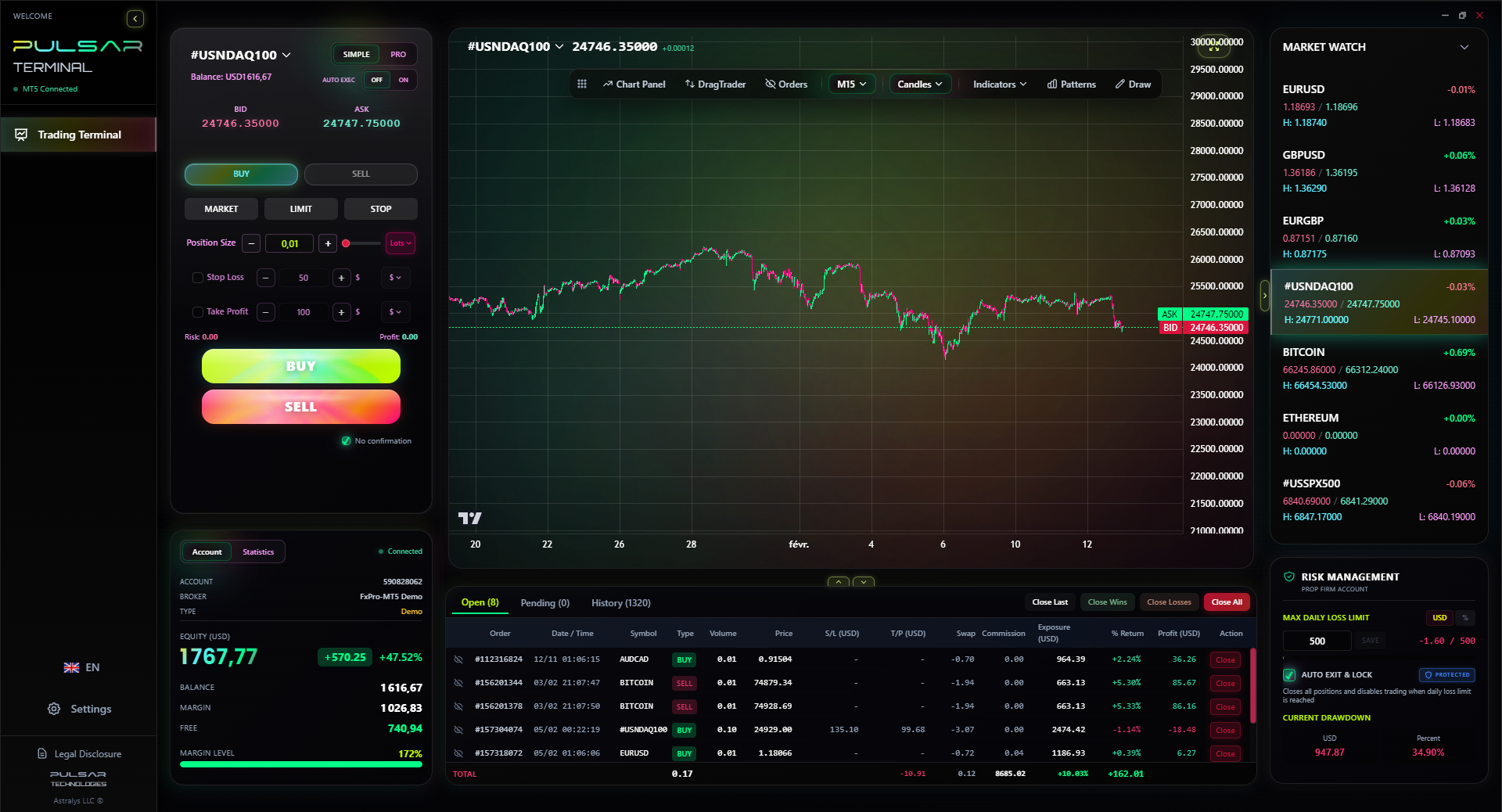
Managing complex trades and risk on MT5 is easier with tools that automate your strategy rules, like setting multiple take-profit levels or moving stops to breakeven, which is exactly what Pulsar Terminal is built for.
Pulsar Terminal
Hepsi bir arada MT5 aracı: sürükle-bırak emirler, çoklu TP/SL, trailing stop, grid trading, Volume Profile ve prop firm koruması. Her gün 1.000'den fazla trader tarafından kullanılıyor.
“Your goal isn't to mimic a restricted market; it's to use the relatively open access we have here in South Africa.”
This is the most practical headache for us. Here’s my streamlined process after years of trial and error.
The Best Method: Local ZAR Settlement If your broker offers it, use it. You'll get South African banking details. You EFT from your Absa/FNB/Capitec account directly to them. The money lands in your trading account within a few hours, often converted at a very fair rate. Withdrawals are the reverse: you request Rands, they EFT you. It feels like dealing with a local company. No SWIFT codes, no international transfer dramas.
The International Transfer Method If your chosen broker doesn't have local settlement, you'll need to do a SWIFT/International EFT. Here's the drill:
- Initiate a deposit from your broker's website. They'll give you their international bank details.
- Go to your online banking, set up a foreign currency payment to those details.
- You'll pay: Your bank's forex commission (e.g., 2.15%), a SWIFT fee (R100-R300), and the broker might charge a small receiving fee.
- Wait 2-5 business days.
Credit/Debit Cards & E-Wallets Options like Skrill, Neteller, or even Visa/Mastercard are instant. But beware: they often have higher currency conversion fees than your bank, and some brokers charge a fee for card deposits. I use Skrill only for small, quick top-ups. For large deposits, the local EFT or even a SWIFT transfer is usually cheaper percentage-wise.
Tax Time I'm not an accountant, but I can tell you what mine tells me every year: Keep. Every. Single. Record. Your deposit/withdrawal confirmations, your monthly broker statements, your trade history. Forex profits are taxable as income in South Africa. The onus is on you to declare it. A clean paper trail makes this infinitely easier.
“I rarely use more than 20:1 use, even if I have 500:1 available. The FSCA's 30:1 cap is more than enough for sensible trading.”
Let's wrap this up with some blunt honesty about where I've messed up. Learn from my Rands.
Chasing the Highest use When I started, I thought 1000:1 use was a superpower. It's not. It's a loaded gun pointed at your account. My second-ever live trade was on USD/JPY with 500:1 use. A 20-pip move against me (a tiny blip) triggered a margin call and wiped out 40% of my account. I was stunned. Now, I rarely use more than 20:1, even if I have 500:1 available. The FSCA's 30:1 cap is more than enough for sensible trading.
Ignoring the Total Cost of Funding I already mentioned the scalping story, but another one: I deposited $1000 with a broker using my credit card. Seemed easy. What I didn't see was the 3.5% currency conversion fee my card issuer charged. There went $35 before I even placed a trade. Always calculate the total cost of getting your money to the broker.
Picking a Broker for One Gimmick 'Free VPS!' '$30 Welcome Bonus!' 'Copy the top trader!' These are marketing tools. I once chose a broker because they offered a 'free' trading signals service. The signals were mediocre, the spreads were terrible, and the platform was clunky. The core product - reliable, cheap trade execution - was bad. Don't let a shiny bonus distract you from the fundamentals: regulation, cost, and execution.
Not Testing With a Small Withdrawal First Before you withdraw your first big profit, do a small test withdrawal. Say, R500 or R1000. This verifies the process, confirms the banking details are correct, and gives you an idea of the timing and fees. I didn't do this once, and a large withdrawal got stuck for two weeks due to a minor paperwork issue. A small test run would have flagged it.
Your journey isn't about finding a mythical 'forex trading brokers in india' secret. It's about doing the boring, diligent work of finding a reputable partner for your South African trading business. Get that right, and you've solved 80% of the headaches before you even place your first trade.
💡 Winston'ın İpucu
If you're comparing two brokers, the one with a local ZAR settlement account will almost always save you more money in the long run than a slightly tighter spread.
FAQ
Q1Is forex trading legal in South Africa?
Yes, completely legal. It's regulated by the Financial Sector Conduct Authority (FSCA). This is a key difference from countries like India where it's heavily restricted for residents.
Q2Can I use international brokers like IC Markets or Pepperstone from South Africa?
Absolutely. Most major international brokers actively accept South African clients. Many, like Pepperstone and IC Markets, also hold FSCA licenses. You'll typically open an account under their global entity, which is standard practice.
Q3What is the maximum use I can get in South Africa?
If you use a broker's FSCA-regulated entity, the legal retail limit is 30:1. However, many South Africans use the international entities of these same brokers, which may offer higher use (like 500:1) under a different regulator's rules (e.g., ASIC). The choice is yours, but higher use significantly increases risk.
Q4How do I avoid high bank fees when funding my trading account?
Look for brokers that offer a 'local ZAR settlement' or 'local deposit' option. This allows you to EFT Rands directly to a South African bank account in the broker's name. It bypasses expensive international SWIFT transfers and usually has much lower conversion fees.
Q5Do I pay tax on my forex trading profits in South Africa?
Yes. Profits from trading are considered income and are subject to normal income tax rates (from 18% to 45%, depending on your total income bracket). You must declare this income to SARS. Keep detailed records of all deposits, withdrawals, and statements.
Q6Why is searching for 'forex trading brokers in India' bad advice for me?
Because India's forex market is closed for speculative trading by its residents. The brokers and information you find are tailored to an entirely different, restricted regulatory environment that has no relevance or benefit to a trader in South Africa's open market. It will lead you to irrelevant or misleading information.
Q7What's the most important thing to check before depositing with a broker?
Their regulatory license. Verify it on the regulator's official website (FSCA, ASIC, FCA etc.). Then, check the actual trading costs (spreads/commissions) during your trading hours on a demo, and understand their deposit/withdrawal fees for ZAR. Regulation, cost, and access to your money are the holy trinity.
Prof. Winston'ın Dersi
Önemli Noktalar:
- ✓Ignore 'forex trading brokers in India' searches - they're irrelevant to SA traders.
- ✓FSCA regulation is your baseline safety net; always verify the license.
- ✓Local ZAR settlement accounts save hundreds in bank fees annually.
- ✓Total trade cost = Spread + Commission + Funding Fees. Know all three.
- ✓Test a small withdrawal first to avoid big problems later.
Bu makale ne kadar faydalıydı?
Bir yıldıza tıklayın
Haftalık Trading Analizleri
Ücretsiz haftalık analiz ve stratejiler. Spam yok.
Yazar hakkında
David van der Merwe
Gelişen Piyasalar Yatırımcısı
Johannesburg merkezli, gelişmekte olan piyasa dövizlerinde 11 yıllık deneyime sahip trader. ZAR pariteleri, FSCA düzenlemeli ticaret ve Güney Afrika piyasa analizi uzmanı.
Yorumlar
Risk Uyarısı
Finansal araçlarla işlem yapmak önemli riskler taşır ve tüm yatırımcılar için uygun olmayabilir. Geçmiş performans gelecekteki sonuçları garanti etmez. Bu içerik yalnızca eğitim amaçlıdır ve yatırım tavsiyesi olarak değerlendirilmemelidir. İşlem yapmadan önce her zaman kendi araştırmanızı yapın.
Bunları da beğenebilirsiniz

Cara Trading Forex Sukses: 7 Prinsip dari Trader Profesional
Cara trading forex sukses dengan 7 prinsip trader pro: manajemen modal, disiplin, journal trading, backtest. Data nyata, bukan janji profit palsu.
Jam Trading Forex Terbaik untuk Trader Indonesia: Panduan Lengkap dengan Tabel Waktu
Panduan jam trading forex untuk trader Indonesia. Tabel 4 sesi dunia, jam emas 20:00-00:00, sesi mana yang harus dihindari. Data akurat + tips dari trader berpengalaman.
Top 5 Sàn Forex Uy Tín Nhất 2026: Review Jujur dari Trader Indonesia
Top 5 sàn forex uy tín 2026 untuk trader Indonesia. Review jujur: spread, deposit, withdraw, dukungan lokal. Exness, XM, IC Markets & lebih.
Pulsar Terminal'ı Edinin
Tüm bu hesaplayıcılar MT5 hesabınızdan gerçek zamanlı verilerle Pulsar Terminal'e entegredir.
Pulsar Terminal'ı Edinin