


Here's a hard truth most new traders in Australia ignore: over 70% of the daily moves in the AUD/USD happen within 30 minutes of a major economic data release.

Sarah Collins
Yatırım Stratejisti ·  Australia
☕ 10 dk okuma
Neler öğreneceksiniz:
Here's a hard truth most new traders in Australia ignore: over 70% of the daily moves in the AUD/USD happen within 30 minutes of a major economic data release. You can spend all day staring at charts, but if you're not aligned with the economic calendar, you're just guessing. The calendar isn't just a list of dates, it's the market's heartbeat. For us trading from Sydney or Melbourne, understanding it - especially for our own currency - isn't optional. It's the difference between catching a 50-pip wave and getting wiped out by it.
If you're trading the Aussie dollar, you're trading a story. That story is written by data. The AUD is a classic 'commodity currency,' meaning its value is tied to what we dig out of the ground - iron ore, coal, natural gas. When China (our biggest customer) sneezes, the AUD gets a cold. But it's not just about trucks and rocks. The Reserve Bank of Australia (RBA) sets the price of money here, and every word from Governor Bullock is dissected by the market.
The economic calendar formalises this story. It tells you when the next chapter drops. Trading without it is like sailing without checking the weather forecast. You might get lucky, but a storm (like a surprise inflation print) will capsize you fast. I learned this the hard way early on. I was long AUD/USD, feeling clever about my technical setup. Then the US Non-Farm Payrolls data hit, the USD ripped higher, and I watched a 1.5% move against me in under a minute. I hadn't even known the event was scheduled. That was a $700 lesson in calendar awareness I've never forgotten.
For us, the calendar has two layers: local and global. You need to watch Australian data to predict RBA moves, and you need to watch US, Chinese, and sometimes European data to see how the world will treat our exports. It's a balancing act.
Not all calendar events are created equal. Some are market-shakers, others are barely a ripple. Let's break down the Aussie events that actually move the needle.
The Big Three: CPI, Employment, and the RBA
First, the holy trinity. The Consumer Price Index (CPI) Quarterly is the king. Inflation dictates everything the RBA does. A high print sends the AUD soaring on rate hike bets; a low print crushes it. The Monthly Employment Change is a close second. A strong jobs number suggests a healthy economy, supporting the currency. Then you have the RBA Cash Rate Decision and Statement. The rate itself is usually priced in, but the accompanying statement and press conference are pure volatility fuel. A single changed word - 'possible' vs 'likely' - can trigger a 20-pip move.
The Supporting Cast
These matter, but often set the tone rather than cause a crash.
- Retail Sales: Shows if Aussies are spending. Weak sales = weak economy = potential rate cuts.
- Trade Balance: Surplus is good (we're selling more than we're buying), deficit is bad.
- Building Approvals & Housing Data: The housing market is a huge part of our economy. Weakness here worries the RBA.
- Chinese PMI Data: Not Australian, but critical. As our largest trading partner, weak Chinese manufacturing data often hits the AUD harder than soft Australian data.

Example: Let's say the quarterly CPI prints at 1.2% vs an expected 0.8%. That's a massive beat. The immediate reaction could be a 40-50 pip spike in AUD/USD. If you were short, your stop-loss would be vaporised. This is why you check the calendar before you place a trade, not after.
I got caught once on a 'second-tier' event I'd ignored. It was Westpac Consumer Confidence. I thought, 'Who cares what consumers feel?' The print was disastrously low. It didn't cause a huge spike, but it started a slow, grinding sell-off in the AUD that lasted all day, erasing the gains from my perfectly good swing trading setup. Lesson learned: even minor data can shift market sentiment.

💡 Winston'ın İpucu
The market's reaction to news is more important than the news itself. A 'bad' number that gets ignored tells you the trend is very strong. A 'good' number that causes a sell-off is a major warning sign.
“Trading without the economic calendar is like sailing without checking the weather forecast.”
Opening an economic calendar can be overwhelming. Here’s how to make sense of the noise.
The Three Figures: Previous, Forecast, Actual. This is the core. The 'Previous' is last period's number. The 'Forecast' is what economists surveyed by Reuters/Bloomberg are expecting. The 'Actual' is the just-released number. The magic (or chaos) happens in the gap between 'Forecast' and 'Actual'.
- Actual > Forecast: Typically good for the currency (if it's positive data like GDP or Employment).
- Actual < Forecast: Typically bad for the currency.
The 'Impact' Rating (High, Medium, Low). Take these with a grain of salt. A 'High' impact US event (like the Fed) will always overshadow a 'Medium' impact Australian event. For an Australian trading AUD pairs, our local 'High' impact events are the most important. But never, ever ignore a 'High' impact US event when trading any USD pair, including AUD/USD.
The 'Whisper Number'. This is the unofficial market expectation that sometimes circulates just before the release. It can differ from the published forecast. If the 'Actual' beats the whisper number but misses the official forecast, the price reaction can be confusing. I don't trade on whispers, but being aware of them helps explain odd price action.
My Process:
- The night before, I scan the calendar for the next 24 hours.
- I note any High-impact events for the currencies I'm trading.
- I do not enter new trades 15 minutes before a major event. Period. It's not worth the gamble.
- I assess if my existing trades have enough breathing room (stop-loss distance) to survive a volatility spike.
Using a tool like a position size calculator becomes even more critical around news events. Your normal 2% risk might turn into a 10% risk in seconds if the spread widens monstrously.
There are two main schools of thought here: trading the news or trading the aftermath. I've done both, and both can blow up your account if you're not careful.
1. The Fade (My Preferred Approach). This is trading the aftermath. You wait for the initial, often frantic, spike after the news (the 'knee-jerk' reaction). Once the price starts to stall and consolidate, you look for a trade in the direction of the trend that re-establishes. The key is patience. Let the amateurs who chased the initial spike get stopped out. For example, if a great CPI print sends AUD/USD shooting up 40 pips but then it retraces 20 pips and finds solid support, a long entry there has much better risk/reward. This requires watching price action closely and using tools like the RSI indicator to spot overextended moves.
2. The Straddle/Volatility Play. This is a higher-risk, pure scalping strategy. You place both a buy stop and a sell stop order just above and below the current price range before the news. Whichever way the price breaks, it triggers an order. The trick is to set your take-profit quickly (10-15 pips) and your stop-loss tight, and to close the other pending order immediately. The danger? 'Slippage.' Your order might get filled at a much worse price than you wanted, especially with brokers that don't have great execution during news. I tried this early on with a small account. On the RBA decision, my buy stop got filled 8 pips above my order price due to spread widening. I still hit my 15-pip profit target, but my risk was nearly double what I'd calculated. The profit wasn't worth the heart palpitations.

Warning: Never, ever try to 'guess' the direction of a news event and place a market order just before it releases. That's not trading, it's gambling. The spread will widen, you'll get a terrible entry, and you'll be at the mercy of the initial volatility spike.
💡 Winston'ın İpucu
Always know the next two High-impact events for your currency pair. If one is within 4 hours, consider your position size very carefully. If two are stacked on the same day, it's often a day for observation, not action.
“Never, ever try to 'guess' the direction of a news event and place a market order just before it releases. That's not trading, it's gambling.”
I've made most of these. Consider this a shortcut to preserving your capital.
Mistake 1: Trading Right Before High-Impact News. You see a nice setup forming 5 minutes before the US CPI data. You think, 'I'll just get in early and ride the wave.' This is how you get a margin call. The wave might crash on you first. The market often goes into a holding pattern before big news - liquidity dries up, spreads widen. Just wait.
Mistake 2: Ignoring Correlated Events. You're trading AUD/JPY. You're all over the Australian employment data, but you forget that the Bank of Japan is speaking at the same time. The AUD news is good, but the JPY strengthens more on BoJ comments, and your pair goes down. Always check the calendar for all currencies in your pair.
Mistake 3: Not Understanding the 'Why'. A number comes out 'good,' but the currency sells off. Why? Maybe the good number was already fully priced in ('buy the rumour, sell the fact'). Maybe a sub-component of the report was terrible. Maybe a bigger global story (like a war headline) trumps the local data. Don't just trade the headline figure; listen to the initial analyst commentary.
Mistake 4: Using Tight Stops Around News. If you're going to hold a trade through an event, your normal 20-pip stop on the EUR/USD guide might be useless. News volatility can easily produce a 30-pip wick that takes you out before the price moves in your intended direction. Either use a wider stop, or close the position before the news.
My worst mistake was on Gold (XAU/USD guide). I was in a profitable trade ahead of the Fed. I got greedy and left it on with a 15-pip trailing stop. The initial Fed statement was confusing, gold whipsawed violently, my trail got hit, and I was ejected for a small profit. It then rallied 80 dollars in my original direction. I'd over-managed the risk because I was scared of the news. Sometimes, if you have a strong conviction trade, it's better to just remove the stop and watch the screen manually (only with a size you can afford to lose!).
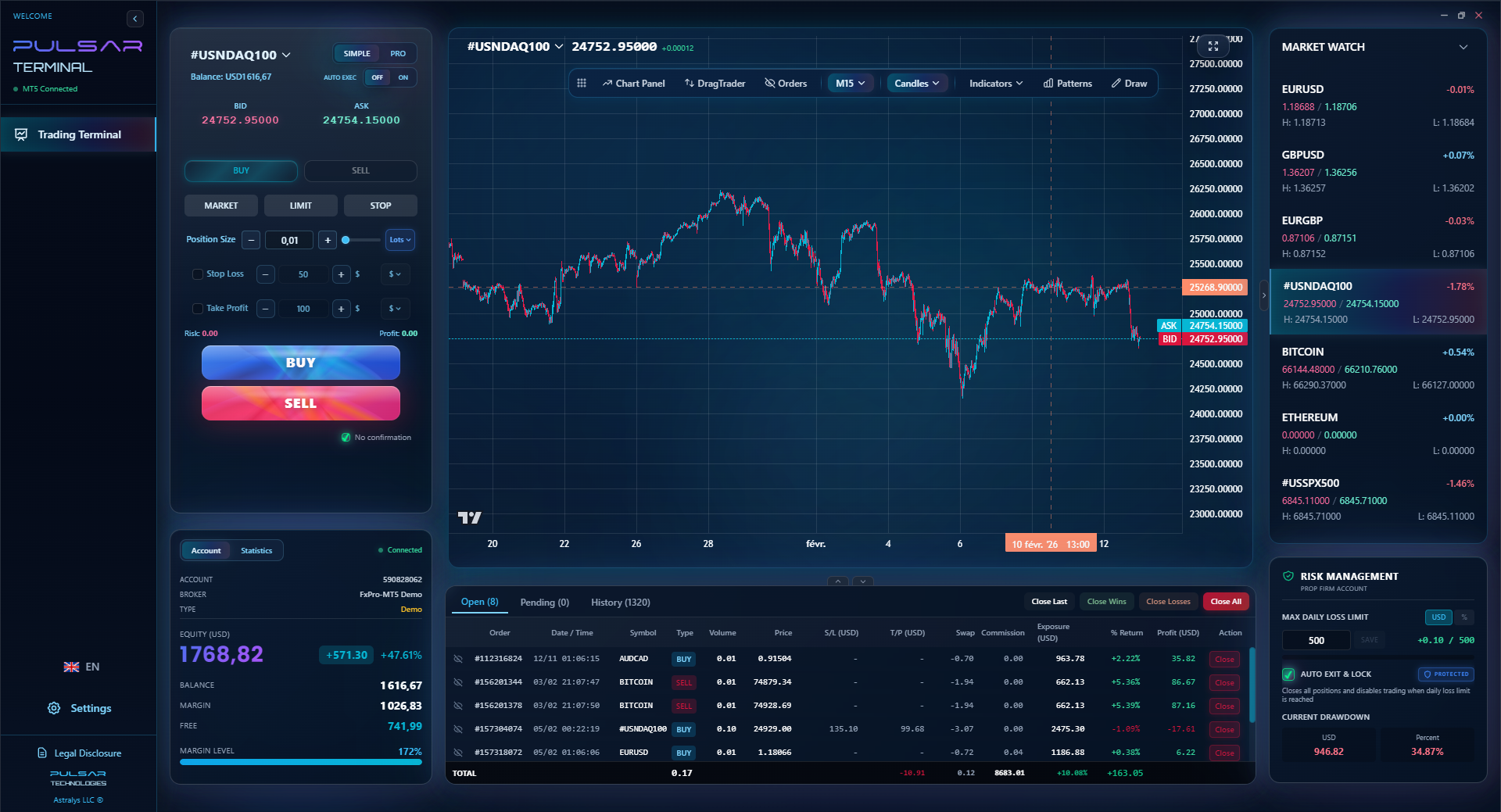
Managing trades manually during high-volatility news events is stressful; Pulsar Terminal's drag-and-drop order modification and automated trailing stops let you adjust your risk instantly without taking your eyes off the chart.
Pulsar Terminal
Hepsi bir arada MT5 aracı: sürükle-bırak emirler, çoklu TP/SL, trailing stop, grid trading, Volume Profile ve prop firm koruması. Her gün 1.000'den fazla trader tarafından kullanılıyor.
You don't need to pay for a fancy calendar. The best ones are free.
Free Calendars:
- ForexFactory.com: The old reliable. It's ugly but effective. You can filter for 'AUD' and set your timezone to Sydney/Melbourne. The comments section is a circus, avoid it.
- Investing.com: Has a cleaner interface and a decent mobile app. Good for a quick glance.
- Your Broker's Calendar: Brokers like IC Markets review, Pepperstone review, and Exness review have built-in calendars in their client areas. These are often tailored and reliable.
Essential Settings:
- Set Your Timezone: Make absolutely sure it's set to AEST/AEDT. An event listed for '14:30' in New York time is 5:30 AM the next day in Sydney. Getting this wrong is a classic, costly error.
- Use Filters: Filter to show only 'High' and maybe 'Medium' impact events. Filter for the currencies you trade: AUD, USD, CNY, NZD, JPY.
Beyond the Calendar: The calendar tells you the 'what' and 'when.' You need other resources for the 'why.'
- RBA Website: For statements, meeting minutes, and speeches. Read the actual text, not just the summary.
- Reuters/Bloomberg Terminal Headlines: If you can't afford the terminal, their free websites have breaking news that provides context.
- A Trusted Technical Tool: News sets the direction, but price action on the chart tells you when to enter. Having a reliable platform for analysis is key.
, the economic calendar is your planning tool. It tells you when to be extra alert, when to reduce position size, and when to maybe just take the day off. It won't give you the trade signal, but it will tell you when to look for one.
FAQ
Q1What timezone should I set my economic calendar to in Australia?
Always set it to Australian Eastern Standard Time (AEST) or Australian Eastern Daylight Time (AEDT) during daylight saving. This is critical. A US event at 2:30 PM EST is at 5:30 AM AEST the following day. Getting this wrong means you'll miss the event entirely.
Q2Which Australian economic data release has the biggest impact on the AUD?
The quarterly Consumer Price Index (CPI) is typically the most market-moving. It's the primary gauge of inflation and directly influences Reserve Bank of Australia interest rate decisions, which are the main driver of currency valuation. The monthly Employment Change and the RBA Cash Rate Decision itself are very close seconds.
Q3Is it safe to trade during high-impact news events?
For most retail traders, no. It's high-risk. Spreads can widen dramatically, causing slippage on your orders, and price can move erratically in both directions very quickly. A safer approach is to wait 5-15 minutes after the release for the initial volatility to settle and a clearer direction to emerge.
Q4Why did the AUD go down when the economic data was good?
This is common. It's often due to 'buy the rumour, sell the fact.' The positive result may have been already priced into the market by the time the data is released. Alternatively, a different, bigger global story (like a risk-off mood in US markets) could be overwhelming the positive local data.
Q5Do I need to pay for an economic calendar?
Absolutely not. Free calendars from ForexFactory, Investing.com, or your ASIC-regulated broker (like XM review or others) are perfectly sufficient. They provide all the key data: time, event, previous, forecast, and actual figures. Paid services might offer more analysis, but the core information is free.
Q6How far in advance should I look at the economic calendar?
I check it at the end of each trading day for the next 24-48 hours. For planning weekly trades, I look at the whole upcoming week every Sunday night. You need to know what's coming so you can adjust your trade management - like widening stops or avoiding new entries before major events.
Prof. Winston'ın Dersi
Önemli Noktalar:
- ✓Set your calendar to AEST/AEDT. A timezone mistake is a guaranteed loss.
- ✓The CPI, Jobs data, and RBA decisions move the AUD. Everything else is background noise.
- ✓Wait 5-15 minutes after news for the panic to clear before entering a trade.
- ✓If you hold through news, widen your stop-loss by at least 50%.
Bu makale ne kadar faydalıydı?
Bir yıldıza tıklayın
Haftalık Trading Analizleri
Ücretsiz haftalık analiz ve stratejiler. Spam yok.
Yazar hakkında
Sarah Collins
Yatırım Stratejisti
Londra merkezli, finansal piyasalarda 12 yıllık deneyime sahip ticaret stratejisti. Londra City'deki bir aracı kurumda eski analist. GBP pariteleri, Avrupa piyasaları ve FCA düzenlemeli ticareti kapsıyor.
Yorumlar
Risk Uyarısı
Finansal araçlarla işlem yapmak önemli riskler taşır ve tüm yatırımcılar için uygun olmayabilir. Geçmiş performans gelecekteki sonuçları garanti etmez. Bu içerik yalnızca eğitim amaçlıdır ve yatırım tavsiyesi olarak değerlendirilmemelidir. İşlem yapmadan önce her zaman kendi araştırmanızı yapın.
Bunları da beğenebilirsiniz

Cara Trading Forex Sukses: 7 Prinsip dari Trader Profesional
Cara trading forex sukses dengan 7 prinsip trader pro: manajemen modal, disiplin, journal trading, backtest. Data nyata, bukan janji profit palsu.
Jam Trading Forex Terbaik untuk Trader Indonesia: Panduan Lengkap dengan Tabel Waktu
Panduan jam trading forex untuk trader Indonesia. Tabel 4 sesi dunia, jam emas 20:00-00:00, sesi mana yang harus dihindari. Data akurat + tips dari trader berpengalaman.
Top 5 Sàn Forex Uy Tín Nhất 2026: Review Jujur dari Trader Indonesia
Top 5 sàn forex uy tín 2026 untuk trader Indonesia. Review jujur: spread, deposit, withdraw, dukungan lokal. Exness, XM, IC Markets & lebih.
Pulsar Terminal'ı Edinin
Tüm bu hesaplayıcılar MT5 hesabınızdan gerçek zamanlı verilerle Pulsar Terminal'e entegredir.
Pulsar Terminal'ı Edinin