


Most guides on forex trading in the United Kingdom make it sound like a walk in Hyde Park.

Sarah Collins
Yatırım Stratejisti ·  United Kingdom
☕ 10 dk okuma
Neler öğreneceksiniz:
- 1The FCA: Your Safety Net and Your Leash
- 2Trading in London's Shadow: The Real Advantage
- 3Picking Your UK Broker: It's All About the Real Cost
- 4Trading the Pound: A Local's Curse and Advantage
- 5Taxes and the Spread Betting Loophole (For Now)
- 6Building a Strategy That Works With UK Rules
- 7Pitfalls I Walked Right Into (So You Don't Have To)
Most guides on forex trading in the United Kingdom make it sound like a walk in Hyde Park. They talk about the 'strong FCA framework' and 'London's liquidity' but skip the gritty reality. The truth? Trading here is a double-edged sword. You get world-class protection, but you also face use caps that force a different kind of discipline. I learned that the hard way. Let me walk you through what 12 years on these markets has actually taught me, mistakes and all.
Everyone bangs on about FCA regulation. It's the gold standard, and for good reason. Your money is segregated. You get negative balance protection. If your broker goes belly-up, the Financial Services Compensation Scheme (FSCS) covers you up to £85,000. That peace of mind is priceless.
But here's what they don't tell you upfront: the FCA also puts you in a padded cell. The 1:30 use cap on majors (1:20 on minors) changes everything. Coming from trading with higher use overseas, it felt like trying to sprint in Wellington boots. My old 100-pip stop-loss strategy on a standard lot suddenly required three times the margin. I had to completely rethink my position size calculator inputs.
The Good, The Bad, The Necessary
The use limit forced me to become a better trader. It killed the 'get-rich-quick' fantasy stone dead. You can't just throw a tiny deposit into a massive position and hope for the best. You have to be precise. You have to be patient. It pushed me towards strategies that didn't rely on huge, leveraged swings. I started focusing more on quality setups in pairs like EUR/USD where the lower spread helped offset the need for massive moves.

Warning: Don't even think about an unregulated broker offering you 1:500 use to 'get around' the FCA rules. You might as well just wire your deposit directly to a scam artist. The protection you lose isn't worth the hypothetical gains.
The other big FCA mandate is the risk warning. You'll see it on every broker site: '72-89% of retail investor accounts lose money.' That's not a disclaimer. It's a cold, hard statistic. The first time I saw it, I shrugged. Years later, after blowing up my first account, I understood it was the most important piece of information on the page.

💡 Winston'ın İpucu
The FCA's 1:30 use isn't a limit, it's a teacher. It forces you to seek quality, not quantity, in your trades. The best setups are clear even at low use.
The numbers are staggering. London handles nearly 40% of all global forex turnover. That's about $4.7 trillion a day sloshing through the City. For you, the retail trader, this means one thing above all else: liquidity.
Liquidity is the magic that makes trading possible. It's the difference between your order getting filled at the price you see and it slipping two pips against you. During the London session (8 AM to 5 PM GMT), the major pairs move with purpose. The spreads on something like GBP/USD can get razor-thin, often below 1 pip on a good ECN account with a broker like IC Markets.
I remember a specific trade from a few years back. It was during the London open, and there was a key Bank of England speech. I took a position on Cable (GBP/USD) at 1.3050. The market was so liquid that even with the news volatility, my 5-lot order filled instantly with no slippage. I took half off at 1.3120 and let the rest run. That kind of execution is a gift of this market.
But that liquidity has a twin: volatility. The London session, especially when it overlaps with New York, is when the big moves happen. It's when you can make money, and it's when you can lose it fastest. You need a strategy that respects that energy, not one that fights it. This is where a solid swing trading plan, catching these session-driven waves, can really pay off.
“The use limit forced me to become a better trader. It killed the 'get-rich-quick' fantasy stone dead.”
Choosing a broker in the UK isn't about who has the flashiest platform. It's a forensic examination of costs. The FCA ensures transparency, but you still have to read the fine print.
There are two main pricing models:
- Spread-Only: The broker's profit is built into the bid/ask spread. Simple, but can be expensive during quiet markets.
- Commission + Raw Spread: You pay a small commission per trade (e.g., $3.50 per 100k lot) but get access to the raw interbank spread, which can be near zero.
I used to be a spread-only guy, thinking commissions were a rip-off. Then I did the maths. On a busy trading day with 10 round-turn trades on EUR/USD:
- Spread-Only (1.2 pip avg): Cost = 10 trades * 1.2 pips * $10 per pip = $120
- Commission ($7 round turn) + Raw Spread (0.1 pip): Cost = (10 * $7) + (10 * 0.1 * $10) = $70 + $10 = $80
I was leaving $40 on the table for no reason. I switched to a commission-based account with Pepperstone and never looked back.

Example: Let's say you trade 20 standard lots of GBP/USD in a month. A 0.8 pip spread-only cost is 20 * 0.8 * $10 = $160. A 0.1 pip raw spread + $7 commission model is (20 * $7) + (20 * 0.1 * $10) = $140 + $20 = $160. They tie. But in volatile markets, the raw spread often stays tight while the spread-only one widens. That's where you save.
Other costs? Watch for inactivity fees (some brokers charge after 12 months), and always check withdrawal fees. A good FCA broker like XM or Exness will offer at least one free withdrawal method.
The minimum deposit is almost irrelevant. If you're stressing over a £100 vs £200 minimum, you're not ready to trade with real money. The margin requirement, dictated by the 1:30 use, is what really matters. On GBP/USD, a standard lot (100,000 units) requires about £3,333 in margin. That's your real entry ticket.
Trading GBP pairs when you live in the UK is... interesting. You're immersed in the news cycle. You feel the sentiment at the petrol pump and the supermarket. This can be an advantage, but more often, it's a massive psychological trap.
My biggest mistake ever was trading GBP/USD during the Brexit referendum. I was convinced 'Remain' would win. I was reading the same newspapers, watching the same telly, living in my London bubble. I went long Cable at 1.4850 the night before the vote, far too big for my account. We all know what happened. It crashed. I got a margin call and was wiped out. My local bias cost me thousands.
The lesson? Your lived experience is data, but it's emotional, anecdotal data. The chart and the price action don't care about your opinion at the pub. You have to divorce your national pride (or pessimism) from your trading terminal.
The GBP/USD Rhythm
That said, living here helps you learn the rhythm. You know to be alert at 7 AM for the UK economic data dump (GDP, CPI, PMIs). You learn that the 10:30 AM BoE press conferences can cause chaos. You understand that GBP/JPY is the 'risk-on' proxy for the UK, and it can be a wild ride.
I now have a simple rule: I never trade GBP news on the initial spike. I wait 15 minutes for the algos to finish their knife fight. Then I look for the real direction. Using the MACD indicator on a 15-minute chart after major news has saved me from countless fakeouts.
💡 Winston'ın İpucu
Your biggest edge trading GBP isn't news insight; it's knowing when *not* to trade. Avoid the first 15 minutes after major UK data. Let the institutional chaos settle.
“Trading GBP pairs when you live in the UK is a massive psychological trap. Your lived experience is emotional data.”
This is the part most non-UK guides get completely wrong. They talk about Capital Gains Tax (CGT) allowances. Forget that. For forex trading in the United Kingdom, the primary vehicle for most serious retail traders is Spread Betting.
Why? Because spread betting profits are completely free from Capital Gains Tax and Income Tax in the UK. It's a monumental advantage. You keep every single penny you make.
But (there's always a but), spread betting is only offered by UK-regulated brokers on UK-domiciled accounts. You're betting on the price movement in pounds per point. It's still forex, just wrapped in a tax-efficient package. The use, spreads, and platforms are identical to CFD trading.

Pro Tip: If you're a UK resident, open a spread betting account for your main trading. Keep a separate CFD account if you want to trade other instruments not available as bets. Never use a CFD account for forex if you have the spread betting option.
What about ISAs? You can't trade forex directly in a Stocks and Shares ISA. It's for shares, funds, and bonds. So, the tax-free wrapper for active currency trading is, unequivocally, spread betting.
Just remember, this is a political gift. It could change. But for now, it's the single biggest perk of trading from this country.
💡 Winston'ın İpucu
If you're not using a spread betting account for your UK forex trading, you are voluntarily writing a cheque to HMRC. It's the single largest structural advantage you have.
The FCA's 1:30 use cap forces a strategic rethink. The high-frequency, micro-lot scalping strategy that might work with 1:500 use is often strangled by the transaction costs here. You need strategies with better risk/reward ratios.
I shifted my focus. Here’s what worked for me:
1. Higher Timeframe Swing Trading: This became my bread and butter. I'd use the daily and 4-hour charts to find trends, then use the London session open for precise entries. The goal was 150-300 pip moves, not 10-pip scalps. This played perfectly with the lower use, as I needed less margin to hold a position for days.
2. News & Volatility Traps: Instead of trading the news, I started trading the reaction to the news. After a big BoE announcement, volatility would spike, then often contract. I'd wait for a clear breakout or rejection from a key level (using the previous day's high/low) and enter with a tight stop. The high liquidity meant clean fills.
3. The 'London Breakout': A classic. Identify the tight range that forms in the Asian session (often between 1 AM - 7 AM GMT). Place buy stops above the range and sell stops below it ahead of the London open (7 AM). The first strong push often sets the direction for the morning. With use capped, you size appropriately for the 30-50 pip move.
Tools became crucial. I relied heavily on the RSI indicator for divergence on these higher timeframes to spot potential reversals. Managing multiple take-profit levels became key to banking profit and letting winners run, a process that's manual and tedious on most platforms.
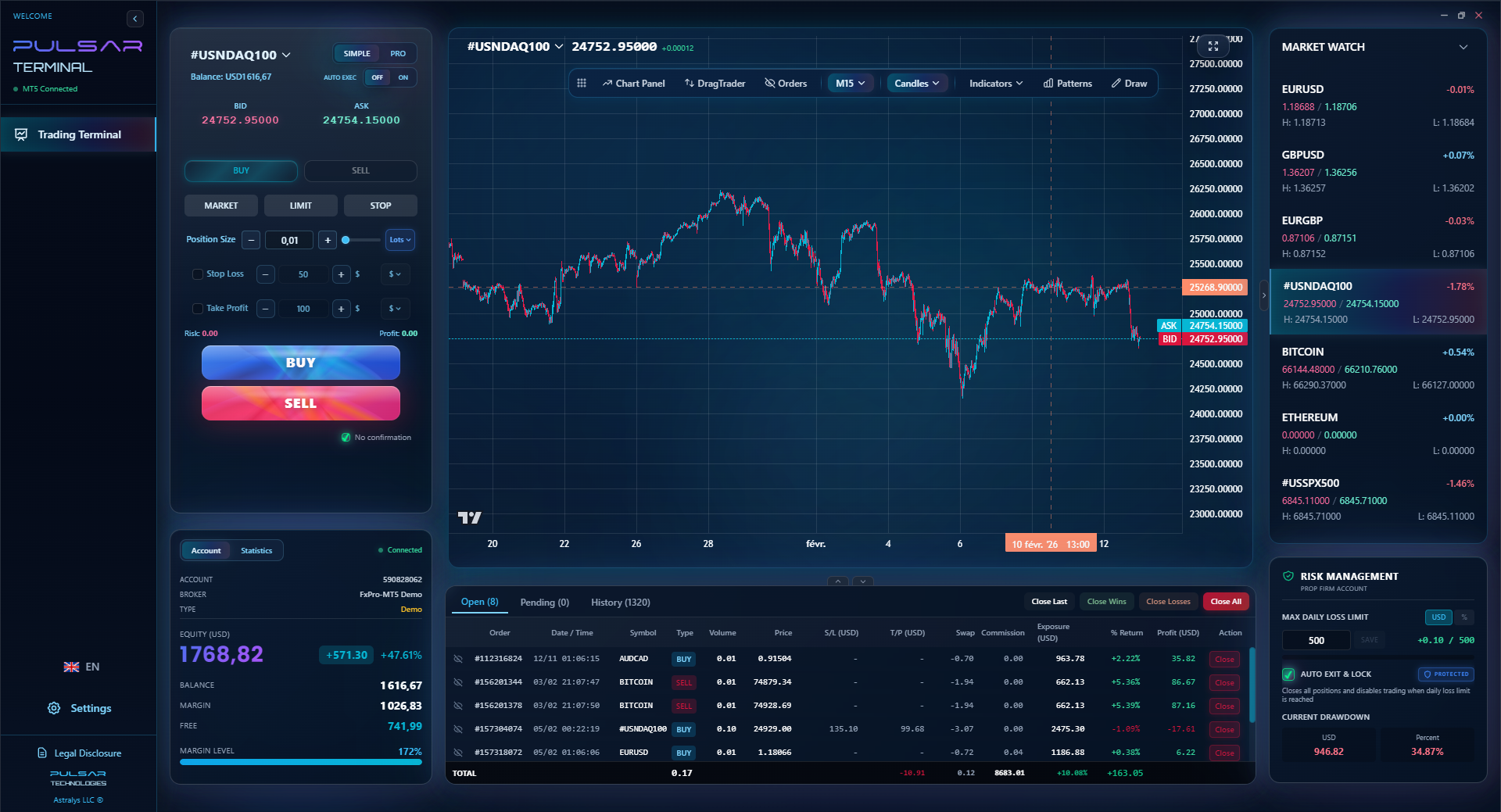
Managing complex swing trades with multiple take-profit levels is a chore on MT5, but Pulsar Terminal lets you set them all with a simple drag-and-drop before you even enter the trade.
Pulsar Terminal
Hepsi bir arada MT5 aracı: sürükle-bırak emirler, çoklu TP/SL, trailing stop, grid trading, Volume Profile ve prop firm koruması. Her gün 1.000'den fazla trader tarafından kullanılıyor.
“Choosing a broker in the UK isn't about flashy platforms. It's a forensic examination of costs.”
Let's get honest about failure. It's the best teacher.
Pitfall 1: Chosing a 'UK' Broker Without Checking its Entity. Early on, I signed up with a big international brand. They had an FCA license, but when I opened my account, I was automatically placed under their offshore entity (in the Seychelles) because I selected a 'Pro' account with higher use. I lost all FCA protections. I didn't realise until I had a withdrawal issue. Always, always confirm you are opening an account under the broker's UK Ltd. FCA-regulated entity (Firm Reference Number should be on their site).
Pitfall 2: Ignoring the Cost of the Rollover (Swap). Trying to hold a GBP/USD position long-term. I was short GBP, long USD. The interest rate differential meant I was paying a daily swap fee. Over a month, it ate nearly 20% of my paper profits. I was trading the chart but losing to finance. Now, I check the swap rates on my broker's site before any multi-day hold. Sometimes, it's better to close before 5 PM NY time and reopen.
Pitfall 3: Underestimating the Psychological Weight of 'Home' News. As mentioned with Brexit, but it happens with smaller data too. A bad UK inflation print would make me instinctively want to short the pound, even if the chart was showing a clear bullish reversal pattern. I had to create a rule: no trading GBP pairs for 2 hours before and after major UK data releases. Let the machines fight it out first.
The core of all these mistakes? Impatience. The UK market, with its rules, rewards the patient planner and punishes the impulsive gambler. Every time I've rushed, I've paid for it.
FAQ
Q1Is forex trading legal and safe in the UK?
Yes, it's completely legal. Its safety depends entirely on you using a broker regulated by the Financial Conduct Authority (FCA). This gives you crucial protections like segregated client funds, negative balance protection, and access to the £85,000 FSCS compensation scheme. Trading with an unregulated broker is extremely risky.
Q2What is the maximum use I can get in the UK?
For retail clients, the FCA caps use at 1:30 for major currency pairs (like EUR/USD, GBP/USD) and 1:20 for non-major pairs. This is a hard rule for all FCA-regulated brokers serving retail traders. Professional clients can apply for higher use, but the eligibility criteria are very strict.
Q3How are my forex trading profits taxed in the UK?
If you trade via Spread Betting with a UK broker, your profits are entirely free from Capital Gains Tax and Income Tax. This is the primary method for UK-based forex traders. Profits from CFD trading are subject to Capital Gains Tax, after using your annual tax-free allowance (which is currently £3,000).
Q4What's the best time to trade forex in the UK?
The most active and liquid period is the London trading session, from 8:00 AM to 5:00 PM GMT. The absolute peak volatility and volume usually occur when London overlaps with the US session, between 1:30 PM and 4:00 PM GMT. This is when you'll see the tightest spreads and strongest trends.
Q5What's a typical spread for GBP/USD with a UK broker?
With a good FCA-regulated ECN/STP broker, you can expect the spread on GBP/USD (Cable) to be between 0.7 and 1.5 pips during the core London session. It can widen significantly during off-hours (Asian session) or around major news events. Always check a broker's live account feed for real-time examples.
Q6Can I use a prop firm while trading from the UK?
Yes, many international prop firms accept UK traders. However, you must be extremely careful. The firm's trading challenge will likely use higher use (like 1:100). If you pass and get a funded account, ensure you understand the legal structure and how your profits are paid. The trading itself is done on the firm's platform, but your personal tax situation on any payouts remains your responsibility.
Q7What's the minimum deposit needed to start?
Technically, many UK brokers allow you to start with £100 or even less. However, with 1:30 use, that gives you very little practical trading power. A more realistic starting point to trade responsibly without being stopped out by minor noise is £1,000-£2,000. This allows for sensible position sizing and risk management.
Prof. Winston'ın Dersi
Önemli Noktalar:
- ✓FCA 1:30 use demands higher-quality setups, not bigger bets.
- ✓Spread betting is your tax-free superpower. Use it.
- ✓London's liquidity is for execution, not gambling.
- ✓Your home bias on GBP is your worst enemy. Trust the chart.
Bu makale ne kadar faydalıydı?
Bir yıldıza tıklayın
Haftalık Trading Analizleri
Ücretsiz haftalık analiz ve stratejiler. Spam yok.
Yazar hakkında
Sarah Collins
Yatırım Stratejisti
Londra merkezli, finansal piyasalarda 12 yıllık deneyime sahip ticaret stratejisti. Londra City'deki bir aracı kurumda eski analist. GBP pariteleri, Avrupa piyasaları ve FCA düzenlemeli ticareti kapsıyor.
Yorumlar
Risk Uyarısı
Finansal araçlarla işlem yapmak önemli riskler taşır ve tüm yatırımcılar için uygun olmayabilir. Geçmiş performans gelecekteki sonuçları garanti etmez. Bu içerik yalnızca eğitim amaçlıdır ve yatırım tavsiyesi olarak değerlendirilmemelidir. İşlem yapmadan önce her zaman kendi araştırmanızı yapın.
Bunları da beğenebilirsiniz

Cara Trading Forex Sukses: 7 Prinsip dari Trader Profesional
Cara trading forex sukses dengan 7 prinsip trader pro: manajemen modal, disiplin, journal trading, backtest. Data nyata, bukan janji profit palsu.
Jam Trading Forex Terbaik untuk Trader Indonesia: Panduan Lengkap dengan Tabel Waktu
Panduan jam trading forex untuk trader Indonesia. Tabel 4 sesi dunia, jam emas 20:00-00:00, sesi mana yang harus dihindari. Data akurat + tips dari trader berpengalaman.
Top 5 Sàn Forex Uy Tín Nhất 2026: Review Jujur dari Trader Indonesia
Top 5 sàn forex uy tín 2026 untuk trader Indonesia. Review jujur: spread, deposit, withdraw, dukungan lokal. Exness, XM, IC Markets & lebih.
Pulsar Terminal'ı Edinin
Tüm bu hesaplayıcılar MT5 hesabınızdan gerçek zamanlı verilerle Pulsar Terminal'e entegredir.
Pulsar Terminal'ı Edinin