


You've typed 'forex trading school near me' into Google, haven't you? You're picturing a classroom, a wise mentor, and a clear path to riches.

David van der Merwe
Gelişen Piyasalar Yatırımcısı ·  South Africa
☕ 9 dk okuma
Neler öğreneceksiniz:
- 1The Classroom Fantasy vs. The Chart Reality
- 2What a Real Trading Education Actually Looks Like
- 3Mentors, Coaches, and The Guru Problem
- 4Building Your Own 'Curriculum' with Free & Paid Tools
- 5The Local Advantage: SA-Specific Knowledge You Need
- 6Red Flags: How to Spot a Scam or Useless Course
- 7Your Action Plan (Forget the 'School')
You've typed 'forex trading school near me' into Google, haven't you? You're picturing a classroom, a wise mentor, and a clear path to riches. I need to stop you right there. That search is the first mistake 90% of new South African traders make. They're looking for a shortcut, a syllabus for wealth. Trading doesn't work like a university degree. This guide will gut the fantasy and show you what you're really searching for: real competence, not just a certificate.
Let's be brutally honest. The image of a 'forex trading school' is a sales tactic. It's packaged to make an unregulated, high-risk skill look like a safe, structured education. In South Africa, anyone can rent an office in Sandton, print some certificates, and call themselves a school. I've seen 'graduates' of these places blow R50,000 accounts in a week because they learned theory, not market feel.
What you're imagining - the lectures, the group sessions - often misses the core of trading: solitary screen time and psychological grit. A real education happens when you're alone at 10 PM, your trade is 20 pips in the red, and you have to decide whether your analysis was wrong or the market is just testing you. No 'school' can simulate that pressure. They can teach you what a MACD indicator is, but they can't teach you when to ignore it.

Warning: The most expensive courses are often sold by the best marketers, not the best traders. If their main evidence of success is a flashy car, run.
The truth is, the resources you need are mostly online, global, and often free or low-cost. Your 'campus' is your trading platform. Your 'lecturers' are the decades of price action printed on the XAU/USD or EUR/USD chart. Your first step is to shift your search from a physical 'school near me' to a proven, self-directed learning path.
Forget semesters. A real trading education is messy, non-linear, and deeply personal. It's a cycle of study, practice, failure, and adjustment. Here’s the unstructured syllabus you won't get in a brochure.
The Foundation: Not Glamorous, But Essential
This is the boring stuff most skip. You must understand how the forex market works: who the players are (banks, hedge funds, retailers like us), what moves prices (interest rates, economic data, geopolitics), and the mechanics of a trade. Know what a pip and spread are, inside out. Learn how to use a position size calculator before you place a single live trade. I didn't, and my first major loss was 3% of my account because I misjudged the lot size. That's an expensive lesson you can avoid.
The Technical Grind
This is where 'schools' spend 80% of their time, and it's a trap. You'll learn 20 indicators. You'll use maybe two. Focus on price action - support/resistance, candlestick patterns, and trend structure. Pick one or two indicators like the RSI for confluence and learn them obsessively. I built my first profitable year mostly on simple trendline breaks and RSI divergences on the 4-hour chart.
The Simulator (Demo) Pitfall
Everyone tells you to use a demo account. It's good advice, with a huge caveat. Demo trading teaches you platform mechanics, but it's psychologically worthless. There's no fear, no greed. The real test begins with a live, small account. Start with a R500 account at a reputable broker like Pepperstone or IC Markets. That real-money sting is your most valuable teacher.

💡 Winston'ın İpucu
Your first R10,000 is better spent on 100 micro-lot trades (risking R100 each) than on any single course. The market's tuition is the only one that sticks.
“Trading doesn't work like a university degree.”
This is the closest you'll get to a 'forex trading school near me' - a personal mentor. And here, the waters are murky.
A good mentor doesn't give you signals. A good mentor audits your journal, points out that you lose more on Tuesday afternoons (true story for one of my students), and questions your trade rationale. They're a psychologist and an editor for your strategy.
A bad mentor (the common kind) sells you a WhatsApp group with 'live calls'. You become dependent, not educated. When they eventually fail - and they will - you're left with nothing. I paid R15,000 for a 'mentorship' early on. The guy's only strategy was chasing news. I lost two accounts following him before I realized he was just guessing with more confidence.
How to spot a real one? They're often less flashy. They'll show you losing trades. They focus on risk management and psychology more than secret indicators. They might not even be in South Africa; a good digital mentor is better than a local charlatan.

Pro Tip: Before paying a mentor, ask if you can review a few weeks of their actual trade journal (not just screenshots of winners). Their reaction will tell you everything.
You are the dean of your own trading university. Here’s how to assemble your coursework.
| Resource Type | What to Look For | South African Consideration |
|---|---|---|
| Broker Education | Webinars, market analysis. | Use global brokers like XM or Exness who offer solid, free material. Their analysis is generic but a good starting point. |
| Online Courses (Paid) | Structured learning paths from verified traders. | Look for courses focused on a single strategy (e.g., a scalping course). Avoid the 'become a millionaire' packages. |
| YouTube & Forums | Real trader discussions, live trading sessions. | Goldmine of free info, but also a cesspool of nonsense. Verify everything. Babypips.com is the free 'textbook' everyone should start with. |
| Trading Journals | Templates, methodology. | Non-negotiable. Your journal is your most important tool. Track every trade, your emotion, and the market context. |
Your key investment shouldn't be a R20,000 course. It should be in a reliable internet connection, a decent monitor, and eventually, a strong trading platform. The learning is free; the discipline is what you pay for with your time and emotional energy.
💡 Winston'ın İpucu
If a 'teacher' can't immediately explain the logic behind their last three losing trades, they're not trading, they're gambling. And you're paying to learn how to gamble.
“Your first goal is not to make money, it's to not lose it.”
While the market is global, you trade from South Africa. That matters. This is the practical 'local school' knowledge you need.
Trading Hours: Your edge might be in the London/South African time overlap (10 AM - 1 PM SAST). It's often the most liquid period for ZAR pairs. I found my rhythm in swing trading setups I'd identify after the London close and manage the next morning.
The Rand Pairs (USD/ZAR, EUR/ZAR): They're volatile and can gap like crazy over weekends or on local political news. Spreads are wider. They're not for beginners, but understanding them is crucial for a SA trader. I learned this the hard way holding USD/ZAR over a long weekend when a cabinet reshuffle was announced. Came back to a 500 pip gap against me.
Tax (SARS): Your 'school' won't teach this, but your accountant will. Trading profits are generally considered income tax. Keep careful records from day one.
Deposits/Withdrawals: Use brokers with easy local bank transfer (EFT) or Instant EFT options. Dealing with international wire fees kills small accounts. Check broker reviews for their SA payment processing speed.
Psychology: Trading in ZAR terms warps your perspective. A 50 pip move on USD/ZAR is worth a lot more in Rands than 50 pips on EUR/USD. You must learn to think in percentages and risk, not in Rand values, or you'll become emotionally attached to trades.
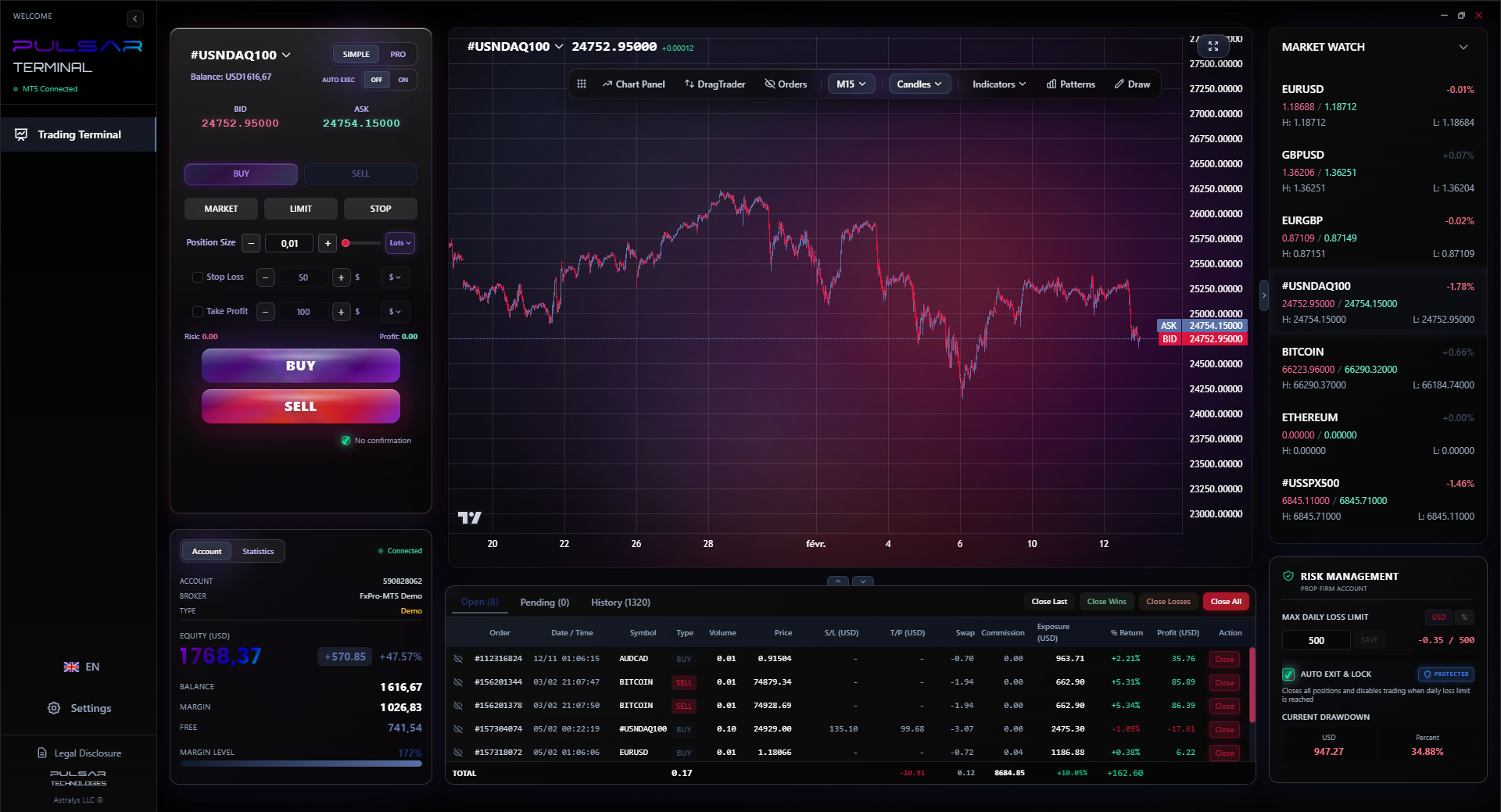
Managing volatile pairs like USD/ZAR requires precise order tools, which Pulsar Terminal provides directly on your MT5 platform for faster, more controlled execution.
Pulsar Terminal
Hepsi bir arada MT5 aracı: sürükle-bırak emirler, çoklu TP/SL, trailing stop, grid trading, Volume Profile ve prop firm koruması. Her gün 1.000'den fazla trader tarafından kullanılıyor.
If you're still determined to find a 'forex trading school near me,' know these warning signs. They're universal.
- Guaranteed Profits: The single biggest lie. If it were guaranteed, they'd be trading, not teaching.
- Overemphasis on Luxury: Course sales pages filled with rented sports cars and penthouse views. It's a fantasy sold to you.
- Vague Strategy: They talk about 'the system' or 'the algorithm' but never show the specific, unedited rules. If it's not 100% mechanical, it's not a system, it's an opinion.
- Pressure to Sign Up: 'Only 5 spots left at this price!' It's a marketing funnel, not an exclusive class.
- No Focus on Risk Management: If their first module isn't about surviving, they're setting you up to blow up. Your first goal is not to make money, it's to not lose it. Understanding a margin call is more important than any entry technique.
- They Offer 'Funding': Some 'schools' double as prop firms with impossible rules. It's a double-dip scheme: you pay for the course, then you pay the challenge fee, and the rules are designed for you to fail.
A legitimate educator talks about losses, drawdowns, and the years of grind. They sound boring compared to the gurus. That's how you know they're real.
💡 Winston'ın İpucu
The most valuable local knowledge isn't a trading secret; it's knowing which SA bank has the fastest, cheapest international transfers for broker deposits. Save yourself the 3-day wait and R250 fees.
“The market itself is the only examiner that matters, and it fails 80% of students.”
Stop searching for 'forex trading school near me.' Start doing this instead, in order:
- Month 1-2: Foundation. Complete the free course on Babypips.com. Open a demo account at a top broker like IC Markets and practice placing trades, setting stops, calculating position size.
- Month 3-4: Focus. Choose one major pair (EUR/USD is perfect) and one timeframe (like the 1-hour or 4-hour). Paper trade one simple strategy - like trading bounces off a key moving average. Log every trade in a journal.
- Month 5-6: Go Live, Tiny. Deposit the minimum (maybe R500-R1000) with a broker known for good execution. Your goal is not profit. Your goal is to execute 20-30 trades with perfect risk management (never risking more than 1% per trade). Feel the emotion.
- Ongoing: Iterate. Review your journal weekly. What patterns of mistake emerge? Only then, consider paying for a specific, focused course to fix that weakness, or seek a mentor for accountability.
Your journey is a solo trek. The right guidance is a compass, not a guided tour. The market itself is the only examiner that matters, and it fails 80% of students. Don't pay a 'school' to give you a fake diploma. Pay the market with small, smart risk to earn a real education.
FAQ
Q1Are there any legit forex trading schools in South Africa?
Legit educational providers exist, but they are rare. Look for those affiliated with regulated financial bodies, those teaching for recognized qualifications (like those from the Financial Markets Practitioners Board), and those whose primary business isn't just selling dream. Most 'schools' are unregulated marketing operations.
Q2How much should I expect to pay for a good trading course?
Anywhere from R0 (free online resources) to R10,000 for a complete, reputable course from an internationally recognized trader. If you're paying more than R15,000, you are almost certainly paying for marketing hype, not content. The R50,000 'mastermind' programs are for ego, not education.
Q3Is a mentor better than a course?
They serve different purposes. A good course gives you structured knowledge. A good mentor gives you personalized feedback and psychological support. You need the knowledge first. Getting a mentor before you have a basic strategy is like hiring a sports coach before you know how to hold the ball.
Q4What's the single most important thing to learn first?
Risk and money management. Specifically, how to calculate your position size so you never risk more than 1-2% of your capital on a single trade. This is the skill that keeps you in the game long enough to learn everything else. Use a position size calculator religiously.
Q5Can I make a living from forex trading in South Africa?
A very small percentage do. It requires significant capital (think R500,000+ to generate a modest monthly income safely), years of disciplined practice, and an iron-clad psychology. It's a marathon, not a get-rich-quick scheme. Your first goal should be consistent small gains, not replacing your salary.
Q6I found a local mentor with great verified results. Should I join?
Do your extreme due diligence. 'Verified' can be faked. Ask if you can speak to 2-3 long-term (1+ year) students privately. Ask them about the mentor's teaching style during losing streaks. If the mentor refuses this, it's a major red flag. Real success has references.
Prof. Winston'ın Dersi
Önemli Noktalar:
- ✓Forget 'schools'; build your own curriculum from global resources.
- ✓Risk management is 80% of the game. Master it first.
- ✓A real mentor critiques your journal, not just your entries.
- ✓Trade a R500 live account before you spend R5000 on a course.
Bu makale ne kadar faydalıydı?
Bir yıldıza tıklayın
Haftalık Trading Analizleri
Ücretsiz haftalık analiz ve stratejiler. Spam yok.
Yazar hakkında
David van der Merwe
Gelişen Piyasalar Yatırımcısı
Johannesburg merkezli, gelişmekte olan piyasa dövizlerinde 11 yıllık deneyime sahip trader. ZAR pariteleri, FSCA düzenlemeli ticaret ve Güney Afrika piyasa analizi uzmanı.
Yorumlar
Risk Uyarısı
Finansal araçlarla işlem yapmak önemli riskler taşır ve tüm yatırımcılar için uygun olmayabilir. Geçmiş performans gelecekteki sonuçları garanti etmez. Bu içerik yalnızca eğitim amaçlıdır ve yatırım tavsiyesi olarak değerlendirilmemelidir. İşlem yapmadan önce her zaman kendi araştırmanızı yapın.
Bunları da beğenebilirsiniz

Cara Trading Forex Sukses: 7 Prinsip dari Trader Profesional
Cara trading forex sukses dengan 7 prinsip trader pro: manajemen modal, disiplin, journal trading, backtest. Data nyata, bukan janji profit palsu.
Jam Trading Forex Terbaik untuk Trader Indonesia: Panduan Lengkap dengan Tabel Waktu
Panduan jam trading forex untuk trader Indonesia. Tabel 4 sesi dunia, jam emas 20:00-00:00, sesi mana yang harus dihindari. Data akurat + tips dari trader berpengalaman.
Top 5 Sàn Forex Uy Tín Nhất 2026: Review Jujur dari Trader Indonesia
Top 5 sàn forex uy tín 2026 untuk trader Indonesia. Review jujur: spread, deposit, withdraw, dukungan lokal. Exness, XM, IC Markets & lebih.
Pulsar Terminal'ı Edinin
Tüm bu hesaplayıcılar MT5 hesabınızdan gerçek zamanlı verilerle Pulsar Terminal'e entegredir.
Pulsar Terminal'ı Edinin