


Thinking about using a forex trading signals app to make money from your phone in Lagos or Abuja? You're not alone.

Olumide Adeyemi
Batı Afrika Yatırım Öncüsü ·  Nigeria
☕ 13 dk okuma
Neler öğreneceksiniz:
- 1What Exactly Are Forex Signals Apps?
- 2The Nigerian Legal Reality: What's Allowed and What Isn't
- 3The Real Cost Breakdown: What You'll Actually Pay
- 4Choosing a Nigerian-Friendly Broker for Signal Trading
- 5How to Properly Test a Signals App (Without Losing Money)
- 6Nigerian-Specific Scams to Avoid
- 7A Better Alternative: Learning to Generate Your Own Signals
- 8How to Integrate Signals Apps With Your Trading (The Right Way)
Thinking about using a forex trading signals app to make money from your phone in Lagos or Abuja? You're not alone. Half of Nigeria's 300,000+ retail traders are looking at these apps right now. But here's the brutal truth I've learned trading here for over a decade: 90% of signal services will lose your money, and the SEC isn't coming to save you. I've paid for the fancy subscriptions, followed the 'gurus,' and watched my account bleed. Let me show you what actually works, what's legal, and how to use these tools without getting scammed.
At their core, forex signals apps are just notification services. Someone (or some algorithm) analyzes the market and sends you a message saying "Buy EUR/USD at 1.0850, stop loss at 1.0820, take profit at 1.0900." That's it. The promise is simple: do the thinking for you so you can just click and profit.
In Nigeria, these apps come in three flavors, and you need to know the difference:
1. Social Trading Platforms: Think eToro's copy trading or ZuluTrade. You literally copy another trader's moves automatically. Your account mirrors theirs, wins and losses included. These platforms are generally legal to use in Nigeria as long as you're using your own money with an international broker.
2. Independent Signal Services: This is where most Nigerian traders get burned. Some guy on Telegram with a fancy name like "Alpha Forex Signals NG" charges you ₦20,000 monthly for his 'premium calls.' He has no license, no track record you can verify, and when his signals fail (which they will), he disappears and creates a new channel. The SEC warns against these constantly.
3. Broker-Integrated Tools: Some brokers like IC Markets or Pepperstone build basic signal features into their platforms. These are usually free with your account. They're less flashy but more reliable since the broker has some reputation to protect.

Warning: If a signals app promises guaranteed returns or uses phrases like "risk-free profit," run. That's the hallmark of a Ponzi scheme, not a trading tool. The SEC has shut down dozens of these operations targeting Nigerians.

💡 Winston'ın İpucu
The most expensive signal is the free one from a 'guru' showing off a rented Lamborghini. Real traders drive Corollas and keep spreadsheets.
Here's where most guides get fuzzy. Let me be crystal clear about where the law stands in 2026.
Trading for yourself is in a gray area, but generally okay. The Central Bank of Nigeria (CBN) hates speculation because it pressures the Naira, but there's no law that says you can't use your own money with an FCA-regulated broker overseas. The CBN's restrictions are on banks facilitating these transactions, not on you personally placing trades.
The SEC's position is more specific. They don't license retail forex brokers in Nigeria. Zero. Nada. That means any broker operating here physically should be registered with them, but most aren't because they're based offshore. The SEC's main job is protecting you from scams. They've issued warnings about unregulated platforms constantly.
For signals apps, the rule is simple: If the app just provides information, charts, or a place to share ideas, it's usually fine. But the moment it crosses into giving specific investment advice for a fee without SEC registration, it's operating illegally. That ₦10,000,000 capital requirement for Digital Sub-brokers exists for a reason.
I learned this the hard way in 2021. I subscribed to a Lagos-based signal service that claimed SEC approval. They didn't have it. When their signals caused a 40% drawdown in my account, there was absolutely no recourse. No regulator to complain to, no compensation scheme. Just lost money.
Remember: Using an international signals app like TradingView's ideas stream or a MetaTrader signal from a provider in another country is generally safer from a regulatory standpoint than trusting a local 'guru' with no oversight.
“The real skill isn't following instructions - it's learning to read the market yourself.”
Let's talk numbers. Everyone focuses on the signal subscription fee, but that's just the tip of the iceberg. Here's what a month of using signals really costs a Nigerian trader.
1. The Signal Subscription Itself Most decent international services charge in dollars or pounds. Signal Start is $25/month just for access, then another $30-$100 monthly per provider you follow. Learn 2 Trade charges £50-£250. At current exchange rates, you're looking at ₦20,000 to ₦100,000+ monthly just for the signals.
2. Brokerage Costs (The Silent Killer) Every time you follow a signal, you pay:
- Spread: On EUR/USD, expect 0.6 pips minimum. That's $6 per standard lot.
- Commission: ECN accounts charge around $7 per round lot.
- Swap/Overnight Fees: If the signal holds positions overnight (most do), you pay interest. I once paid $12 in swaps on a GBP/JPY signal that went sideways for a week.
3. The Nigerian Tax Man This is non-negotiable. The FIRS wants 10% of your capital gains. If you make ₦500,000 profit following signals, ₦50,000 goes to taxes. Keep detailed records. I got audited in 2023 and had to provide two years of trading statements.
4. Payment Processing Fees Depositing to your broker isn't free. Local bank transfers might cost ₦500-₦2,000. Using cards or payment processors adds another 2-5%. If you're depositing $200 monthly, that's an extra ₦1,600-₦4,000 gone.

Example: Let's say you follow one signal provider at $50/month (₦40,000). You take 20 trades monthly at 1 lot each. Your costs:
- Signal: ₦40,000
- Spreads/commissions: 20 trades × $13 = $260 (₦208,000)
- Payment fees: ₦3,000
- Total monthly cost: ₦251,000
You need to make over ₦250k monthly just to break even. Most traders don't do this math.
Not all brokers play nice with signals apps. Here's what matters for Nigerian traders:
Execution Speed is Everything
Signals often target quick moves. If your broker's execution is slow, you'll enter late and miss the profit. I tested this in 2022 with the same signal on three brokers. On Exness, I entered a EUR/USD buy at 1.0950. On a slower local-facing broker, my fill was 1.0954. The trade hit TP at 1.0980. My profit was 26 pips instead of 30. That 4-pip slippage cost me $40 on a standard lot.
Minimum Deposits That Make Sense
Some signals require larger stop losses, meaning you need proper capital. If a broker like XM lets you start with $5, that's great for learning, but you can't realistically follow signals with that. You'll get a margin call on the first losing trade. I recommend starting with at least $200-500 if you're serious about signals.
Naira-Friendly Features
Look for:
- Local bank deposit options (Access Bank, Zenith)
- Naira-denominated accounts (HFM offers these)
- Low minimum deposits in Naira (FXTM takes ₦100)
- Customer support that understands Nigerian payment issues
My Top Picks for Signal Traders
Based on my experience:
- IC Markets: Raw spreads from 0.0 pips, fast execution, accepts Nigerian deposits. Their cTrader platform integrates well with signal services.
- Pepperstone: Excellent Razor account for low costs, reliable with copy trading platforms.
- Exness: Unlimited use (be careful!) and negative balance protection. Good for the high-risk signals some providers offer.
Avoid brokers that don't offer negative balance protection. During the Swiss Franc crash in 2015, I know Nigerian traders who owed brokers thousands because they didn't have this protection.
💡 Winston'ın İpucu
If you wouldn't risk ₦50,000 on a business idea from a stranger at a bus stop, why would you risk it on a signal from a Telegram profile picture?
“Signals apps are tools, not masters. You should be in the driver's seat.”
Here's my 4-step process for vetting any signal service. I wish I'd done this before losing ₦800,000 to bad signals in 2020.
Step 1: The Paper Trade Test Don't pay a kobo yet. Most apps offer free trials or you can simply paper trade their signals. Do this for at least 100 trades. Not 10, not 20 - 100. Why? Because anyone can get lucky for a week. I tracked a signal provider that showed 15 straight wins in their marketing. When I paper traded the next 100 signals, their win rate was 48%. They were just cherry-picking.
Step 2: Verify the Track Record Real providers show verifiable, real-time performance on platforms like Myfxbook or FXBlue. These services connect directly to the trader's account and can't be faked. If they're showing screenshots of profits instead, assume they're fake. I once reverse-image searched a provider's 'results' and found them stolen from a Russian trading forum.
Step 3: Check the Risk Parameters Look at their average loss versus average win. A good signal shouldn't have stop losses larger than their take profits. I see Nigerian providers offering "1:5 risk-reward" signals that actually have 100-pip stops and 20-pip targets. The math never works.
Use a position size calculator to see what their signals would do to your account. If their average loss is 50 pips and you're trading 1 lot, that's a $500 risk per trade. Can your account handle three losses in a row?
Step 4: Start Microscopically Small When you finally go live, use the smallest possible position. Most brokers let you trade 0.01 lots (micro lots). At that size, a 50-pip loss is only $5. Test with real money but minimal risk for another 50 trades. Only then consider scaling up.

Pro Tip: Create a separate "signal testing" account with your broker. Fund it with only the amount you're willing to lose completely. Keep your main trading account separate until you've proven the signals work over 6+ months.
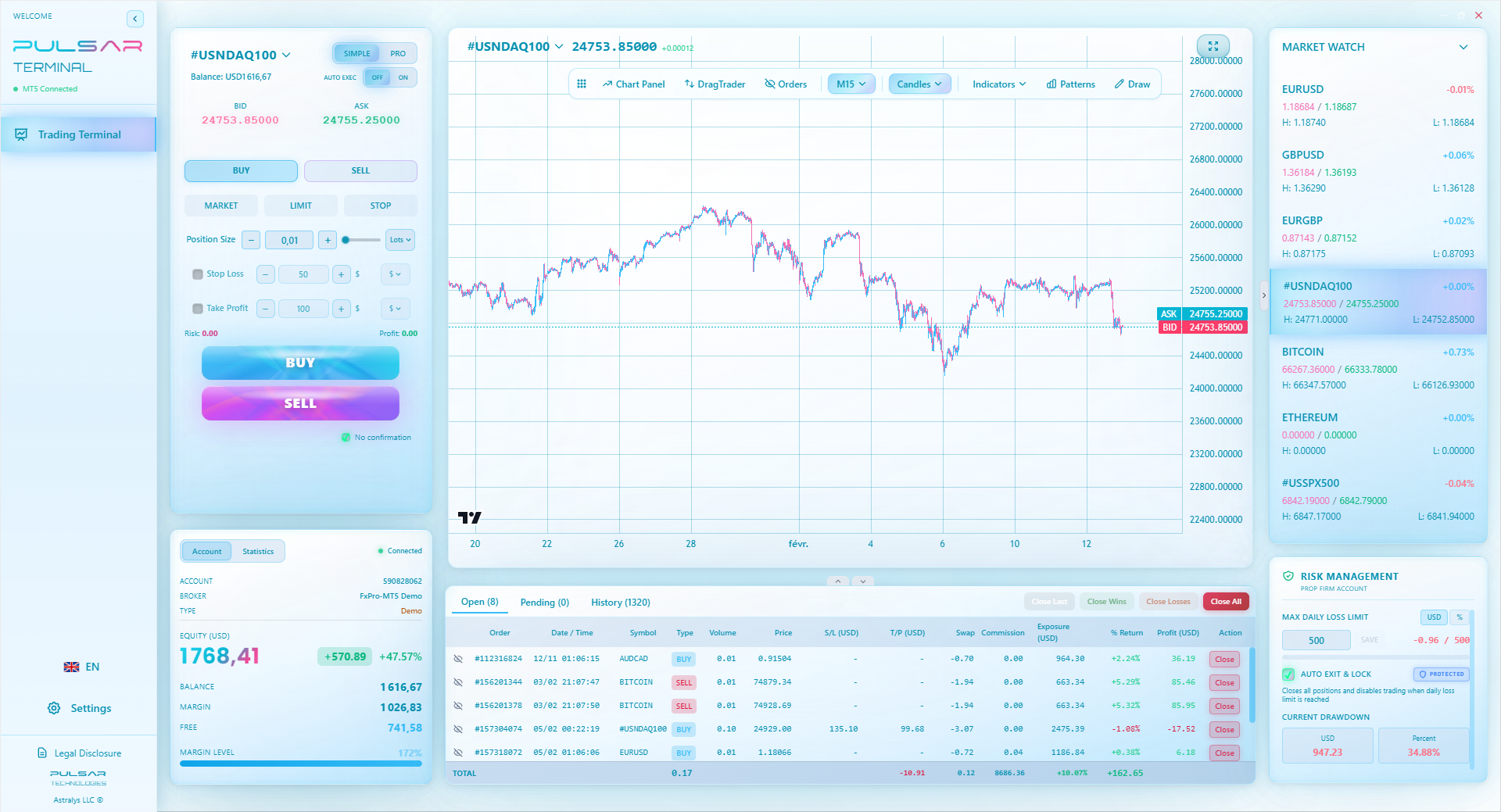
When testing signals, precise order execution and risk management are critical—Pulsar Terminal's drag-and-drop orders and multi-take-profit tools let you execute complex signal strategies faster on MT5.
Pulsar Terminal
Hepsi bir arada MT5 aracı: sürükle-bırak emirler, çoklu TP/SL, trailing stop, grid trading, Volume Profile ve prop firm koruması. Her gün 1.000'den fazla trader tarafından kullanılıyor.
We have our own special breed of forex scams here. Recognize these patterns:
The "SEC-Approved" Lie: As mentioned, the SEC doesn't approve retail signal services. Any provider claiming this is lying. Check the SEC's website yourself - they maintain a list of registered capital market operators.
The WhatsApp/Telegram Guru: He messages you unsolicited, shows fake screenshots of Lamborghinis, and claims he'll teach you the 'secret' for a fee. His signals are just guesses from free websites. Once you pay, the signals stop or consistently lose.
The Prop Firm Signal Scam: Newer and more sophisticated. They sell you signals specifically for passing prop firm challenges like FTMO or MyForexFunds. They claim their signals have small drawdowns perfect for challenge rules. What they don't tell you is they're using demo accounts to generate the signals, not real market conditions. When you try them live, the slippage and execution differences cause you to fail.
The "Managed Account" Twist: They don't sell signals directly. Instead, they offer to manage your account for "30% of profits." They'll show amazing backtested results. What actually happens? They use insane use to generate either huge wins (they take their cut) or blow your account (they disappear). Either way, they win.
I fell for a variation of this in 2019. A guy in Port Harcourt offered signals with "85% accuracy." I paid ₦150,000 for three months. The first month was break-even. The second month lost 25%. When I complained in the third month, he said I wasn't following the signals properly and offered 'personal coaching' for another ₦100,000. That's when I realized the signals were just a funnel to sell more services.
“That ₦10,000,000 capital requirement for Digital Sub-brokers exists for a reason.”
Here's my controversial opinion after 12 years: depending on signals makes you a permanent customer, not a trader. The real skill isn't following instructions - it's learning to read the market yourself.
Start With Price Action
Forget complicated indicators initially. Learn to read candlestick patterns, support/resistance, and market structure. I made more consistent money once I stopped looking at other people's signals and started watching price itself. A simple swing trading strategy based on daily chart highs and lows served me better than any subscription service.
Use Indicators as Confirmation, Not Generators
When you do use indicators, don't let them give the signal. Let price action give the signal, then use indicators to confirm. For example:
- Price bounces off support (price action signal)
- RSI shows oversold and starts turning up (confirmation)
- MACD histogram shows decreasing selling momentum (confirmation)
That's three filters instead of one. My win rate improved from 55% to 68% when I switched to this approach.
Build a Simple Scanner
Most signals apps are just automated scanners looking for certain conditions. You can build your own basic version in TradingView for free. Set alerts for:
- Price touching a key moving average
- RSI crossing above 30 or below 70
- Volume spikes on breakouts
These are your "signals." Then you apply your own judgment to whether to take the trade.
The truth? It takes time. Maybe 6-12 months of dedicated study and practice. But after that, you own the skill forever. You're not paying monthly fees. You're not wondering if the signal provider is having a bad week. You're in control.
I still use tools to help - don't get me wrong. A good [forex trading signals app] can be a fantastic scanner and idea generator. But I never follow the signals blindly anymore. They're inputs for my own analysis, not commands to execute.
💡 Winston'ın İpucu
Spend your first ₦100,000 on trading education, not signal subscriptions. Knowledge can't be taken away when the subscription expires.
If you're going to use signals, here's how to do it properly as part of a complete trading system.
Use Multiple Sources
Never rely on one signal provider. That's putting all your eggs in one basket. Instead, use 2-3 different sources and look for confluence. If Signal App A says buy EUR/USD, and your own analysis of the EUR/USD guide shows strong support at that level, and the economic calendar shows potential USD weakness coming - that's a much stronger case.
I maintain a watchlist of ideas from:
- TradingView's top ideas (filtered by users with verified track records)
- A paid signal service I've tested for 2+ years
- My own daily chart analysis When two or three align, I consider a trade.
Add Your Own Risk Management
The signal gives entry, stop, and take profit. You should adjust these based on your account size and risk tolerance. If their stop loss is 50 pips but that represents 5% of your account (too high), either reduce your position size or pass on the trade entirely. Never risk more than 1-2% per trade.
Keep a Trading Journal
Record every signal you follow:
- Who provided it
- The rationale given
- Your entry/exit prices vs. their suggested ones
- The outcome After 100 trades, you'll see patterns. Maybe Provider X is great for gold signals but terrible for currencies. Maybe their afternoon signals (during London/NY overlap) perform better than their Asian session signals.
This data is gold. It turns you from a passive follower into an intelligent consumer of signals.
Know When to Stop
If a provider has a losing month, that's normal. If they have three consecutive losing months, something's changed. Maybe their strategy doesn't work in the current market conditions. Pause following them. I had a gold signal provider that crushed it during high inflation in 2022 but lost consistently when the market shifted in 2023. I stopped following them and saved myself a 15% drawdown.
Signals apps are tools, not masters. You should be in the driver's seat, using them to enhance your own trading - not replace it.
FAQ
Q1Are forex trading signals apps legal in Nigeria?
Using them is legal, but operating one as a business giving investment advice requires SEC registration as a Digital Sub-broker (₦10 million capital minimum). Most local 'gurus' on Telegram aren't registered, making their paid services illegal. Using international apps like TradingView or broker-integrated signals is generally safe for individual traders.
Q2What's the best forex signals app for Nigerian traders?
There's no single 'best.' It depends on your strategy. For social trading, eToro's copy trading is user-friendly. For independent signals, platforms with verified track records like Myfxbook-connected services are more reliable. For learning, TradingView's idea stream is free and educational. Avoid any app that guarantees profits or pressures you to pay large upfront fees.
Q3How much do forex signals apps cost in Naira?
International services charge $25-$250 monthly, which converts to ₦20,000-₦200,000+ at current rates. Local Telegram 'gurus' charge ₦10,000-₦50,000 monthly. Remember: the subscription fee is just the start - you also pay spreads, commissions, swaps, and taxes on any profits.
Q4Can I make consistent profits using signals apps?
Some traders do, but most don't. The 2021 Nigerian retail trader survey showed only about 15% of signal followers were profitable after one year. The problem isn't just the signals - it's poor risk management, starting with too little capital, and not understanding why a signal works. Signals give you the 'what,' not the 'why.'
Q5Do I need a special broker account for signals apps?
Usually no, but check compatibility. Some social trading platforms require specific brokers. For most signal services, you just need a standard MT4/MT5 account with a reliable broker like IC Markets or Pepperstone. Ensure your broker offers fast execution and micro-lot trading for testing signals safely.
Q6How do I avoid forex signal scams in Nigeria?
- Never pay for promises of guaranteed returns. 2) Demand verifiable, real-time track records (Myfxbook/FXBlue). 3) Paper trade for at least 100 signals before paying. 4) Check if the provider is registered with the SEC (most aren't). 5) Be wary of unsolicited WhatsApp/Telegram messages showing luxury cars - those are always fake.
Q7Should I pay taxes on profits from following signals?
Yes. The FIRS requires 10% capital gains tax on all trading profits, regardless of whether you generated the signals yourself or followed someone else's. Keep detailed records of all trades, as you'll need to declare this income in your annual tax returns.
Prof. Winston'ın Dersi
Önemli Noktalar:
- ✓Test 100 signals on demo before paying one kobo
- ✓Never risk more than 2% per signal trade
- ✓The FIRS wants 10% of your profits - always
- ✓Real track records are on Myfxbook, not screenshots
- ✓Learn price action - it's the only signal that never expires
Bu makale ne kadar faydalıydı?
Bir yıldıza tıklayın
Haftalık Trading Analizleri
Ücretsiz haftalık analiz ve stratejiler. Spam yok.
Yazar hakkında
Olumide Adeyemi
Batı Afrika Yatırım Öncüsü
Nijerya'nın en aktif forex eğitmenlerinden biri. Lagos'tan 8 yıllık ticaret deneyimi. Afrika'lı trader'lar için düşük sermaye stratejileri ve prop firma yarışmaları uzmanı.
Yorumlar
Risk Uyarısı
Finansal araçlarla işlem yapmak önemli riskler taşır ve tüm yatırımcılar için uygun olmayabilir. Geçmiş performans gelecekteki sonuçları garanti etmez. Bu içerik yalnızca eğitim amaçlıdır ve yatırım tavsiyesi olarak değerlendirilmemelidir. İşlem yapmadan önce her zaman kendi araştırmanızı yapın.
Bunları da beğenebilirsiniz

Cara Trading Forex Sukses: 7 Prinsip dari Trader Profesional
Cara trading forex sukses dengan 7 prinsip trader pro: manajemen modal, disiplin, journal trading, backtest. Data nyata, bukan janji profit palsu.
Jam Trading Forex Terbaik untuk Trader Indonesia: Panduan Lengkap dengan Tabel Waktu
Panduan jam trading forex untuk trader Indonesia. Tabel 4 sesi dunia, jam emas 20:00-00:00, sesi mana yang harus dihindari. Data akurat + tips dari trader berpengalaman.
Top 5 Sàn Forex Uy Tín Nhất 2026: Review Jujur dari Trader Indonesia
Top 5 sàn forex uy tín 2026 untuk trader Indonesia. Review jujur: spread, deposit, withdraw, dukungan lokal. Exness, XM, IC Markets & lebih.
Pulsar Terminal'ı Edinin
Tüm bu hesaplayıcılar MT5 hesabınızdan gerçek zamanlı verilerle Pulsar Terminal'e entegredir.
Pulsar Terminal'ı Edinin