


It was March 2023, and the Naira was in freefall.

Olumide Adeyemi
Batı Afrika Yatırım Öncüsü ·  Nigeria
☕ 11 dk okuma
Neler öğreneceksiniz:
- 1What Exactly Is a Forex Trading Template? (It's Not What You Think)
- 2Why Templates Are a Lifesaver for Nigerian Traders
- 3The 5 Non-Negotiable Parts of Your Template
- 4Sample Templates You Can Steal and Adapt Today
- 5Making It Real: Using Your Template with Nigerian Brokers
- 6The Truth About Backtesting & Keeping a Journal
- 7Mistakes I Made (So You Don't Have To)
- 8When and How to Change Your Template
It was March 2023, and the Naira was in freefall. USD/NGN had just broken through 750 on the unofficial market, and my phone was buzzing with alerts. I had a simple template running: a breakout above 745 with a 2% risk. That single, pre-defined rule turned chaos into a clean 150-pip gain while others were panicking. That's the power of a template. It's not magic, it's a checklist that stops you from making expensive, emotional decisions when the market gets wild. For us trading in Nigeria, with our unique volatility and liquidity issues, having a solid plan you can just execute is the difference between surviving and thriving.
Forget fancy software or expensive courses. A forex trading template is just a repeatable set of rules. It's your personal trading constitution. It answers every question before the market even asks it: What do I trade? When do I enter? How much do I risk? When do I get out?
Most new traders in Lagos or Abuja jump from one YouTube strategy to another. One day they're a scalper, the next they're trying to swing trade gold. A template kills that noise. It's the system you build, backtest, and then follow religiously. My first real success came from a simple EUR/USD guide template I adapted for high-volatility sessions. It wasn't complicated, but it was consistent.

Pro Tip: Your template isn't the strategy itself. It's the container for the strategy. Think of the strategy as the engine (e.g., 'buy when RSI is oversold on the 4H chart'). The template is the whole car, including the seatbelt (risk management), the fuel gauge (position size), and the GPS (trade management rules).
The biggest mistake I see? Traders have an entry signal but no plan for what happens after. A proper template forces you to define your exit before you ever click 'buy' or 'sell'. This is non-negotiable in a market like ours, where spreads on exotic pairs can widen suddenly.
Trading from Nigeria comes with its own special flavour of challenges. Our internet can be shaky at the worst times. Power outages don't care about your stop loss. And let's be real, the emotional pressure of trading with Naira, our local currency, adds a whole other layer. A template is your anchor in that storm.
Dealing with Infrastructure & Psychology
When the lights go out in Surulere and you're relying on your phone's data, you don't have time to analyze. If you have a template, you already know: "If price hits X, I do Y." You can place or manage a trade in 30 seconds. I learned this the hard way. I once missed closing a profitable trade on GBP/NGN because I was over-analyzing a retracement. The power went out, and by the time I got back online, the profit was gone. A template with a clear take-profit level would have saved me.
Navigating Local Market Quirks
Liquidity for pairs involving Naira can be thin, especially on weekends. A good template accounts for this. It might include a rule like: "No new positions within 2 hours of the Lagos market close on Friday" to avoid being caught in a weird, wide-spread squeeze. Your position size calculator must also be part of this template, especially with our currency's volatility. Risking 2% on USD/NGN is a different animal than risking 2% on EUR/USD.

Warning: Never copy a template built for stable, high-liquidity markets (like London session EUR/USD) and apply it directly to Nigerian forex pairs or during our local session times without adjusting for spread and volatility. You will get burned.

💡 Winston'ın İpucu
Your first template will be wrong. That's fine. The goal isn't perfection on day one; it's to have a clear hypothesis you can test, journal, and improve. A bad plan you follow is better than a genius plan you ignore.
“Risking 2% on USD/NGN is a different animal than risking 2% on EUR/USD.”
Every single one of your forex trading templates needs these five sections. Miss one, and you're building a house without a roof.
-
Instrument & Timeframe: Be specific. Not "major pairs," but "EUR/USD and GBP/USD only." Not "any chart," but "Primary analysis on 4-hour chart, entry confirmation on 1-hour." For Nigerian traders, this might include XAU/USD guide (gold) if that's your focus, as it's a popular hedge against Naira volatility.
-
Entry Conditions: This is your strategy's trigger. Write it like a computer program. IF (price closes above the 50-period EMA) AND (the MACD indicator histogram is above zero and rising) THEN (signal is valid). Use indicators you understand deeply.
-
Risk Management Rules: This is the most important part. It must define:
- Risk Per Trade: A fixed percentage of your account. 1-2% is standard. Use a position size calculator every time.
- Stop Loss Placement: Based on technicals, not a random number of pips. "Place stop loss 5 pips below the recent swing low."
- Daily/Weekly Loss Limit: E.g., "Stop trading for the day if I hit -3%. Stop for the week if I hit -6%." This saved me from revenge trading more times than I can count.
-
Trade Management (Take Profit & Exits): Will you use a fixed risk-reward ratio (like 1:2)? Will you scale out? A rule could be: "Close 50% of position at 1.5x risk, move stop to breakeven on remainder, trail remainder with a 20-pip trailing stop."
-
Market Filter & Session Rules: When NOT to trade. Examples: "No trading during major Naira news announcements from the CBN." "Only trade EUR/USD during first 2 hours of London open." "Avoid all scalping strategy on Fridays."
Here are two concrete starting points. These aren't holy grails, but they're structured examples you can tweak with your own research.
Template 1: The Lagos Session Momentum Trade
This is for trading major pairs when London liquidity kicks in, which overlaps with our morning.
- Instrument: EUR/USD, GBP/USD
- Timeframe: 1-Hour Chart
- Entry: Price must make a new high (for the day) in the first 2 hours of the London session (7 AM - 9 AM WAT). Wait for a pullback to the 9-period EMA. Enter on a bullish candle close above the EMA.
- Stop Loss: Place 15 pips below the pullback's low.
- Take Profit: Set two targets. TP1 at 20 pips (close half). Move stop to breakeven. TP2 at 40 pips, using a 10-pip trailing stop.
- Risk: Max 1.5% per trade.
- Filter: Do not trade if there is a major US news event scheduled within the next 2 hours.
Template 2: The Naira Hedge Swing Trade
This is a slower, broader template for when you're looking to hedge against Naira depreciation.
- Instrument: XAU/USD guide (Gold/USD)
- Timeframe: 4-Hour Chart for direction, Daily for context.
- Entry: Wait for price to bounce off a clear support level on the daily chart (like a previous swing low). On the 4-hour chart, the RSI indicator must be below 40 and start turning up. Enter on a strong bullish 4H candle close.
- Stop Loss: Place below the daily swing low, with a buffer of 0.3% of gold's price.
- Take Profit: Aim for the next major resistance level on the daily chart. Use a 1:3 risk-reward ratio minimum.
- Risk: Max 1% per trade. This is a swing trading template, so fewer trades.
- Filter: Only 1 open position of this type at a time.

Example: On the momentum trade, if your account is ₦500,000 and you risk 1.5%, that's ₦7,500 risk. With a 15-pip stop loss, your position size is (₦7,500 / 15 pips) = ₦500 per pip. On EUR/USD, that translates to a specific lot size your broker will calculate. Never guess this.
“Backtesting is tedious, but it turns confidence from a feeling into a statistic.”
A template on paper is useless. You need to execute it. This is where your choice of broker and tools matters hugely.
First, you need a broker that allows for precise order placement. Look for features like:
- Stop Loss & Take Profit Orders: You must be able to set these the moment you place the trade. This is non-negotiable for following your template.
- Trailing Stops: Crucial for the trade management part of many templates.
- Reliable Execution: Slippage during Naira news will destroy a tight template. Read reviews for brokers like Exness review or IC Markets review to see how they handle volatile conditions.
Most of us in Nigeria use MetaTrader 4 or 5. The basic platform works, but managing multiple take-profit levels or moving stops to breakeven manually is a hassle. You'll break your own rules. I did. I'd set a target, price would hit it, and I'd get greedy and move it, only to watch the trade reverse. My template said "take profit at 50 pips," but my fingers didn't listen.
This is where having the right tools on MT5 changes everything. Automating the boring, disciplined parts of your template - like moving stops to breakeven or taking partial profits - takes the emotion out. It lets you focus on finding the next setup instead of babysitting a trade and second-guessing your plan.
💡 Winston'ın İpucu
Print your core risk management rules and tape them to your monitor. 'Max 2% risk per trade. Max -5% daily loss.' When emotion hits, your eyes need to see the law.
You wouldn't drive a car you've never tested. Don't trade a template you haven't backtested.
Backtesting is simple: Go to your MT4/5 platform, open the historical data, and start scrolling back in time. For each point where your entry conditions were met, mark what would have happened. Did you get stopped out? Did you hit your profit target? Do this for at least 30-50 instances. I know it's tedious. I spent two full weekends backtesting my first real template on GBP/JPY. But those weekends showed me the strategy only worked 45% of the time, but the risk-reward was solid. That gave me the confidence to stick with it during a losing streak.
Your Trading Journal is Part of the Template: Your template document should have a section for post-trade notes. After every trade - win or loss - you must write:
- Did I follow my template 100%? (If not, why?)
- What was the market context? (News, overall trend)
- What would I do differently?
This feedback loop is how you improve the template. Maybe you notice your stop losses on EUR/USD are always getting hit by 1-2 pips before price reverses. That's a clue to widen your stop by 5 pips - a template adjustment based on real data, not emotion.
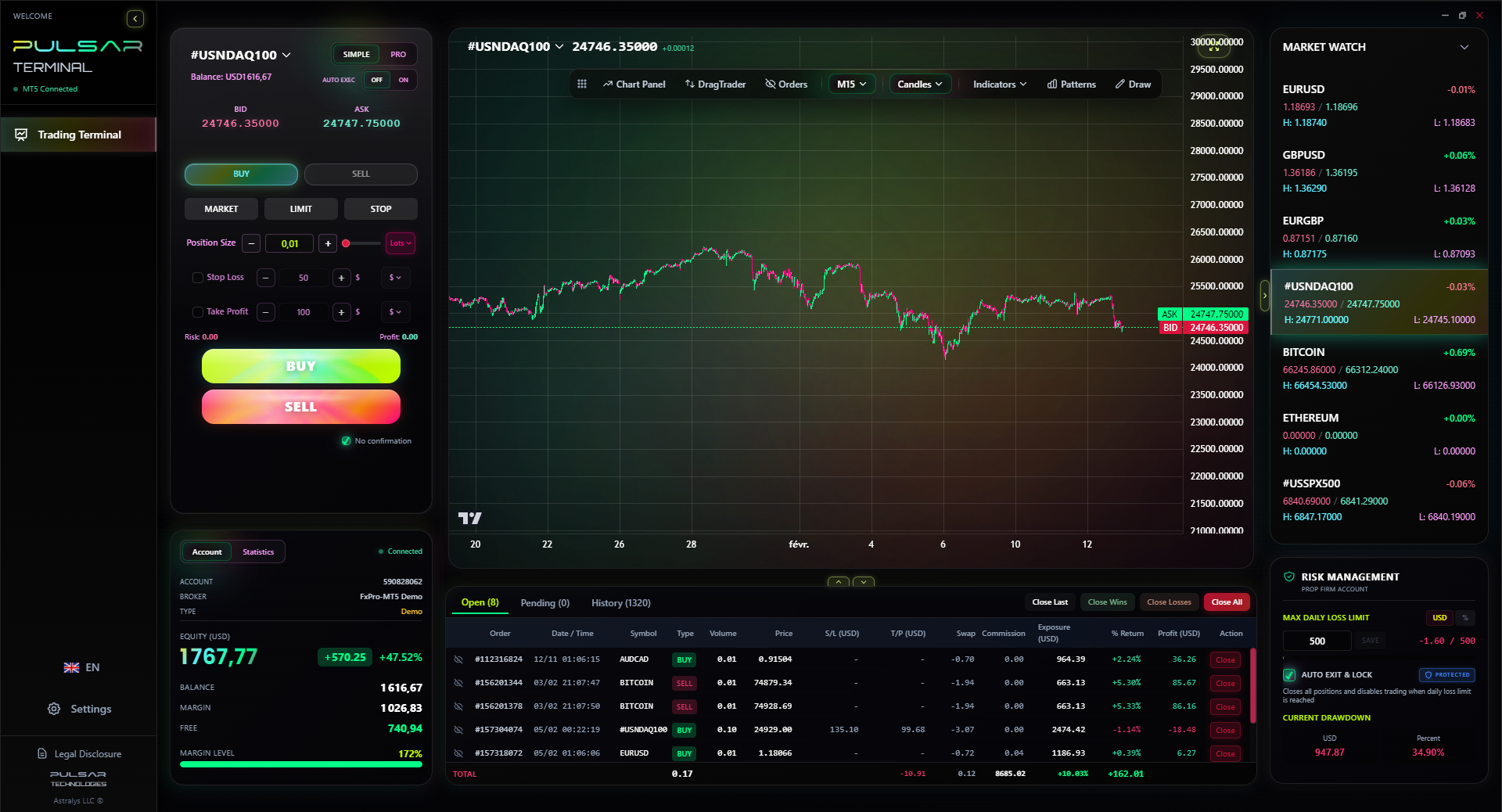
Manually moving stops to breakeven or managing partial take-profits is where discipline often fails; Pulsar Terminal automates these exact template rules directly on your MT5 charts.
Pulsar Terminal
Hepsi bir arada MT5 aracı: sürükle-bırak emirler, çoklu TP/SL, trailing stop, grid trading, Volume Profile ve prop firm koruması. Her gün 1.000'den fazla trader tarafından kullanılıyor.
“The goal of a template isn't to find perfect rules, but to build a disciplined framework that grows with you.”
Let's get real about where this can go wrong.
Pitfall 1: Over-optimization. This is the killer. You backtest a template and tweak it to make the historical results perfect. "If I move my stop loss to 14.7 pips instead of 15, my profit increases by 2%!" That's noise. You're fitting the template to past data, not creating rules for the future. Keep it simple and strong.
Pitfall 2: Not accounting for spread. If your template requires a 5-pip stop loss, but the average spread on your USD/NGN pair is 15 pips with your broker, your template is mathematically doomed from the start. Always factor in the typical spread definition into your risk calculations, especially with local brokers.
Pitfall 3: Abandoning the template after 2 losses. This is the psychological test. A template with a 40% win rate will have losing streaks. I once had 7 losses in a row on a tested template. I doubted everything. But because I had my daily loss limit (-3%) in the template, I was still standing. The 8th trade was a winner that covered most of the losses. If I had abandoned it, I'd have taken the pain but missed the gain.
Pitfall 4: No disaster protocol. What happens if your internet drops mid-trade? My rule is: If I have a trade open and lose connection for more than 5 minutes, I use my mobile data to log in via my broker's app and check. If I can't, I have a trusted friend who knows my template basics to close my positions if I call them. Sounds extreme, but a margin call is more extreme.
💡 Winston'ın İpucu
If you find yourself repeatedly breaking a rule in your template, don't just get angry at yourself. Ask why. The rule might be psychologically impossible for you. It's better to adjust the template to be followable than to have a 'perfect' one you never obey.
Your first template won't be your last. The market changes, and you learn. But you don't change it on a whim.
Valid reasons to change your template:
- Market Regime Shift: If you built a range-trading template for EUR/USD and it enters a strong, sustained trending phase, your template might stop working. You need a trend template or a filter to avoid range markets.
- Statistical Evidence: Your journal shows that over 50 trades, a specific rule consistently fails. For example, "taking profit at 20 pips" gets hit 90% of the time, but price then runs another 50 pips. Maybe you adjust to take partial profit at 20 pips and trail the rest.
- Personal Risk Tolerance Change: You have a baby, buy a house, or just decide you hate the stress. It's okay to lower your risk per trade from 2% to 0.5% and adjust your template accordingly.
Invalid reasons to change your template:
- After 2 losing trades.
- Because you saw a new indicator on Instagram.
- Because you're bored.
Treat your template like a professional contract with yourself. Amendments require due diligence, not emotion. The goal of using forex trading templates isn't to find a perfect, static set of rules. It's to build a disciplined framework that grows and adapts as you do, keeping you in the game long enough to let your edge play out.
FAQ
Q1Are forex trading templates a guaranteed way to make money?
No, absolutely not. There is no guarantee in trading. A template is a tool for applying discipline and managing risk. It turns your strategy from a vague idea into an executable plan. It guarantees you will follow your rules, but it doesn't guarantee the market will reward those rules every time. Your edge comes from your strategy within the template, and even the best strategies have losing periods.
Q2How much money do I need to start using a trading template in Nigeria?
You need enough so that your position size, after proper risk calculation, is viable with your broker. If your template risks 1% per trade and your broker's minimum for a micro lot (0.01) is say $1,000, then you'd need an account where 1% is at least $10. Realistically, to comfortably withstand a drawdown and pay attention to percentages, a starting capital of at least ₦200,000 - ₦500,000 is more practical for serious testing. Start in a demo account first, always.
Q3Can I use the same template for USD/NGN and EUR/USD?
I would strongly advise against it. USD/NGN is an exotic pair with different liquidity, spread patterns, and volatility drivers (like direct CBN policy) compared to a major pair like EUR/USD. A template built for one will likely fail on the other. You should create separate, specialized templates for different market types (majors, exotics, commodities).
Q4How many different trading templates should I have?
Start with ONE. Master it. Understand its every nuance in backtesting and live trading. Once you are consistently following it and it's proven itself over many months and trades, you might add a second for a completely different market condition (e.g., a trend-following template and a range-trading template). Running more than 2-3 active templates at once usually leads to confusion and rule-breaking.
Q5Do I need to be good at math to use templates?
Not advanced math, but you must be comfortable with basic percentages and using a calculator. The critical math is for position sizing: (Account Balance x Risk %) / (Stop Loss in pips) = Value per Pip. This is why using a good position size calculator is essential - it does this for you. The discipline to do this calculation every single time is more important than being a math genius.
Q6What's the biggest benefit you've seen from using templates?
Sleep. Seriously. Before templates, I'd stay up watching charts, stressing over every pip. Now, I set my trade according to the template, set my orders, and walk away. The template manages the trade. It removed the constant anxiety and emotional rollercoaster. It turned trading from a stressful hobby into a structured, albeit risky, business activity.
Prof. Winston'ın Dersi
Önemli Noktalar:
- ✓A template must include Instrument, Entry, Risk Rules, Exit Plan, and Market Filters.
- ✓Always factor in the broker's spread, especially for exotic pairs like Naira crosses.
- ✓Backtest for at least 30-50 instances before going live with any template.
- ✓Use a daily loss limit (e.g., -3%) to protect yourself from emotional revenge trading.
Bu makale ne kadar faydalıydı?
Bir yıldıza tıklayın
Haftalık Trading Analizleri
Ücretsiz haftalık analiz ve stratejiler. Spam yok.
Yazar hakkında
Olumide Adeyemi
Batı Afrika Yatırım Öncüsü
Nijerya'nın en aktif forex eğitmenlerinden biri. Lagos'tan 8 yıllık ticaret deneyimi. Afrika'lı trader'lar için düşük sermaye stratejileri ve prop firma yarışmaları uzmanı.
Yorumlar
Risk Uyarısı
Finansal araçlarla işlem yapmak önemli riskler taşır ve tüm yatırımcılar için uygun olmayabilir. Geçmiş performans gelecekteki sonuçları garanti etmez. Bu içerik yalnızca eğitim amaçlıdır ve yatırım tavsiyesi olarak değerlendirilmemelidir. İşlem yapmadan önce her zaman kendi araştırmanızı yapın.
Bunları da beğenebilirsiniz

Cara Trading Forex Sukses: 7 Prinsip dari Trader Profesional
Cara trading forex sukses dengan 7 prinsip trader pro: manajemen modal, disiplin, journal trading, backtest. Data nyata, bukan janji profit palsu.
Jam Trading Forex Terbaik untuk Trader Indonesia: Panduan Lengkap dengan Tabel Waktu
Panduan jam trading forex untuk trader Indonesia. Tabel 4 sesi dunia, jam emas 20:00-00:00, sesi mana yang harus dihindari. Data akurat + tips dari trader berpengalaman.
Top 5 Sàn Forex Uy Tín Nhất 2026: Review Jujur dari Trader Indonesia
Top 5 sàn forex uy tín 2026 untuk trader Indonesia. Review jujur: spread, deposit, withdraw, dukungan lokal. Exness, XM, IC Markets & lebih.
Pulsar Terminal'ı Edinin
Tüm bu hesaplayıcılar MT5 hesabınızdan gerçek zamanlı verilerle Pulsar Terminal'e entegredir.
Pulsar Terminal'ı Edinin