


I lost £420 in a single night back in 2015, and it wasn't because of a bad analysis.
Sarah Collins
Yatırım Stratejisti ·  United Kingdom
☕ 10 dk okuma
Neler öğreneceksiniz:
- 1The 24/5 Market: Why Time Matters More Than You Think
- 2The London Session: Your Home Game Advantage
- 3Session Overlaps: Where the Real Action Is
- 4The Quiet Times (And The Weekly Schedule)
- 5A Practical Trading Schedule for UK Traders
- 6Brokers, Platforms, and the UK Context
- 7Common Mistakes (And How I Made Them)
I lost £420 in a single night back in 2015, and it wasn't because of a bad analysis. I was trading the GBP/USD at 11:30 PM UK time, trying to catch a move that never came. The spread was 5 pips wide, the price was barely breathing, and my limit order just sat there for hours before a tiny news spike triggered it and immediately reversed. I was trading in a dead zone, fighting against a market that had gone to sleep. That's when I learned that in forex, your watch is just as important as your chart. Knowing the UK forex trading times isn't just a detail, it's the difference between swimming with the current and drowning in a stagnant pool.
Forex is open 24 hours a day, five days a week, from Sunday night to Friday night. That's the sales pitch, right? 'Trade anytime!' It sounds like freedom, but it's a trap for the unprepared. Just because the market is open doesn't mean it's worth trading. Think of it like a pub. It's open from 11 AM to 11 PM, but if you walk in at 11:05 AM, it's dead quiet. The real action, the buzz, the opportunities, happen during peak hours.
The price moves when money moves. Big banks, hedge funds, and corporations are the ones pushing serious volume, and they operate on a strict 9-to-5 (or similar) schedule in their local financial centres. When London's traders are at their desks, the EUR/USD wakes up. When New York logs on, the USD pairs get a shot of adrenaline. When both are open together, that's when the magic - and the danger - really happens.
Trading outside these active windows means you're dealing with thin liquidity. This leads to wider spreads, which immediately puts you at a disadvantage. Your broker's spread definition isn't fixed; it widens when fewer people are trading. It also makes the market prone to sharp, erratic spikes from relatively small orders, which can stop you out unfairly. My late-night £420 mistake was a classic lesson in this. I was a kid trying to play a professional's game, and I was playing it in an empty stadium.
“Knowing when not to trade is a superpower.”
For us in the UK, the London session (8:00 AM to 5:00 PM GMT, or 7:00 AM to 4:00 PM BST) is our home turf. This isn't just another session; it's the biggest. It accounts for roughly 35% of all global forex volume. The sheer weight of money flowing through the City creates the most consistent and reliable trends of the day.
Why London Dominates
First, it's the gateway between Asia and America. European banks and funds are executing massive orders. Second, most major economic data for the Eurozone and the UK is released during this window (think 7:00 AM, 9:30 AM, 10:00 AM UK time). A surprise CPI print from Germany or a Bank of England speech can send the EUR/USD guide into a frenzy.
My most profitable setups consistently come between 8:30 AM and 12:00 PM UK time. The market has digested the Asian session, London has set its tone, and the initial volatility from European data releases has often settled into a clear direction. I remember a specific trade on EUR/GBP where I went long at 0.8560 after a supportive comment from the ECB during the London morning. The pair trended steadily up to 0.8625 over the next four hours. That's 65 pips of clean, session-driven movement.

Warning: The first hour of London (8:00-9:00 AM) can be chaotic. False breakouts are common as the market 'finds' itself. I often wait for the first 60-minute candle to close before committing to a direction.
This is also the best time for day trading and certain swing trading entries, as the volume validates price levels. Support and resistance mean something here. A bounce off a level in the London session carries far more weight than one that happens at 3 AM.

💡 Winston'ın İpucu
The market's first job in the London session is to find the suckers from the Asian session. Wait for its first move to fail before you commit.
“The London session isn't just another session; it's the biggest. It's your home turf.”
If the London session is a steady engine, the session overlaps are the afterburners. This is when two major financial centres are fully active at the same time. Volume doubles, spreads tighten to their lowest, and trends can accelerate dramatically.
The London-New York Overlap (1:00 PM - 4:00 PM UK Time)
This is the superstar overlap. For three hours, from when New York opens at 1:00 PM UK time until London starts to wind down around 4:00 PM, you have the two largest trading hubs in the world working together. Liquidity is at its absolute peak.
This is my favourite window for momentum trading. If a currency pair was trending in London, the New York influx often gives it a second wind. I've seen the USD/JPY move 50+ pips in under an hour during this overlap on a busy data day. The key is to be already in a trade, or to enter on a very clear signal. The speed can be punishing if you're wrong.

Example: On a typical day, the spread on EUR/USD might be 0.8 pips in London. During the London-NY overlap, it can shrink to 0.2-0.5 pips. That might seem small, but if you're scalping strategy, it makes your break-even point much easier to reach.
The Other Overlaps
The Tokyo-London overlap (8:00 AM - 9:00 AM UK time) is shorter but can be useful. It often sets the early range for European trading. The Sydney-Tokyo overlap happens in the middle of our night (around 12:00 AM - 6:00 AM) and is generally less relevant for UK-based traders unless you're a serious night owl. For most of us, focusing on the London open and the London-NY overlap is more than enough.
“The London session isn't just another session; it's the biggest. It's your home turf.”
Knowing when not to trade is a superpower. The market has clear lulls, and trading during them is like watching paint dry, except the paint can suddenly jump and slap you.
The major dead zone is between about 10:00 PM and 12:00 AM UK time (after New York closes and before Asia fully wakes up). This is when my disastrous £420 trade happened. Spreads widen, and price action becomes slow and manipulative. Avoid it. Seriously.
The Weekly Rhythm
- Sunday Evening (5:00 PM - 10:00 PM UK Time): The market reopens. This can see a 'gap' from Friday's close and initial volatility as positions are adjusted for the new week. It's often choppy. I rarely trade here.
- Monday: Often a continuation or establishment of the weekly trend. Can be range-bound as the market gathers information.
- Tuesday - Thursday: The 'meat' of the week. This is when most major economic data drops and trends develop. These are your prime trading days.
- Friday: Can be volatile, especially during the US session with Non-Farm Payrolls data. But beware of 'Friday Afternoon Syndrome' in the late London and New York sessions. Traders close positions for the weekend, leading to unpredictable reversals or squeezes. I rarely hold positions over the weekend unless it's a core swing trading idea.
A tool like a position size calculator is crucial, but it's useless if you're calculating a position for a market that isn't moving. Save your capital for the active windows.
💡 Winston'ın İpucu
Your P&L has a time zone. If most of your losses occur between 10 PM and 6 AM, you're not trading, you're gambling with expensive spreads.
“If the London session is a steady engine, the session overlaps are the afterburners.”
Let's get concrete. Here’s how I structure my week based on UK forex trading times. Your personal schedule will vary, but this is the framework.
| Your Availability | Best Action | What to Trade |
|---|---|---|
| Early Morning (6:00-8:00 AM) | Plan. Review Asia. Set alerts. | Not much. Maybe prepare for EUR crosses if Asia moved. |
| London Morning (8:00 AM - 12:00 PM) | ACTIVE TRADING. Execute day trades, enter swings. | EUR/USD, GBP/USD, EUR/GBP. Major pairs with European focus. |
| Lunchtime (12:00 - 1:00 PM) | Review. Manage open positions. | Manage existing trades, trail stops. |
| London-NY Overlap (1:00 - 4:00 PM) | ACTIVE TRADING. Momentum, breakouts. | USD pairs (USD/JPY, USD/CAD), Gold (XAU/USD guide). |
| Evening (After 5:00 PM) | Review, journal, plan for tomorrow. | Nothing new. Maybe manage a long-term swing. |
| Night (After 10:00 PM) | Sleep. Seriously. | Absolutely nothing. |
If you have a day job, the London lunchtime period and the first hour of the overlap (1:00-2:00 PM) might be your only windows. That's fine. It's a fantastic window. Focus your analysis there. Don't try to trade the 7 AM move if you're on the tube. Play to your own schedule.

Pro Tip: Use the MACD indicator or RSI indicator on a 1-hour or 4-hour chart? Their signals are far more reliable during high-volume London hours than they are in the thin Asian session. A divergence that forms at 3 PM means business. One that forms at 3 AM is probably noise.
“If the London session is a steady engine, the session overlaps are the afterburners.”
Trading times are universal, but your broker's execution and your platform's tools can make or break your ability to capitalise on them, especially in the UK.
Regulation is non-negotiable. You must use an FCA-regulated broker. This ensures your funds are segregated (protected in separate accounts) and you have recourse if something goes wrong. I've used several over the years. Pepperstone review shows they have razor-sharp spreads, which is perfect for the London-NY overlap. IC Markets review highlights their raw pricing model, great for high-volume traders. For beginners, XM review offers a solid, user-friendly FCA-regulated entity.
Your trading platform needs to handle speed. During the volatile London open, a 2-second delay in order execution can cost you 5 pips. MT4/MT5 is the standard for a reason. But the native platforms can be clunky for advanced order management.
This is where tools built for traders shine. Imagine you're in a fast-moving trend during the overlap. Manually dragging a stop-loss up every 10 pips is distracting and slow. Having a tool that can automate a trailing stop, or set multiple take-profit levels on a single order, changes the game. It lets you focus on analysis instead of clicking. Managing risk quickly is how you survive the most active UK forex trading times without getting whiplash.
💡 Winston'ın İpucu
A trend that starts in London and gets confirmed by New York volume is the closest thing to a freight train you'll see in forex. Don't stand in front of it.
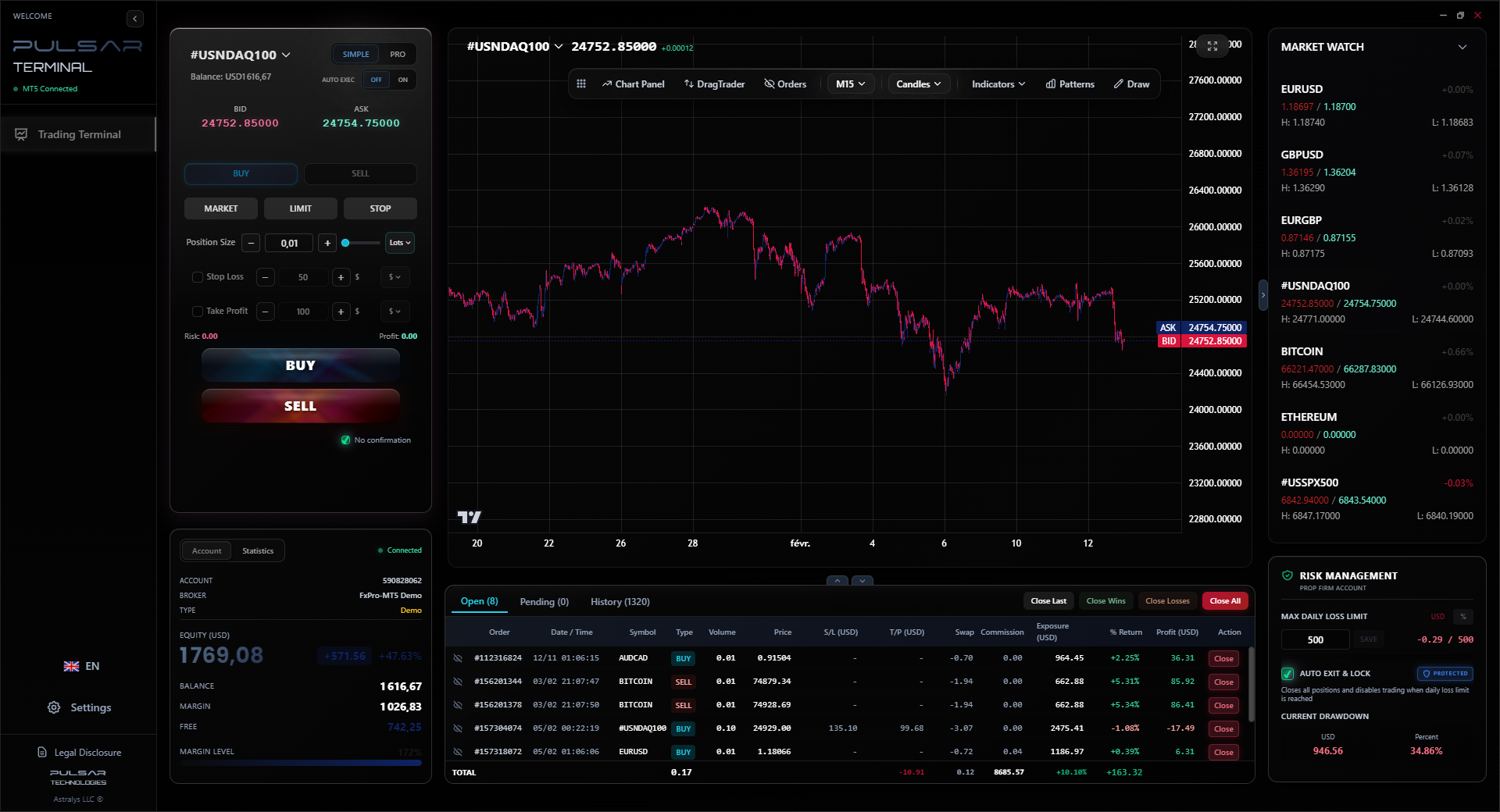
When the market moves fast during the London-NY overlap, managing multiple orders and trailing stops manually on MT5 is nearly impossible. Pulsar Terminal automates all of it directly on your charts.
Pulsar Terminal
Hepsi bir arada MT5 aracı: sürükle-bırak emirler, çoklu TP/SL, trailing stop, grid trading, Volume Profile ve prop firm koruması. Her gün 1.000'den fazla trader tarafından kullanılıyor.
“Boredom is a trader's worst enemy.”
Let's learn from my errors so you don't fund your broker's Christmas party.
- Trading the News Blind: At 9:30 AM, UK CPI data hits. The GBP/USD spikes 40 pips in 10 seconds. You FOMO in. It then reverses and takes out your stop loss 30 pips lower. You've just been 'whipsawed.' The news volatility during London hours is a trap for the impulsive. Wait for the initial spike to settle (15-30 minutes) and see if a new level holds.
- Overtrading the Quiet Times: Boredom is a trader's worst enemy. At 11 PM, with nothing moving, you start looking at exotic pairs or lower timeframes, convincing yourself you see a pattern. This is how you take low-probability, high-cost trades. If the major pairs are asleep, you should be too.
- Ignoring the Friday Close: I once held a large long EUR/USD position into a Friday close before a contentious EU summit weekend. It gapped down 80 pips against me on Sunday night. The weekend risk is real, especially in politically sensitive times. Unless you have a very good reason, reduce size or close ahead of the weekend.
- Not Adjusting Position Size: A strategy that works on the 1-hour chart at 10 AM might be far too aggressive for the same chart at 10 PM. Lower liquidity means wider stops are needed. Use your position size calculator religiously, but understand that the 'volatility' input should be higher for quiet periods if you absolutely must trade then. Better yet, just don't.
The core lesson? Respect the market's rhythm. It's a living thing with its own heartbeat. The London session is its strongest pulse. Sync your trading to it, and you're no longer fighting the flow.
FAQ
Q1What is the best time to trade forex in the UK?
The absolute best time is during the London session (8:00 AM - 5:00 PM GMT) and specifically the London-New York overlap from 1:00 PM to 4:00 PM UK time. This period has the highest volume, tightest spreads, and strongest, most reliable trends.
Q2Can I trade forex at night in the UK?
Technically yes, but you shouldn't unless you have a very specific strategy. The period from about 10:00 PM to 6:00 AM UK time is the Asian session, which has lower volatility and wider spreads. Trading during this 'quiet time' increases costs and the risk of erratic price spikes.
Q3What time does the London forex session open and close?
The core London session runs from 8:00 AM to 5:00 PM Greenwich Mean Time (GMT). During British Summer Time (BST), this shifts to 7:00 AM to 4:00 PM UK time. The most active trading typically occurs in the first few hours after the open.
Q4Is forex trading legal in the UK?
Yes, forex trading is completely legal and regulated in the UK. The Financial Conduct Authority (FCA) oversees brokers to ensure client fund protection, fair pricing, and transparent operations. Always choose an FCA-regulated broker.
Q5What are the worst times to trade forex for a UK trader?
The worst times are late Friday afternoon (as traders close weekly positions), the market open on Sunday evening (often choppy), and the dead zone between the New York close (~10:00 PM UK) and the Tokyo/London overlap (~8:00 AM UK). Low liquidity makes trading risky and expensive.
Q6How do UK trading times affect spreads?
Spreads are dynamic. They are tightest (often below 1 pip on majors) during the high-volume London and London-NY overlap sessions. They widen significantly (sometimes 2-5+ pips) during the Asian session and the late-night dead zone, eating directly into your potential profit.
Prof. Winston'ın Dersi
Önemli Noktalar:
- ✓Trade London hours (8 AM-5 PM GMT) for reliable volume.
- ✓The 1 PM-4 PM London-NY overlap is peak momentum.
- ✓Avoid trading 10 PM-6 AM UK time (wide spreads).
- ✓Friday afternoons are for closing, not opening.
Bu makale ne kadar faydalıydı?
Bir yıldıza tıklayın
Haftalık Trading Analizleri
Ücretsiz haftalık analiz ve stratejiler. Spam yok.
Yazar hakkında
Sarah Collins
Yatırım Stratejisti
Londra merkezli, finansal piyasalarda 12 yıllık deneyime sahip ticaret stratejisti. Londra City'deki bir aracı kurumda eski analist. GBP pariteleri, Avrupa piyasaları ve FCA düzenlemeli ticareti kapsıyor.
Yorumlar
Risk Uyarısı
Finansal araçlarla işlem yapmak önemli riskler taşır ve tüm yatırımcılar için uygun olmayabilir. Geçmiş performans gelecekteki sonuçları garanti etmez. Bu içerik yalnızca eğitim amaçlıdır ve yatırım tavsiyesi olarak değerlendirilmemelidir. İşlem yapmadan önce her zaman kendi araştırmanızı yapın.
Bunları da beğenebilirsiniz

Cara Trading Forex Sukses: 7 Prinsip dari Trader Profesional
Cara trading forex sukses dengan 7 prinsip trader pro: manajemen modal, disiplin, journal trading, backtest. Data nyata, bukan janji profit palsu.
Jam Trading Forex Terbaik untuk Trader Indonesia: Panduan Lengkap dengan Tabel Waktu
Panduan jam trading forex untuk trader Indonesia. Tabel 4 sesi dunia, jam emas 20:00-00:00, sesi mana yang harus dihindari. Data akurat + tips dari trader berpengalaman.
Top 5 Sàn Forex Uy Tín Nhất 2026: Review Jujur dari Trader Indonesia
Top 5 sàn forex uy tín 2026 untuk trader Indonesia. Review jujur: spread, deposit, withdraw, dukungan lokal. Exness, XM, IC Markets & lebih.
Pulsar Terminal'ı Edinin
Tüm bu hesaplayıcılar MT5 hesabınızdan gerçek zamanlı verilerle Pulsar Terminal'e entegredir.
Pulsar Terminal'ı Edinin