


Most Nigerian traders get uptrends completely wrong.

Olumide Adeyemi
Batı Afrika Yatırım Öncüsü ·  Nigeria
☕ 9 dk okuma
Neler öğreneceksiniz:
- 1What Exactly Is a Forex Uptrend? (It's Not Just a Green Line)
- 2How to Spot a Real Uptrend: Tools Beyond Your Eyes
- 3Getting In: My Go-To Uptrend Entry Strategies
- 4Managing the Trade: How to Ride It Without Panic
- 5Brokers for Nigerian Traders: Focus on Execution
- 6The Classic Mistakes (I've Made Them All)
- 7Putting It All Together: A Real Trade Example

Most Nigerian traders get uptrends completely wrong. They see a chart going up and think it's a one-way ticket to profit, jumping in with all their capital only to get stopped out at the first pullback. I've been there, and I've lost money that way. The truth is, trading a forex uptrend isn't about blind optimism; it's a disciplined game of patience, structure, and knowing when to get in and, more importantly, when to get out. In this guide, I'll show you the exact framework I use to spot, enter, and ride these moves without getting shaken out.
Forget what you see on Nairaland forums. An uptrend isn't just a chart that's generally moving up. That's too vague, and vagueness loses money. In my trading journal, I define a forex uptrend with one simple rule: a series of higher highs (HH) and higher lows (HL). That's it. The price makes a peak, pulls back, but that pullback stops at a point higher than the last low. Then it pushes to a new peak higher than the last one. That's the heartbeat of the trend.
I used to chase every little green candle. It was exhausting and unprofitable. Now, I wait for this structure to reveal itself. If I can't clearly draw a line connecting at least two higher lows on my chart, I'm not interested. It's not a trend yet; it's just noise. This simple filter saved me from countless bad trades during choppy market sessions, especially when trading pairs like EUR/USD that can look tempting but lack real direction.

Warning: A common mistake is calling any price rise an 'uptrend.' A sharp, vertical spike with no consolidation or higher lows is often a bull trap, not a sustainable trend. I've been caught in those more times than I care to admit.

💡 Winston'ın İpucu
A trend isn't what you hope for; it's what the chart structure proves. If you have to squint to see higher highs and lows, it's not a trend. Walk away.
Your eyes can deceive you, especially after staring at charts for hours. You need objective tools to confirm what you think you see.
The 200 EMA: The Trend's Foundation
My non-negotiable starting point is the 200-period Exponential Moving Average on the daily or 4-hour chart. If the price is consistently trading above the 200 EMA, the long-term bias is up. It's like the market's gravity. I don't take long-term buy positions if we're below this line. It's that simple. This one rule kept me out of disastrous counter-trend trades during major sell-offs.
Trendlines and Structure
I draw a trendline connecting those higher lows. The trendline is your friend, but it's not a rigid wall. Price will often kiss it and bounce. A break below this line, especially on a closing basis, is your first warning sign that the uptrend might be weakening. Don't panic sell immediately, but tighten your stops and pay attention.
Using the MACD for Momentum
I use the MACD indicator not for crossovers to signal entries (they're often late), but to gauge momentum. In a healthy uptrend, the MACD histogram (those little bars) should generally be above the zero line. If the price makes a new high but the MACD histogram makes a lower high, that's called bearish divergence. It's a massive red flag. I remember a trade on GBP/JPY where I ignored this. Price hit a new high, I got greedy and added to my position, but the MACD was screaming weakness. The reversal wiped out a week's profits. Now, I always check.

Example: On USD/NGN (if your broker offers it) or a major pair like XAU/USD (gold), zoom out to the daily chart. Can you see a clear sequence of HH and HL? Is price above the 200 EMA? That's your first checkpoint.

“Trading a forex uptrend isn't about blind optimism; it's a disciplined game of patience and structure.”
Buying the top is a surefire way to lose. You want to buy the dip within the trend. Here are the two ways I do it.
1. The Pullback to Support: This is my bread and butter. I wait for the price to pull back to a key area. This could be:
- The rising trendline I drew.
- A previous resistance level that has now turned into support (a classic "break and retest").
- A key moving average like the 50 or 100 EMA. I don't just buy the moment it touches the line. I wait for a sign of rejection - a bullish pin bar, a strong engulfing candle, or the start of a new upward move. Patience here is everything.
2. The Breakout Retest: When price breaks above a significant consolidation or resistance level, it often rockets up, then comes back to test the top of that broken level. If it holds as support, that's a high-probability entry. I got into a beautiful EUR/USD trade like this last quarter. Price broke 1.0950, ran to 1.1020, then pulled all the way back to 1.0960. It held, formed a small bullish candle, and I entered. The ride back up to 1.1080 was smooth. The key was waiting for the retest confirmation, not chasing the initial breakout.
No matter the entry, I always use a stop loss. For a pullback trade, my stop goes just below the support level or trendline. If that level breaks, my thesis is wrong, and I'm out. Using a position size calculator here is critical to ensure that stop distance doesn't risk more than 1-2% of my account.
This is where most traders fail. They get in, price moves in their favor, then a small pullback hits and they exit with a tiny profit, missing the big move. Or worse, they let a winner turn into a loser.
Trailing Your Stop Loss: This is the secret to letting profits run. I don't use a fixed trailing stop in pips. Instead, I move my stop loss to just below the most recent significant higher low. As the trend creates a new HL, I raise my stop. This locks in profit and lets the trend breathe. Manually doing this on MT4/MT5 is a hassle, which is why I eventually looked for tools to automate it.
Taking Partial Profits: I'm a fan of scaling out. On a strong trend move, I might take 50% of my position off at a 1:1 risk-to-reward ratio. This covers my initial risk and the spread. I then move my stop on the remaining half to breakeven. Now, I'm playing with the market's money. The rest can run, guided by my trailing stop method. This psychology is huge. It removes the fear of giving back profits.
I learned this the hard way. Early on, I watched a 300-pip gain on a gold (XAU/USD) trade evaporate to 50 pips because I had no trailing stop plan. That sting taught me more than any winning trade ever did.
💡 Winston'ın İpucu
Your first profit target should always be to cover your risk. Take 50% off at 1:1 R:R. Now you're trading with house money, and your psychology becomes unshakable.
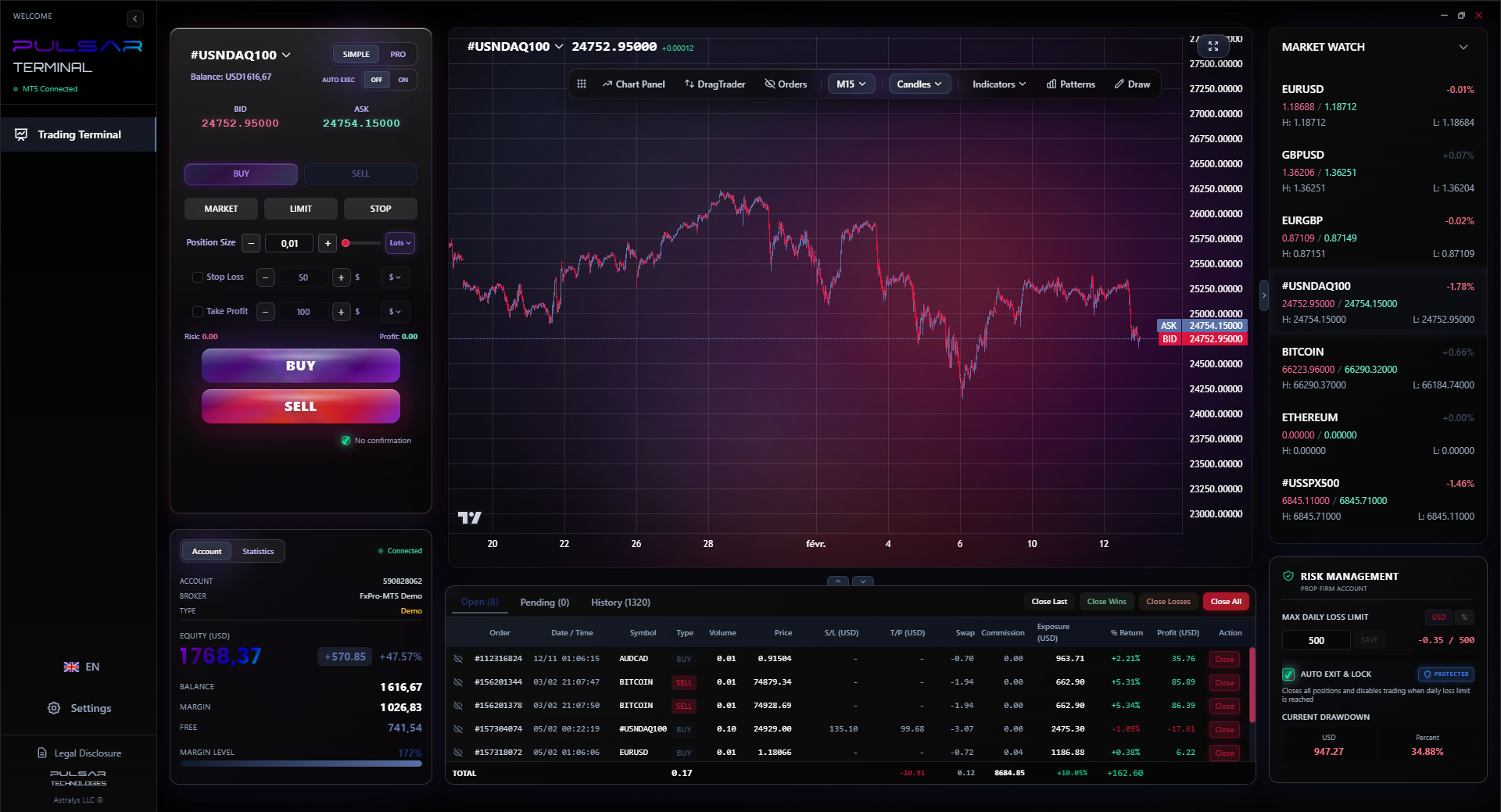
Manually trailing stops and managing multiple take-profit levels on MT5 is clunky and emotional; Pulsar Terminal automates this with drag-and-drop orders and partial closures, letting you stick to your plan.
Pulsar Terminal
Hepsi bir arada MT5 aracı: sürükle-bırak emirler, çoklu TP/SL, trailing stop, grid trading, Volume Profile ve prop firm koruması. Her gün 1.000'den fazla trader tarafından kullanılıyor.
“Buying the top is a surefire way to lose. You want to buy the dip within the trend.”
Trading uptrends, especially strategies like scalping pullbacks, requires a broker with tight spreads and reliable execution. Slippage on your entry or stop loss can ruin a good plan. From my experience and community feedback, international brokers with good local support are the way to go. They typically offer better conditions than local options.
What to look for:
- Low Spreads: Especially on major pairs. Every pip saved on the spread is a pip earned.
- Fast Deposits/Withdrawals: You need to fund your account and access profits reliably. Look for brokers supporting local bank transfers or popular payment gateways in Nigeria.
- MT4/MT5 Platform: This is standard, but ensure it's stable.
Some brokers I've used or have been consistently recommended by other serious Nigerian traders include Exness for their flexible account types and local payment processing, and IC Markets for their raw spreads and excellent execution speed, which is vital for precise entries. XM and Pepperstone also have strong reputations. Do your own due diligence, but prioritize execution quality over flashy bonuses.
Let's be honest, so you can avoid these pitfalls.
- Adding to a Losing Position in an 'Uptrend': The trend is up, so you buy. It drops. "It's just a pullback," you think, and you buy more to average down. This is called 'doubling down' and it's a great way to trigger a margin call. If your first entry is wrong, adding more is usually compounding the error. My rule now: one entry per thesis. If I'm wrong, I take the loss and re-evaluate.
- Ignering Higher Timeframes: You see a beautiful uptrend on the 15-minute chart and go all in. Meanwhile, the daily chart is showing a massive rejection at a key resistance level. The higher timeframe wins. Always, always check the daily chart direction first.
- Chasing After a Big Move: The train has left the station. Buying after a 100-pip vertical rally with no pullback is not trading an uptrend; it's gambling on FOMO. Wait for the next station (the pullback).
- Not Understanding Spread Costs: On exotic pairs or during volatile news, spreads can widen dramatically. Your beautiful pullback entry might instantly be 10 pips in the red due to spread alone. Stick to majors and minors with tight spreads for trend trading.
💡 Winston'ın İpucu
The 200 EMA isn't a magic line, but it's the best single filter you have. Price above it? Long bias. Below it? Don't force long trades. Respect the gravity.
“Complacency is the biggest risk in an uptrend. The trend is your friend until it ends.”
Let me walk you through a recent swing trading idea I had on AUD/USD. This is how the framework works in practice.
- The Trend: On the Daily chart, AUD/USD was in a clear uptrend - HH & HL, trading above the 200 EMA. The overall bias was up.
- The Opportunity: On the 4-hour chart, price pulled back sharply to a previous resistance zone around 0.6550, which was now acting as support. It also coincided with the 100-period EMA.
- The Entry: I waited. Price touched 0.6550, formed a bullish engulfing candle, and started to climb. I entered a buy order at 0.6565.
- The Risk: I placed my stop loss at 0.6530, 35 pips below my entry. Using my position size calculator, this risked 1.5% of my account.
- The Management: My first target was a 1:1 risk/reward at 0.6600. Price hit it, and I closed half my position. I then moved my stop loss on the remaining half to my entry price (0.6565), securing a risk-free trade. The trend continued, and I used subsequent 4-hour higher lows to trail my stop manually, eventually getting stopped out near 0.6650 for a very nice profit on the second half.
This process - identify, wait, confirm, enter, manage - takes the emotion out. It's mechanical. That's the goal.

FAQ
Q1What's the best timeframe to identify a forex uptrend?
Start with the daily chart to establish the primary trend direction. A trend on the daily chart is far more significant than one on a 5-minute chart. Once you confirm the daily trend is up, then use lower timeframes like the 4-hour or 1-hour to find precise entry points during pullbacks.
Q2How many pips should I trail my stop loss in an uptrend?
Don't use a fixed pip amount. Instead, trail your stop to just below the most recent significant swing low (higher low) on the timeframe you're trading. This dynamic method protects profits while giving the trend room to develop. A fixed 20-pip trail will get you stopped out in a normal retracement.
Q3Can I use the RSI to trade uptrends?
Yes, but carefully. In a strong uptrend, the RSI indicator can stay in 'overbought' territory (above 70) for a long time. Using it to signal sells can be a disaster. I use it to spot bullish divergences during pullbacks (price makes a lower low, RSI makes a higher low) as a potential entry confirmation, not as a standalone sell signal.
Q4What is the biggest risk when trading an uptrend?
Complacency. Believing the trend will go up forever. The trend is your friend until it ends. The risk is ignoring reversal signs like bearish divergence, breaking of key trendlines, or failure to make new highs. Always have a stop loss and a plan to protect profits.
Q5Is forex trend trading suitable for beginners in Nigeria?
It can be, but only if you start on a demo account. The concepts are simpler than reversal trading, but the discipline required is immense. Practice identifying HH/HL, drawing trendlines, and paper-trading your entry and exit rules for at least 3 months before risking real Naira. Understanding what a pip is and how spreads affect you is non-negotiable first.
Q6How do I know when an uptrend is over?
The most classic sign is a break of the pattern: price makes a lower high (LH) and then a lower low (LL). This breaks the sequence of HH & HL. A decisive break and close below your key rising trendline or the 200 EMA on the daily chart are strong confirmations that the trend has likely reversed or entered a prolonged consolidation.
Prof. Winston'ın Dersi
Önemli Noktalar:
- ✓Define a trend objectively: Higher Highs & Higher Lows. Nothing else.
- ✓Use the 200 EMA on D1 to filter your bias. Trade in its direction.
- ✓Enter on pullbacks to support, not after vertical rallies.
- ✓Trail your stop to below recent swing lows, not a fixed pip amount.
- ✓Scale out profits. Secure your risk early to trade stress-free.
Bu makale ne kadar faydalıydı?
Bir yıldıza tıklayın
Haftalık Trading Analizleri
Ücretsiz haftalık analiz ve stratejiler. Spam yok.
Yazar hakkında
Olumide Adeyemi
Batı Afrika Yatırım Öncüsü
Nijerya'nın en aktif forex eğitmenlerinden biri. Lagos'tan 8 yıllık ticaret deneyimi. Afrika'lı trader'lar için düşük sermaye stratejileri ve prop firma yarışmaları uzmanı.
Yorumlar
Risk Uyarısı
Finansal araçlarla işlem yapmak önemli riskler taşır ve tüm yatırımcılar için uygun olmayabilir. Geçmiş performans gelecekteki sonuçları garanti etmez. Bu içerik yalnızca eğitim amaçlıdır ve yatırım tavsiyesi olarak değerlendirilmemelidir. İşlem yapmadan önce her zaman kendi araştırmanızı yapın.
Bunları da beğenebilirsiniz

Cara Trading Forex Sukses: 7 Prinsip dari Trader Profesional
Cara trading forex sukses dengan 7 prinsip trader pro: manajemen modal, disiplin, journal trading, backtest. Data nyata, bukan janji profit palsu.
Jam Trading Forex Terbaik untuk Trader Indonesia: Panduan Lengkap dengan Tabel Waktu
Panduan jam trading forex untuk trader Indonesia. Tabel 4 sesi dunia, jam emas 20:00-00:00, sesi mana yang harus dihindari. Data akurat + tips dari trader berpengalaman.
Top 5 Sàn Forex Uy Tín Nhất 2026: Review Jujur dari Trader Indonesia
Top 5 sàn forex uy tín 2026 untuk trader Indonesia. Review jujur: spread, deposit, withdraw, dukungan lokal. Exness, XM, IC Markets & lebih.
Pulsar Terminal'ı Edinin
Tüm bu hesaplayıcılar MT5 hesabınızdan gerçek zamanlı verilerle Pulsar Terminal'e entegredir.
Pulsar Terminal'ı Edinin