


You're sitting in Lagos, Abuja, or Port Harcourt, and your trading platform just froze during a crucial NFP release because NEPA took light.

Olumide Adeyemi
Batı Afrika Yatırım Öncüsü ·  Nigeria
☕ 9 dk okuma
Neler öğreneceksiniz:
- 1What the Hell is a Forex VPS & Why Do You Need One in Nigeria?
- 2The 'Free' VPS Reality Check: Strings Attached
- 3Brokers with Realistic Free VPS for Nigerian Traders
- 4When to Just Pay for a Damn VPS (It's Cheap)
- 5setting-up-vps-first-time
- 6Mistakes That Will Burn You (I Made #3)
- 7The Final Verdict: Should You Get a Free Forex VPS?

You're sitting in Lagos, Abuja, or Port Harcourt, and your trading platform just froze during a crucial NFP release because NEPA took light. Again. You've heard whispers about a 'free forex VPS' being the solution. Is it the holy grail for Nigerian traders, or just another internet scam waiting to eat your data? Let me tell you, after 12 years of trading through generator fumes and ISP failures, I've tried every VPS promise under the sun. Some are brilliant. Most are rubbish. Here's the unvarnished truth.
Let's cut through the jargon. A VPS (Virtual Private Server) is a remote computer you rent. It runs 24/7 in a data center with industrial-grade power and internet. You install your MT4 or MT5 on it, and you connect to it from your laptop or phone.
For a Nigerian trader, this solves three critical, daily problems:
- Power Reliability: The VPS doesn't care if IKEDC or EKEDC is having a bad day. It stays on.
- Internet Stability: It's connected via fiber to major financial hubs. Your trade executes in milliseconds from London, not after your Spectranet signal decides to return.
- Latency (Speed): This is the big one for strategies like scalping. If your broker's server is in London and you're trading from Ikeja, your order has to travel there and back. That's latency. A VPS hosted near your broker (e.g., in London or New York) slashes that delay. Your EA or manual trade gets there first.

Warning: A VPS does NOT improve your trading strategy. It just ensures your brilliant (or terrible) ideas get executed reliably. A bad trade on a VPS is still a bad trade.
I learned this the hard way in 2018. I was running a grid EA on USD/NGN. Light went, internet died. Came back 6 hours later to find the EA had opened 47 positions during a news spike because it lost connection mid-trade. My account was margin called. A VPS would have kept the logic running smoothly. That loss was over $2,300. A VPS costs about $20 a month. You do the math.
Nothing is truly free, especially in forex. When a broker offers a 'free forex VPS,' they are giving you a discount bundled into your trading costs. You're paying for it, just not with a direct monthly invoice.
How Brokers 'Pay' For Your VPS
They have deals with VPS providers. The provider gets a steady stream of clients. The broker gets a sticky customer (you're less likely to leave if your fancy EA is set up on their free VPS). The cost is absorbed from their overall revenue - which comes from your spreads, commissions, or swap fees.
The Classic Catch-22
Here's the standard requirement to qualify for a free VPS from most international brokers:
- Minimum Monthly Trading Volume: Often $5 million to $10 million in notional turnover. That's a lot of lots.
- Minimum Account Balance: Sometimes a $5,000 minimum deposit.
- Active Trading: No dormant accounts.
For a new trader in Nigeria trading 0.01 lots, hitting a $5M volume is nearly impossible. So, the 'free' offer is really a loyalty bonus for high-volume traders. For the rest of us, it's a marketing tease.

Pro Tip: If you see a broker advertising 'free VPS with no minimum deposit,' read the terms. Often, you need to maintain the minimum volume for 2-3 consecutive months. If you fail in month 4, they charge your account for the VPS that month. I got caught by this with a broker I won't name. A $25 charge appeared out of nowhere.

💡 Winston'ın İpucu
Treat a VPS like a generator: test it before you need it. Run a demo account on it for a week during local blackouts to see how it holds up.

“The 'free' VPS offer is really a loyalty bonus for high-volume traders. For the rest of us, it's a marketing tease.”
Based on my experience and checking terms in 2026, here are a few brokers where the free VPS offer is somewhat accessible. Remember, you must fund your account with a minimum of $100 (standard for most international brokers serving Nigeria) and usually trade a certain volume.
| Broker | Free VPS Requirement (Typical) | Good For Nigerian Traders Because... |
|---|---|---|
| Exness | Deposit $500+ (or sometimes lower promo). Maintain a certain traded volume. | Local deposits/withdrawals via bank transfer are relatively smooth. Their VPS is reliable. |
| IC Markets | Trade 4-5 standard lots per month. | Raw spread accounts are cheap, so hitting the volume is more feasible. Excellent execution. |
| XM | Deposit $500+ or trade specific lots. | Frequent deposit bonuses (use cautiously) can help boost equity to qualify. |
| Pepperstone | Trade AUD $50,000 volume monthly (approx. 5 standard lots on major pairs). | Strong regulation and very stable VPS infrastructure. |
My Personal Setup: I use a VPS from a broker not because it's free, but because it's integrated. My main EA account runs on an IC Markets VPS. I qualified by trading about 6 lots total in a month on my 0.5% risk position size calculator settings. It's doable if you're active.
Warning: Never choose a broker solely for their free VPS offer. Regulation, withdrawal reliability, and spreads are infinitely more important. A free VPS from a shady broker is a tool to help them steal your money faster.
If you're serious about trading but can't hit the high-volume requirements, just pay for one. For the cost of one decent meal in Victoria Island (about $15-$30/month), you eliminate your single biggest operational risk in Nigeria: infrastructure.
Recommended Paid VPS Providers:
- CheapWindowsVPS / ForexVPS.net: The go-to for many EAs traders. Plans start around $15/month. Reliable, with servers in New York, London, and Tokyo.
- Amazon AWS / Microsoft Azure: You can set up a micro-instance for as low as $10-12/month if you know your way around. More technical, but ultimate control.
Calculate Your Break-Even: Let's say a paid VPS costs $20/month. How much capital does it protect? If you have a $2,000 account, that's 1% per year to insure against disconnection losses. Worth it. If you're trading a $100 account, a VPS is overkill - focus on growing your capital first.
I run a second, smaller account for testing new strategies. It's on a paid CheapWindowsVPS plan costing $16/month. Why? Because the strategy is time-sensitive. The peace of mind is worth more than the fee. Last month, my area had no light for 3 days. My main trades didn't skip a beat.
💡 Winston'ın İpucu
The 'Ping' command is your friend. A consistent ping under 50ms to your broker's server from your VPS is good. Over 150ms, look for a different VPS location.

“A free VPS from a shady broker is a tool to help them steal your money faster.”
The first time you remote into a VPS, it feels like you're in a movie. It's just a blank screen on a computer somewhere else. Here’s the no-fluff setup guide.
- Get Your Credentials: From your broker or VPS provider, you'll get an IP address, username, and password.
- Connect on Windows: Search for "Remote Desktop Connection" on your PC. Enter the IP. Click connect. Enter your credentials.
- You're In: You'll see a fresh Windows desktop. Now, treat it like a new PC.
- Install MT4/5: Download the installer from your broker's website (crucial - so it connects to their servers). Install.
- Configure: Disable Windows updates on the VPS to prevent random restarts. Set up your charts, indicators like RSI or MACD, and install your EAs.
The Golden Rule: The VPS is only for running your trading platform. Don't browse YouTube on it. Don't check email. That consumes RAM and CPU, which can slow down your trade execution. This is a work machine.
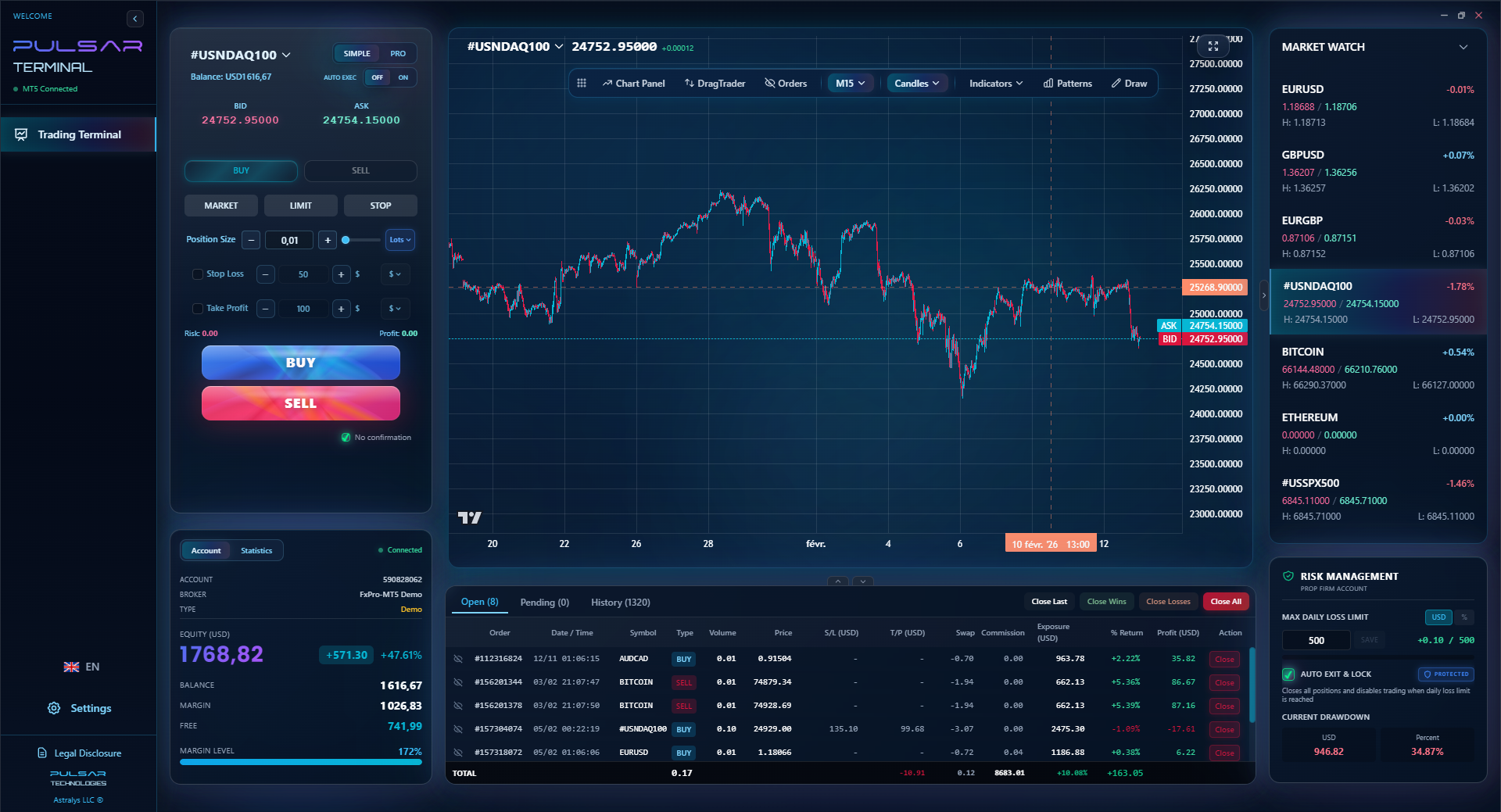
Managing trades on a remote VPS can be clunky with standard MT5. This is where a proper trading terminal shines. Having a tool that lets you drag-and-drop orders and manage multi-level take-profits from your local chart is a game-saver.

Managing complex trades on a remote VPS is clunky with basic MT5, but a tool like Pulsar Terminal lets you drag-and-drop orders and set multi-level take-profits directly from your chart, making remote trade management seamless.
Pulsar Terminal
Hepsi bir arada MT5 aracı: sürükle-bırak emirler, çoklu TP/SL, trailing stop, grid trading, Volume Profile ve prop firm koruması. Her gün 1.000'den fazla trader tarafından kullanılıyor.
- Ignoring Resource Limits: Cheap VPS plans have limited RAM and CPU. If you run 50 charts with complex indicators and 10 EAs, it will freeze. Start simple. Monitor the performance tab.
- Poor Security: Using a weak password for your remote desktop is asking for trouble. Use a strong, unique password. The VPS is directly exposed to the internet.
- Not Testing the Connection: My mistake? I set everything up, placed trades, and left. A week later, I logged in to find my EA inactive. The VPS had a temporary network glitch and MT4 had crashed. No alerts. Now, I use a simple ping monitoring service that texts my phone if the VPS goes offline. Cost: $5/month. Saves thousands.
- Assuming 'Set and Forget': You still need to check on your VPS weekly. Update your trading platform (manually, during quiet hours), check logs for errors, ensure your EA is running.
- Using it for the Wrong Strategy: If you're a swing trader holding trades for weeks, a VPS is less critical. Your 500ms latency won't matter. It's essential for scalpers, news traders, and any automated system.
Understanding your spread behavior during different market hours is key, and a VPS helps you catch the best prices, especially on pairs like EUR/USD or XAU/USD.
💡 Winston'ın İpucu
If you pay for a VPS, get one billed monthly, not annually. Test it for a month. If it's junk, you can walk away without a fight.

“In Nigeria, the biggest physical barriers are power and internet. A VPS, free or paid, smashes those barriers.”
Here's my straight talk.
Yes, if:
- You trade actively (3+ standard lots a month).
- You rely on EAs or scalping.
- Your local power and internet are as reliable as a politician's promise.
- You can qualify without changing your strategy or over-trading just to hit a volume target.
No, forget it, just pay:
- You're a beginner with a small account (< $1,000).
- You trade manually a few times a week.
- The stress of monitoring volume requirements isn't worth the $20 savings.
- You found a perfect paid VPS with better specs closer to your broker's server.
The ultimate goal is to remove barriers between your strategy and the market. In Nigeria, the biggest physical barriers are power and internet. A VPS, free or paid, smashes those barriers. It's not a magic profit machine. It's a utility. Like a generator for your trading business. You wouldn't run a serious business without a generator, would you? Don't run a serious trading operation without a VPS.
Start by checking if your current broker offers one. Look at the real terms. If it's out of reach, budget $20 a month as a necessary business expense. The first month you avoid a disaster because of it, you'll never go back.

FAQ
Q1Can I use a free forex VPS from Nigeria with any broker?
Usually not. The free VPS is typically provided by and locked to a specific broker. You install their version of MT4/5 on it. You can't use an Exness VPS to trade on an IC Markets account. Some paid, independent VPS services allow you to install any platform.
Q2What internet speed do I need to control a VPS from home?
Surprisingly little. You're just sending screen images and keyboard clicks. A stable 5 Mbps connection is more than enough. The heavy lifting (trade execution) happens on the VPS's own fast connection in the data center.
Q3Will a VPS protect me from a margin call?
No. A VPS ensures your stop-loss orders are active and can be executed. If your trade hits your stop-loss, it will close properly. But if your trade moves against you and hits your stop, you still lose. A VPS doesn't change your risk. Learn how a margin call works to protect your capital.
Q4Is it legal for Nigerian traders to use a VPS?
Absolutely. There's no law against renting a computer abroad. You're just using a tool to access your legally opened trading account with an international broker. The legality depends on your broker being reputable, not the VPS.
Q5My free VPS is slow. What should I do?
Complain to your broker's support. Free VPS plans are often on crowded servers. Ask if they can move you to a less loaded server. If they can't, this is a sign to switch to a paid provider where you get guaranteed resources.
Q6Can I run multiple MT4 accounts on one free VPS?
Technically yes, but check your broker's terms. Also, each terminal consumes RAM. On a resource-limited free VPS, running multiple terminals might cause all of them to freeze. It's risky.
Prof. Winston'ın Dersi
Önemli Noktalar:
- ✓Free VPS usually requires $5M+ monthly volume.
- ✓Paid VPS costs $15-$30/month, a worthy expense.
- ✓Test your VPS connection before going live.
- ✓Never choose a broker just for a free VPS.
Bu makale ne kadar faydalıydı?
Bir yıldıza tıklayın
Haftalık Trading Analizleri
Ücretsiz haftalık analiz ve stratejiler. Spam yok.
Yazar hakkında
Olumide Adeyemi
Batı Afrika Yatırım Öncüsü
Nijerya'nın en aktif forex eğitmenlerinden biri. Lagos'tan 8 yıllık ticaret deneyimi. Afrika'lı trader'lar için düşük sermaye stratejileri ve prop firma yarışmaları uzmanı.
Yorumlar
Risk Uyarısı
Finansal araçlarla işlem yapmak önemli riskler taşır ve tüm yatırımcılar için uygun olmayabilir. Geçmiş performans gelecekteki sonuçları garanti etmez. Bu içerik yalnızca eğitim amaçlıdır ve yatırım tavsiyesi olarak değerlendirilmemelidir. İşlem yapmadan önce her zaman kendi araştırmanızı yapın.
Bunları da beğenebilirsiniz

Cara Trading Forex Sukses: 7 Prinsip dari Trader Profesional
Cara trading forex sukses dengan 7 prinsip trader pro: manajemen modal, disiplin, journal trading, backtest. Data nyata, bukan janji profit palsu.
Jam Trading Forex Terbaik untuk Trader Indonesia: Panduan Lengkap dengan Tabel Waktu
Panduan jam trading forex untuk trader Indonesia. Tabel 4 sesi dunia, jam emas 20:00-00:00, sesi mana yang harus dihindari. Data akurat + tips dari trader berpengalaman.
Top 5 Sàn Forex Uy Tín Nhất 2026: Review Jujur dari Trader Indonesia
Top 5 sàn forex uy tín 2026 untuk trader Indonesia. Review jujur: spread, deposit, withdraw, dukungan lokal. Exness, XM, IC Markets & lebih.
Pulsar Terminal'ı Edinin
Tüm bu hesaplayıcılar MT5 hesabınızdan gerçek zamanlı verilerle Pulsar Terminal'e entegredir.
Pulsar Terminal'ı Edinin