


Most traders overcomplicate chart patterns, but the truth is, one of the most reliable signals for a trend change is also one of the simplest to spot.

Olumide Adeyemi
Batı Afrika Yatırım Öncüsü ·  Nigeria
☕ 10 dk okuma
Neler öğreneceksiniz:
- 1What Exactly Is a Head and Shoulders Pattern?
- 2How to Spot the Pattern on Your Charts
- 3Your Trading Plan: Entry, Stop Loss, and Take Profit
- 4Common Mistakes (And How I Made Them)
- 5Trading This Pattern as a Nigerian Trader
- 6Making It Stronger: Combining with Other Tools
- 7The Inverse Pattern: Catching the Bottom
Most traders overcomplicate chart patterns, but the truth is, one of the most reliable signals for a trend change is also one of the simplest to spot. I've watched traders in Lagos pour money into fancy indicators while ignoring the clear picture painted by price action itself. The head and shoulders pattern in forex is that picture. It's not a magic trick, but when you learn its rules - and more importantly, its exceptions - it becomes a powerful tool for catching major market turns. In this guide, I'll show you exactly how to identify it, trade it, and avoid the common traps that cost me money when I was starting out.
Think of it as the market's way of showing exhaustion. After a strong uptrend, buyers get tired. The price makes a final, powerful push (the head), but fails to hold the new highs. It then tries to rally again but can't even reach the head's peak, forming the second shoulder. Connecting the lows between these peaks gives you the 'neckline'. A break below this neckline signals the party's over for the bulls and a new downtrend is likely starting.
It's the opposite for an inverse head and shoulders, which forms at the bottom of a downtrend and signals a bullish reversal. The psychology is simple: the market tries to go lower one last time (the head), fails, and the subsequent failure to make a new low (the second shoulder) shows the sellers are out of steam.

Example: On the EUR/NGN chart in early 2023, I spotted a near-perfect head and shoulders top. The left shoulder formed around ₦840, the head shot up to ₦870, and the right shoulder struggled at ₦845. The neckline, drawn from the troughs, was at ₦830. The break below that was our signal.
The key is that all parts of the pattern must form during an existing trend. You can't have a reversal pattern if there's nothing to reverse. I learned this the hard way trading GBP/USD, mistaking a messy consolidation for a head and shoulders and getting stopped out quickly. Always check the bigger picture first.
“The head and shoulders pattern isn't a magic trick, it's the market's clear handwriting showing a shift from exhaustion to a new direction.”
Finding a textbook pattern is rare. Markets are messy. Your job is to see the story, not just the perfect drawing.
Look for the Trend First
Always start with the higher timeframes. A head and shoulders pattern on the 4-hour or daily chart carries far more weight than one on the 15-minute. I start on the daily to see the major trend, then zoom into the 4-hour or 1-hour to pinpoint the pattern's structure. If you're a fan of swing trading, this is where you'll do most of your hunting.
Identify the Three Peaks (or Troughs)
The left shoulder and head should form within the prevailing trend. The right shoulder is the warning sign - it shows weakening momentum. The peaks don't have to be perfectly symmetrical, but the right shoulder should clearly be lower than the head in a top pattern. Volume is a great clue here; it often diminishes as the pattern forms, especially on the rally to the right shoulder.
Draw the Neckline Correctly
This is where many get it wrong. The neckline isn't a horizontal line. It's a trendline connecting the reaction lows (for a top) or highs (for a bottom) between the shoulders and head. Sometimes it's sloping up or down. The slope can actually give you a hint about the pattern's strength. A downward-sloping neckline in a top pattern is often considered weaker for the bulls.

Warning: Don't force it. If you're bending your neckline to make it fit, the pattern probably isn't valid. Walk away and look for a cleaner setup. I've ignored this advice and paid for it with lost pips.

💡 Winston'ın İpucu
The market's memory is in the shoulders. The distance between the left and right shoulder peaks often predicts the volatility of the coming breakdown. Wider shoulders, bigger move.
“I've blown accounts learning that the higher timeframe trend always, always wins against a pretty pattern on a lower chart.”
Seeing the pattern is only half the battle. The real skill is in the trade execution. Here’s a concrete plan I’ve used for years.
Entry: The classic entry is on a candlestick close below (for a top) or above (for an inverse pattern) the neckline. Don't jump in on the first wick that touches it. Wait for confirmation. Patience here saves you from fakeouts.
Stop Loss: Your logical stop loss for a head and shoulders top is placed just above the right shoulder. This level represents the point where the pattern's premise (seller dominance) is invalidated. For an inverse pattern, place your stop below the right shoulder. Never place your stop just above the head; that's giving away too much risk.
Profit Target: The most common method is to measure the vertical distance from the head's peak to the neckline. Then, project that same distance downward from the point of the neckline break. This gives you a minimum price objective.
Let me give you a real example from my journal. On USD/NGN in 2022, I traded an inverse head and shoulders.
- Neckline: ₦415
- Head low: ₦400 (Distance = 15 Naira)
- Entry on break: ₦415.50
- Stop loss: ₦409 (below the right shoulder)
- Take profit target: ₦430 (₦415 + 15)
The trade hit target in about two weeks. Using a position size calculator is non-negotiable here. That 15 Naira target dictated my lot size based on my 2% risk rule.
Remember, this target is a minimum. Sometimes the move goes much further, especially on major pairs like EUR/USD. You can consider taking partial profits at this target and trailing the rest of your position.
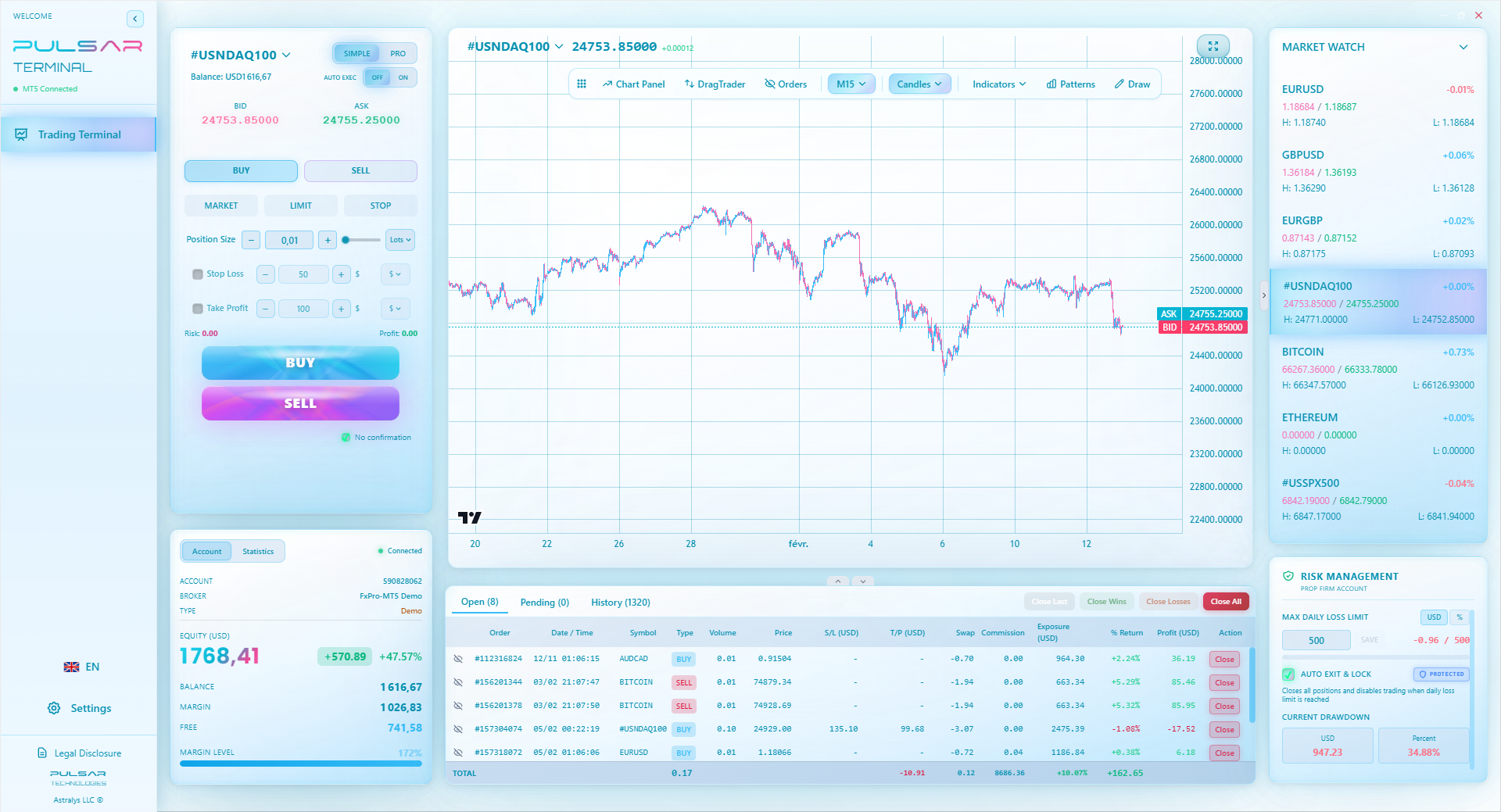
Managing multiple profit targets and a trailing stop on a head and shoulders trade is complex, but Pulsar Terminal automates this directly on your MT5 platform.
Pulsar Terminal
Hepsi bir arada MT5 aracı: sürükle-bırak emirler, çoklu TP/SL, trailing stop, grid trading, Volume Profile ve prop firm koruması. Her gün 1.000'den fazla trader tarafından kullanılıyor.
“I've blown accounts learning that the higher timeframe trend always, always wins against a pretty pattern on a lower chart.”
I've blown accounts learning these lessons so you don't have to.
Mistake 1: Trading Against the Major Trend. I once saw a beautiful head and shoulders bottom on a 1-hour chart for XAU/USD (gold) and went all in. What I ignored was that on the daily chart, gold was in a brutal, strong downtrend. The 1-hour pattern was just a tiny pullback. The trade failed spectacularly. The higher timeframe trend always wins.
Mistake 2: Ignoring Volume. The head and shoulders pattern gets its power from the shift in supply and demand. In a valid top pattern, volume is often highest on the left shoulder, lower on the head, and lowest on the right shoulder. If volume is screaming higher on the right shoulder, it's probably not a real head and shoulders. I learned to use the RSI indicator or MACD indicator as a momentum check to confirm the volume story.
Mistake 3: Poor Neckline Drawing. Early on, I'd draw my neckline connecting the closing prices of the troughs. Wrong. You should use the lows of the candlesticks (the wicks). This small difference can mean your entry signal comes several pips later, but it's more accurate.
Mistake 4: No Patience for the Break. The excitement of a potential big win made me jump the gun. Entering as price approached the neckline, hoping for the break, is a surefire way to get chopped up. Wait for the close. This single habit improved my win rate on these patterns by at least 20%.
💡 Winston'ın İpucu
A sloping neckline tells a story. An upward slope in a top pattern shows buyers are getting desperate on each dip. The break is often more violent when that last bit of hope fails.
“Waiting for the candlestick close beyond the neckline is the single habit that improved my win rate by 20%.”
Our context in Nigeria adds specific layers to this strategy. You're not just trading charts; you're trading in an environment with unique volatility and broker considerations.
Focus on Naira Pairs: The head and shoulders pattern forex strategy works brilliantly on USD/NGN and EUR/NGN. These pairs often have strong, sustained trends driven by fundamental pressures (think forex liquidity, CBN policies), which then create clear exhaustion points. The moves can be huge. A 500-pip break on USD/NGN is a life-changing trade if your position size is right. But remember, the spread definition on these local pairs can be wider, so factor that into your entry and stop calculations.
Broker Execution Matters: When that neckline breaks, you want to get in. Slippage or requotes can kill the trade's potential profit. This is why I stick with brokers known for good execution, like Exness or IC Markets, especially for a scalping strategy derivative of this pattern. If your broker's platform lags during Lagos peak trading hours, you have a problem.
Mind the Fundamentals: In 2024, if you see a head and shoulders top forming on USD/NGN, but the CBN is just about to hike interest rates, pause. The fundamental driver might overpower the technical signal. Always have an ear to the ground for local news. Technical patterns give you the 'when', but fundamentals often give you the 'why' and the fuel for the move.

Pro Tip: Practice drawing these patterns on the free demo accounts offered by brokers like XM or Pepperstone. Use historical data on GBP/NGN and just look for the patterns. Don't even trade them. Just train your eyes to see the structure. It's free education.
“Waiting for the candlestick close beyond the neckline is the single habit that improved my win rate by 20%.”
The head and shoulders pattern is a great signal, but it's not infallible. I use other tools to filter for the highest-probability trades.
1. Key Support and Resistance: Does the neckline align with a known, major support or resistance level on a higher timeframe? If the USD/NGN neckline is also sitting at a round number like ₦800 that has held as support for months, the break becomes even more significant. That's confluence.
2. Momentum Oscillators: As price forms the right shoulder, I look for bearish divergence on the RSI or MACD. If the price makes a higher high on the head (compared to the left shoulder) but the RSI makes a lower high, that's a classic warning of weakening momentum. It's the market whispering the reversal to you before the neckline breaks.
3. Fibonacci Retracement: After the neckline breaks, price often pulls back to retest the neckline (now turned resistance). This pullback frequently finds a ceiling at a key Fibonacci level, like the 50% or 61.8% retracement of the initial break move. This retest is a beautiful, low-risk opportunity for a second entry.
I treat the naked pattern as a 'high alert' signal. When I add one or two of these confirming filters, that's when I'm comfortable allocating more capital from my risk pool. It turns a good setup into a great one.
💡 Winston'ın İpucu
The retest is a gift, not a threat. After the neckline breaks, a pullback to test it as new resistance (for a top) happens 60-70% of the time. Have a limit order waiting there for a second, better entry.
“In Nigeria, you're not just trading charts; you're trading volatility, broker execution, and the whispers of the CBN all at once.”
Everything we've discussed flips for the inverse head and shoulders, but it's worth its own focus. This is the pattern you want to spot at the end of a long bear market.
The psychology is about failed selling. The market makes a final plunge (the head), but the subsequent drop (the right shoulder) can't make a new low. The buyers are finally stepping in. The neckline break to the upside is your signal that a new uptrend may be beginning.
My biggest win with this pattern was on the NASDAQ index (though the principle is the same). After the 2022 crash, a massive inverse head and shoulders formed on the weekly chart. The neckline break was explosive. In forex, look for this on pairs that have been beaten down for a long time, especially commodity pairs or GBP/USD after a period of sustained pessimism.
The trading rules are mirrored:
- Entry: On a close above the neckline.
- Stop Loss: Just below the right shoulder.
- Target: Measured move from head to neckline, projected upward.
One extra tip: Bullish reversals often need a fundamental catalyst to sustain them. An inverse pattern on EUR/USD might need a shift in ECB policy rhetoric to really fly. The technicals give you the setup, but the fundamentals provide the thrust.
FAQ
Q1Which timeframe is best for trading the head and shoulders pattern in forex?
The pattern can form on any timeframe, but for reliability, focus on the 4-hour and daily charts. Patterns on these timeframes represent shifts in sentiment among larger market participants. A head and shoulders on a 1-minute chart is just noise. I use the daily chart to identify the major trend and the 4-hour to pinpoint the pattern's structure and entry.
Q2How reliable is the head and shoulders pattern?
No pattern is 100% reliable, but a well-formed head and shoulders with a clear neckline break is one of the stronger technical signals. Its reliability increases massively when it aligns with a higher-timeframe trend and key support/resistance levels. On its own, maybe 60-65% success rate if traded perfectly. With proper confluence, you can push those odds in your favor.
Q3What is the measured move target and is it always reached?
The measured move is the vertical distance from the head's peak to the neckline. This distance is then projected from the neckline break point to set a minimum price target. It's not a guarantee, but it's a statistically common outcome. In strong trends, the price can exceed this target. I often take 50-70% of my position off at this target and use a trailing stop for the remainder.
Q4Can I trade this pattern on Naira pairs like USD/NGN?
Absolutely. In fact, USD/NGN and EUR/NGN often exhibit strong, clear trends that make reversal patterns like head and shoulders very visible. Just be mindful of the wider spreads compared to major pairs and ensure your broker offers stable execution on these pairs, especially around key market hours in Lagos.
Q5What's the biggest risk when trading this pattern?
The biggest risk is a false breakout or 'fakeout.' Price breaks the neckline, triggers all the orders, and then snaps back above it, invalidating the pattern. This is why waiting for a candlestick close beyond the neckline is crucial. Placing your stop loss correctly (above the right shoulder) also limits your loss if a fakeout occurs.
Q6How does volume confirm a head and shoulders pattern?
In a classic top pattern, volume tends to be highest on the left shoulder, lower on the head, and lowest on the right shoulder. The breakout below the neckline should ideally occur on a spike in volume, showing conviction. If volume is high on the right shoulder, be suspicious - it might not be a true reversal pattern.
Q7Should I use other indicators with the head and shoulders pattern?
Yes, I strongly recommend it. Use momentum oscillators like RSI or MACD to look for divergence as the pattern forms (e.g., price makes a higher high on the head but RSI makes a lower high). Also, check if the neckline aligns with a major Fibonacci level or horizontal support/resistance. This confluence increases the trade's probability significantly.
Prof. Winston'ın Dersi
Önemli Noktalar:
- ✓Always confirm the pattern with the higher timeframe trend first.
- ✓Wait for a candlestick close beyond the neckline for entry.
- ✓Place your stop loss above/below the right shoulder, not the head.
- ✓Use the measured move (head to neckline) for your minimum profit target.
- ✓Factor in wider spreads on Naira pairs into your risk calculation.
Bu makale ne kadar faydalıydı?
Bir yıldıza tıklayın
Haftalık Trading Analizleri
Ücretsiz haftalık analiz ve stratejiler. Spam yok.
Yazar hakkında
Olumide Adeyemi
Batı Afrika Yatırım Öncüsü
Nijerya'nın en aktif forex eğitmenlerinden biri. Lagos'tan 8 yıllık ticaret deneyimi. Afrika'lı trader'lar için düşük sermaye stratejileri ve prop firma yarışmaları uzmanı.
Yorumlar
Risk Uyarısı
Finansal araçlarla işlem yapmak önemli riskler taşır ve tüm yatırımcılar için uygun olmayabilir. Geçmiş performans gelecekteki sonuçları garanti etmez. Bu içerik yalnızca eğitim amaçlıdır ve yatırım tavsiyesi olarak değerlendirilmemelidir. İşlem yapmadan önce her zaman kendi araştırmanızı yapın.
Bunları da beğenebilirsiniz

Cara Trading Forex Sukses: 7 Prinsip dari Trader Profesional
Cara trading forex sukses dengan 7 prinsip trader pro: manajemen modal, disiplin, journal trading, backtest. Data nyata, bukan janji profit palsu.
Jam Trading Forex Terbaik untuk Trader Indonesia: Panduan Lengkap dengan Tabel Waktu
Panduan jam trading forex untuk trader Indonesia. Tabel 4 sesi dunia, jam emas 20:00-00:00, sesi mana yang harus dihindari. Data akurat + tips dari trader berpengalaman.
Top 5 Sàn Forex Uy Tín Nhất 2026: Review Jujur dari Trader Indonesia
Top 5 sàn forex uy tín 2026 untuk trader Indonesia. Review jujur: spread, deposit, withdraw, dukungan lokal. Exness, XM, IC Markets & lebih.
Pulsar Terminal'ı Edinin
Tüm bu hesaplayıcılar MT5 hesabınızdan gerçek zamanlı verilerle Pulsar Terminal'e entegredir.
Pulsar Terminal'ı Edinin