


I lost R1,200 in my first week.

David van der Merwe
Gelişen Piyasalar Yatırımcısı ·  South Africa
☕ 12 dk okuma
Neler öğreneceksiniz:
- 1The Technical Minimum vs. The Real Cost
- 2FSCA Rules and use: The 30:1 Reality
- 3Breaking Down the Real Starting Capital
- 4Hidden Costs Beyond Your Deposit
- 5SARS and Tax: The R50k You Forget
- 6Choosing a Broker: What Minimum Really Matters
- 7A Practical Funding Plan for South Africans
- 8The Final Verdict on Starting Capital
I lost R1,200 in my first week. Not on a bad trade, but on a stupid one. I’d scraped together R2,500, opened a micro account, and thought I was being clever. I put R1,000 into a single USD/ZAR trade with way too much use. A 50-pip move against me triggered a margin call. Poof. Half my capital gone before I even understood what a pip really was. That’s the problem with asking 'how much money is needed to start forex trading.' The technical minimum is a joke. The real answer is about survival.
Let's get the marketing nonsense out of the way first. Yes, you can technically start with almost nothing. Brokers like XM or Fusion Markets will let you open an account with $5 or even $0. That's about R70 to R100. You can trade micro-lots. It's possible.
But here's the brutal truth: starting with that little is a fantastic way to lose all your money and learn nothing. You'll be so focused on making R50 that you'll ignore proper risk management. Your position size calculator will spit out numbers so small they're meaningless. You'll overtrade just to feel like you're doing something.
When I review a student's first account, I don't look at the balance. I look at the trades. If I see ten trades of 0.01 lots with a R200 account, I know they're practicing gambling, not trading. The real cost of starting isn't the deposit. It's the capital required to implement a strategy with room to breathe and make mistakes without being wiped out.

Warning: A R200 account with 1:30 use gives you R6,000 in buying power. One bad trade can obliterate you. The low minimum is a trap for the impatient.
Forget the broker's minimum. Your personal minimum should be an amount you can afford to lose completely without it affecting your rent or groceries, and an amount large enough to trade properly. For most South Africans, that's not R100. It's significantly more.

💡 Winston'ın İpucu
Your first deposit isn't trading capital. It's tuition. Expect to pay it in full to the market. The real question is what you learn before it's gone.
This is the single biggest factor shaping how much money is needed to start forex trading here. Since 2021, the FSCA has capped use for retail traders at 30:1. That means for every R1 in your account, you can control R30 in the market.
This is a good thing. It probably saved you from my R1,200 mistake. In other jurisdictions, you can get 500:1 or even 1000:1. That's financial suicide for a beginner. 30:1 forces a bit of discipline.
What 30:1 use Actually Means for Your Capital
Let's say you want to trade one standard lot of EUR/USD (that's 100,000 units). Without use, you'd need $100,000 in your account. With 30:1 use, you only need about $3,333 in margin. That's roughly R60,000.
See the problem for a starter? To trade a standard lot responsibly, you already need a decent-sized account. This is why most serious beginners should think in terms of mini-lots (10,000 units) or micro-lots (1,000 units). A mini-lot on EUR/USD requires about R6,000 in margin. That's more manageable.
The use cap directly answers our main question. You need enough capital so that the 30:1 use allows you to take positions that are meaningful for profit, but small enough relative to your account to manage risk. If your entire R1,000 account is used as margin for one micro-lot, you have zero room for error. You're one trade away from zero.
Brokers like Exness and Pepperstone are FSCA-regulated and apply this cap automatically to retail clients. Don't even think about trying to skirt this by using an offshore broker illegally. The FSCA's rules are there for your protection, and SARS will still find your profits.
“With a R10,000 account, you can withstand a string of losses without being destroyed. That's the point.”
Let's move from theory to practice. Here’s how I categorize starting capital for South African traders.
The 'Learn to Lose' Account (R500 - R1,500) This is for pure education. You're paying for the experience of losing money in a controlled way. Your goal isn't profit. Your goal is to feel the emotional sting of a loss, to practice placing orders, and to blow up an account you expected to blow up. It's a tuition fee. If you start here, commit to losing it all. The lesson is priceless.
The 'Serious Beginner' Account (R5,000 - R20,000) This is the sweet spot. With R10,000, you can start to apply real risk management. Let's say you risk 1% per trade. That's R100. Trading EUR/USD, with a 10-pip stop loss, you can calculate a position size that risks exactly R100. This forces you to use tools and think. You can withstand a string of losses (10-15 trades) without being destroyed. This capital level lets you focus on your strategy, not just on surviving the next hour.

Example: You have R10,000. You risk 1% (R100) on a GBP/USD trade with a 15-pip stop. Your position size should be roughly 0.07 lots. This is a real, calculable trade, not a guess.
The 'Business Capital' Account (R50,000+) This is where trading shifts from a side hustle to a potential primary income. With this base, 1-2% risk per trade yields meaningful absolute returns (R500-R1,000). You can diversify across a few pairs, maybe even dabble in XAU/USD. The psychological pressure is different; it's about growth and consistency, not desperation.
My first profitable year came after I saved up and started with R15,000. The previous two years of fiddling with R2,000 accounts were largely wasted time.
Your starting capital isn't just what you trade with. It's what covers the costs of doing business. Miss these, and your R10,000 plan falls apart.
The Spread: This is your main fee. It's the difference between the buy and sell price. If the EUR/USD buy price is 1.0850 and the sell is 1.0848, the spread is 2 pips. You start every trade in a small hole. On a standard lot, a 2-pip spread is a $20 cost. On a micro lot, it's $0.20. With a tiny account, spreads eat a much larger percentage of your potential profit. This is why scalping strategy with a R1,000 account is almost impossible - the costs are too high relative to your gains.
Swap Fees (Overnight Financing): Hold a trade past 5 PM New York time (midnight-ish SA time), and you'll pay or receive a small interest fee. It can add up, especially if you're into swing trading. I once held a USD/JPY short for three weeks, forgetting about swaps. The fees wiped out 40% of my profit. A painful lesson in attention to detail.
Currency Conversion: Funding an international broker in USD? Your bank will charge you a fee and give you a poor exchange rate. Losing 2-3% of your capital before you even trade is a terrible start. Look for brokers that offer ZAR accounts, like some local providers or international ones with local presence.
The 'Time is Money' Cost: This is the big one. You will spend hundreds of hours learning, watching charts, and reviewing trades. That time has value. If you're not funding your account with enough to make the potential reward worth that time investment, you're better off putting that effort elsewhere.
“SARS does not consider frequent forex trading as capital gains. They see it as income. That R50k profit? A third of it isn't yours.”
Here’s a South African-specific cost that catches everyone off guard: tax. SARS does not consider frequent forex trading as capital gains. They see it as income. That means your profits are added to your salary and taxed at your marginal rate.
Let's say you have a good year. You turn R20,000 into R70,000. That's a R50,000 profit. If you're in the 36% tax bracket, you owe SARS R18,000. If you didn't set that aside, you're in a world of hurt.
You need to factor tax into your capital plan from day one. I treat 30% of every withdrawal as immediately belonging to SARS. It goes into a separate savings account. This also affects your risk calculations. If you need a R10,000 net profit to live on, you actually need to make about R14,285 before tax.
Record-keeping is non-negotiable. You need a log of every trade, every deposit and withdrawal (with exchange rates), and all broker statements. I learned this the hard way with a 3-month audit in 2023. My 'shoebox' method of record-keeping nearly cost me a fortune in penalties. Now I use a simple spreadsheet. SARS is getting more sophisticated, and their data-sharing with banks and brokers is improving. Assume they will see everything.

Pro Tip: Open a separate tax savings account. The moment you withdraw trading profits, transfer 30% of it directly to that account. Don't let it touch your spending money. It's not yours.
💡 Winston'ın İpucu
If the thought of losing 30% of your starting capital makes you sweat, you've answered the 'how much' question. It's too much. Scale down.
Don't choose a broker based on their advertised minimum deposit. That's a marketing gimmick. Choose based on the minimums that affect your trading.
Minimum Realistic Trade Size: Can you trade micro (0.01) lots? This is crucial for small accounts. If a broker only allows mini (0.1) lots as the smallest, a R5,000 account can't trade safely.
Minimum Spreads & Commissions: This is your cost of doing business. Compare the typical spread on the EUR/USD guide pair. A 0.8 pip spread vs. a 1.5 pip spread makes a massive difference over 100 trades. Some brokers like IC Markets offer tight spreads but charge a commission. You need to calculate the total cost for your typical trade size.
Minimum for Useful Features: Do you need access to a VPS for automated trading? That might require a minimum account balance. Do you want to use a platform like Pulsar Terminal on MT5? Ensure your broker supports the necessary MT5 features.
Here’s a quick comparison of factors that matter more than the deposit minimum:
| Broker Consideration | Why It Matters for Your Capital |
|---|---|
| Micro-lot availability | Allows precise risk management on accounts under R20k. |
| Average EUR/USD Spread | A 0.5 pip difference costs you R50 more per standard lot. |
| ZAR Account Option | Saves you 2-3% on bank conversion fees. |
| FSCA Regulation | Non-negotiable. Ensures 30:1 use cap and fund safety. |
I started with a broker that had a R0 minimum but terrible spreads. I was so excited by the 'free' entry that I didn't see I was paying R200 more per lot in costs. I was penny-wise, pound-foolish.
“Your first capital amount sets your entire mindset. Choose an amount that commands your respect.”
Let's build a plan from the ground up. This is what I wish someone had told me.
Phase 1: The Demo (0 Rand) Spend 2-3 months on a demo account. Not to 'make fake profit,' but to test a specific strategy. Your goal is to execute 50-100 trades following strict rules. Use a demo balance of R20,000 to simulate reality. If you can't be disciplined with fake money, you'll be a disaster with real money.
Phase 2: The Paid Lesson (R1,500) Deposit R1,500 into a live micro account. Your goal is to lose it. I'm serious. Trade with 0.01 lots. Your mission is to follow your strategy and see how the real spread, slippage, and your own emotions affect the demo plan. When this money is gone (and it will be), you should have pages of notes on what went wrong. This R1,500 is your most valuable educational expense.
Phase 3: The Real Start (R10,000) Now, save up R10,000. This is your real starting capital. Open a new account. Your rules: never risk more than 1% (R100) per trade. Use a position size calculator for every entry. Your focus is on consistency over 6 months, not a big win. Withdraw 30% of any profits immediately to your tax account.
Phase 4: The Growth (Re-investment) Only after you have shown 6 months of breakeven or profitable trading, do you add more capital. Add it in chunks from your savings, not from trading profits. Let your profits compound in the account. This phased approach manages your financial and emotional risk.
Funding this through your salary is the safest way. Do not, under any circumstances, use debt, your emergency fund, or money meant for your bond or child's education. The market doesn't care about your deadlines.
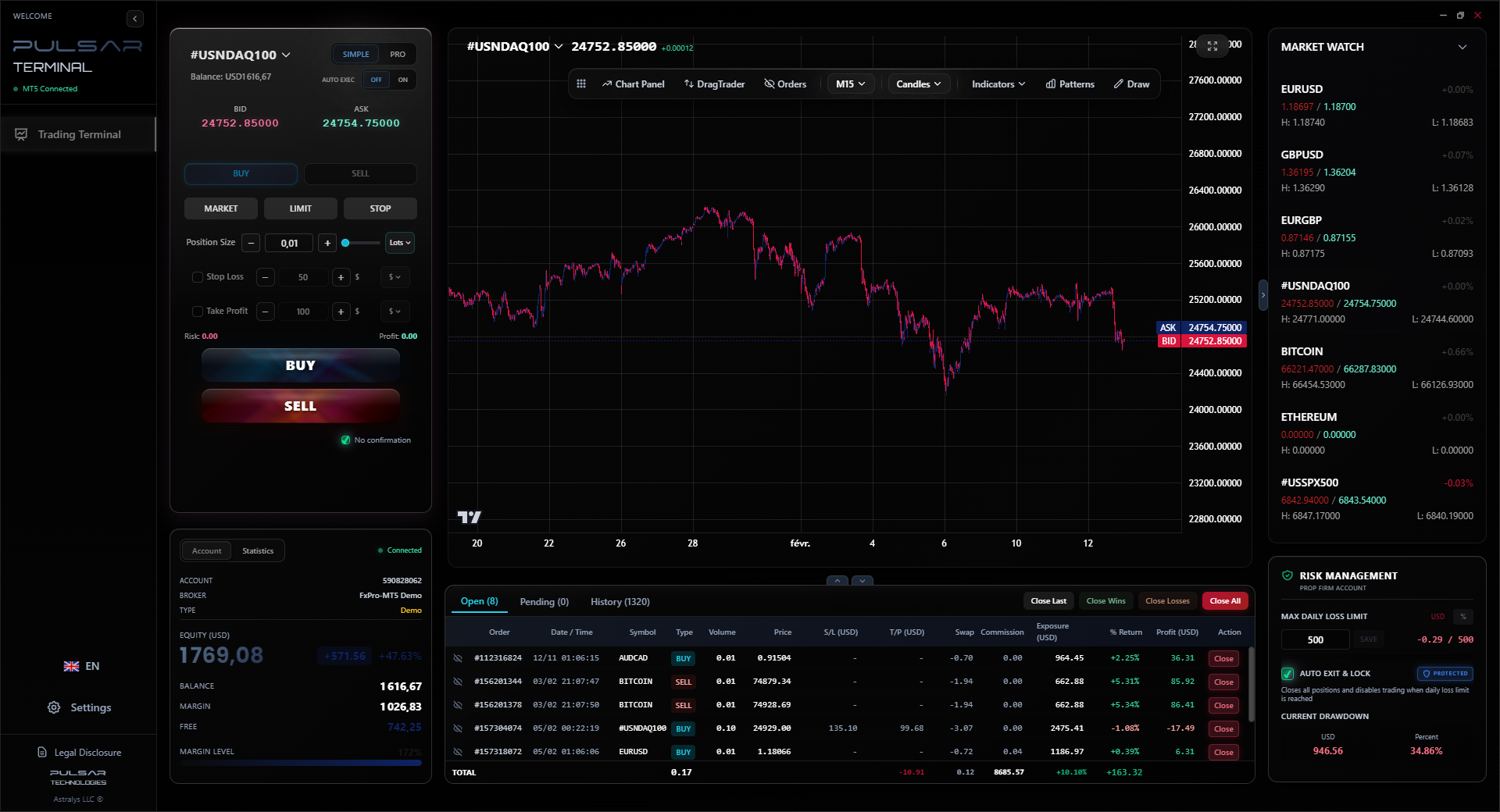
Managing multiple trades and risk on a small account is complex, but tools like Pulsar Terminal automate partial closures and trailing stops directly on MT5, turning a good risk plan into an executed one.
Pulsar Terminal
Hepsi bir arada MT5 aracı: sürükle-bırak emirler, çoklu TP/SL, trailing stop, grid trading, Volume Profile ve prop firm koruması. Her gün 1.000'den fazla trader tarafından kullanılıyor.
So, how much money is needed to start forex trading in South Africa?
If you just want to poke around and see a platform, R500 will do it. You'll learn a little and lose it all.
If you want a fighting chance to actually learn the skill and potentially build something, you need at least R5,000. Preferably R10,000 to R20,000.
If you want to generate a meaningful secondary income from the start, think R50,000 and up.
The number isn't arbitrary. It's the price of admission for a seat at a table where the odds are already stacked against you. It's the capital that allows you to use the FSCA's 30:1 use as a tool, not a trap. It's the buffer that lets you lose ten trades in a row without panicking. It's the foundation that makes you think like a business owner, not a gambler at the slots.
I started with too little, lost, and quit twice. The third time, I saved R15,000, treated it as a business investment, and finally got somewhere. Your first capital amount sets your entire mindset. Choose an amount that commands your respect, not one that invites your recklessness.
Pro Tip: Your starting capital should be an amount that, if you lost 30% of it, you'd be annoyed but not devastated. If the thought of losing R3,000 of a R10,000 account makes you feel sick, you're not ready. Save more, or trade smaller.
💡 Winston'ın İpucu
The market charges fees whether you win or lose. A R2,000 account can't afford the toll. Start with enough to pay the vig and still play the game.
FAQ
Q1Can I really start forex trading with just R100?
Technically, yes. Some brokers accept it. Practically, it's a terrible idea. With R100 and 30:1 use, your margin is R3,000. A single micro-lot trade will use a huge chunk of that, leaving no room for error. The spreads and one bad move will wipe you out. You'll learn nothing about real trading. View R100 as a platform fee to click buttons, not a trading capital.
Q2How does the FSCA's 30:1 use limit affect how much I need?
It forces you to need more capital to take meaningful positions. To control a standard lot (100k units), you need about R60,000 in margin. This pushes beginners towards mini or micro lots. For a R10,000 account, 30:1 gives you R300,000 in buying power. This is still massive and dangerous if mismanaged. The limit protects you from 500:1 insanity, but it doesn't eliminate risk. You need enough capital so your position sizes are sensible within this framework.
Q3What is the single biggest mistake beginners make with starting capital?
They fund an account with 'spare change' they don't care about. This leads to reckless trading because the loss has no consequence. Conversely, they sometimes use money they absolutely cannot afford to lose, which creates panic. The right amount is in the middle: money that is significant enough to command your full attention and respect, but not so much that its loss would ruin you.
Q4Do I need a different amount for scalping vs. swing trading?
Yes, but not in the way you might think. Scalping strategy aims for small, frequent profits. This requires tighter spreads, which often means ECN accounts with commissions. Your capital must be large enough that these commissions don't consume your tiny profits. Swing trading holds trades for days/weeks, so swap fees matter more, and you need enough capital to withstand larger market swings without being stopped out. Both require a solid base (R10k+) to be executed properly.
Q5How should I factor in taxes when planning my capital?
From day one, assume 30% of your net profit belongs to SARS. If your trading plan requires a R10,000 annual profit to be worthwhile, you actually need to generate about R14,300 in gross profit. Fund your account with this in mind. Set up a separate savings account and immediately move 30% of any withdrawal into it. Never consider that money yours to spend.
Q6Is it better to start with a local South African broker or an international one?
It depends. A local FSCA-regulated broker offers easy ZAR deposits/withdrawals and you're definitely covered by local law. Some international brokers (like Pepperstone, XM) are also FSCA-regulated and may offer better technology or tighter spreads. The key is FSCA regulation. Avoid unregulated offshore brokers promising high use - they're a fast track to losing everything with no recourse.
Q7I have R20,000. Should I deposit it all at once?
No. Deposit R5,000-R10,000 first. Trade with that for at least 3 months. Prove to yourself that you can follow your plan, manage risk, and handle the emotions. If you're successful, then add the remaining capital in a second lump sum. This phased approach protects you from losing your entire stake while you're still making beginner mistakes.
Prof. Winston'ın Dersi
Önemli Noktalar:
- ✓The real minimum is R5,000-R10,000 for serious learning.
- ✓FSCA's 30:1 use cap makes small accounts dangerously rigid.
- ✓Always deduct 30% of profits for SARS, immediately.
- ✓Broker minimums are irrelevant; focus on spreads and micro-lots.
- ✓Fund in phases: demo, then a 'tuition' account, then real capital.
Bu makale ne kadar faydalıydı?
Bir yıldıza tıklayın
Haftalık Trading Analizleri
Ücretsiz haftalık analiz ve stratejiler. Spam yok.
Yazar hakkında
David van der Merwe
Gelişen Piyasalar Yatırımcısı
Johannesburg merkezli, gelişmekte olan piyasa dövizlerinde 11 yıllık deneyime sahip trader. ZAR pariteleri, FSCA düzenlemeli ticaret ve Güney Afrika piyasa analizi uzmanı.
Yorumlar
Risk Uyarısı
Finansal araçlarla işlem yapmak önemli riskler taşır ve tüm yatırımcılar için uygun olmayabilir. Geçmiş performans gelecekteki sonuçları garanti etmez. Bu içerik yalnızca eğitim amaçlıdır ve yatırım tavsiyesi olarak değerlendirilmemelidir. İşlem yapmadan önce her zaman kendi araştırmanızı yapın.
Bunları da beğenebilirsiniz

Cara Trading Forex Sukses: 7 Prinsip dari Trader Profesional
Cara trading forex sukses dengan 7 prinsip trader pro: manajemen modal, disiplin, journal trading, backtest. Data nyata, bukan janji profit palsu.
Jam Trading Forex Terbaik untuk Trader Indonesia: Panduan Lengkap dengan Tabel Waktu
Panduan jam trading forex untuk trader Indonesia. Tabel 4 sesi dunia, jam emas 20:00-00:00, sesi mana yang harus dihindari. Data akurat + tips dari trader berpengalaman.
Top 5 Sàn Forex Uy Tín Nhất 2026: Review Jujur dari Trader Indonesia
Top 5 sàn forex uy tín 2026 untuk trader Indonesia. Review jujur: spread, deposit, withdraw, dukungan lokal. Exness, XM, IC Markets & lebih.
Pulsar Terminal'ı Edinin
Tüm bu hesaplayıcılar MT5 hesabınızdan gerçek zamanlı verilerle Pulsar Terminal'e entegredir.
Pulsar Terminal'ı Edinin