


Most South African traders get position sizing completely backwards.

David van der Merwe
Gelişen Piyasalar Yatırımcısı ·  South Africa
☕ 12 dk okuma
Neler öğreneceksiniz:
Most South African traders get position sizing completely backwards. They focus on how much they could make, not how much they can afford to lose. They'll risk R500 on a hunch about USD/ZAR because the 'chart looks good,' with zero calculation. That's not trading, it's gambling with extra steps. I've seen it blow up more accounts than I can count. Let's set the record straight. Proper position sizing isn't a fancy trick, it's your financial seatbelt. This guide will show you the exact, non-negotiable math to keep you in the game.
Forget indicators, forget news trading, forget finding the 'perfect' entry. If you don't master position sizing, you're finished before you start. It's that simple. The market's randomness will eat you alive. Your edge doesn't come from predicting price. It comes from controlling your losses so consistently that when you're right, the profits actually matter.
I learned this the hard way in 2015. I had a solid run on EUR/USD, turned R15,000 into R22,000. Got cocky. Saw a 'sure thing' setup on GBP/JPY. Instead of my usual 1% risk, I threw 8% of my account at it. Why? Greed, plain and simple. The trade went 30 pips against me, hit my stop, and I lost R1,760 in minutes. That one stupid decision wiped out nearly all my profits from the previous month. It took me two weeks of disciplined trading just to get back to where I was. That loss wasn't about analysis, it was about poor capital management.
In South Africa, with the FSCA capping use at 30:1 for retail traders, this is even more critical. Lower use feels restrictive, but it's a gift. It forces you to think about size. A 30:1 cap means you can't accidentally over-use yourself into oblivion as easily, but you can still do plenty of damage if your position size is reckless.

Warning: Your broker's platform will happily let you open a position that risks 20% of your account. It's not their job to protect you from yourself. That's your job.
You can't calculate anything until you define four things. Miss one, and your calculation is garbage.
1. Your Account Balance (in ZAR)
This is your trading capital. Not your net worth, not your savings. The money you've decided you can afford to lose. Be honest. If it's R5,000, use R5,000. If it's R50,000, use R50,000. This number is sacred.
2. Your Per-Trade Risk Percentage
This is the single most important decision you'll make. How much of your sacred capital are you willing to lose on one trade? For most retail traders, 1% is the gold standard. Aggressive traders might go to 2%. Anything above 3% per trade is playing with fire. At 5% risk, ten losing trades in a row (which happens to everyone) cuts your account in half. I use 1.5% for my standard swing trading setups.
Risk Amount = Account Balance × (Risk Percentage / 100) Example: R10,000 account, 1% risk = R100 risk per trade.
3. Your Stop-Loss Distance (in Pips)
Your stop-loss isn't a suggestion, it's a law. You must know exactly where it goes BEFORE you calculate your size. This distance, measured in pips, defines the 'space' your trade has to move against you. If your EUR/USD entry is 1.0850 and your stop is at 1.0820, your stop-loss distance is 30 pips.
4. The Pip Value for Your Pair
This is where many South Africans get tripped up. The value of one pip depends on:
- The currency pair you're trading.
- The lot size.
- Your account currency (ZAR).
For a standard lot (100,000 units) of EUR/USD, one pip is usually $10. But if your account is in ZAR, you need to convert that. If USD/ZAR is at 18.50, then a $10 pip is worth roughly R185. This conversion is automatic on most platforms, but you need to understand it. For a EUR/USD guide, pip value is straightforward. For something like USD/ZAR, the calculation is different because the quote currency is ZAR.

💡 Winston'ın İpucu
A professor once told me, 'Risk management isn't about avoiding losses, it's about surviving them long enough for your edge to play out.' Your position size is your survival tool.
“Your edge doesn't come from predicting price. It comes from controlling your losses so consistently that when you're right, the profits actually matter.”
Here's the universal formula. Write it down.
Position Size (in units) = (Account Balance × Risk Percentage) / (Stop-Loss in Pips × Pip Value per Unit)
Let's walk through a real example with a South African twist.
Scenario:
- Account Balance: R20,000
- Risk Percentage: 1.5%
- Trade: USD/ZAR (You think the Rand will weaken)
- Entry: 18.7500
- Stop-Loss: 18.7000 (50 pips away)
- Account Currency: ZAR
Step 1: Find your Risk Amount in ZAR. R20,000 × 0.015 = R300 You are willing to lose R300 on this trade. No more.
Step 2: Find the Pip Value for USD/ZAR. This is the tricky bit for ZAR pairs. For a standard lot (100,000 units) of USD/ZAR, the pip value is usually ZAR 1,000. Let's verify: A 1 pip move from 18.7500 to 18.7501 on 100,000 units is worth 100,000 × 0.0001 = ZAR 10. Wait, that's ZAR 10, not 1,000. I see confusion here all the time. The key is the lot size. A micro lot (1,000 units) of USD/ZAR has a pip value of about ZAR 0.10. A mini lot (10,000 units) = ZAR 1.00. A standard lot (100,000 units) = ZAR 10.00. My earlier memory was wrong - it's ZAR 10 per standard lot, not 1,000. This is why you must check your broker's specs or use a calculator.
Step 3: Plug it into the formula. We want Position Size in units. Pip Value per unit for USD/ZAR: If 100,000 units = ZAR 10 per pip, then 1 unit = ZAR 0.0001 per pip.
Position Size = R300 / (50 pips × ZAR 0.0001 per pip per unit) Position Size = R300 / ZAR 0.005 Position Size = 60,000 units
Step 4: Translate to lots. 60,000 units = 0.6 standard lots, or 6 mini lots, or 60 micro lots.
That's your trade. Not 1 lot because it 'feels right.' Not 2 lots because you're confident. 0.6 standard lots. This ensures if USD/ZAR falls 50 pips to your stop, you lose exactly R300, which is 1.5% of your R20k.

Example: Quick check: 60,000 units. Pip move: 60,000 × 0.0001 = ZAR 6 per pip. 50 pips × ZAR 6 = R300 loss. Perfect.
This is why using a good position size calculator is non-negotiable. It does this math instantly, accounting for your account currency and the specific pair. Trying to do this in your head during a fast market is a recipe for error.
Your position size isn't calculated in a vacuum. Your broker's terms directly impact the math.
Spreads: The spread is your immediate cost. On a major pair like EUR/USD with a 0.1 pip spread on an ECN account, it's negligible. On USD/ZAR, the spread can be 5-10 pips. You must include this in your risk! If your stop is 50 pips away, but you pay a 7 pip spread to enter, your effective risk is 57 pips. Your position size needs to be slightly smaller to keep your monetary risk the same.
Commissions: Some brokers, like IC Markets or Pepperstone on their raw accounts, charge a commission per lot. This is a direct cost that reduces your potential profit and increases your effective loss. Factor it in as a cost of doing business.
use (The FSCA 30:1 Limit): This is a blessing. It dictates the maximum position size your margin will allow. Let's say you have R20,000 and want to buy 1 standard lot of EUR/USD (€100,000). At 30:1, the required margin is roughly €100,000 / 30 = €3,333. At a USD/ZAR rate of 18.5, that's about R61,660 in margin. You don't have that. The 30:1 limit physically prevents you from opening that trade with a R20k account. It forces you to trade smaller sizes, which is inherently safer. Don't view it as a limitation, view it as a guardrail.
Minimum Trade Sizes: Most brokers allow micro (0.01) or even nano lots. This is fantastic for South Africans starting with smaller accounts. You can precisely calibrate your position size to the exact number of units your calculation demands, not just round to the nearest lot.
“At 5% risk per trade, ten losing trades in a row cuts your account in half. It happens to everyone.”
I've coached local traders for years. These are the position sizing errors I see every week.
Mistake 1: Trading ZAR Pairs Like Major Pairs. USD/ZAR and EUR/ZAR are volatile. A 100-pip move is common. If you use the same 20-pip stop you'd use on EUR/USD, your position size calculation will tell you to trade enormous size to meet your risk amount. This is suicidal. You need wider stops on volatile pairs, which naturally leads to smaller position sizes. It's a feature, not a bug.
Mistake 2: Ignoring Volatility Around SARB Announcements. When the South African Reserve Bank announces interest rates, USD/ZAR can spike 200 pips in seconds. If your stop is 50 pips away, you could get 'gapped' right through it, suffering a loss much larger than your calculated risk. Before major news, either don't trade, or reduce your position size significantly to account for the potential slippage.
Mistake 3: Letting Winners Turn Into Losers. You risk 1% (R100) to make 2% (R200). The trade goes in your favor, up 1.5%. You move your stop to breakeven. Then it reverses and hits your breakeven stop. You think, 'Well, I didn't lose money.' Wrong. You lost the opportunity cost. You risked R100 to make nothing. That's a poor use of risk capital. Consider using a partial close or a trailing stop to lock in some profit while letting a portion run. Managing trades after entry is part of the sizing story.
Mistake 4: Changing Size Based on a 'Feeling'. You had three losses in a row. The next setup looks just as good, but you cut your size in half because you're scared. Or, you had two big wins, so you double your size on the next trade because you're 'hot.' This is emotional trading. Your position size should be a cold, mechanical output of your account balance and stop-loss distance. Nothing else. If a R10,000 account dictates a 0.15 lot trade, you trade 0.15 lots whether you're crying or celebrating.
💡 Winston'ın İpucu
If your calculated position size feels too small to be exciting, you're doing it right. Trading is a marathon of boredom, punctuated by moments of controlled risk.
Let's build a simple plan for a fictional South African trader, Thabo.
- Account Balance: R15,000
- Risk Per Trade: 1% (R150)
- Preferred Pairs: EUR/USD (lower volatility), USD/ZAR (higher volatility)
- Broker: Uses an FSCA-regulated broker like Exness or XM with tight spreads.
Trade 1: EUR/USD Swing Trade
- Analysis suggests buying at 1.0750, stop at 1.0720 (30 pips).
- Pip value for a micro lot (1,000 units) is ~$0.10. In ZAR (USD/ZAR=18.5), that's ~R1.85 per micro lot per pip.
- Calculation: R150 / (30 pips × R1.85 per pip per micro lot) = R150 / R55.5 = 2.7 micro lots.
- Thabo rounds down to 2 micro lots (2,000 units). His max loss: 30 pips × (R1.85 × 2) = R111 (under his R150 limit).
Trade 2: USD/ZAR Momentum Trade
- Thabo sees a potential breakout on USD/ZAR. Entry at 18.8000, stop at 18.7500 (a wider 100-pip stop due to volatility).
- Pip value for a micro lot of USD/ZAR is ~R0.10.
- Calculation: R150 / (100 pips × R0.10) = R150 / R10 = 15 micro lots.
- Thabo trades 15 micro lots (15,000 units). His max loss: 100 pips × (R0.10 × 15) = R150.
Notice the difference? The USD/ZAR trade requires a much wider stop, so the position size in units is larger (15k vs 2k), but the monetary risk is identical (R150). The volatility is baked into the calculation.
Thabo's plan also includes a rule: If his account drops to R12,000, his risk per trade remains 1%, but now it's R120. He recalculates every position. If his account grows to R20,000, his risk becomes R200 per trade. This is how you grow an account steadily, without wild swings.

Pro Tip: Keep a trading journal. For every trade, write down: Account Balance, Risk %, Calculated Position Size, and Actual Position Size. If they don't match, ask yourself why. This will expose your emotional biases fast.
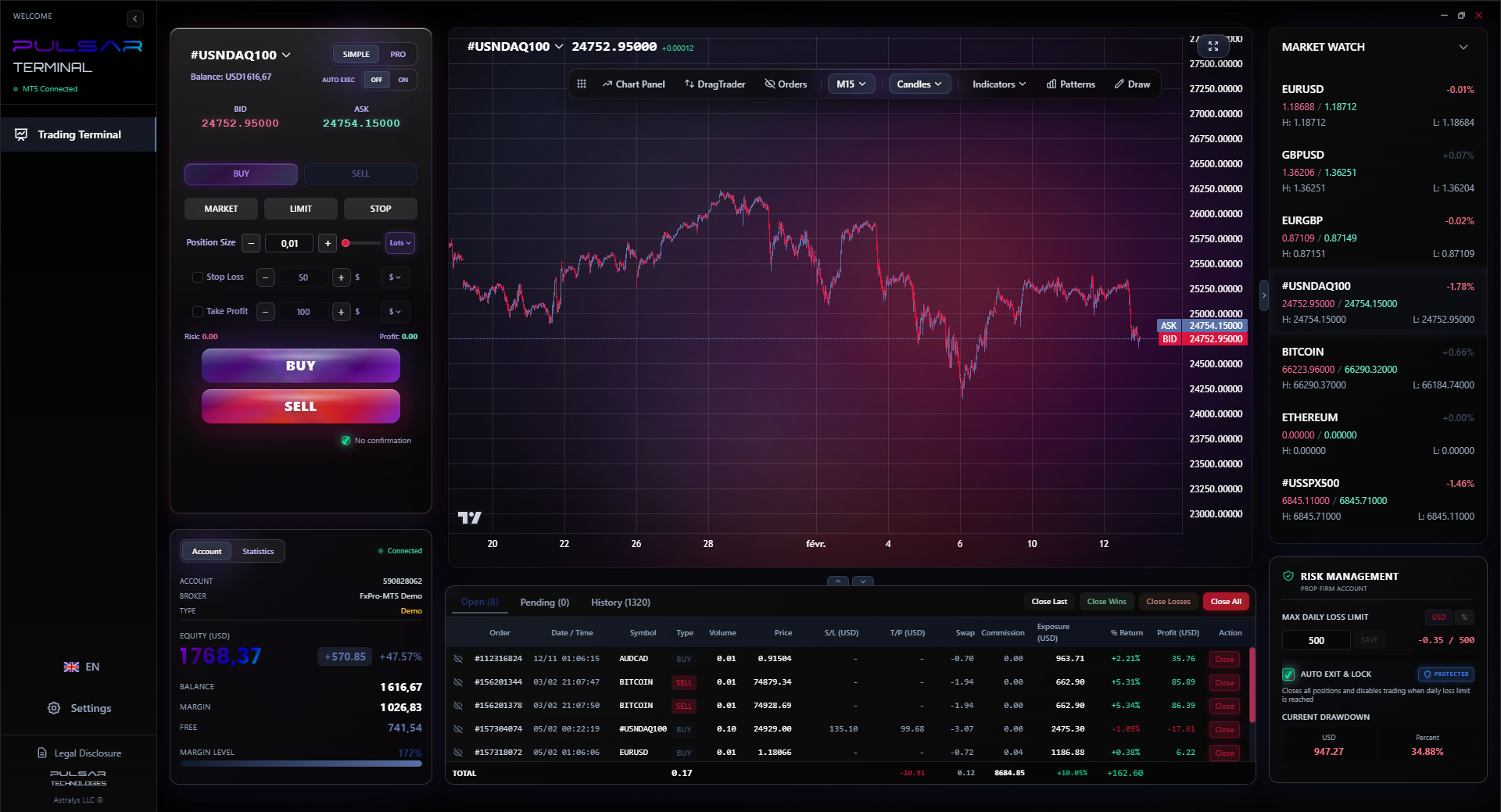
Manually adjusting stops and calculating partial closes for multiple trades is time-consuming and error-prone; Pulsar Terminal automates trailing stops, breakeven moves, and multi-level take-profits directly on your MT5 charts.
Pulsar Terminal
Hepsi bir arada MT5 aracı: sürükle-bırak emirler, çoklu TP/SL, trailing stop, grid trading, Volume Profile ve prop firm koruması. Her gün 1.000'den fazla trader tarafından kullanılıyor.
“Your position size should be a cold, mechanical output of your account balance and stop-loss distance. Nothing else.”
Once you've mastered the basic formula and executed it flawlessly for 100+ trades, you can explore more nuanced approaches.
Volatility-Based Position Sizing: Instead of a fixed stop in pips, you base your stop on a measure of market volatility, like the Average True Range (ATR). If the ATR(14) of USD/ZAR is 150 pips, you might set your stop at 1.5 x ATR (225 pips). Your position size formula uses this dynamic stop distance. This adjusts your size automatically based on how 'active' the market is, which is logically sound.
The Kelly Criterion: This is a mathematical formula used to optimize bet size based on your historical win rate and risk/reward ratio. It's advanced and can be aggressive. For a trader with a 55% win rate and a 1:1.5 risk/reward, Kelly might suggest risking around 2.5% per trade. I don't recommend pure Kelly for most retail traders - it's too sensitive to errors in estimating your edge. But understanding it teaches you that your ideal risk percentage is linked to your strategy's performance.
Correlation Adjustments: If you're in two trades that are highly correlated (like long EUR/USD and short USD/CHF), you're effectively doubling your risk on one market move. Sophisticated traders will reduce the position size on each correlated trade so the combined risk doesn't exceed their single-trade limit. If your max risk is 1%, and you take two 80% correlated trades, you might size each at 0.6% so the total exposure is roughly 1%.
Remember, these are refinements. The foundation - the basic formula - never changes. Get that wrong, and all the advanced stuff just helps you blow up in a more sophisticated way.
FAQ
Q1What's a simple way to calculate position size without complex math?
Use an online position size calculator. You input your account balance in ZAR, your risk percentage, your stop-loss in pips, and the currency pair. It does the conversion and gives you the lot size. It's the most practical tool for everyday trading. Just make sure you understand the inputs it's asking for.
Q2I only have R2,000 to start. Can I even trade forex with proper position sizing?
Yes, but you must be realistic. At 1% risk, you're risking R20 per trade. With a typical 30-pip stop on a major pair, that means trading very small sizes - micro or even nano lots. Your potential profits will be small in Rand terms. This is actually a great way to learn discipline without huge financial stakes. Consider it paying tuition fees to the market. A R2,000 account is for practice, not income.
Q3How does use from my broker change the position size calculation?
It doesn't change the calculation itself. use determines how much margin is required to open a position of a given size. Your calculation tells you the correct size (e.g., 0.5 lots). use then tells you if you have enough margin to open it. With South Africa's 30:1 limit, you need roughly 3.33% of the trade's value in margin. The position size formula protects your capital; use is just a tool to access that size.
Q4Should I adjust my position size if I'm on a losing streak?
No. Your position size is based on your current account balance and your fixed risk percentage. If you're on a losing streak, your account balance is shrinking, so your position size will naturally get smaller. That's the system working as intended. Do NOT artificially increase your size to 'make back losses' - that's the road to a margin call.
Q5What's the difference between position size and lot size?
Position size is the total number of currency units you trade (e.g., 25,000 units). Lot size is a standardized grouping of those units. A standard lot is 100,000 units, a mini lot is 10,000, a micro lot is 1,000. You calculate your position size in units, then translate it into the appropriate number of lots for your broker's platform.
Q6How do I calculate pip value for a pair like GBP/JPY with a ZAR account?
It gets complex because it involves a cross rate. The simplest answer: don't do it manually. Use your broker's trading calculator or a reliable online tool. The platform needs to convert from GBP to JPY, then to USD, then to ZAR. This is a prime example of where technology saves you from costly errors.
Prof. Winston'ın Dersi
Önemli Noktalar:
- ✓Always calculate position size before every single trade, no exceptions.
- ✓Risk 1-2% of your account per trade, never more.
- ✓Your stop-loss distance determines your size, not your confidence.
- ✓Use a calculator for ZAR accounts trading non-ZAR pairs.
Bu makale ne kadar faydalıydı?
Bir yıldıza tıklayın
Haftalık Trading Analizleri
Ücretsiz haftalık analiz ve stratejiler. Spam yok.
Yazar hakkında
David van der Merwe
Gelişen Piyasalar Yatırımcısı
Johannesburg merkezli, gelişmekte olan piyasa dövizlerinde 11 yıllık deneyime sahip trader. ZAR pariteleri, FSCA düzenlemeli ticaret ve Güney Afrika piyasa analizi uzmanı.
Yorumlar
Risk Uyarısı
Finansal araçlarla işlem yapmak önemli riskler taşır ve tüm yatırımcılar için uygun olmayabilir. Geçmiş performans gelecekteki sonuçları garanti etmez. Bu içerik yalnızca eğitim amaçlıdır ve yatırım tavsiyesi olarak değerlendirilmemelidir. İşlem yapmadan önce her zaman kendi araştırmanızı yapın.
Bunları da beğenebilirsiniz

Cara Trading Forex Sukses: 7 Prinsip dari Trader Profesional
Cara trading forex sukses dengan 7 prinsip trader pro: manajemen modal, disiplin, journal trading, backtest. Data nyata, bukan janji profit palsu.
Jam Trading Forex Terbaik untuk Trader Indonesia: Panduan Lengkap dengan Tabel Waktu
Panduan jam trading forex untuk trader Indonesia. Tabel 4 sesi dunia, jam emas 20:00-00:00, sesi mana yang harus dihindari. Data akurat + tips dari trader berpengalaman.
Top 5 Sàn Forex Uy Tín Nhất 2026: Review Jujur dari Trader Indonesia
Top 5 sàn forex uy tín 2026 untuk trader Indonesia. Review jujur: spread, deposit, withdraw, dukungan lokal. Exness, XM, IC Markets & lebih.
Pulsar Terminal'ı Edinin
Tüm bu hesaplayıcılar MT5 hesabınızdan gerçek zamanlı verilerle Pulsar Terminal'e entegredir.
Pulsar Terminal'ı Edinin