


I remember the first time someone asked me to manage their money.

Olumide Adeyemi
Batı Afrika Yatırım Öncüsü ·  Nigeria
☕ 10 dk okuma
Neler öğreneceksiniz:
I remember the first time someone asked me to manage their money. It was 2017. A friend, impressed by a few lucky trades, handed me ₦500,000. No contract, no plan, just trust. I blew it in two weeks on a single, over-leveraged GBP/USD trade. I had to pay him back from my own pocket, a painful lesson that cost me six months of savings. That experience taught me that getting investors isn't about hype or promises. In Nigeria, it's a serious business with serious rules. If you're wondering how to get investors for forex trading, you need to start with the law, not the pitch.
Let's get the most important thing out of the way first. In Nigeria, you cannot just start collecting money from friends, family, or the public to trade forex for them. Full stop. The Securities and Exchange Commission (SEC Nigeria) is very clear on this. They view forex trading as a securities activity. If you're managing other people's money, you are, in their eyes, operating a collective investment scheme or acting as a fund manager.
Doing that without a license is illegal. The SEC has shut down countless outfits - often fancy websites calling themselves 'Forex Investment Funds' - that promise guaranteed returns. They're not playing. If you solicit funds without being a licensed Capital Market Operator (specifically, a Fund/Portfolio Manager), you're risking serious legal trouble.
So, the first step in learning how to get investors for forex trading is understanding what you cannot do. You cannot run an unregistered pool. You cannot advertise guaranteed profits. You cannot accept Auntie Ngozi's pension money to 'multiply' it. That path leads to fines, shutdowns, and a destroyed reputation.

Warning: The most common mistake is thinking a verbal agreement or a WhatsApp chat is enough. It's not. Operating an unregistered investment scheme is a fast track to problems with the SEC. Your first investor should be yourself, building a verifiable track record.
“In Nigeria, you cannot just start collecting money from friends, family, or the public to trade forex for them. Full stop.”
Before you even think about another person's money, you need proof. Not screenshots of one winning trade, but a consistent, documented history. Investors aren't buying your dream; they're buying your proven ability to generate returns while managing risk.
Start with a Live Account
You need a live trading account, even if it's small. A $100 account with a broker like XM or Exness is a valid starting point. The key is to trade it with the same discipline you would a $100,000 account. This isn't for gambling; it's for building data.
Use a Verified Performance Service
Simply saying "I made 50% last month" means nothing. You need third-party verification. Use a service like Myfxbook or FX Blue. Connect your live trading account to it. This creates a public, auto-updated, and verified track record. It shows your equity curve, your drawdowns (the painful dips), your win rate, and your average profit/loss. It's transparent and hard to fake.
I did this for 18 months before my first formal investor approach. My stats weren't crazy - a 24% annual return with a maximum drawdown of 11%. But it was real, boring, and consistent. That transparency was worth more than any slick PowerPoint presentation.
Define Your Strategy Clearly
Are you a scalping wizard on EUR/USD? A swing trading specialist on gold? You must be able to articulate your edge. For example: "I trade breakouts on the 4-hour chart for XAU/USD, using the MACD indicator for confirmation, with a strict 2% risk per trade." This specificity builds confidence.

💡 Winston'ın İpucu
Your track record is your resume. No one cares about your three best trades. They care about your worst month and how you recovered from it. Build that story with data.
“Investors aren't buying your dream; they're buying your proven ability to generate returns while managing risk.”
Okay, you have a solid track record. Now, how do you legally accept funds? You have two main paths, and one is significantly more accessible for most traders.
The Prop Firm Route (The Most Practical Start)
This is the best way to 'get investors' without directly handling client money. Proprietary trading firms give you their capital to trade. You pass an evaluation challenge (like a 10% profit target with strict drawdown limits), and then you trade a funded account. They take a split of the profits - often 70-90% to you.
It's perfect because:
- It's Legal: You're trading the firm's money, not soliciting from the public.
- It Validates You: Passing a rigorous challenge adds to your credibility.
- It Scales: Firms like FTMO or The5%ers offer accounts up to $200,000 or more.
The key is surviving the challenge phase. This requires iron-clad discipline. Using a tool that automates risk rules can be a game-saver here.
The Licensed Fund Manager Route (The Heavy Lift)
This is the formal, full-scale option. You register with the SEC Nigeria as a Fund/Portfolio Manager. This involves meeting substantial capital requirements, having a physical office, hiring compliance officers, and undergoing regular audits. It's expensive, time-consuming, and meant for establishing a full-fledged asset management business. For 99% of retail traders starting out, this is overkill. But it's the end goal if you want to build a major firm.
For now, focus on the prop firm path. It's the legitimate bridge between being a solo trader and managing significant capital.
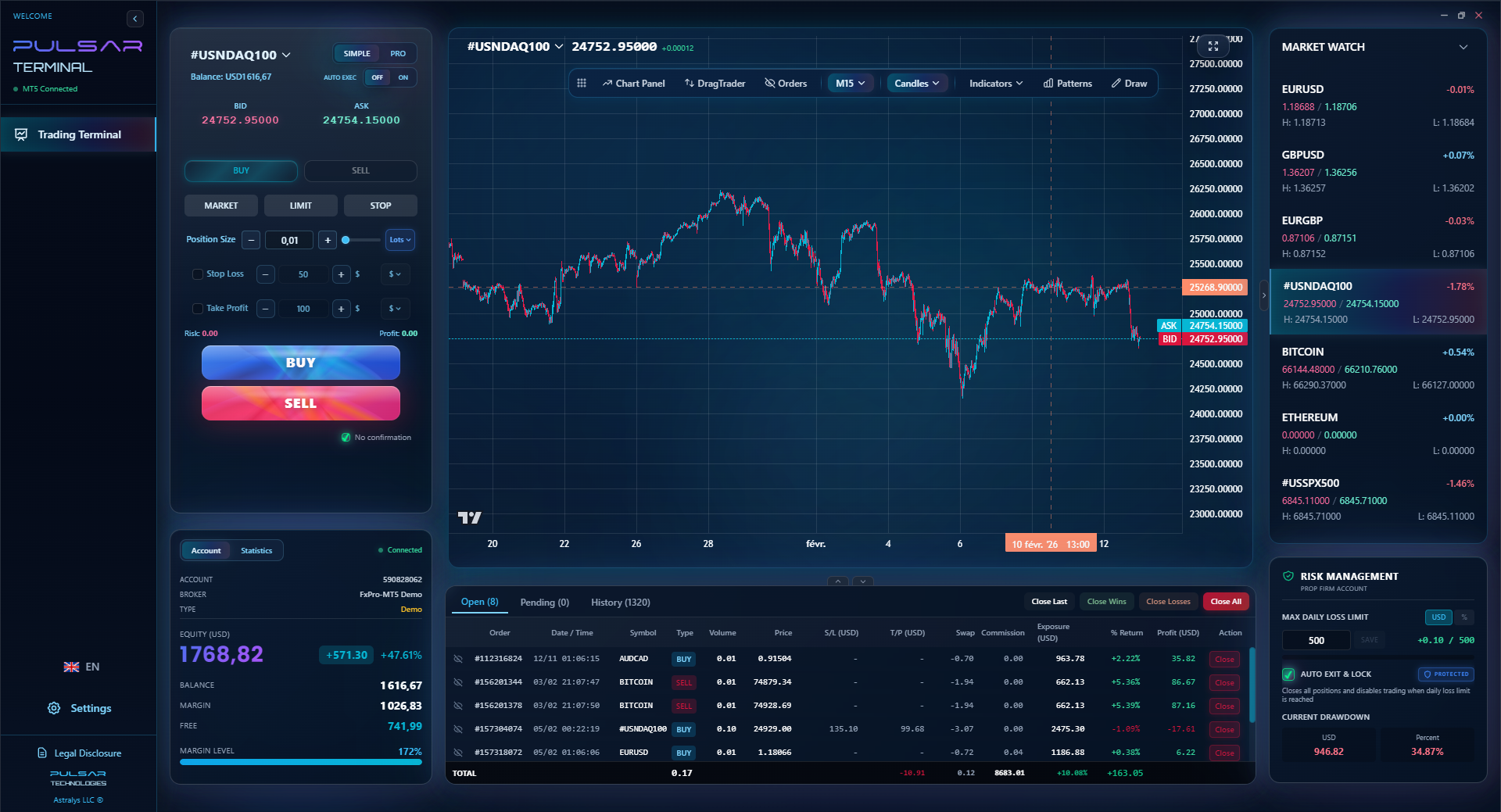
Passing a prop firm challenge requires robot-like discipline to their strict loss limits, which is where automating your risk management with a tool becomes non-negotiable.
Pulsar Terminal
Hepsi bir arada MT5 aracı: sürükle-bırak emirler, çoklu TP/SL, trailing stop, grid trading, Volume Profile ve prop firm koruması. Her gün 1.000'den fazla trader tarafından kullanılıyor.
“Investors aren't buying your dream; they're buying your proven ability to generate returns while managing risk.”
When you eventually do present to a potential private investor (like a high-net-worth individual who approaches YOU based on your track record), your proposal must be professional and risk-forward.
The Investment Management Agreement (IMA)
This is a non-negotiable contract drafted by a lawyer. It outlines:
- Fees: A management fee (e.g., 2% per year) and a performance fee (e.g., 20% of profits).
- Risk Disclosure: A clear statement that losses are possible and capital is at risk.
- Investor's Role: They provide capital but have no say in trading decisions.
- Reporting: How often you'll provide statements (monthly/quarterly).
- Withdrawals: The terms for adding or withdrawing funds.
The Central Role of Risk Management
This is what smart investors care about most. You must explain your risk controls in detail:
- Per-Trade Risk: "I never risk more than 1% of the account's total capital on a single trade." Use a position size calculator for this.
- Maximum Drawdown (Max DD): "My strategy has a historical maximum drawdown of 15%. I will stop trading and return funds if we ever hit a 20% drawdown from the highest point."
- use Discipline: "Even though the broker offers 1:500 use, my effective use on the account will never exceed 1:10."
I once presented to a potential investor and spent 10 minutes on my returns and 40 minutes on my risk management rules. He signed because of the 40 minutes, not the 10. He said, "Anyone can get lucky. I'm paying for the system that stops you from getting unlucky."

Example: If you have a $10,000 account and risk 1% per trade, your maximum loss per trade is $100. If your stop-loss is 50 pips away on GBP/USD, your position size must be calculated as: ($100) / (50 pips * $1 per pip per standard lot) = 0.20 lots. This precise math is what builds trust.
💡 Winston'ın İpucu
The SEC isn't your enemy; they're your blueprint. Their rules force you to build a real business, not a Ponzi scheme. See compliance as a competitive advantage.
“Anyone can get lucky. I'm paying for the system that stops you from getting unlucky.”
You have to be upfront about all the costs involved. Transparency here separates professionals from amateurs.
| Cost | Typical Rate | What It Means for Your Investor |
|---|---|---|
| Trading Costs (Spread/Commission) | EUR/USD: ~0.6 pips | This is the cost of entering/exiting trades. On a Zero account, you might pay a $3.50 commission per lot. |
| Your Performance Fee | 15-30% of profits | Your cut. Usually calculated quarterly or annually, after accounting for all losses. |
| Capital Gains Tax | 10% on gross profits | Crucial for Nigeria! The Federal Inland Revenue Service (FIRS) expects 10% tax on all trading profits, regardless of the broker's location. This comes out of the investor's returns, and you must account for it. |
| Bank/Transfer Fees | Varies | Costs for depositing/withdrawing from the broker, especially with international transfers. |
Let me give you a real example from 2022. I managed a small pool for two associates. We made a gross profit of ₦2,000,000.
- First, we paid the 10% capital gains tax: ₦200,000.
- Net profit after tax: ₦1,800,000.
- My 20% performance fee was on the after-tax profit: ₦360,000.
- Investors' net take-home: ₦1,440,000.
If I hadn't explained the tax part upfront, they would have expected ₦1,600,000. That conversation would have ended our partnership. Always model the returns after all costs and taxes.
“Anyone can get lucky. I'm paying for the system that stops you from getting unlucky.”
You don't find them; they find you. But you have to be visible in the right way.
- Network Within Trading Communities: Be active in serious Nigerian trading forums or Telegram groups (not the 'signal-sender' spam ones). Share your verified Myfxbook link when relevant. Offer genuine insights about the market, not boasts.
- Start with a 'Friends & Family' Round (The Legal Way): This doesn't mean taking their cash informally. It means presenting your verified track record, a simple IMA, and a clear risk document to people who already know and trust you. Keep it very small. My first formal pool was just three people and $5,000 total.
- Let Performance Attract Capital: As your prop firm accounts grow and your private track record extends to 2+ years, referrals will start. Someone who knows your investor will ask, "Who's managing your forex?" That's the best lead you can get.
Avoid at all costs: social media blasting, promising returns, or targeting people who don't understand the markets. That's the world of scams, and it will bury your reputation before it starts.

Pro Tip: Your first 'investor' should be a prop firm. Your second should be yourself again - re-investing your prop firm profits into your own personal account to compound your own wealth. This builds your personal balance sheet, making you more credible and less desperate when you do talk to external people.
💡 Winston'ın İpucu
When presenting returns, always show the 'net' figure - after your fees, after spreads, and after the 10% tax. The gross number is a fantasy. The net number is trust.
“The dream of getting investors is about graduating from a gambler to a professional. It's a slow, disciplined climb.”
I've seen talented traders destroy their chances by making basic errors.
- Underestimating the Psychological Load: Trading your own money is stressful. Trading for others is 10x worse. Every drawdown feels like a personal failure. You need rock-solid psychology.
- Changing Strategy for an Investor: Don't promise 5% monthly returns if your strategy typically yields 2%. You'll start forcing trades, breaking rules, and blowing up the account. Stick to your proven system.
- Poor Communication: Going silent during a losing period is a killer. Be proactive. Send a brief note: "Market is in a drawdown phase, as expected. We are at X% drawdown, well within our Max DD limit of Y%. Strategy rules are being followed." This maintains trust.
- Ignoring the Margin Call: Over-leveraging to chase a profit target is the fastest way to a disaster. A margin call doesn't just lose money; it ends your management career. Always keep use in check.
- Mixing Funds: Never, ever co-mingle investor funds with your personal trading capital. Use separate accounts, always. The legal and accounting nightmare is not worth it.
The dream of getting investors for forex trading is about graduating from a gambler to a professional. It's a slow, disciplined climb. It starts with respecting the law, proving yourself with real numbers, and managing risk like your future depends on it - because it does.
FAQ
Q1Is it legal to collect money from people in Nigeria to trade forex for them?
No, it is not legal to solicit or collect money from the public to trade forex without being a licensed Fund/Portfolio Manager with the Securities and Exchange Commission (SEC) Nigeria. Doing so operates an unregistered investment scheme, which the SEC actively prosecutes.
Q2What is the best way to start managing larger capital as a Nigerian forex trader?
The most practical and legal starting point is to pass evaluation challenges with proprietary trading firms. They provide the capital, you trade it for a profit split. It validates your skills without the legal burden of soliciting funds. It's a crucial step in learning how to get investors for forex trading the right way.
Q3How much tax do I pay on forex trading profits in Nigeria?
Forex trading profits are subject to a 10% Capital Gains Tax in Nigeria. This applies to all gross profits, whether you trade with a local or international broker. You must account for this when calculating returns for yourself or any investors.
Q4Do I need a license if I'm only managing money for my close family?
The legal line is blurry but risky. The SEC's rules are based on soliciting and managing funds for others, regardless of the relationship. To be completely safe and professional, even for family, you should have a formal Investment Management Agreement and treat it as a professional engagement. For significant amounts, seeking legal advice is essential.
Q5What's more important to show a potential investor: high returns or low drawdowns?
Low, controlled drawdowns are almost always more important. Smart investors prioritize capital preservation. A track record with a 15% annual return and a 8% maximum drawdown is far more attractive than one with 40% returns and 35% drawdowns. The latter shows unacceptable risk.
Q6Can I use a foreign broker to manage funds for Nigerian investors?
Yes, you can use a reputable international broker like IC Markets or Pepperstone. However, the legal requirement for a manager's license is based on your activity in Nigeria (soliciting/managing funds), not the broker's location. The 10% Nigerian capital gains tax also still applies on all profits.
Prof. Winston'ın Dersi
Önemli Noktalar:
- ✓Soliciting forex investment without an SEC license is illegal in Nigeria.
- ✓A 2+ year verified track record is your only valid pitch.
- ✓Prop firms are the safest first step to managing external capital.
- ✓Always model returns after the mandatory 10% capital gains tax.
- ✓Professionalism is shown in risk rules, not return promises.
Bu makale ne kadar faydalıydı?
Bir yıldıza tıklayın
Haftalık Trading Analizleri
Ücretsiz haftalık analiz ve stratejiler. Spam yok.
Yazar hakkında
Olumide Adeyemi
Batı Afrika Yatırım Öncüsü
Nijerya'nın en aktif forex eğitmenlerinden biri. Lagos'tan 8 yıllık ticaret deneyimi. Afrika'lı trader'lar için düşük sermaye stratejileri ve prop firma yarışmaları uzmanı.
Yorumlar
Risk Uyarısı
Finansal araçlarla işlem yapmak önemli riskler taşır ve tüm yatırımcılar için uygun olmayabilir. Geçmiş performans gelecekteki sonuçları garanti etmez. Bu içerik yalnızca eğitim amaçlıdır ve yatırım tavsiyesi olarak değerlendirilmemelidir. İşlem yapmadan önce her zaman kendi araştırmanızı yapın.
Bunları da beğenebilirsiniz

Cara Trading Forex Sukses: 7 Prinsip dari Trader Profesional
Cara trading forex sukses dengan 7 prinsip trader pro: manajemen modal, disiplin, journal trading, backtest. Data nyata, bukan janji profit palsu.
Jam Trading Forex Terbaik untuk Trader Indonesia: Panduan Lengkap dengan Tabel Waktu
Panduan jam trading forex untuk trader Indonesia. Tabel 4 sesi dunia, jam emas 20:00-00:00, sesi mana yang harus dihindari. Data akurat + tips dari trader berpengalaman.
Top 5 Sàn Forex Uy Tín Nhất 2026: Review Jujur dari Trader Indonesia
Top 5 sàn forex uy tín 2026 untuk trader Indonesia. Review jujur: spread, deposit, withdraw, dukungan lokal. Exness, XM, IC Markets & lebih.
Pulsar Terminal'ı Edinin
Tüm bu hesaplayıcılar MT5 hesabınızdan gerçek zamanlı verilerle Pulsar Terminal'e entegredir.
Pulsar Terminal'ı Edinin