


I once watched a client burn through R8 million trying to launch a brokerage.

David van der Merwe
Gelişen Piyasalar Yatırımcısı ·  South Africa
☕ 11 dk okuma
Neler öğreneceksiniz:
I once watched a client burn through R8 million trying to launch a brokerage. He thought it was about renting a fancy office in Sandton and buying a slick website. Sixteen months later, he was out of cash, his FSCA application was a pile of rejected paperwork, and his 'partner' from overseas had vanished with the remaining tech budget. That's the dream versus the reality. Starting a brokerage isn't trading; it's running a heavily regulated financial institution. If you're here because you think it's a quick path to riches, close this tab now. If you're serious about building something legitimate, and you understand it's a marathon requiring deep pockets and thicker skin, let's get to work.
Forget everything you've heard about 'offshore easy setups.' In South Africa, if you're offering forex or CFDs to the public, you answer to the Financial Sector Conduct Authority (FSCA). There's no way around it, and trying to operate without their blessing is a one-way ticket to fines, shutdowns, and possibly jail time.
The core license you need is a Financial Services Provider (FSP) license. For a forex brokerage, you're typically looking at a Category II license, which covers 'Discretionary Financial Services.' But here's the kicker: that's not enough on its own. You must also get specific permission to deal in Over-the-Counter (OTC) Derivatives. People often call this an 'ODP license,' though it's technically an added authority to your FSP license. Missing this detail is where many first applications get sent back.
The Non-Negotiable Requirements
The FSCA isn't messing around. Their checklist isn't suggestions, it's law.
- Local Presence: You must incorporate a company (Pty Ltd) in South Africa with a physical, registered office address. A PO Box or virtual office won't cut it for the regulator, though you can use one for marketing.
- Key Individuals: You need at least one Key Individual (KI) who is a South African resident. This person is legally responsible for the financial services. They need relevant experience and must pass the FSCA's regulatory exams (about R1,300 per exam). Finding a qualified, reputable KI is one of your biggest hurdles.
- Compliance Officer: You need a dedicated compliance officer. For a startup, this is often an external service, costing anywhere from R15,000 to R50,000+ per month. They build your rulebook: Anti-Money Laundering (AML), Know Your Customer (KYC), conflict of interest policies, you name it.
- Client Money Rules: This is sacred. Client funds must be held in segregated trust accounts at a reputable bank. You cannot touch this money for operational expenses. The moment you mix client and company funds, you've committed a cardinal sin.

Warning: The '6-9 month' processing time you hear is optimistic for a clean application. If your paperwork is sloppy or your business plan is weak, it can stretch to 12-18 months. Your capital needs to last through this entire period with zero revenue.
The regulatory framework builds on the FAIS Act, and now includes crypto assets as financial products. This isn't a static rulebook, it's a living document that changes. Your compliance officer's job is to keep you updated, because ignorance is never a defence.

💡 Winston'ın İpucu
Your first hire shouldn't be a salesman. It should be a ruthless, experienced compliance officer. They will save you from yourself and the regulator.
Let's talk numbers, because this is where dreams get a reality check. The license application fee (around $1,900 USD for Category II) is the smallest bill you'll pay. It's the tip of the iceberg.
Your startup capital isn't for trading; it's for building a fortress that the FSCA will approve. You need to show them you have enough cash to operate for at least a year, cover all potential liabilities, and still have a buffer.
| Cost Category | Low-End Estimate (ZAR) | Realistic Estimate (ZAR) | What It Covers |
|---|---|---|---|
| Initial Capital / Proof of Funds | 5,000,000 | 7,000,000 - 10,000,000 | Money set aside to cover liabilities. Not an expense, but must be in the bank. |
| Legal & Incorporation | 80,000 | 150,000 - 300,000 | Company registration, drafting MOI, initial legal advice. |
| Regulatory Application & Consulting | 250,000 | 400,000 - 800,000 | Compliance officer fees, application preparation, KI sourcing. |
| Technology & Infrastructure | 500,000 | 1,000,000 - 2,500,000 | Trading platform (MT4/5 white-label or full), CRM, back-office, liquidity bridge. |
| Operational Runway (12 months) | 1,500,000 | 2,500,000 - 4,000,000 | Salaries, office rent, marketing, banking fees, professional services. |
| **Total Cash Required ** | ~7.3 million | ~11 - 17 million |
Yes, you read that right. A realistic, fully-licensed startup needs R11 to R17 million in accessible capital. The R5 million 'minimum' you might see quoted is just for the proof of funds. It doesn't pay the bills.
I advised one group that budgeted R8 million. They blew through their technology budget in 4 months because they kept changing platform providers, then couldn't pay their compliance firm. The project died. Your tech stack is critical - you need a reliable MetaTrader 4 or 5 white-label solution or a more expensive custom platform, plus a rock-solid liquidity bridge to get client orders to the market. This isn't the place to hire your cousin's friend who 'knows computers.'

Pro Tip: Your biggest ongoing cost after launch is marketing. Acquiring a single active, depositing trader in South Africa can cost you R1,500 to R5,000 in advertising. If your average client deposits R10,000, you see the math problem. You need a deep war chest.
“Your biggest ongoing cost after launch isn't tech or salaries; it's marketing. Acquiring a single active trader can cost you more than their first deposit.”
This is the engine room. Your traders will judge you on two things: the trading platform and the execution quality. Screw up either, and they'll leave for IC Markets or Pepperstone in a heartbeat.
1. The Trading Platform: MetaTrader 4 (MT4) is still the king in South Africa. MT5 is growing. Offering both is smart. You have two main options:
- White-Label (WL): You rent a branded version of a larger broker's platform. It's faster and cheaper to launch (could be $10,000 - $50,000 setup). The downside? You have less control, and you're tied to your provider's liquidity and risk management systems.
- Full License: You buy the server license from MetaQuotes (the company behind MT4/5). This costs hundreds of thousands upfront but gives you full control. You then need to build or buy all the backend admin tools (CRM, reporting). This is the route for serious players with big budgets.
2. Liquidity & The Bridge: You are not the market. You need to connect to a liquidity provider (LP) or a prime broker - companies like PrimeXM, OneZero, or larger institutional banks. This requires a 'bridge' - software that connects your MT4/5 server to the LP's feeds. This is where spreads and execution speed are determined. A bad bridge means requotes, slippage, and angry clients.
3. The Back Office & CRM: This is where you manage clients, process withdrawals, monitor for suspicious trading (like scalping arbitrage), and generate reports for the FSCA. It's a massive, unsexy piece of software that's absolutely critical. Many WL solutions include a basic one.

Example: A client wants to withdraw R2,000. Your CRM should automatically check if the request meets your policy (e.g., only to verified accounts), flag it for compliance approval, generate the instruction to your payment processor, and then update the client's ledger. Doing this manually for hundreds of clients is impossible.
Your choice here defines your business model. Are you a market maker (taking the other side of some client trades) or a straight-through processing (STP) broker (passing all trades to the LP)? Most South African startups begin as a hybrid, using a WL provider that handles the risk. Understanding your own margin call and risk management settings within this system is non-negotiable.
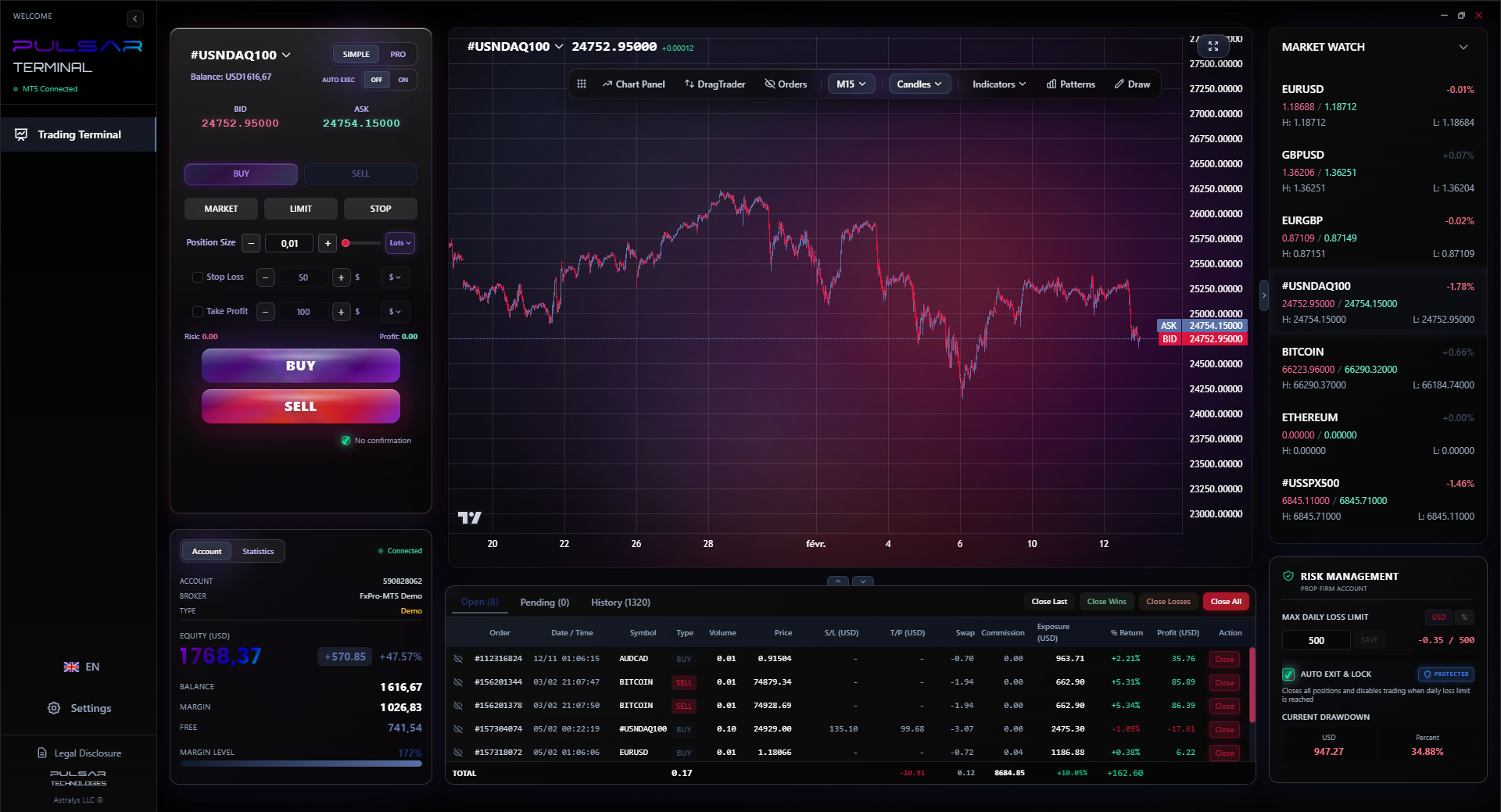
Managing complex trades and risk for your clients is a headache, which is why professional tools that integrate directly with your MT5 server, like Pulsar Terminal, are essential for serious operations.
Pulsar Terminal
Hepsi bir arada MT5 aracı: sürükle-bırak emirler, çoklu TP/SL, trailing stop, grid trading, Volume Profile ve prop firm koruması. Her gün 1.000'den fazla trader tarafından kullanılıyor.
If you thought regulation was tough, try opening a business bank account for a forex brokerage. South African banks are notoriously risk-averse. They'll scrutinize your FSCA application, your business plan, your shareholders, and likely still say no. You often need to start with smaller or niche banks, and even then, it's a fight.
Client Payment Methods: You must offer what the local market uses.
- Local EFTs: Instant EFTs via banks like FNB, Absa, Nedbank are essential. Processing time and fees are your problem.
- Credit/Debit Cards: Work with a payment processor that can handle Visa/Mastercard. Be aware of high fraud rates and chargebacks.
- Digital Wallets: PayPal, Skrill, and local solutions are expected. Each has its own integration cost and fee structure.
The 2025/2026 Exchange Control Wrinkle: This is a recent headache. The South African Reserve Bank (SARB) updated its rules in October 2025. Now, when your clients (who are South African residents) want to withdraw profits to an offshore account, your bank (the Authorised Dealer) must get a SARS Tax Compliance Status Approval for International Transfer (TCS-AIT PIN) for the client first.
In plain English: You can't just send your client's money overseas. You have to make sure SARS is happy they've paid their taxes. The onus is on your client to get this PIN from SARS, but you need to have the systems to collect and verify it before processing the withdrawal. If you mess this up, your bank faces penalties from the SARB, and they will drop you as a client. This single rule has added a massive layer of complexity and client education.
On the flip side, the 2026 budget increased the Single Discretionary Allowance to R2 million, making it easier for clients to get funds offshore for investment. It's a double-edged sword you need to understand inside out.
💡 Winston'ın İpucu
When budgeting, double your estimated marketing costs and triple your timeline for breaking even. If you can still afford it, you might be ready.
“In this business, your compliance officer is more important than your head of trading. One keeps you profitable, the other keeps you out of jail.”
You've got the license, the tech works, the bank account is open. Now you need the only thing that matters: clients. And in South Africa, you're competing with giant, well-funded international brokers who spend millions on marketing.
Forget TV ads. Your customer acquisition will be almost entirely digital and brutally expensive.
- Google & Facebook Ads: You'll be bidding against every other broker and 'trading guru' for keywords like 'forex trading South Africa.' Cost-per-click can be R50-R150. Converting that click to a live account? Maybe 1 in 200. Do the math.
- Affiliate Marketing & Introducing Brokers (IBs): This is where most brokers get clients. You pay a commission (a percentage of the spread or a fee per lot) to affiliates who refer traders to you. The good IBs have loyal followings. The bad ones will send you 'bonus hunters' who blow an account and leave. Vetting them is key.
- Educational Content: This is a long game. Create honest guides, webinars, market analysis. Build trust. It's slow, but the clients you get are better quality. You're not just selling a platform; you're selling a service.
Your Value Proposition: Why should a trader choose you over XM or any other established broker? Lower spreads? ZAR-denominated accounts? Better local support? Faster withdrawals? You need a clear answer. 'We're new' is not an answer, it's a liability.
I made this mistake early on, thinking a fancy website was enough. We spent R400,000 on a site and branding, but our deposit process was clunky. We had a 95% drop-off rate between sign-up and first deposit. We fixed the tech, but the marketing money was already gone. Your funnel needs to be seamless from ad to funded account.
Getting the license is the starting line, not the finish. The FSCA will monitor you. You have annual renewal fees, ongoing reporting requirements, and the constant threat of regulatory changes.
Annual Requirements:
- Financial Statements: Audited by a registered auditor.
- Compliance Reports: Your compliance officer submits regular reports on your adherence to your own policies.
- Levies: You pay annual levies to the FSCA based on your revenue.
The Big Risks:
- Client Litigation: A trader who loses money may blame your 'slow platform' or 'manipulated spreads.' Even if you win, legal defence is costly.
- Cybersecurity: You are a target for hackers. A breach that leaks client data or, worse, drains funds, will destroy your reputation and bring the regulator down on you.
- Operational Risk: What if your key liquidity provider goes down? What if your head of trading quits? You need redundancy plans.
- Market Risk: Even as a broker, you have risk. If you're running a B-book (keeping some trades in-house), a major market event like a flash crash can cause huge losses if your position size calculator and hedges aren't perfect. Most new brokers should avoid this and stick to pure STP.
Your business is a constant balancing act between profitability, client satisfaction, and regulatory box-ticking. One slip in any area can be fatal. It's a 24/7 operation, not a passive investment.
💡 Winston'ın İpucu
Before you sign a contract with a tech provider, get a current client reference. Call them and ask about downtime, support response, and hidden fees. Trust, but verify.
FAQ
Q1What is the absolute minimum amount I need to start a forex brokerage in South Africa?
In hard cash you need to spend? Realistically, R11 to R17 million. That covers the mandatory proof of capital (R5m+), plus all setup and operating costs for at least a year before you're profitable. Anyone telling you it can be done for less is either selling you a non-compliant white-label with no FSCA license, or they're lying. The license application fee itself is just under $2,000 USD, but that's a tiny fraction of the total cost.
Q2How long does it take to get an FSCA license for a forex brokerage?
Plan for 9 to 12 months for a complete, well-prepared application. The official estimate is 6-9 months, but delays are common if your paperwork has any issues. This isn't a quick process. You need to have all your capital, your key individual, your compliance framework, and your business plan fully ready before you even apply, and then you wait with zero revenue coming in.
Q3Can I use a white-label solution to start my brokerage?
Yes, and for most startups, it's the only viable path. A white-label gives you a branded MT4/5 platform, back-office tools, and often liquidity access from a larger broker. However, you still need your own FSCA license. The white-label provider does NOT give you their license. You are still fully responsible for all regulatory compliance, client fund segregation, and local laws. It's a tech shortcut, not a regulatory one.
Q4What are the use limits for retail traders with an FSCA-regulated broker?
The FSCA enforces a maximum use of 30:1 for retail traders on major forex pairs, in line with European standards. You can offer lower use, but you cannot exceed this cap for any client classified as retail. This limits the risk for traders (and indirectly for you), but it also means you can't attract reckless gamblers with 500:1 offers like some offshore brokers.
Q5Do I need to be in South Africa to run the brokerage?
Your company must be incorporated in South Africa with a physical address. Your appointed Key Individual (the person legally responsible to the FSCA) must be a South African resident. While you can have foreign partners or investors, the operational and compliance leadership needs a strong, physically present local footprint. You can't run it from a beach in Bali.
Q6What is the biggest mistake new brokerage founders make?
Underestimating the cost and time of regulation, and overestimating how easy it is to get clients. They blow 80% of their budget on fancy offices and a website before securing their license or setting up proper banking. They think, 'If we build it, they will come.' The truth is, you build it, then you spend a fortune on marketing to beg them to come, while fighting established players with 100x your budget.
Q7Can I offer trading in cryptocurrencies as well?
Yes, but it's an additional regulatory step. Since late 2022, crypto assets are classified as financial products under the FAIS Act. You would need to apply to the FSCA for a Crypto Asset Service Provider (CASP) license in addition to your FSP license. The FSCA started approving these in 2024. It adds another layer of complexity, compliance, and risk to your operation.
Prof. Winston'ın Dersi
Önemli Noktalar:
- ✓Minimum realistic startup capital: R11-17 million
- ✓FSCA license processing: 9-12 months minimum
- ✓Key Individual must be a SA resident
- ✓Client funds are sacred: segregated accounts only
- ✓Post-2025: Verify SARS PIN for offshore withdrawals
Bu makale ne kadar faydalıydı?
Bir yıldıza tıklayın
Haftalık Trading Analizleri
Ücretsiz haftalık analiz ve stratejiler. Spam yok.
Yazar hakkında
David van der Merwe
Gelişen Piyasalar Yatırımcısı
Johannesburg merkezli, gelişmekte olan piyasa dövizlerinde 11 yıllık deneyime sahip trader. ZAR pariteleri, FSCA düzenlemeli ticaret ve Güney Afrika piyasa analizi uzmanı.
Yorumlar
Risk Uyarısı
Finansal araçlarla işlem yapmak önemli riskler taşır ve tüm yatırımcılar için uygun olmayabilir. Geçmiş performans gelecekteki sonuçları garanti etmez. Bu içerik yalnızca eğitim amaçlıdır ve yatırım tavsiyesi olarak değerlendirilmemelidir. İşlem yapmadan önce her zaman kendi araştırmanızı yapın.
Bunları da beğenebilirsiniz

Cara Trading Forex Sukses: 7 Prinsip dari Trader Profesional
Cara trading forex sukses dengan 7 prinsip trader pro: manajemen modal, disiplin, journal trading, backtest. Data nyata, bukan janji profit palsu.
Jam Trading Forex Terbaik untuk Trader Indonesia: Panduan Lengkap dengan Tabel Waktu
Panduan jam trading forex untuk trader Indonesia. Tabel 4 sesi dunia, jam emas 20:00-00:00, sesi mana yang harus dihindari. Data akurat + tips dari trader berpengalaman.
Top 5 Sàn Forex Uy Tín Nhất 2026: Review Jujur dari Trader Indonesia
Top 5 sàn forex uy tín 2026 untuk trader Indonesia. Review jujur: spread, deposit, withdraw, dukungan lokal. Exness, XM, IC Markets & lebih.
Pulsar Terminal'ı Edinin
Tüm bu hesaplayıcılar MT5 hesabınızdan gerçek zamanlı verilerle Pulsar Terminal'e entegredir.
Pulsar Terminal'ı Edinin