


I stared at the screen, my stomach in knots.

Olumide Adeyemi
Batı Afrika Yatırım Öncüsü ·  Nigeria
☕ 11 dk okuma
Neler öğreneceksiniz:

I stared at the screen, my stomach in knots. My account balance read $187.32. Just two weeks earlier, I'd deposited $1,000, convinced I'd cracked the code. I'd chased a losing trade on EUR/USD, adding to it as it moved against me, sure it would turn around. It didn't. I ignored every rule, let emotion take over, and wiped out over 80% of my capital. That was my brutal welcome to forex trading over a decade ago. If you're starting out, you don't have to learn that way. This guide is the roadmap I wish I'd had, showing you exactly how to trade forex as a beginner without the expensive tuition I paid.
Forex, or foreign exchange, is simply the market where currencies are traded. It's the largest financial market in the world, open 24 hours a day, five days a week. You're betting on the value of one currency against another. Think of it like Naira to Dollar, but on a global scale with pairs like EUR/USD (Euro vs. US Dollar) and GBP/JPY (British Pound vs. Japanese Yen).
Why do people trade it? The appeal is clear: accessibility, potential for profit, and no central exchange. You can start with a relatively small amount. But let's be brutally honest. The 'why' for most beginners is the dream of quick money. My 'why' was financial freedom. It took me years to realize that the market doesn't care about your dreams. It only responds to your skill and discipline. Trading isn't a get-rich-quick scheme; it's a skill-based profession with a very high failure rate. The real reason to trade should be a fascination with the markets and a commitment to the long process of mastering them.

Warning: The high use offered by brokers is a double-edged sword. It can amplify tiny gains, but it amplifies losses even faster. That $1,000 I lost? use made it happen in minutes, not days.

💡 Winston'ın İpucu
Your first $1000 in the market is tuition, not investment. Expect to learn, not to earn.
Before you place a single trade, you need to speak the language. This isn't optional.
Understanding a Currency Pair
EUR/USD = 1.0850. This means 1 Euro is worth 1.0850 US Dollars. The first currency (EUR) is the 'base.' The second (USD) is the 'quote.' If you think the Euro will strengthen against the Dollar, you BUY (go long). If you think it will weaken, you SELL (go short).
What is a Pip?
A pip is how price movement is measured. For most pairs, it's the fourth decimal place. If EUR/USD moves from 1.0850 to 1.0851, it moved 1 pip. For pairs involving the Japanese Yen, it's the second decimal place. Knowing how to calculate a pip's value is critical for risk management. I have a simple pip definition and calculator guide that breaks it down.
What are Spreads and Commissions?
The spread is the difference between the buy (ask) and sell (bid) price. It's the broker's fee. A tight spread (like 0.8 pips on a major pair) is good. A wide spread eats into your profit before the trade even moves. Always check the typical spreads a broker offers. Some brokers, like IC Markets or Pepperstone, are known for consistently low spreads, which is crucial for certain styles like scalping strategy.
What is a Lot Size?
This is your trade size. A standard lot is 100,000 units of the base currency. Thankfully, you can trade micro lots (1,000 units) and mini lots (10,000 units). When I started, I traded micro lots exclusively. My biggest mistake early on was jumping to mini lots too soon because I got overconfident after a few wins.

“You are a risk manager first, a speculator second.”
This is where many beginners get scammed. You must choose a reputable, regulated broker. In Nigeria, look for brokers regulated by authorities like the FCA (UK), ASIC (Australia), or CySEC (Cyprus). They have client money protection rules.
I made my first deposit with an unregulated 'bucket shop' offering insane bonuses. Withdrawing my profits was a nightmare of delays and excuses. Never again.
What to look for:
| Feature | Why It Matters |
|---|---|
| Regulation | Protects your funds. Non-negotiable. |
| Low, Consistent Spreads | Reduces your trading costs. |
| Reliable Platform (MT4/MT5) | The industry standard. You'll learn on it. |
| Easy Deposits/Withdrawals | Local bank transfers or reliable payment processors. |
| Good Customer Support | Test their response time before depositing. |
I've used many over the years. For beginners, I often point people to reviews of brokers like XM review or Exness review as starting points for their own research, as they have solid local support here. But always, always do your own due diligence.

Pro Tip: Open a demo account with at least 3 different brokers. Test their platform speed, execution, and spreads during volatile market times (like news releases). Don't just look at the shiny website.
This is the most important section. Your psychology will make or break you. Technical knowledge is maybe 20% of the battle. The other 80% is managing yourself.
I used to sit glued to the screen, my heart racing with every pip movement. If a trade went my way, I'd close it early for a small profit, scared it would reverse. If it went against me, I'd hold on, praying, turning a small loss into a catastrophic one. This is the exact opposite of what you should do.
You need a trader's mindset:
- You are a risk manager first, a speculator second. Your primary job is to protect your capital.
- Losses are part of the business. Even the best traders have losing trades. The goal is to keep them small.
- Emotion is the enemy. You need rules to take you out of the decision-making process.
My turning point came after another blown account. I wrote a trading plan on paper. It had my entry rules, my exact exit rules for profit and loss, and my maximum daily loss limit. I followed it like a robot for 3 months, even when it felt wrong. That was my first profitable quarter. The plan saved me from myself.
A tool that later helped me enforce this mindset was using a trading journal that forced me to log every trade and emotion. Modern tools can automate parts of this discipline, like setting a hard daily stop-loss that closes all positions. For traders in prop firm challenges, this kind of automated discipline is non-negotiable to avoid a margin call.
“A brilliant strategy will fail with poor risk management.”
Don't try to learn 10 strategies. Master one. Here's a basic, price-action based framework you can start practicing on a demo account.
The Concept: Support & Resistance with a Trend Filter
- Identify the Trend: Use a simple moving average. I use the 50-period EMA on the 1-hour chart. If price is above it, look for buys only. If price is below it, look for sells only. This keeps you trading with the higher probability direction.
- Find Key Levels: Look for horizontal price levels where the market has reversed before. These are support (floor) and resistance (ceiling).
- Wait for a Reaction: In an uptrend (price above 50 EMA), wait for price to pull back to a support level. Watch for a bullish rejection candle (like a pin bar or a strong engulfing candle) to form at that support.
- Enter and Set Stops: Enter a buy order after the bullish candle closes. Place your stop loss just below the support level. Your take profit should be at least 1.5 to 2 times the distance of your stop loss.
Example from my journal: On GBP/USD, price was above the 50 EMA on the H1. It pulled back to a clear support at 1.2750. A bullish pin bar formed. I entered at 1.2758. Stop loss at 1.2740 (18 pips risk). Take profit at 1.2794 (36 pips target). The trade hit TP in about 8 hours. Risk:Reward was 1:2.
This isn't about fancy indicators. It's about reading what price is telling you. Once you're comfortable, you can add a basic indicator like the RSI indicator to help identify overbought/sold conditions within the trend. But start simple.

Example: If you risk $10 on that trade (18 pips), a 1:2 R:R means a potential $20 profit. The math must be clear before you enter. Use a position size calculator every single time.
💡 Winston'ın İpucu
If you can't explain your trade setup in one simple sentence, you don't have a strategy. You have a hope.

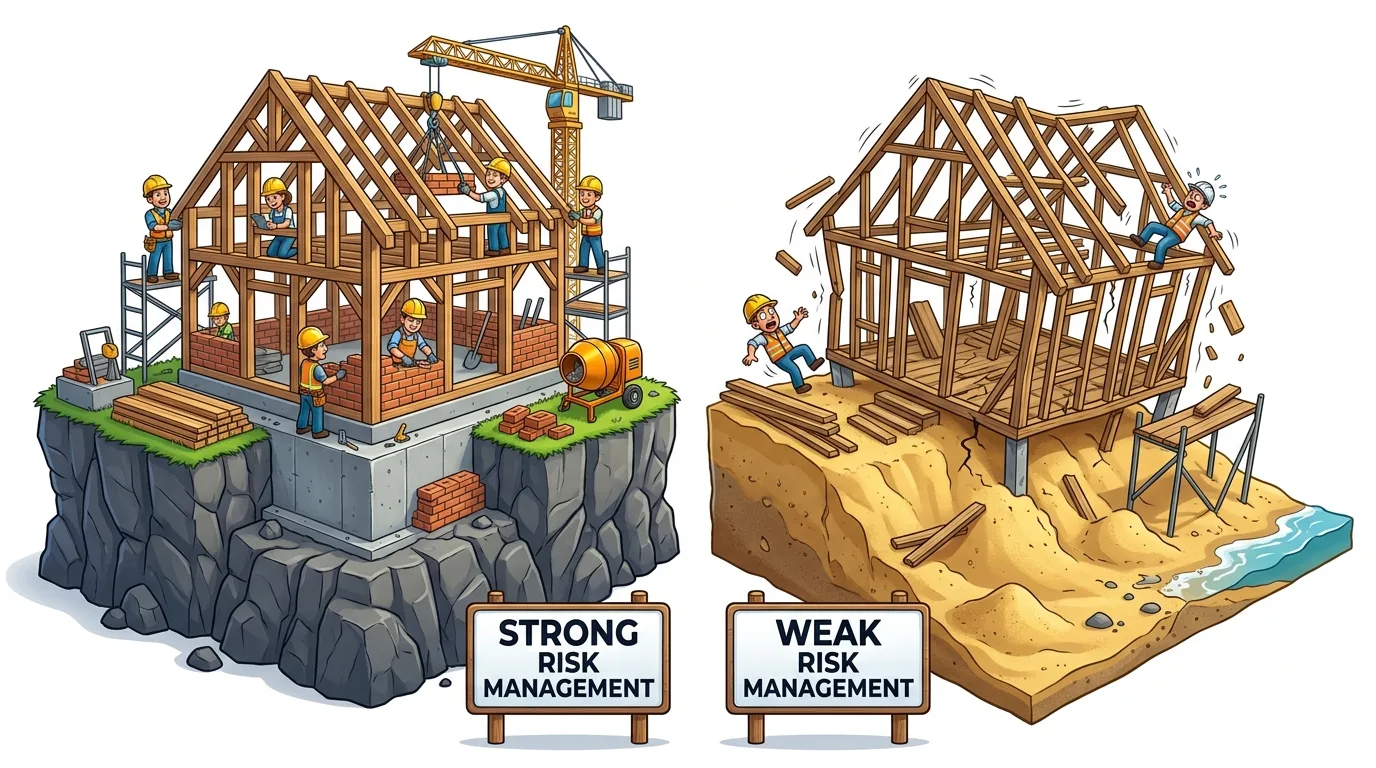
This is the master key. You can have a mediocre strategy and survive with excellent risk management. A brilliant strategy will fail with poor risk management.
The Golden Rule: Never risk more than 1-2% of your account on a single trade. Let's say you have a $500 account. 1% is $5. That $5 is your maximum allowable loss on the trade.
How does that translate to pips? If your stop loss is 25 pips away from your entry, then the pip value for that trade must be set so that 25 pips lost = $5. So, $5 / 25 pips = $0.20 per pip. You'd need to trade a position size that gives you a $0.20 pip value. A position size calculator does this math instantly.
I learned this the hard way. Early on, I'd risk 5-10% per trade. A string of 3 losses would decimate my account and my confidence. When I switched to 1%, a 5-trade losing streak was a manageable 5% drawdown. It kept me in the game.
Other essential rules:
- Set a Daily Loss Limit: If you lose 2-3% of your account in a day, stop trading. Walk away. Bad days happen.
- Use Stop Losses ALWAYS: No debate. If you don't know where you're wrong, you shouldn't be in the trade.
- Don't Move Your Stop Loss Further Away: This is just delaying a loss and usually making it bigger. Accept the loss and move on.
Managing multiple trades and their stops can be cumbersome on a basic platform. This is where having better order management tools can help you stick to your rules without emotional interference.
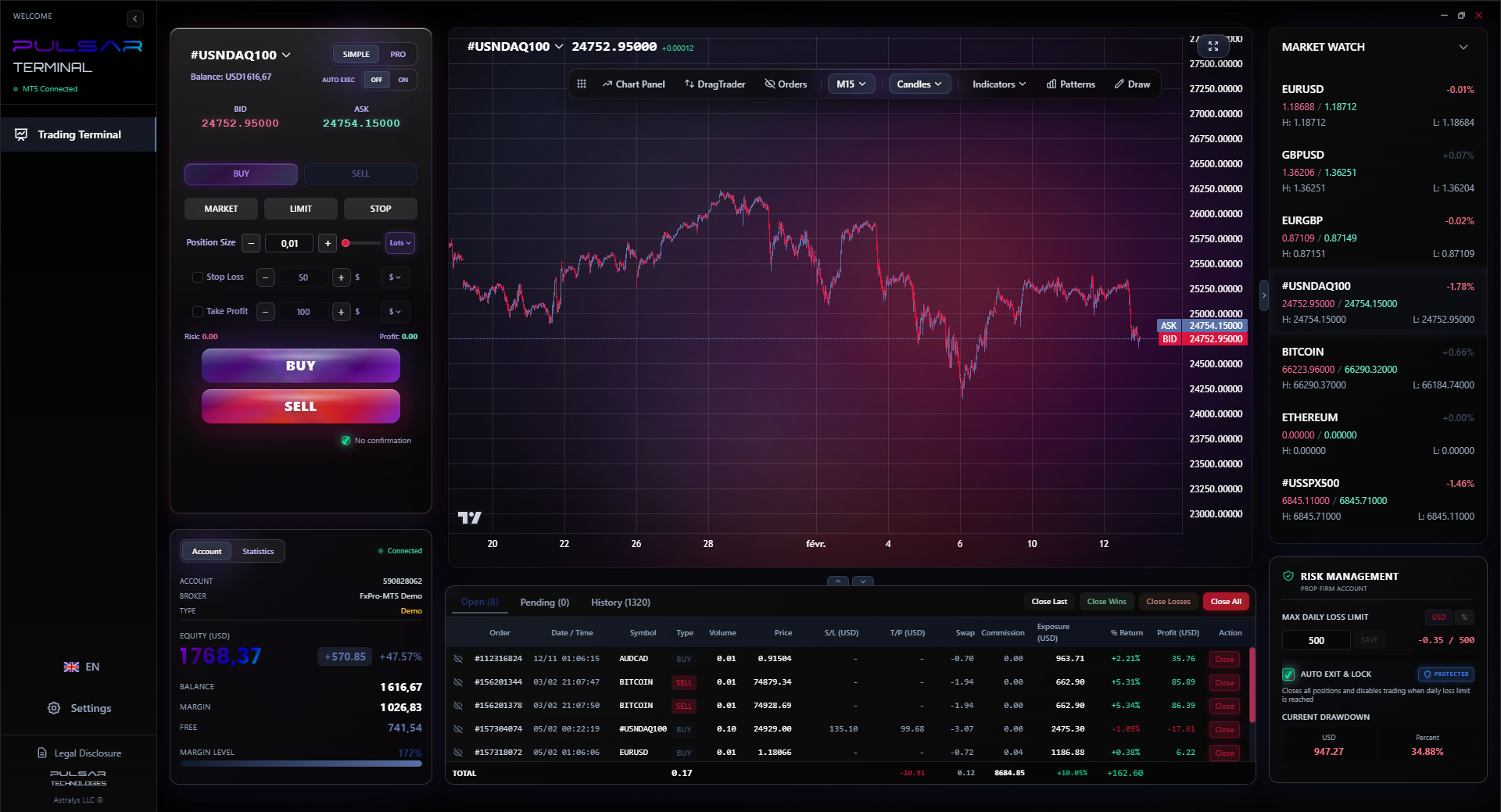
Manually calculating position size and managing multiple stop-loss orders for every trade is tedious and error-prone, which is why I now use tools that automate this directly on my MT5 platform.
Pulsar Terminal
Hepsi bir arada MT5 aracı: sürükle-bırak emirler, çoklu TP/SL, trailing stop, grid trading, Volume Profile ve prop firm koruması. Her gün 1.000'den fazla trader tarafından kullanılıyor.
“Boredom is not a trading signal.”
Let me save you some pain and money.
1. Overtrading: Boredom is not a trading signal. I used to trade 10-15 times a day, taking low-probability setups just to be 'in the market.' Most were losses. Quality over quantity. Now, I might take 2-3 high-conviction trades a week.
2. Revenge Trading: After a loss, the urge to 'get it back immediately' is powerful. This is when you take your biggest, dumbest trades. After a loss, I have a mandatory 1-hour break. No exceptions.
3. Ignoring Economic News: Trading right before a major news release (like US Non-Farm Payrolls) is gambling. The spreads widen massively, and price can spike 50 pips in a second. I learned this by getting stopped out instantly on what should have been a winning trade. Now, I check an economic calendar and avoid trading 15 minutes before and after high-impact news.
4. Chasing the Market: You see EUR/USD rocket up 50 pips. Fear of missing out (FOMO) kicks in, and you buy at the top. The move is exhausted, it reverses, and you're left holding a bag. If you miss an entry, wait. The market will always give you another opportunity. It's not going anywhere.
5. Not Keeping a Journal: This was my biggest operational mistake. Without a journal, you're just guessing. You don't know what's working. Start one today. Note the pair, entry/exit, reason for trade, and most importantly, your emotional state.
💡 Winston'ın İpucu
The market's job is to find the most people wrong. If your trade feels obvious and easy, be very careful.
Here's exactly what to do, in order.
Weeks 1-4: Education & Paper Trading
- Learn the basics from this guide and other reputable sources.
- Open a demo account with a reputable broker.
- Practice identifying trends and support/resistance levels on the charts. Don't trade yet.
- Get familiar with the trading platform. Learn how to place orders, set stops, and take profits.
Weeks 5-8: Demo Trading with Rules
- Paper trade the simple support/resistance strategy I outlined. Aim for consistency, not huge profits.
- Practice calculating your position size for every trade, risking 1% of your demo capital.
- Keep a detailed trading journal for every single demo trade.
- Review your journal weekly. What patterns do you see in your losing trades?
Weeks 9-12: Live Trading with Micro Lots
- Fund a live account with money you can afford to lose completely. Start small.
- Trade ONLY micro lots (0.01). Your goal is not profit. Your goal is to execute your plan perfectly and manage your emotions with real money on the line.
- Stick to your 1% risk rule and daily loss limit.
- If you can be breakeven or slightly profitable over 4 weeks of micro-lot trading, you're on the right path. Then, and only then, consider slowly scaling up.
Remember, this is a marathon. I didn't become consistently profitable for years. But by following a structured plan like this, you're building the right habits from day one. You can explore more advanced concepts like swing trading or specific instruments like XAU/USD guide once this foundation is rock solid.
FAQ
Q1How much money do I need to start trading forex?
Technically, you can start with as little as $50-$100 with some brokers offering micro accounts. However, I strongly advise starting with at least $500. This allows you to trade micro lots while properly implementing the 1% risk rule without your position size being absurdly tiny. More importantly, it's an amount whose loss won't devastate you financially, which is crucial for managing emotion.
Q2Can I really make money trading forex as a beginner?
It's possible, but extremely unlikely in the short term. Your primary goal for the first 6-12 months should be to not lose money, or to lose very little while you learn. Focus on education and preserving capital. The few beginners who make money early often get lucky, and luck is not a strategy. Consistent profitability comes from experience, discipline, and a tested system.
Q3What is the best time of day to trade forex?
The most liquid and volatile sessions are when two major markets overlap. The London-New York overlap (1 PM - 4 PM GMT) is often the most active. For beginners, I suggest starting by watching the London session open (8 AM GMT) or the New York session open (1 PM GMT). Avoid the Asian session initially, as lower liquidity can lead to erratic, whippy price movements that are harder to read.
Q4Which forex pair is best for beginners?
Start with the major pairs: EUR/USD, GBP/USD, USD/JPY, or USD/CHF. They have the tightest spreads (lowest trading costs) and the most available analysis. EUR/USD is often the most recommended because of its high liquidity and generally smooth trends. Avoid exotic pairs (like USD/TRY or EUR/SEK) as a beginner - they have wide spreads and can gap significantly.
Q5How long does it take to learn forex trading?
Think in terms of years, not months. It took me about 3 years to become consistently breakeven and another 2 to become consistently profitable. You can learn the mechanics in a few weeks. But mastering your own psychology, developing intuition, and building unshakable discipline takes thousands of hours of screen time and hundreds of trades. There are no shortcuts.
Q6Do I need to use a lot of indicators?
No, and I advise against it. Indicator overload leads to confusion and 'analysis paralysis.' I know successful traders who use only raw price action and support/resistance. Start with a clean chart. Add one trend-following tool (like a moving average) and one momentum oscillator (like the MACD indicator or RSI) at most. More indicators just give you more conflicting signals.
Prof. Winston'ın Dersi
Önemli Noktalar:
- ✓Risk only 1-2% of your capital per trade.
- ✓Master one simple strategy before learning ten.
- ✓A trading plan is useless unless you follow it.
- ✓Your psychology is 80% of the battle.
Bu makale ne kadar faydalıydı?
Bir yıldıza tıklayın
Haftalık Trading Analizleri
Ücretsiz haftalık analiz ve stratejiler. Spam yok.
Yazar hakkında
Olumide Adeyemi
Batı Afrika Yatırım Öncüsü
Nijerya'nın en aktif forex eğitmenlerinden biri. Lagos'tan 8 yıllık ticaret deneyimi. Afrika'lı trader'lar için düşük sermaye stratejileri ve prop firma yarışmaları uzmanı.
Yorumlar
Risk Uyarısı
Finansal araçlarla işlem yapmak önemli riskler taşır ve tüm yatırımcılar için uygun olmayabilir. Geçmiş performans gelecekteki sonuçları garanti etmez. Bu içerik yalnızca eğitim amaçlıdır ve yatırım tavsiyesi olarak değerlendirilmemelidir. İşlem yapmadan önce her zaman kendi araştırmanızı yapın.
Bunları da beğenebilirsiniz

Cara Trading Forex Sukses: 7 Prinsip dari Trader Profesional
Cara trading forex sukses dengan 7 prinsip trader pro: manajemen modal, disiplin, journal trading, backtest. Data nyata, bukan janji profit palsu.
Jam Trading Forex Terbaik untuk Trader Indonesia: Panduan Lengkap dengan Tabel Waktu
Panduan jam trading forex untuk trader Indonesia. Tabel 4 sesi dunia, jam emas 20:00-00:00, sesi mana yang harus dihindari. Data akurat + tips dari trader berpengalaman.
Top 5 Sàn Forex Uy Tín Nhất 2026: Review Jujur dari Trader Indonesia
Top 5 sàn forex uy tín 2026 untuk trader Indonesia. Review jujur: spread, deposit, withdraw, dukungan lokal. Exness, XM, IC Markets & lebih.
Pulsar Terminal'ı Edinin
Tüm bu hesaplayıcılar MT5 hesabınızdan gerçek zamanlı verilerle Pulsar Terminal'e entegredir.
Pulsar Terminal'ı Edinin