


You've slapped the RSI on your chart, seen it hit 70, and thought 'sell!' only to watch the price rocket higher.

Olumide Adeyemi
Batı Afrika Yatırım Öncüsü ·  Nigeria
☕ 11 dk okuma
Neler öğreneceksiniz:
You've slapped the RSI on your chart, seen it hit 70, and thought 'sell!' only to watch the price rocket higher. What gives? The RSI isn't a magic sell button, and using it wrong in the volatile markets we trade from Nigeria is a fast track to a blown account. I've made every mistake you can think of with this indicator. Let's cut through the noise and talk about how to actually use the Relative Strength Index in forex trading, with the Naira, local brokers, and our unique market quirks in mind.
The Relative Strength Index, cooked up by J. Welles Wilder back in 1978, is a momentum oscillator. It measures the speed and magnitude of recent price changes to evaluate overbought or oversold conditions. That's the textbook definition. Here's what it really is: a gauge of recent wins versus losses. It's not predicting the future. It's telling you if the recent price move has been a one-sided beatdown.
The classic setup is the 14-period RSI (that's 14 candles, whether they're 1-hour or daily). It moves between 0 and 100. The famous lines are 70 (overbought) and 30 (oversold). The problem? New traders see 70 and immediately short, or see 30 and immediately buy. In a strong trend, that's a recipe for disaster. The price can stay overbought for weeks. I learned this the hard way shorting GBP/USD every time RSI touched 70 during a monstrous bull run in 2017. I got stopped out three times before I admitted the trend was stronger than the indicator.

Warning: An RSI reading above 70 doesn't mean 'sell.' It means 'the recent momentum has been very strong to the upside.' In a powerful uptrend, that's just a confirmation of strength. The same logic applies to oversold readings in a downtrend.

💡 Winston'ın İpucu
Stop using the RSI like a traffic light. Red (70) doesn't always mean stop and sell. In a hurricane of an uptrend, it just means 'hold on tight.'
“The RSI isn't a magic sell button, and using it wrong in the volatile markets we trade from Nigeria is a fast track to a blown account.”
Overbought and Oversold... Contextually
Yes, the 70/30 levels are your starting point. But you must read them with the trend. In a clear uptrend, I only look for buy signals. That means I ignore the RSI going above 70. Instead, I watch for it to dip down to or below 30 (or better yet, 40) and then curl back up. That's a potential buy-in point within the larger trend. For a downtrend, flip it: watch for rallies to 70 (or drops to 60) and then a turn back down.
The 50 Line is Your Friend
This is underrated. The 50 level on the RSI is the centerline. Think of it as the momentum equator. When the RSI is above 50, it suggests the average momentum of the last 14 periods is bullish. Below 50, it's bearish. A crossover of the 50 line can be a cleaner signal than chasing extremes. A move from 45 to 55 on rising price is often stronger confirmation of a shift than an RSI leaping from 75 to 25.
The Holy Grail: Divergence
This is where the RSI earns its keep. Divergence occurs when price makes a new high (or low) but the RSI fails to make a corresponding new high (or low).
- Bearish Divergence: Price makes a higher high. RSI makes a lower high. This suggests upward momentum is waning, and a reversal or pullback is likely.
- Bullish Divergence: Price makes a lower low. RSI makes a higher low. This suggests selling momentum is exhausting, and a bounce is coming.
I caught a great one on XAU/USD (gold) last year. Price scratched out a new high at $2050, but the RSI on the 4-hour chart peaked at 65, well below its prior high of 78. That was a classic bearish divergence. I entered a short at $2048 with a stop at $2065. Gold proceeded to drop to $1980 over the next week. That's the power of divergence. You can learn more about trading this instrument in our XAU/USD guide.

Pro Tip: Don't use divergence on very short timeframes (like 1-minute charts). The noise will give you false signals all day. Stick to 1-hour charts and above for cleaner reads.
“An overbought reading in a strong uptrend is a sign of strength, not weakness.”
The default is 14 periods. It's default for a reason - it works. But you can tweak it.
- For more sensitive signals: Use a lower period, like 9 or 7. The RSI will swing more violently between overbought and oversold. This can be good for scalping strategy on faster pairs like EUR/USD, but you'll get more false signals.
- For smoother, stronger signals: Use a higher period, like 21 or 25. This slows the RSI down. It won't hit extremes as often, but when it does, the signal tends to be more reliable. This is my preference for swing trading setups.
What about the overbought/oversold levels? 70/30 is standard. Some traders use 80/20 for ultra-strong trends. Personally, I use 70/30 as 'alert zones' and 80/20 as 'extreme action zones.' If the RSI punches above 80 in an uptrend, I'm not buying, but I'm also not rushing to short. I'm waiting for it to break back below 70 to confirm any exhaustion.
Remember, with the high use offered by many brokers here (think 1:500 from Exness review or 1:1000 elsewhere), a few false signals can really hurt. Smoother settings can help filter out some of that noise. Always, always use a position size calculator before you enter. A bad RSI read with an oversized lot will ruin your week.
“An overbought reading in a strong uptrend is a sign of strength, not weakness.”
The RSI alone is a dangerous thing. It needs friends. You wouldn't use a hammer to fix everything in your house. Don't use just the RSI to trade.
My Go-To Combo: RSI + Moving Averages I use the 50-period and 200-period Exponential Moving Average (EMA) to define the trend. If price is above both EMAs, the trend is up. I then only take RSI signals that align: bullish divergences or oversold bounces. This simple filter would have saved me from those disastrous GBP/USD shorts I mentioned earlier.
RSI + Support/Resistance This is pure gold. Look for the RSI to become oversold (near 30) right as price touches a known, strong support level. That's a high-probability buy setup. The same for overbought at resistance. The key is confluence - multiple reasons for the market to react at a specific price.
RSI + MACD While both are momentum indicators, they work differently. The MACD indicator is trend-following. I might use the MACD to confirm the overall trend direction (e.g., MACD histogram above zero = bullish), and then use the RSI to time my entry on a pullback. If the MACD is bullish and the RSI dips to 40, that's a much stronger buy signal than an RSI at 40 in a market where the MACD is bearish.
Here's a real example from trading EUR/NGN (through a CFD). Price was in a clear downtrend, below all key EMAs. The RSI rallied to 65 - not even overbought - but it coincided with price hitting a descending trendline resistance. The MACD indicator histogram was still below zero, showing bearish momentum intact. That confluence was my sell signal. I didn't need to wait for RSI 70.
💡 Winston'ın İpucu
If you see a beautiful RSI divergence, don't jump in. Wait for the price to close a candle in the direction of your trade. Let the market pay the spread to confirm your idea.
“Divergence is a warning, not a command. Wait for price action confirmation.”
Let's get vulnerable. Here's where I've sent money into the market's pockets using the RSI poorly.
- Selling at 70 in a Bull Market. This is the classic. I did it on Bitcoin in 2020. RSI hit 75 on the daily chart. I shorted. Bitcoin proceeded to go on a tear, with the RSI staying above 70 for almost a month. My stop-loss was obliterated. The lesson? The trend is king. An overbought reading in a strong uptrend is a sign of strength, not weakness.
- Ignoring Divergence Failures. Not every divergence works. Sometimes you get a bullish divergence, buy in, and the price just chops sideways before breaking lower. I lost about 1.5% of my account on a USD/JPY trade like this. I saw the divergence, but ignored that price was stuck below a major 4-hour moving average. The lesson? Divergence is a warning, not a command. Wait for price action confirmation - a bullish candle closing above a key level, for instance.
- Using RSI on Low Timeframes with High use. This is a deadly cocktail common in Nigeria because of our appetite for high use. Scalping the 1-minute chart with RSI and 1:500 use is gambling. The spread alone (check your broker's spread definition) will eat you alive, and market noise will generate constant false signals. I tried it early on with a $200 account on a broker offering 1:1000. I was up 30% in an hour, felt like a genius, and was back to zero 90 minutes later. The RSI was whipsawing between 25 and 75 every few minutes. It was useless.
Warning: If you're trading with the extreme use some brokers offer here, a single misread RSI signal can trigger a margin call. Your settings need to be more conservative, not more aggressive.
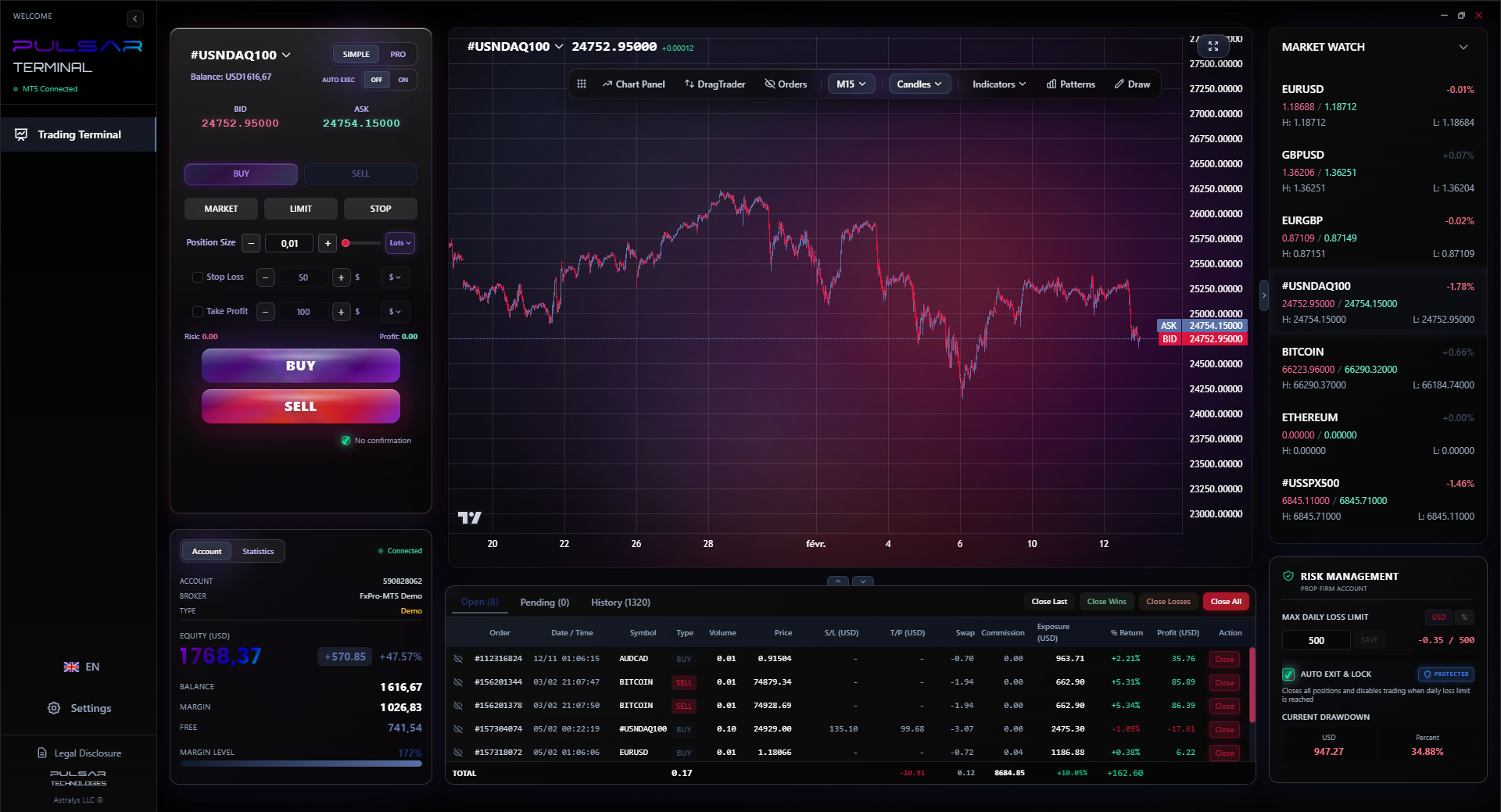
Manually moving stops to breakeven after an RSI trade moves in your favor is a hassle; Pulsar Terminal automates breakeven and trailing stops directly on your MT5 chart.
Pulsar Terminal
Hepsi bir arada MT5 aracı: sürükle-bırak emirler, çoklu TP/SL, trailing stop, grid trading, Volume Profile ve prop firm koruması. Her gün 1.000'den fazla trader tarafından kullanılıyor.
“Divergence is a warning, not a command. Wait for price action confirmation.”
Trading from Nigeria isn't abstract. It comes with real costs and platform choices that affect how you use the RSI.
The Tax Man Cometh Remember, the Nigerian government wants 10% Capital Gains Tax on your profits. That RSI divergence that netted you $1000? It's actually $900. Factor this into your risk-reward. If your RSI-based system has a 1:2 risk-reward, that post-tax reward is effectively lower. It pushes you towards needing more accuracy or better reward ratios.
Platforms and Execution Most of us use MT4 or MT5. The RSI is built right in. But here's a tip: on platforms like MT5 from IC Markets review or cTrader from Pepperstone review, you can change the RSI's appearance. I make the 70 and 30 lines bold and a different color. It helps visually. Also, be aware of your broker's execution speed. If you're trading RSI bounces off support on a 5-minute chart, a slow execution or requote can turn a winning trade into a loser by the time your order fills.
Spreads Matter When the RSI gives you a signal at 30.5 and starts turning up, you want to buy. But if your broker's spread on that pair is 2 pips, you're already starting the trade in a hole. This is especially crucial for mean-reversion RSI plays. I prefer brokers with tight, consistent spreads for this reason. That extra 0.5 pip of spread can be the difference between your RSI signal being valid or not by the time you get filled.
Local Pairs & Liquidity Trading something like USD/NGN? Be warned: liquidity can be thinner, and spreads wider. The RSI might behave more erratically. I generally stick to major forex pairs (EUR/USD, GBP/USD) for my RSI strategies because the liquidity is deep and the indicator behaves more predictably. You can get a deep dive on the most traded pair in our EUR/USD guide.
💡 Winston'ın İpucu
Your most profitable RSI trade will be the one you don't take because the trend was against it. Patience is an indicator too.
“The RSI isn't the star of the show. It's a supporting actor that helps the lead (price action and trend) deliver a better performance.”
Let's walk through a recent setup I took, step-by-step.
Instrument: AUD/USD Timeframe: 4-Hour Chart Broker: I was using an account with XM review at the time.
- Trend Analysis: Price was consistently making higher highs and higher lows, trading above the 50-period and 200-period EMA. Clear uptrend. Rule established: Only look for buy signals.
- RSI Observation: The RSI (set to 14) had been oscillating between 40 and 75 for weeks, respecting the trend. It never went below 35.
- The Setup: Price pulled back to a previous resistance level that had now turned into support (a classic 'break and retest'). At the same time, the RSI dipped down to 42.
- Confluence: My buy zone was the support area + RSI near oversold in an uptrend. I didn't wait for it to hit 30. At 42, with price touching support, I had my signal.
- Entry & Management: I entered a buy order at 0.6650. My stop-loss was placed below the support zone at 0.6620 (30 pips risk). My first take-profit target was set at 0.6710 (60 pips), giving me a 1:2 risk-reward. I used a simple 2% position size based on my account balance.
- The Result: Price bounced off support, the RSI curled back above 50, and my first target was hit within two days. I moved my stop to breakeven after the first 40-pip gain. The trade worked because I used the RSI in context - not in isolation.
This is the mindset. The RSI isn't the star of the show. It's a supporting actor that helps the lead (price action and trend) deliver a better performance.
FAQ
Q1What is the best RSI setting for forex trading?
There's no single 'best' setting, but the default 14-period is a great starting point. For less noise and stronger signals, try 21 or 25 periods, especially for swing trading. For faster, more sensitive signals (with more false alerts), try 9 or 7. Your choice should match your trading style and the volatility of the pair you're trading.
Q2Can I use RSI for scalping in forex?
You can, but it's tricky and I don't recommend it for beginners, especially with the high use common in Nigeria. On very low timeframes (1-min, 5-min), the RSI whipsaws constantly due to market noise and spread costs. If you do scalp with it, use it on slightly higher timeframes like the 15-min chart, combine it with strong support/resistance levels, and be hyper-aware of your broker's spreads.
Q3RSI is showing overbought, but the price keeps rising. What should I do?
Do not fight the trend. An overbought RSI in a strong uptrend is a sign of momentum, not an automatic sell signal. In this case, you should either avoid taking a sell trade, or wait for the RSI to show bearish divergence (price makes a new high, RSI makes a lower high) AND for price action to show weakness (like a bearish reversal candle pattern) before considering a short.
Q4How does the 10% capital gains tax in Nigeria affect my RSI trading strategy?
It effectively reduces your net profit on every winning trade. This means your risk-reward ratio needs to be even more favorable. A 1:2 risk-reward trade becomes a 1:1.8 after tax. It pushes you to either be more selective with your RSI signals (higher win rate) or aim for trades with a larger reward relative to your risk (like 1:3 or better) to offset the tax impact.
Q5What's more important, RSI divergence or the overbought/oversold levels?
In my experience, divergence is a far more powerful signal, especially when it occurs at a key support or resistance level. Overbought/oversold levels are best used as alert zones within the context of the trend. A divergence signals a potential momentum shift, while an extreme level just tells you the momentum has been strong.
Q6Should I use RSI on exotic pairs like USD/NGN?
Be very careful. Exotic and local currency pairs often have wider spreads and lower liquidity. This can cause the RSI to behave erratically, giving false or exaggerated signals. I strongly recommend practicing and using the RSI primarily on major forex pairs (EUR/USD, GBP/USD, USD/JPY) where market conditions are more stable and the indicator is more reliable.
Prof. Winston'ın Dersi
Önemli Noktalar:
- ✓The 70/30 RSI levels are alert zones, not trade signals.
- ✓Always filter RSI signals with the prevailing trend direction.
- ✓A divergence needs price action confirmation to be valid.
- ✓Factor Nigeria's 10% capital gains tax into your risk-reward math.
Bu makale ne kadar faydalıydı?
Bir yıldıza tıklayın
Haftalık Trading Analizleri
Ücretsiz haftalık analiz ve stratejiler. Spam yok.
Yazar hakkında
Olumide Adeyemi
Batı Afrika Yatırım Öncüsü
Nijerya'nın en aktif forex eğitmenlerinden biri. Lagos'tan 8 yıllık ticaret deneyimi. Afrika'lı trader'lar için düşük sermaye stratejileri ve prop firma yarışmaları uzmanı.
Yorumlar
Risk Uyarısı
Finansal araçlarla işlem yapmak önemli riskler taşır ve tüm yatırımcılar için uygun olmayabilir. Geçmiş performans gelecekteki sonuçları garanti etmez. Bu içerik yalnızca eğitim amaçlıdır ve yatırım tavsiyesi olarak değerlendirilmemelidir. İşlem yapmadan önce her zaman kendi araştırmanızı yapın.
Bunları da beğenebilirsiniz

Cara Trading Forex Sukses: 7 Prinsip dari Trader Profesional
Cara trading forex sukses dengan 7 prinsip trader pro: manajemen modal, disiplin, journal trading, backtest. Data nyata, bukan janji profit palsu.
Jam Trading Forex Terbaik untuk Trader Indonesia: Panduan Lengkap dengan Tabel Waktu
Panduan jam trading forex untuk trader Indonesia. Tabel 4 sesi dunia, jam emas 20:00-00:00, sesi mana yang harus dihindari. Data akurat + tips dari trader berpengalaman.
Top 5 Sàn Forex Uy Tín Nhất 2026: Review Jujur dari Trader Indonesia
Top 5 sàn forex uy tín 2026 untuk trader Indonesia. Review jujur: spread, deposit, withdraw, dukungan lokal. Exness, XM, IC Markets & lebih.
Pulsar Terminal'ı Edinin
Tüm bu hesaplayıcılar MT5 hesabınızdan gerçek zamanlı verilerle Pulsar Terminal'e entegredir.
Pulsar Terminal'ı Edinin