


I remember the first time I saw an ad for an instant funded account.

James Mitchell
Kıdemli Yatırım Analisti
☕ 13 dk okuma
Neler öğreneceksiniz:
- 1What Exactly Are Instant Funded Prop Firms?
- 2The Real Costs (And Why The Math Is Stacked Against You)
- 3The Silent Killer: Daily Loss & Maximum Drawdown Rules
- 4The Looming Regulatory Storm (2024-2026)
- 5So, Who Actually Benefits From Instant Funding?
- 6Choosing a Firm: The Due Diligence Checklist
- 7My Final Verdict & Realistic Alternatives
I remember the first time I saw an ad for an instant funded account. 'Trade with $50,000 today, no challenge!' It was January 2023, and I was frustrated after failing a two-phase evaluation by just 0.5%. I thought, 'This is it. Skip the grind.' I paid a $250 fee for a $25,000 account. Within 48 hours, I was down $1,250 - my daily loss limit - and the account was closed. That $250 lesson taught me more about instant funding than any sales page ever could. Let's talk about what these firms really are, who they're for, and the regulatory storm that's changing everything.
In simple terms, an instant funded prop firm lets you skip the traditional evaluation or 'challenge' phase. You pay a one-time or monthly fee, and boom, you're trading what looks like real capital right away. No profit target to hit, no time limit, no simulated first phase. It sounds like a cheat code, right?
Here's the catch, and it's a big one. With a traditional prop firm, you're trading in a simulated environment during the challenge. If you pass, you often graduate to a live account where the firm's real money is on the line. With many instant funding models, you're still trading in a simulation, even after you pay. The firm isn't risking its capital until you prove you can be consistently profitable. Your 'profits' are tracked, and if you hit their payout threshold, they pay you out of their own pocket. It's a performance fee model, not true capital allocation.

Warning: Don't confuse 'instant funding' with 'instant access to a firm's real money.' In most cases, you're buying the right to prove yourself in a live simulation. The real funding - where the firm's balance sheet is at risk - often comes later, after you've passed a profit target or demonstrated consistency.
The appeal is obvious, especially after you've blown a few challenges. The psychological pressure of a 10% profit target in 30 days is gone. You can trade your normal scalping strategy without the clock ticking. But that pressure is replaced by another: the daily loss limit. This is where most traders, myself included, get wrecked.

💡 Winston'ın İpucu
The daily loss limit isn't a suggestion, it's a guillotine. Size your positions so that three consecutive max-stop losses in a day won't trigger it. If your limit is 5%, risk 1% per trade, max.
“Instant funding replaces the pressure to make money with the immense pressure to not lose money on any single day.”
Let's talk numbers, because the marketing glosses over them. That '$50,000 account for $299' isn't what it seems.
The Upfront Fee Structure
Instant funding fees are usually lower than big evaluation challenges. You might see a $10,000 account for $99 or a $100,000 account for $499. It feels cheap for the size. But compare that to a traditional two-step evaluation from a firm like Apex Trader Funding, where a $50,000 account challenge might cost $167 for a monthly fee. The instant route has a higher upfront cost for the privilege of skipping the test.
The Profit Split Illusion
They'll advertise '80% profit split' or even '90% to the trader!' Sounds great. But this is a split of simulated profits. Let's run a real example from my trading log.

Example: I took a $25,000 instant account with Firm X (a popular one in 2024). My fee was $199. The rules: 5% max daily loss ($1,250), 10% max overall loss ($2,500), 80% profit split. I traded EUR/USD well for two weeks, built a $1,000 simulated profit. At 80%, my first payout would be $800. Minus the $199 fee, my net is $601. Not bad. But to request that payout, I needed a minimum of $500 in profit. Many firms have these thresholds. So if you make $499, you can't withdraw. You have to keep trading and risk giving it back.
The Harsh Statistics
Industry data is brutal. While 5-10% pass challenges, the stats for instant funded accounts aren't much sunnier. One internal leak from a major firm showed only about 7% of funded accounts ever requested a payout. The average payout size was around 4% of the account value. Think about that. On a $50,000 account, the average payout is roughly $2,000. And only 7 out of 100 traders even get that far.
The real cost isn't just the fee. It's the opportunity cost of not improving your strategy in a structured, evaluative environment. I learned more from failing two challenges than from blowing three instant accounts. The challenge forced me to fix my position size calculator inputs and respect my stop-losses.
“The average payout from a funded account is about 4% of its value, and only 7% of traders ever see one.”
This is the heart of the instant funding model. Since there's no profit target to pass, the firm's risk management is entirely focused on limiting your losses. They do this with two iron-clad rules that are far more restrictive than most retail traders realize.
- Daily Loss Limit: This is usually a fixed percentage of your starting account balance, often between 3% and 5%. On a $10,000 account, a 5% daily loss limit is $500. Hit that, and your account is suspended or closed for the day. Sometimes it's a hard stop for the entire account. My $1,250 loss I mentioned earlier? That was a 5% daily limit on a $25k account. One bad trade on XAU/USD did it.
- Maximum Overall Drawdown (or Trailing Drawdown): This is your absolute loss limit. It's often trailing, meaning it follows your account's highest balance. If you start at $10,000 with a 10% max drawdown, your stop-out point is $9,000. If you profit and push your balance to $10,500, your new stop-out point might trail up to $9,450 (10% below the high). You can't just lose, wait, and try again. The drawdown follows you up.
These rules require a completely different mindset. You're not just avoiding blowing up your account. You're avoiding a single bad day. It forces hyper-aggressive loss management. A 2% risk-per-trade rule might be too high. If you take two losing trades in a day at 2% each, you're at 4% and dangerously close to your daily limit. You have to size tiny and be incredibly selective.

Pro Tip: Before you fund an instant account, paper trade with their exact rules for two weeks. Use a position size calculator set to their daily loss limit. If you can't survive a string of two or three losses without hitting the daily max, your strategy isn't ready.
The psychological effect is real. Knowing one bad session can end it creates a fear that leads to missed opportunities. I once watched a perfect MACD indicator crossover on the 1-hour chart but didn't take it because I was already down 2.5% that day from a scratch trade. The trade ran for 80 pips. The fear of the daily limit cost me more than the limit itself would have.
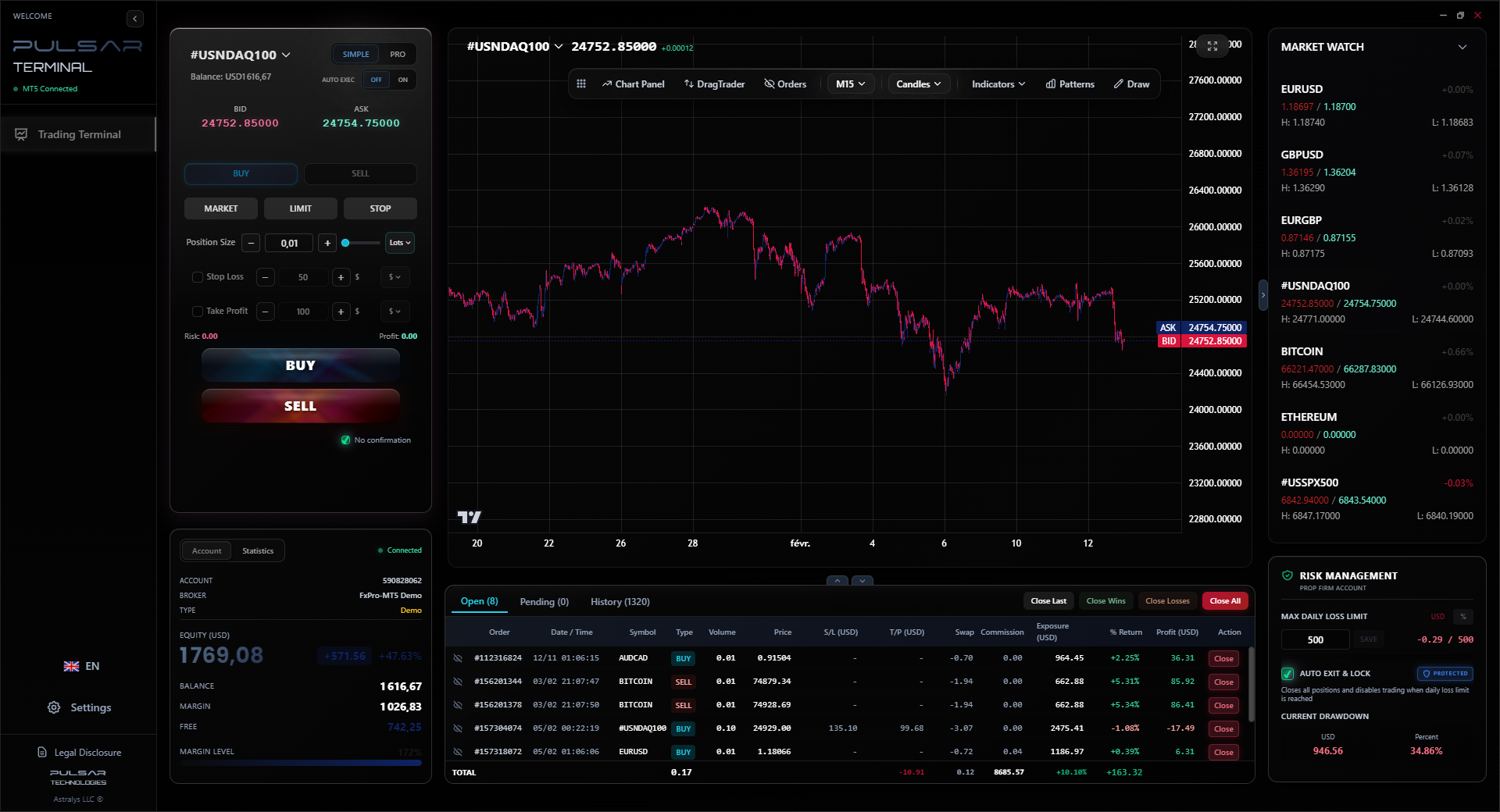
Managing a daily loss limit manually is stressful; Pulsar Terminal can set hard equity-based stop-outs directly on your MT5 chart, automating the firm's most critical rule.
Pulsar Terminal
Hepsi bir arada MT5 aracı: sürükle-bırak emirler, çoklu TP/SL, trailing stop, grid trading, Volume Profile ve prop firm koruması. Her gün 1.000'den fazla trader tarafından kullanılıyor.
“The average payout from a funded account is about 4% of its value, and only 7% of traders ever see one.”
Here's the thing most bloggers won't tell you: the entire prop firm industry, especially the instant funding model, is on shaky legal ground in the US. It's not illegal, but it's operating in a gray area that regulators are starting to flood with light.
As of now, most prop firms avoid direct SEC or CFTC registration by arguing they're not broker-dealers or investment advisors. They're selling an 'evaluation service' for a fee. Your trades, even in a 'funded' account, are often executed in a simulated environment. The firm then pays you a share of your simulated profits as a 'performance fee.' This clever structure has kept them under the radar.
But that's changing. Fast.
By 2026, the consensus among compliance experts I've spoken to is that the CFTC will likely classify these evaluation-based firms as Commodity Trading Advisors (CTAs). This is a game-over level change. CTAs must register, meet capital requirements, provide extensive risk disclosures, and are subject to regular audits. The compliance cost would be enormous.
We're already seeing the tremors. In 2024, over 80 prop firms shut down. Not just small ones - big names like Fidelcrest and SurgeTrader closed up shop. My Forex Funds, a giant in the instant funding space, faced major regulatory action that reshaped its business. State 'Blue Sky Laws' are being used to target firms for deceptive marketing.
What does this mean for you, the trader?
- Firms will vanish. The $99 fee you pay today might be to a company that doesn't exist in 6 months. Your tracked profits? Gone.
- Rules will get stricter. Expect tighter KYC (Know Your Customer), lower use, and more transparent (and restrictive) risk disclosures. Some firms are already moving use on indices and oil down to 1:5.
- The shift to 'real' execution. To survive, firms are partnering with actual regulated brokers (like the ones we review, such as IC Markets or Pepperstone) to execute trades on live markets. This adds legitimacy but also cost, which will be passed on to you.
Trading with an instant funded prop firm in 2025-2026 is like building a sandcastle below the high-tide line. The landscape is going to look very different, very soon.
💡 Winston'ın İpucu
Your first goal with an instant account isn't a payout. It's surviving 30 trading days without violating a single rule. That's the real challenge, and most fail it.
“Trading with an instant funded prop firm now is like building a sandcastle below the high-tide line.”
Given the costs, restrictive rules, and regulatory uncertainty, are these firms good for anyone? Honestly, yes, but for a very specific profile.
Instant funding is potentially a good fit if you:
- Are a consistently profitable, experienced retail trader with years of statements to prove it. You have a proven edge and solid risk management.
- Struggle specifically with the time pressure of evaluation challenges but not with discipline. Your swing trading system needs 6 weeks to work, not 30 days.
- Need to test a strategy in a 'live' psychological environment without risking your own capital. The fee is a cost of education.
- Understand it's a high-cost, short-term capital access tool, not a long-term career solution.
You should avoid instant funding like the plague if you:
- Are new to trading.
- Are using it as a way to avoid learning proper risk management.
- Think it's 'free money' or a way to gamble with 'house money.'
- Cannot easily afford to lose the enrollment fee multiple times.
For most people, the traditional evaluation model is better. It's cheaper, it provides a structured learning path, and the firms that use it (like FTMO, though not available in the US) have a longer track record. The challenge phase is a feature, not a bug. It teaches you to trade under constraints, which is what all professional trading is.
My personal rule now? I use one small instant account as a psychological gauge. If I can't be profitable with its tiny daily loss limit, I know my mindset is off, and I shouldn't be trading my main retail account either. It's a $100 monthly canary in the coal mine.
“Trading with an instant funded prop firm now is like building a sandcastle below the high-tide line.”
If you've decided to proceed, you can't just pick the shiniest ad. You have to do detective work. Here’s my checklist, born from painful experience.
1. Payout Transparency & History: Don't just look for 'Weekly Payouts.' Dig on Twitter, Discord, and Forex forums for actual payout proofs from the last 30 days. Are people complaining about delays? In late 2024, I saw multiple firms suddenly change payout terms from weekly to monthly, trapping profits. A good sign is a firm that uses trusted third-party payment processors.
2. The Broker Partnership: This is critical for execution. Which broker does the firm use? Is it a reputable, regulated entity like those behind XM or Exness? Or is it a no-name offshore broker? Slippage and requotes during news events will kill a scalper. Email their support and ask directly, 'Who is your executing broker for funded accounts?'
3. The Fine Print on Rules: Print out their Terms of Service. Specifically find:
- Daily Loss Calculation: Is it based on starting balance or equity? (Starting balance is stricter).
- Drawdown Type: Is it trailing from balance or equity? Is it based on the initial balance or your highest point?
- Trading Restrictions: Are there banned strategies? (e.g., high-frequency trading, arbitrage). Are there holding rules over weekends or news events?
4. use & Instruments: Check the use for each asset class. If you trade gold (XAU/USD), don't assume you get 1:100. Many firms now cap use on commodities. Make sure your preferred trading instruments are available with usable use.
5. Scaling Plan: If you are successful, how do you grow? Do they automatically increase your capital after hitting a profit target? What are the new rules for the larger account? A firm with a clear, attainable scaling plan is thinking long-term.
A quick comparison of two approaches:
| Feature | Traditional Evaluation Firm (e.g., Apex) | Instant Funding Firm (e.g., FXIFY) |
|---|---|---|
| Upfront Cost | Lower monthly fee | Higher one-time fee |
| Time to 'Funded' | 1-2 months (if you pass) | Immediately |
| Primary Risk | Failing the profit target | Violating daily loss limit |
| Psychological Hurdle | Time pressure & profit target | Fear of a single bad day |
| Best For | Traders needing structure | Profitable traders avoiding time limits |
Finally, start small. Never buy the $100,000 account first. Buy the smallest, cheapest instant account they offer. Prove you can navigate their specific rule set and get a payout. Then, and only then, consider a larger account. That first payout is the only proof that matters.
💡 Winston'ın İpucu
Regulatory change is a cost. If a firm's fees seem too low to survive new CTA rules, they probably are. Bet on the firms that look expensive and boring - they're budgeting for compliance.
“The challenge phase of a traditional firm is a feature, not a bug. It teaches you to trade under constraints.”
Instant funded prop firms are a legitimate but high-risk, high-cost financial instrument. They are not a shortcut to becoming a trader. They are a toll road for traders who are already most of the way there.
The regulatory uncertainty makes them a speculative bet for 2025-2026. I would not sink significant money into multiple accounts right now. The industry is in flux, and the firms that survive will likely look very different - more regulated, more expensive, and with stricter rules.
What should you do instead if you're not ready?
- Master a Traditional Challenge: Pick a well-established firm with a clear track record (even if it's not instant). Treat the challenge fee as tuition. The discipline you learn hitting a 10% target in 30 days is useful. It teaches you to compound gains, which is the core skill of professional trading.
- Build Your Own 'Prop Firm' with a Retail Account: This was the best advice I ever got. Take $2,000 of your own money. Set your own 'daily loss limit' of 3% ($60) and your own 'maximum drawdown' of 10% ($200). Use a broker like Pepperstone for raw spreads. If you can grow that $2,000 by 10% ($200) in a month, you've just passed a challenge with your own money. You keep 100% of the profits, and you've proven you can trade under rules. Scale up from there.
- Use a Trading Combine: Firms like TopStep (for futures) have been around for over a decade. They're not 'instant,' but their model is time-tested and they have a clear regulatory posture. The longevity is a feature.
The allure of instant capital is powerful. I've felt it. But in trading, anything that seems too easy usually is. The path to sustainable funding is through demonstrable skill and discipline, not a skipped evaluation. Build your track record first, whether it's on your own capital or through a challenge. The instant funded route should be an option for your second act, not your first.
FAQ
Q1Are instant funded prop firms a scam?
Not inherently, but the space is riddled with bad actors. A scam would be taking your fee and disappearing or having impossible-to-achieve payout rules. Many are legal businesses selling a high-risk performance fee product. The danger is in the unsustainable business models and looming regulation, not necessarily outright theft (though that happens too). Due diligence is non-negotiable.
Q2What's the biggest difference between instant funding and a normal prop firm challenge?
The risk profile flips. In a challenge, your main risk is not hitting a profit target. In an instant account, your main risk is hitting a daily loss limit. You trade without the pressure to make money, but with immense pressure to not lose money on any single day. It changes your entire trading psychology.
Q3Can I really get rich with an instant funded account?
The statistics scream 'no.' With only about 7% of accounts ever receiving a payout and the average payout being ~4% of account size, the math is brutal. To get rich, you'd need to consistently be in that tiny top percentile, scale your account multiple times, and avoid the daily loss limit for months. It's a lottery-ticket chance, not a plan.
Q4How do I know if a prop firm is about to shut down?
Red flags include: sudden changes to payout terms (e.g., weekly to monthly), new restrictive rules on existing accounts, constant 'sales' and discounting, radio silence from support, and lots of complaints on social media about delayed payments. If they stop asking for KYC documents, that's a major warning - they might be trying to avoid creating records.
Q5What's the best trading style for instant funded accounts?
Low-frequency, high-probability swing trading. You want to avoid the noise of the market that leads to many small losses which can stack up to hit your daily limit. A style where you take 2-3 trades a week with a solid risk/reward ratio (like 1:3) is more sustainable than a scalping strategy that requires 10 trades a day.
Q6Do I pay taxes on profits from a prop firm?
Yes, in the United States, any profit share you receive is considered taxable income. The firm will likely issue you a 1099-MISC or similar form if you earn over $600 in a year. You are responsible for reporting this as self-employment or other income. Keep detailed records of all payouts and fees.
Prof. Winston'ın Dersi
Önemli Noktalar:
- ✓Daily Loss Limits are the #1 account killer.
- ✓Only 7% of funded accounts receive any payout.
- ✓Expect major regulatory changes by 2026.
- ✓Start with the smallest account size offered.
- ✓Your own retail account is the best prop firm.
Bu makale ne kadar faydalıydı?
Bir yıldıza tıklayın
Haftalık Trading Analizleri
Ücretsiz haftalık analiz ve stratejiler. Spam yok.
Yazar hakkında
James Mitchell
Kıdemli Yatırım Analisti
New York merkezli, 9 yılı aşkın trading deneyimine sahip. Başlıca USD paritelerine, prop firma yarışmalarına ve ABD düzenleyici ortamına odaklanıyor.
Yorumlar
Risk Uyarısı
Finansal araçlarla işlem yapmak önemli riskler taşır ve tüm yatırımcılar için uygun olmayabilir. Geçmiş performans gelecekteki sonuçları garanti etmez. Bu içerik yalnızca eğitim amaçlıdır ve yatırım tavsiyesi olarak değerlendirilmemelidir. İşlem yapmadan önce her zaman kendi araştırmanızı yapın.
Bunları da beğenebilirsiniz

Cara Trading Forex Sukses: 7 Prinsip dari Trader Profesional
Cara trading forex sukses dengan 7 prinsip trader pro: manajemen modal, disiplin, journal trading, backtest. Data nyata, bukan janji profit palsu.
Jam Trading Forex Terbaik untuk Trader Indonesia: Panduan Lengkap dengan Tabel Waktu
Panduan jam trading forex untuk trader Indonesia. Tabel 4 sesi dunia, jam emas 20:00-00:00, sesi mana yang harus dihindari. Data akurat + tips dari trader berpengalaman.
Top 5 Sàn Forex Uy Tín Nhất 2026: Review Jujur dari Trader Indonesia
Top 5 sàn forex uy tín 2026 untuk trader Indonesia. Review jujur: spread, deposit, withdraw, dukungan lokal. Exness, XM, IC Markets & lebih.
Pulsar Terminal'ı Edinin
Tüm bu hesaplayıcılar MT5 hesabınızdan gerçek zamanlı verilerle Pulsar Terminal'e entegredir.
Pulsar Terminal'ı Edinin