


I remember watching the EUR/USD chart on IQ Option's slick platform one Tuesday afternoon.

David van der Merwe
Gelişen Piyasalar Yatırımcısı ·  South Africa
☕ 11 dk okuma
Neler öğreneceksiniz:
- 1The Elephant in the Room: FSCA Regulation (Or Lack Thereof)
- 2Breaking Down the Real Costs: It's Not Just the Spread
- 3The Platform: Slick Interface, Limited Power
- 4Deposits & Withdrawals in ZAR: The Practicalities
- 5High use & What It Means For Your Strategy
- 6IQ Option vs. FSCA-Regulated Alternatives
- 7The Final Word for South African Traders
I remember watching the EUR/USD chart on IQ Option's slick platform one Tuesday afternoon. The price was hovering around 1.0850, and their tight 0.6 pip spread looked tempting. I placed a quick $50 long, feeling clever. Two hours later, a news spike wiped out my position before their trailing stop feature could even react properly. That trade cost me R800 and a serious lesson about trading on a platform that looks good but might not have your back. Let's cut through the marketing and talk about what IQ Option forex trading really means for you, a South African trader.
We need to get this out of the way first, because it's the single most important thing you must understand. IQ Option is not regulated by the Financial Sector Conduct Authority (FSCA). In March 2023, the FSCA issued a public warning stating that IQ Option LLC is not authorized to provide financial services here.
What does this mean for you? It means you have zero protection from South Africa's official financial watchdog. If IQ Option decides to freeze your account, delay your withdrawal, or there's some internal dispute, you can't knock on the FSCA's door for help. Your legal recourse is... complicated and international.
They operate here under their international entity, IQ Option LLC, which is completely unregulated. Their European arm (CySEC regulated) doesn't cover us. You're sending your money offshore to a company that answers to no local authority. I've had students ask, 'But is it legal for me to use?' Technically, yes. You can open an account. But 'legal' and 'safe' are two very different things. It's like choosing to drive without car insurance because it's not illegal to own a car.

Warning: Trading with an unregulated broker means you are solely responsible for your funds. There is no guarantee of fair price feeds, timely withdrawals, or protection against broker insolvency. Consider this your first and biggest risk.
Contrast this with brokers like Exness or IC Markets, which have pursued FSCA licensing for their local clients. It shows a commitment to operating within our regulatory framework.

💡 Winston'ın İpucu
A broker's first job is to safeguard your capital. If they aren't answerable to your local regulator, they've failed that job before you even place a trade.
IQ Option's marketing loves to shout about low spreads starting from 0.6 pips. Sure, that's competitive on paper for a pair like EUR/USD. But let's look at the whole fee structure, because this is where they make their money.
The Obvious Costs
- Spreads: Variable, averaging around 0.8 pips on majors. Not terrible.
- Commissions: None on forex CFDs. That's a plus.
- Minimum Deposit: $10 (about R185). Low barrier to entry, which is both good and dangerous.
The Hidden & Not-So-Hidden Costs
- Overnight Fees (Swaps): This is a big one. Holding a position overnight costs you. Rates can swing from 0.01% to a whopping 1.7% of the position's value. I once held a small GBP/USD trade over a weekend and got hit with a fee that ate 40% of my potential profit. For context, a typical fee might be 0.6%, which triples from Friday to Saturday. If you're a swing trader holding for days, this adds up brutally.
- Withdrawal Fees: Your first withdrawal each month is free. After that? A 2% fee (min $1, max $30). Need to pull money out twice in a month? You're paying. Also, note that bank transfers for withdrawals are often not available for South Africans. You're likely stuck with e-wallets.
- Inactivity Fee: Leave your account dormant for 90 days? They'll start charging you 10 EUR (roughly R200) per month. It's a sleeper tax.
- Currency Conversion: If you deposit ZAR into a USD account (the default), you're paying their conversion rate, not your bank's. It's a small margin they pocket.

Example: You deposit R1000 (~$54). You trade EUR/USD with a 1.0 pip spread. You make 5 pips profit on a micro lot ($0.10 per pip). Your gross profit is $0.50. If you held that trade for two nights, a swap fee of just 0.3% on a $1000 position face value would be $3. You've just lost money on a winning trade. This is why understanding all costs is non-negotiable. Always use a position size calculator that factors in swaps.
“You're trading convenience and high use for security and professional tools.”
IQ Option built its own platform. It's visually clean, intuitive for beginners, and the mobile app is genuinely well-rated. But for a serious forex trader, it feels like a toy compared to MetaTrader 4/5 or cTrader.
What I Liked (Initially):
- The one-click trading is fast.
- Drawing tools are simple to use.
- The asset list is broad, mixing forex, crypto, and stocks.
- The demo account comes with a fat $10,000 virtual balance, which is great for practice but can build terrible position size habits when you switch to real money.
Where It Falls Short for Serious Analysis:
- Indicator & Tool Limitations: The selection of advanced technical indicators is thin. You get basics like RSI and MACD, but where's the Volume Profile? Market Profile? Advanced pattern recognition? It's not there. For proper market structure analysis, you're hamstrung.
- Charting Depth: You can't easily run multiple time frame analyses on one chart. The customization feels superficial.
- Order Management: Basic trailing stops exist, but advanced order types are lacking. Want to set multiple take-profit levels with partial closures? Not happening. This is a major drawback for managing risk and scaling out of trades. A tool like Pulsar Terminal exists precisely because MT5's native order management is clunky, but IQ Option's is even more basic.
- No MT4/MT5: You cannot connect IQ Option to MetaTrader. This locks you out of the vast environment of expert advisors (EAs), custom indicators, and community scripts that serious retail traders rely on.
For a complete newbie making their first trade, it's fine. For someone who wants to graduate beyond gambling and into strategic trading, the platform's limitations become a cage.
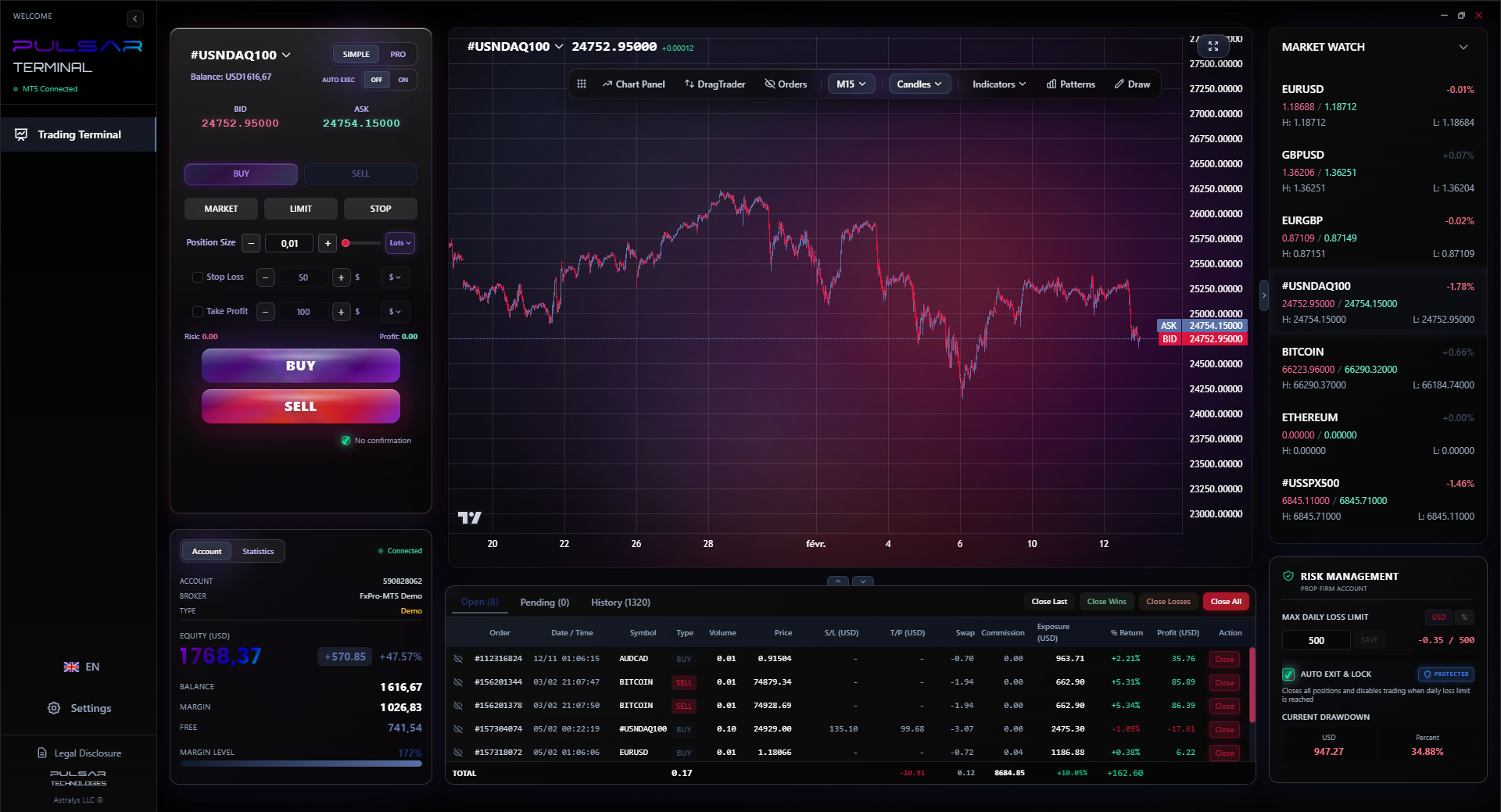
Managing complex trades with multiple exits is clunky on most retail platforms, but tools like Pulsar Terminal bring professional-grade order management directly to your MT5.
Pulsar Terminal
Hepsi bir arada MT5 aracı: sürükle-bırak emirler, çoklu TP/SL, trailing stop, grid trading, Volume Profile ve prop firm koruması. Her gün 1.000'den fazla trader tarafından kullanılıyor.
This is one area where IQ Option does cater to the South African market practically.
Funding Your Account: It's easy. They accept ZAR deposits directly, so you see the Rand amount leaving your account. Methods include:
- Local bank transfers (FNB, Nedbank, Capitec)
- Credit/Debit cards (Visa/Mastercard)
- E-wallets like Ozow, Skrill, and Neteller
Deposits are usually instant, and they don't charge a fee (though your bank might). The low $10 minimum means you can test with very little cash.
Getting Your Money Out: Here's the rub. While depositing via bank transfer is available, withdrawals to a South African bank account are often not an option. You'll typically need to withdraw back to an e-wallet like Skrill or Neteller, then from there to your bank account. This adds an extra step and potential fees from the e-wallet provider.
Processing times are advertised as fast (around 10 hours on average), and my own experience with a $200 withdrawal to Skrill was about 6 hours. But remember, this is for their international entity. There are enough online complaints about delayed withdrawals to make you cautious. Without FSCA oversight, you have little use if they decide to stall.

Pro Tip: Before depositing a large amount, do a full test cycle. Deposit a small sum (e.g., R500), trade it once (or just leave it), then immediately request a withdrawal. Time how long it takes to get back to your bank account. This tests their entire payment pipeline. If it's smooth with R500, it might be smooth with R5000, but there are no guarantees.
💡 Winston'ın İpucu
Always do a withdrawal test with a small amount before committing serious capital to any broker, regulated or not. It's the quickest way to assess their operational integrity.
“The lack of FSCA regulation is the core issue you cannot ignore. It colors everything.”
IQ Option offers use up to 1:500, and some sources even mention 1:1000. Let me be brutally clear: this is a weapon that will destroy you if you don't know how to handle it.
use of 1:500 means with just $200 of your own money (margin), you can control a $100,000 position. A move of just 0.2% against you wipes out your entire $200. On a volatile pair, that can happen in minutes.
Why This Matters for Your Approach:
- Scalping: If you're into scalping strategy, the high use can magnify tiny pip gains. But the spreads and commission-free structure are the real appeal here. The risk of a sudden margin call is extreme if your stop losses are too tight or non-existent.
- Swing Trading: For swing trading, high use is usually overkill and dangerous. You're holding positions for days, exposed to overnight swaps and gap risk. Using high use on a swing trade is like using a rocket engine to power a bicycle - you will crash.
- My Mistake: Early on, I used 1:200 use on a gold (XAU/USD) swing trade. I was right on the direction, but a short-term $15 retracement against me triggered a margin call before the price snapped back to my target. I lost the entire position. The lesson? use must be inversely proportional to your time frame. The longer you hold, the lower your use should be.
The platform's ease of use and low minimum deposit subtly encourage over-leveraging. You think, 'It's only $10,' but with 1:500 use, that $10 is controlling $5000. You can lose it in a heartbeat. Proper position sizing isn't just recommended here, it's a matter of survival.
💡 Winston'ın İpucu
High use is a test of your risk management, not a tool for amplification. If you need more than 1:30 to make your strategy work, the strategy is the problem.
So, should you use IQ Option? Let's compare it to the path of using an FSCA-regulated broker. Here’s a blunt table:
| Feature | IQ Option (for ZA) | FSCA-Regulated Broker (e.g., Exness ZA, IC Markets) |
|---|---|---|
| Regulation | None (FSCA warning issued) | FSCA Licensed (Client fund protection, local recourse) |
| Platform | Proprietary (simple, limited) | MT4, MT5, cTrader (professional, extensible) |
| use | Up to 1:500 (Very High) | Capped by FSCA (Lower, e.g., 1:30 for retail) |
| Deposit/Withdrawal | Easy ZAR deposits, tricky bank withdrawals | Straightforward ZAR bank transfers both ways |
| Safety of Funds | Low (Unregulated entity) | High (Segregated accounts, regulatory oversight) |
| Suitability | Beginners dabbling with small amounts | Serious traders building long-term capital |
The Trade-Off: You're trading convenience and high use for security and professional tools. IQ Option is the easy, flashy shop on the corner. The FSCA-regulated broker is the proper, inspected financial institution.
If you're just curious about trading and want to risk a few hundred Rand with zero paperwork, IQ Option is a valid, if risky, on-ramp. Use the demo account extensively first.
If you have serious capital (let's say over R10,000) or you aim to make trading a sustained part of your financial life, the lack of regulation is a deal-breaker. The peace of mind that comes with knowing your broker answers to the FSCA is worth more than any tight spread or high use offer. Look at brokers like Pepperstone or XM who also have strong global reputations, even if their FSCA use is lower.
“Starting with an unregulated broker makes protecting your capital infinitely harder.”
Here's my straight take, as someone who's used it and seen students use it.
IQ Option's forex trading platform is a paradox. It's brilliantly designed to get you trading quickly and simply. The low minimums, ZAR support, and clean app make it accessible. But that accessibility is its greatest danger. It lowers the barrier to entry so much that people jump in without understanding the monumental risks they're taking - both from the markets and from the broker itself.
The lack of FSCA regulation is the core issue you cannot ignore. It colors everything: the safety of your deposit, the fairness of execution, the reliability of withdrawals. You are operating on trust alone.
Who might it be okay for?
- A complete novice who wants to learn the absolute basics of price movement with money they are 100% prepared to lose.
- Someone who wants to test a very simple trading idea with tiny position sizes.
- A trader who values the mobile experience above all else and only trades major pairs.
Who should avoid it?
- Anyone with significant trading capital.
- Traders who rely on advanced technical analysis or automated strategies.
- Anyone who needs the security of knowing their broker is held accountable by a local authority.
- Swing traders or anyone sensitive to overnight funding costs.
My advice? If you're new, use their demo account relentlessly. But when you go live, start with a broker that has skin in the game here in South Africa. The FSCA warning is not a suggestion; it's a bright red flag. In trading, your first job is to protect your capital. Starting with an unregulated broker makes that job infinitely harder. There are simply better, safer choices available to you now that have done the work to be on the right side of our regulators.
FAQ
Q1Is IQ Option legal to use in South Africa?
Yes, it is legal for you as an individual to open an account and trade with IQ Option. However, it is not regulated by the Financial Sector Conduct Authority (FSCA). The FSCA has issued a public warning against them, meaning you have no regulatory protection or recourse in South Africa if something goes wrong.
Q2What is the minimum deposit for IQ Option in South African Rand?
The minimum deposit is $10 USD. Depending on the exchange rate, this is approximately R160 to R190 ZAR. You can deposit directly in Rands using local bank transfers, cards, or e-wallets like Ozow.
Q3Can I withdraw my money from IQ Option to my South African bank account?
This is often problematic. While ZAR deposits via bank transfer are available, withdrawals directly to a South African bank account are frequently not an option. You will likely need to withdraw to an e-wallet (like Skrill or Neteller) first, then from there to your bank, which adds extra steps and potential fees.
Q4Does IQ Option offer MetaTrader 4 or 5 (MT4/MT5)?
No. IQ Option uses its own proprietary trading platform only. You cannot connect it to MT4, MT5, or any other third-party platform. This limits your access to advanced tools, indicators, and automated trading systems (EAs).
Q5What use does IQ Option offer to South African traders?
IQ Option offers very high use, up to 1:500 (and some reports say 1:1000) for forex trading. This is significantly higher than the use allowed by FSCA-regulated brokers for retail clients (capped at lower levels like 1:30). High use dramatically increases both profit potential and risk of loss.
Q6Are there any good alternatives to IQ Option in South Africa?
Yes. Several international brokers now operate with FSCA regulation, offering greater security. Examples include Exness (SA), IC Markets (SA), and XM. These brokers provide professional platforms like MT4/MT5, direct ZAR bank transfers for deposits and withdrawals, and the crucial protection of operating under a local license.
Prof. Winston'ın Dersi
Önemli Noktalar:
- ✓FSCA warning means zero local protection for your funds.
- ✓Overnight swap fees can turn winning trades into losers.
- ✓Proprietary platform lacks tools for serious analysis.
- ✓High use (1:500) is a major risk, not a benefit.
- ✓Test withdrawal process before depositing significant capital.
Bu makale ne kadar faydalıydı?
Bir yıldıza tıklayın
Haftalık Trading Analizleri
Ücretsiz haftalık analiz ve stratejiler. Spam yok.
Yazar hakkında
David van der Merwe
Gelişen Piyasalar Yatırımcısı
Johannesburg merkezli, gelişmekte olan piyasa dövizlerinde 11 yıllık deneyime sahip trader. ZAR pariteleri, FSCA düzenlemeli ticaret ve Güney Afrika piyasa analizi uzmanı.
Yorumlar
Risk Uyarısı
Finansal araçlarla işlem yapmak önemli riskler taşır ve tüm yatırımcılar için uygun olmayabilir. Geçmiş performans gelecekteki sonuçları garanti etmez. Bu içerik yalnızca eğitim amaçlıdır ve yatırım tavsiyesi olarak değerlendirilmemelidir. İşlem yapmadan önce her zaman kendi araştırmanızı yapın.
Bunları da beğenebilirsiniz

Cara Trading Forex Sukses: 7 Prinsip dari Trader Profesional
Cara trading forex sukses dengan 7 prinsip trader pro: manajemen modal, disiplin, journal trading, backtest. Data nyata, bukan janji profit palsu.
Jam Trading Forex Terbaik untuk Trader Indonesia: Panduan Lengkap dengan Tabel Waktu
Panduan jam trading forex untuk trader Indonesia. Tabel 4 sesi dunia, jam emas 20:00-00:00, sesi mana yang harus dihindari. Data akurat + tips dari trader berpengalaman.
Top 5 Sàn Forex Uy Tín Nhất 2026: Review Jujur dari Trader Indonesia
Top 5 sàn forex uy tín 2026 untuk trader Indonesia. Review jujur: spread, deposit, withdraw, dukungan lokal. Exness, XM, IC Markets & lebih.
Pulsar Terminal'ı Edinin
Tüm bu hesaplayıcılar MT5 hesabınızdan gerçek zamanlı verilerle Pulsar Terminal'e entegredir.
Pulsar Terminal'ı Edinin