


I remember the excitement back in 2018 when a friend showed me his trading account with a broker based in the Dubai International Financial Centre (DIFC).

Rajesh Sharma
Kıdemli Forex Analisti ·  India
India
☕ 9 dk okuma
Neler öğreneceksiniz:
- 1Two Different Worlds: Dubai's Rules vs. India's Rules
- 2The Stiff Penalties: What Happens If You Get Caught
- 3What You CAN Legally Trade in India
- 4Broker Comparison: Dubai vs. India (For Clarity)
- 5The LRS, TCS, and Why They're Not a Loophole
- 6A Practical Path Forward: Building Legally
- 7Final Thoughts & Your Questions Answered
I remember the excitement back in 2018 when a friend showed me his trading account with a broker based in the Dubai International Financial Centre (DIFC). The spreads on EUR/USD were razor-thin, the use was high, and the platform was slick. He convinced me to deposit $5,000. For a few months, I felt like a global citizen, trading from my Mumbai apartment on a Dubai-regulated platform. Then, my accountant asked a simple question during tax filing: 'How did you send this money abroad, and under which RBI scheme?' That's when the cold reality hit. The profits didn't matter. I had broken the law. Understanding if forex trading is legal in Dubai isn't about Dubai's rules - it's about India's.
Let's get this straight right away. In Dubai, forex trading is 100% legal and well-regulated. They have a sophisticated financial system designed to attract international business. For an Indian sitting in India, however, that doesn't matter one bit. Your location determines which law applies to you.
In Dubai, the main regulators are the Dubai Financial Services Authority (DFSA) for the DIFC free zone and the Securities and Commodities Authority (SCA) for the mainland. These are serious regulators with strict rules on client fund segregation, use caps, and transparency. A broker like Exness review, if operating under DFSA rules, must follow these guidelines to the letter.
But here’s the kicker: Indian law, specifically the Foreign Exchange Management Act (FEMA), views you, an Indian resident, as being under its jurisdiction no matter where the broker is based. FEMA draws a very clear, bright red line. You are only allowed to trade currency derivatives on Indian exchanges like the NSE, BSE, or MSEI, and only in specific INR pairs like USD/INR or EUR/INR. Sending money to a Dubai-based broker to trade EUR/USD crosses that line. It's that simple.

Warning: Don't confuse a broker's legitimacy with your legal right to use them. A broker can be perfectly legal in Dubai but using them from India makes your activity illegal under Indian law.
“The profits didn't matter. I had broken the law.”
This isn't a slap on the wrist. The penalties under FEMA are designed to be a severe deterrent. I've spoken to financial lawyers about this, and they don't mince words. The risks are real and financial ruin is a possibility.
Let's talk numbers. If you're caught trading illegally with an offshore broker, the penalty is three times the amount involved in the contravention. Let's say you sent $10,000 abroad over a year. The fine could be $30,000. If the amount can't be quantified, it's a flat ₹2 lakh. On top of that, there's a penalty of ₹10,000 for every day the violation continues.
It gets worse. Under Section 13(1C) of FEMA, you could face imprisonment for up to five years. The authorities can also freeze your bank accounts and confiscate assets. And remember, any profit you made? That becomes undeclared income, inviting scrutiny from the Income Tax department. I've seen cases where a trader made a modest 15% return but faced penalties that wiped out years of savings.

Example: You deposit $5,000 with a Dubai broker via an LRS remittance labeled 'travel.' You grow it to $7,000. If caught, you could face a fine of 3 x $5,000 = $15,000, plus daily penalties, plus tax on the $2,000 profit. You end up deeply in the red.
The common misconception is that using the Liberalized Remittance Scheme (LRS) is a loophole. It's not. The LRS explicitly prohibits remittances for margin trading or speculative forex with overseas brokers. Labeling it as 'travel' or 'education' is misdeclaration, which is a separate, serious offense. For a proper understanding of risk management, which is critical even in legal trading, our guide on margin call is essential reading.

💡 Winston'ın İpucu
The most expensive trade you'll ever make is the one that costs you your freedom. A legal 5% return is infinitely better than an illegal 50% return.
“Indian law views you, an Indian resident, as being under its jurisdiction no matter where the broker is based.”
Okay, so the Dubai dream is off the table. What's left? Actually, quite a bit. The Indian currency derivatives market is strong, liquid, and completely above board. This is where you should focus your energy.
The Approved Instruments
You can legally trade currency futures and options on the National Stock Exchange (NSE), the Bombay Stock Exchange (BSE), and the Metropolitan Stock Exchange (MSEI). The permitted pairs are:
- USD/INR (This is the most liquid)
- EUR/INR
- GBP/INR
- JPY/INR
These are traded in specific contract sizes (like $1000 for USD/INR) and have expiry dates, similar to stock index futures. The use is lower than what offshore brokers offer - usually between 10:1 and 15:1, which, honestly, is a good thing for most retail traders. It prevents the kind of blow-ups I've seen too many times.
How It Works in Practice
You need a trading account with a SEBI-registered broker that offers currency derivatives. Your funds never leave the Indian banking system. All profits and losses are in INR. It's transparent, legal, and you sleep soundly. The strategies you learn, like swing trading or using the MACD indicator, apply here just as they would elsewhere.
I made the switch in 2019. My first legal trade was a USD/INR futures short based on a clear breakout. The profit wasn't as glamorous percentage-wise as some offshore trades, but the peace of mind was priceless. I wasn't looking over my shoulder anymore.
“Indian law views you, an Indian resident, as being under its jurisdiction no matter where the broker is based.”
It's useful to see the differences side-by-side. This table isn't an invitation to choose Dubai; it's to show you why the illegal option might seem tempting and why that temptation is dangerous.
| Feature | Regulated Dubai Broker (e.g., DFSA) | SEBI-Regulated Indian Broker |
|---|---|---|
| Legal for Indian Resident | NO - Violates FEMA | YES - Fully compliant |
| Available Pairs | 50+ majors, minors, exotics (EUR/USD, GBP/USD, etc.) | 4 INR pairs only (USD/INR, EUR/INR, etc.) |
| Typical Max use | 30:1 for majors (DFSA retail limit) | ~10:1 to 15:1 |
| Client Fund Safety | Segregated accounts, regulatory compensation schemes | Segregated accounts, Indian investor protection funds |
| Your Biggest Risk | FEMA penalties, imprisonment, asset seizure | Market risk, within your defined capital |
| Tax Clarity | Murky, potential for double taxation and IT notices | Clear. P&L treated as business income or speculative income. |
As you can see, the Indian broker wins on the only metric that truly matters for you: legality. The wider product range in Dubai is a mirage if accessing it puts your freedom and finances at existential risk. Platforms like IC Markets review or Pepperstone review are irrelevant to your situation, no matter how good their services are.
💡 Winston'ın İpucu
Master the USD/INR. It's your home-field advantage. You understand the local drivers - monsoon reports, election results, RBI commentary - better than any trader in New York or London ever could.
“The 10:1 use in India forces discipline. It makes you focus on quality setups rather than lottery-ticket positions.”
I hear this all the time: 'But I can send $250,000 a year abroad under LRS. Can't I use that for trading?' This is the most dangerous misunderstanding in Indian retail forex.
The Liberalized Remittance Scheme (LRS) is for specific permitted purposes. The list includes travel, education, medical treatment, gifts, and investments in overseas stocks/debt (through specific routes). It explicitly excludes remitting money for margin trading or speculative forex on overseas platforms.
The New TCS Hurdle (Post-2024)
Since April 2025, the Tax Collected at Source (TCS) rules have tightened. For most LRS remittances over ₹7 lakh (and over ₹10 lakh for some categories), a 20% TCS is levied at the time of remittance. So, to send $10,000 (approx. ₹8.3 lakh) abroad, you'd need to pay ₹1.66 lakh upfront as TCS. This tax can be adjusted against your final income tax liability, but it locks up a huge chunk of capital.
Let's say you try to sneak it through. You label a $10,000 remittance as 'travel' but use it to fund a broker like XM review. You now have two problems: a FEMA violation for the purpose of remittance and a potential tax mismatch when the RBI/ banks eventually flag the inconsistent pattern. Banks are required to report these transactions. The audit trail is digital and permanent.

Pro Tip: If you are using LRS for genuine purposes like education, keep careful records - admission letters, fee receipts. For trading, forget LRS exists. Your trading capital stays in India. Always use a position size calculator to manage that capital wisely on the legal Indian exchanges.
“The 10:1 use in India forces discipline. It makes you focus on quality setups rather than lottery-ticket positions.”
So, your dream of trading the global forex markets from India is dead. Welcome to reality. Now, let's build something real and sustainable within the walls of what's allowed. It's more than possible.
First, master the USD/INR pair. It's one of the most traded currency futures contracts in the world. It reacts to RBI policy, global dollar strength, oil prices, and FII flows. It has plenty of volatility for a skilled trader. I dedicated six months to understanding its rhythms, and it's now my primary market. Start with our EUR/USD guide for foundational concepts, as many technical principles translate, but then focus all your analysis on the INR chart.
Second, treat it like a business. Because it is. You're not a speculator dodging the law; you're a derivatives trader operating in a regulated market. Get proper accounting, understand the tax implications (speculative business income), and use professional-grade charting and analysis tools on your NSE terminal.
Third, manage your expectations. You won't get 500:1 use. Good. That use would have killed your account anyway. The 10:1 use in India forces discipline. It makes you focus on quality setups and proper scalping strategy execution rather than lottery-ticket positions. Learn to use the RSI indicator and other tools to find high-probability entries within this framework.
The path is narrower, but it's solid ground. I lost my early fascination with offshore brokers. Today, I know exactly where I stand with the law, my broker, and the taxman. That clarity is the best trading edge you can ever have.
💡 Winston'ın İpucu
Your first calculation for any trade should be your position size. Your second should be your tax liability. If you can't do the second one clearly, you're in the wrong market.
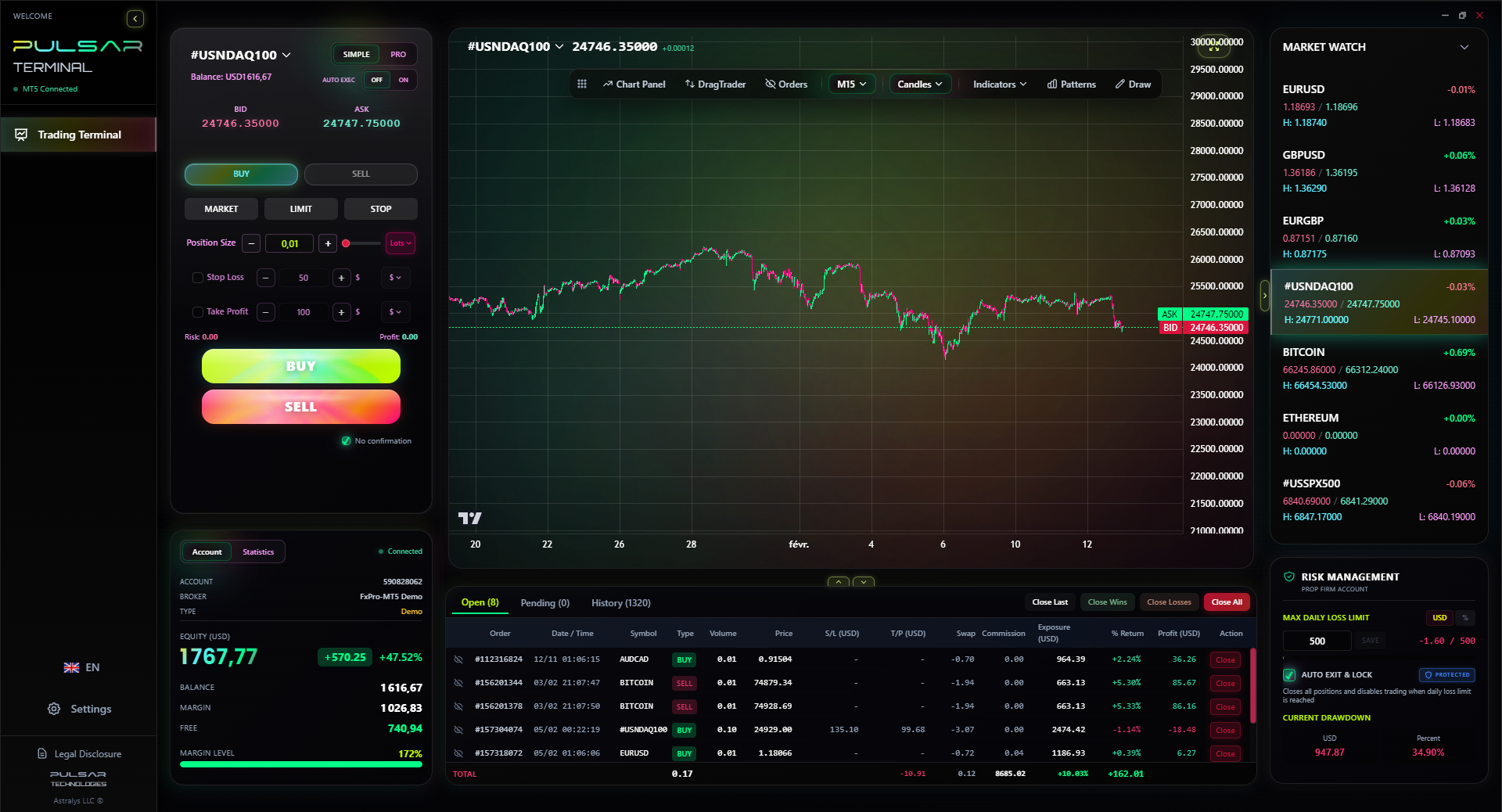
When trading USD/INR futures on MT5, managing multiple take-profit levels and moving stops to breakeven is key, and Pulsar Terminal automates this directly on your chart.
Pulsar Terminal
Hepsi bir arada MT5 aracı: sürükle-bırak emirler, çoklu TP/SL, trailing stop, grid trading, Volume Profile ve prop firm koruması. Her gün 1.000'den fazla trader tarafından kullanılıyor.
“The smart money isn't in finding loopholes; it's in mastering the legitimate, growing market right here.”
The core question - is forex trading legal in Dubai - has a layered answer. For the UAE, yes. For you in India, accessing that market is a legal violation with severe consequences. The smart money isn't in finding loopholes; it's in mastering the legitimate, growing market right here.
I made my peace with it. The energy I used to spend worrying about bank transfers and legal gray areas, I now pour into analysis. The results have been consistently better. Your goal shouldn't be to trade like someone in London or Dubai. Your goal should be to be the best trader you can be within the Indian regulatory framework. That's a challenge worthy of your effort.
Here are answers to the questions I get most often:
FAQ
Q1Can I use a VPN to hide my location and trade with a Dubai broker?
Technically, you could. Legally and practically, it's a terrible idea. Brokers conduct KYC (Know Your Customer). You will have to submit your Indian passport and proof of address. You are explicitly telling them you are an Indian resident. Using a VPN afterwards to login doesn't change that fact. If there's a dispute or withdrawal issue, you have zero legal recourse. Also,, you are now committing fraud in addition to a FEMA violation. The risk-reward is catastrophically bad.
Q2What if I have an NRI (Non-Resident Indian) friend who opens an account for me?
This is called a 'benami' arrangement and is illegal on multiple fronts. You are still controlling the trading from India, which violates FEMA. You are also potentially implicating your friend in tax evasion and violation of the broker's terms of service. If the account generates profits, getting the money back to you in India creates another trail of illegal remittances. Do not involve friends or family in schemes to circumvent forex laws.
Q3Are there any plans for India to legalize international forex trading?
There has been discussion for years about allowing Indian residents to directly invest in overseas securities more easily, but speculative margin forex trading is a very different beast. Given the RBI's primary focus on currency stability and preventing capital flight, a liberalization of rules for retail forex speculation is extremely unlikely in the foreseeable future. Don't base your decisions on hope for regulatory change.
Q4I already have an illegal offshore account. What should I do?
Consult a financial lawyer who specializes in FEMA matters immediately. Do not try to handle this yourself. The general advice would be to cease trading, close the positions, and repatriate the funds back to India. You may need to voluntarily disclose the contravention and settle the penalties. The cost of a lawyer is minor compared to the potential fines and legal jeopardy of doing nothing.
Q5Is trading gold (XAU/USD) with a Dubai broker also illegal?
Yes, absolutely. The prohibition isn't just on forex pairs; it's on using an overseas broker for any form of speculative margin trading (CFDs on commodities, indices, crypto) unless explicitly permitted. The same FEMA rules apply. If you're interested in gold, look at domestic options like gold ETFs, futures on Indian exchanges, or sovereign gold bonds. We have a guide on XAU/USD guide for educational purposes on the global market structure, but trading it from India via an offshore platform is not permitted.
Q6How do I check if my broker is SEBI-registered for currency trading?
Go to the SEBI website (sebi.gov.in). They have a dedicated 'SEBI Intermediaries' section where you can search for the broker's name. A legitimate broker will also prominently display their SEBI registration number on their website and all official documents. Never trust a broker that cannot provide this.
Prof. Winston'ın Dersi
Önemli Noktalar:
- ✓Trading with Dubai brokers from India violates FEMA.
- ✓Penalties include fines of 3x the amount and up to 5 years in prison.
- ✓You can only legally trade 4 INR pairs on Indian exchanges.
- ✓The LRS scheme does NOT allow remittances for forex trading.
- ✓Master USD/INR futures - it's a deep, legal market.
Bu makale ne kadar faydalıydı?
Bir yıldıza tıklayın
Haftalık Trading Analizleri
Ücretsiz haftalık analiz ve stratejiler. Spam yok.
Yazar hakkında
Rajesh Sharma
Kıdemli Forex Analisti
Hindistan ve Güney Asya piyasalarında 10 yılı aşkın deneyim. NSE döviz türevleriyle başlayıp uluslararası forex'e geçiş yaptı. USD/INR ve gelişmekte olan piyasa pariteleri uzmanı.
Yorumlar
Risk Uyarısı
Finansal araçlarla işlem yapmak önemli riskler taşır ve tüm yatırımcılar için uygun olmayabilir. Geçmiş performans gelecekteki sonuçları garanti etmez. Bu içerik yalnızca eğitim amaçlıdır ve yatırım tavsiyesi olarak değerlendirilmemelidir. İşlem yapmadan önce her zaman kendi araştırmanızı yapın.
Bunları da beğenebilirsiniz

Cara Trading Forex Sukses: 7 Prinsip dari Trader Profesional
Cara trading forex sukses dengan 7 prinsip trader pro: manajemen modal, disiplin, journal trading, backtest. Data nyata, bukan janji profit palsu.
Jam Trading Forex Terbaik untuk Trader Indonesia: Panduan Lengkap dengan Tabel Waktu
Panduan jam trading forex untuk trader Indonesia. Tabel 4 sesi dunia, jam emas 20:00-00:00, sesi mana yang harus dihindari. Data akurat + tips dari trader berpengalaman.
Top 5 Sàn Forex Uy Tín Nhất 2026: Review Jujur dari Trader Indonesia
Top 5 sàn forex uy tín 2026 untuk trader Indonesia. Review jujur: spread, deposit, withdraw, dukungan lokal. Exness, XM, IC Markets & lebih.
Pulsar Terminal'ı Edinin
Tüm bu hesaplayıcılar MT5 hesabınızdan gerçek zamanlı verilerle Pulsar Terminal'e entegredir.
Pulsar Terminal'ı Edinin