


Here's a fact that should make you sit up straight: over 70% of the 'brokers' South Africans find online aren't legally allowed to take your money.

David van der Merwe
Gelişen Piyasalar Yatırımcısı ·  South Africa
☕ 9 dk okuma
Neler öğreneceksiniz:

Here's a fact that should make you sit up straight: over 70% of the 'brokers' South Africans find online aren't legally allowed to take your money. The local market is flooded with offshore sharks and slick marketing from unregulated firms. Finding a genuine list of forex brokers in South Africa isn't about who has the flashiest ads; it's about who holds an FSCA license and won't vanish with your capital. I've seen too many traders lose everything to a 'broker' with a fancy website but no physical address here. Let's cut through the nonsense.
If you remember one thing from this guide, let it be this: never, ever deposit money with a broker not licensed by the Financial Sector Conduct Authority (FSCA). This isn't a suggestion; it's the only line between you and getting completely wiped out.
The FSCA isn't just a logo on a website. It means the broker has to follow South African law. Your funds must be held in segregated accounts (so they can't use your deposit to pay their office rent). They have to undergo regular audits. Most importantly, if something goes horribly wrong, you have a local regulator to complain to. Try getting help from some offshore regulator in the Marshall Islands. I'll wait.
I learned this the hard way early on. I deposited $500 with an 'internationally regulated' broker that sounded great. When I tried to withdraw $300 in profits, they froze my account and demanded endless 'verification' documents I'd already sent. After two months of emails, they stopped responding. That money was gone. A local FSCA-regulated broker would have been forced to resolve that.

Warning: An 'international license' from Cyprus (CySEC) or the Seychelles is worthless for you as a South African resident if the broker doesn't also have a specific FSCA license. They are legally required to have it to serve you. Trading with them without it voids any real protection.

💡 Winston'ın İpucu
A broker's regulation status is binary. It's either FSCA-licensed or it's not. There's no 'sort of' regulated. Your first check before clicking 'deposit' should be the FSCA's official register, not the broker's 'Regulations' page.

“Over 70% of the 'brokers' South Africans find online aren't legally allowed to take your money.”
Brokers love to advertise 'zero spread' or 'commission-free' trading. It's mostly rubbish. You always pay, you just need to know where. Let's break down the real numbers you'll face on a legitimate list of forex brokers in South Africa.
Spreads & Commissions: The Main Event
For the EUR/USD, you'll typically see two structures:
- Standard Account: Spreads from 1.0 to 1.5 pips, no commission. That 1.5 pip cost on a standard lot is $15.
- Raw/ECN Account: Spreads from 0.0 to 0.2 pips, plus a commission of $3-$7 per round lot. So on that same trade, you might pay $0.20 on the spread + $6 commission = $6.20.
The ECN account is cheaper for larger volumes. For a beginner trading mini lots (0.1), the standard account is often simpler. I personally use ECN accounts because my average position size is larger, and the transparency is worth it. You can model this yourself with our position size calculator.
The Hidden Killers: Swaps & Inactivity Fees
Holding a trade overnight? You'll pay or earn a swap fee. These vary wildly by broker and pair. A long EUR/USD position might cost you $5 per lot per night. It adds up if you're a swing trading enthusiast.
And that dormant account? Many brokers will start charging a monthly inactivity fee after 3 to 6 months, sometimes up to $15. If you're taking a break, withdraw your cash.

Example: Trade 1 standard lot EUR/USD on a Standard account with a 1.3 pip spread. Your immediate cost is 1.3 pips x $10 per pip = $13. Hold it for two nights at a -$5 swap: that's another $10. Total cost: $23 before the price even moves in your favor.
“If you have to convert your Rands to USD to deposit, you're getting killed by your bank's spread before you even place a trade.”
Here are the major players who are properly licensed. This isn't a ranking of 'best' - it's a breakdown of their models so you can choose. Always verify the FSP number on the FSCA website yourself.
| Broker | FSCA Licensed? | Min. Deposit (ZAR approx.) | Key Model for SA Traders | My Note |
|---|---|---|---|---|
| Exness | Yes | ~R200 ($10) | Very low minimums, high use offered. Popular for scalping. | Their local support is decent. I've used them for scalping strategy tests. See our full Exness review. |
| XM | Yes | ~R100 ($5) | Fixed spreads, massive array of bonuses (be careful). | Good for absolute beginners due to tiny minimums. Their educational material is solid. Check the XM review. |
| IC Markets | Yes | ~R200 ($10) | Raw spreads, true ECN model. Favored by serious retail traders. | My primary broker for years. Execution is excellent. Their IC Markets review details why. |
| Pepperstone | Yes | ~R200 ($10) | Competitive ECN pricing, great platform support. | Another top-tier for active traders. Their Razor account is legit. Our Pepperstone review covers it. |
| FXTM | Yes | ~R200 ($10) | Multiple account types, strong local brand presence. | Reliable. I took a R40,000 profit from them in 2023 with no withdrawal issues. |
| AvaTrade | Yes | ~R2000 ($100) | User-friendly, fixed spreads, good for beginners. | Higher minimum, but very structured. Their platform options are vast. |
A note on HF Markets (HotForex): They are also FSCA regulated and have a strong local following. Their model is similar to XM's.
The point is, you have quality, regulated options. There is zero reason to gamble with an unregulated entity.
💡 Winston'ın İpucu
The spread is the broker's price for providing you a market. If it seems too good to be true (like 0.0 pips on a standard account), you're paying somewhere else, usually in terrible execution or hidden fees. Understand the total cost per trade.

“If you have to convert your Rands to USD to deposit, you're getting killed by your bank's spread before you even place a trade.”
This is where local brokers earn their keep. A good FSCA-regulated broker will let you fund your account in South African Rand (ZAR) via Instant EFT. This is non-negotiable for me.
If you have to convert your Rands to USD or EUR to deposit, you're getting killed by your bank's forex spread before you even place a trade. I once lost nearly 2% of my deposit just on currency conversion with an international broker. That's a terrible start.
Standard Process:
- You initiate a deposit in ZAR from your online banking.
- The broker receives it (usually instantly or within hours).
- They convert it to your account currency (USD, EUR, or sometimes ZAR) at their commercial rate, which is usually far better than your bank's.
Withdrawals work the same way in reverse. The best brokers process them within 24 hours back to your SA bank account. Any broker taking more than 48 hours for a simple withdrawal is a red flag. E-wallets like Skrill/Neteller are faster but sometimes have higher fees on the broker's side.

Pro Tip: Always open a trading account in USD, not ZAR, even if you deposit in Rands. The liquidity and instrument pricing are based on USD. A ZAR-denominated account just adds an extra, often opaque, conversion layer on every trade.
“Your goal for the first six months is not to make money. It's to not lose money while you learn.”
MetaTrader 4 (MT4) is still the king in South Africa. Don't let anyone tell you otherwise. MT5 is gaining ground, but MT4's simplicity, along with the mountain of custom indicators and Expert Advisors (EAs) built for it, keeps it on top. Every broker on our list offers MT4.
But the standard MT4/MT5 platform from your broker is bare bones. This is where professional tools change the game. You need efficient order management. Manually moving stop-losses or setting multiple take-profits on a volatile pair like XAU/USD is a great way to make a mistake.
I used to juggle several charts and manually calculate positions, which led to a classic error. During a volatile EUR/USD news event, I meant to set a 20-pip stop but accidentally set a 2-pip stop due to rushing. The trade was stopped out instantly for a pointless loss. Proper tools prevent that.
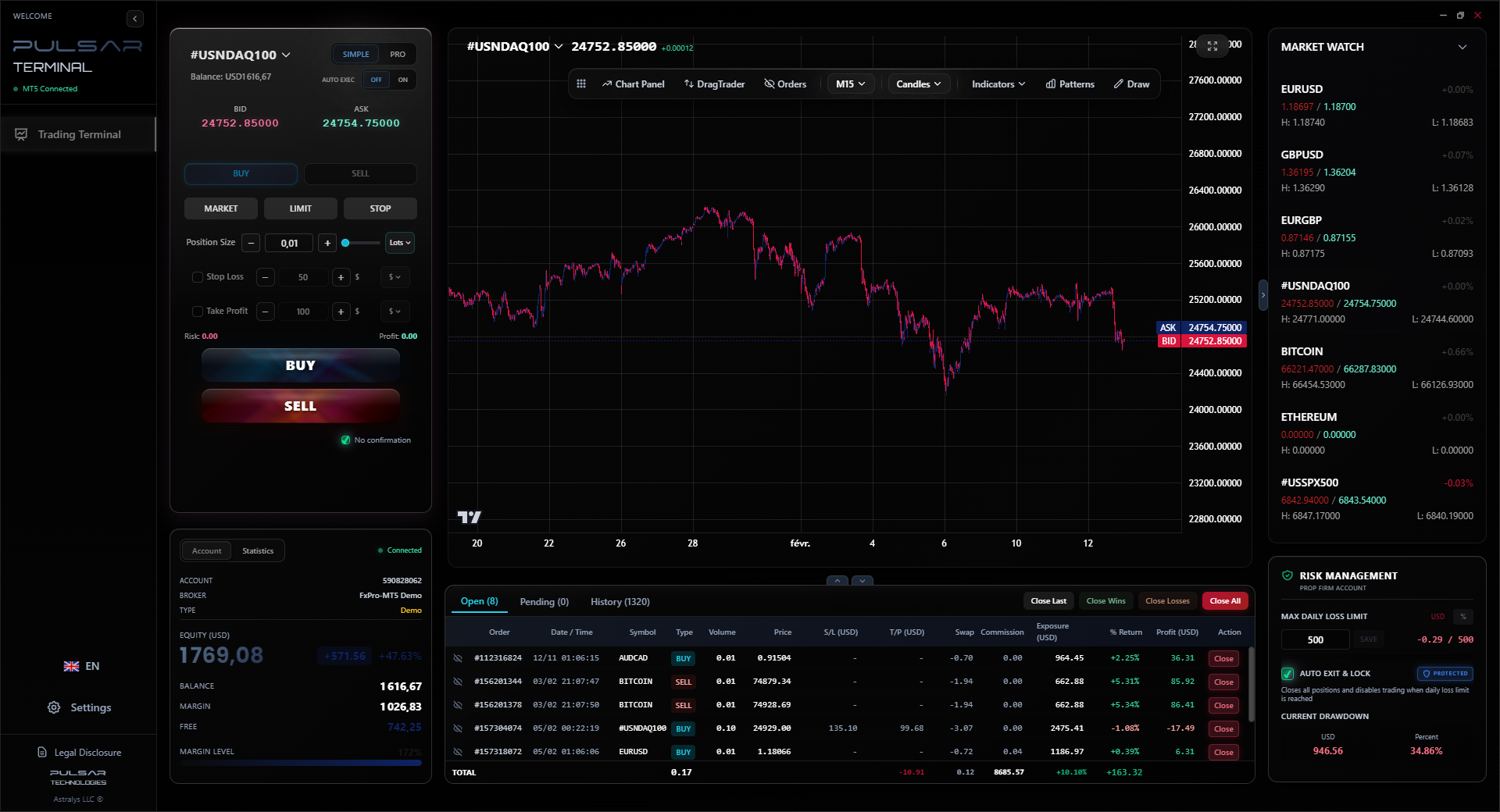
Modern trading terminals that plug into MT4/MT5 let you drag and drop orders directly onto the chart, set trailing stops that actually work, and manage partial closures with a click. For prop firm traders, having automatic daily loss protection is a lifesaver - it turns off your platform before you blow your challenge. For the retail trader, tools like Volume Profile built into your charts are useful for seeing real support and resistance.
Manually managing complex orders on MT4 is prone to error; a tool like Pulsar Terminal automates trailing stops, partial closures, and even prop firm loss limits directly on your charts.
Pulsar Terminal
Hepsi bir arada MT5 aracı: sürükle-bırak emirler, çoklu TP/SL, trailing stop, grid trading, Volume Profile ve prop firm koruması. Her gün 1.000'den fazla trader tarafından kullanılıyor.
“Your goal for the first six months is not to make money. It's to not lose money while you learn.”
The unregulated space is a carnival of cons. Here’s how to spot them:
- "Guaranteed Profits" or "No Risk": If you hear this, run. Trading is risk. Full stop. I fell for a signal service early on that promised 80% win rates. It was a disaster.
- Pressure to Deposit More: A legitimate broker doesn't care if you trade with $100 or $100,000. If an 'account manager' is calling you daily pushing you to deposit more to 'recover losses,' it's a boiler-room scam.
- Withdrawal Problems: The first sign of a scam is when withdrawing your own money becomes a saga of new fees, verifications, or delays. With a proper FSCA broker, it's a simple, fast process.
- Clone Firms: They steal the name and details of a real regulated broker. Check the FSCA website directly, don't just click a link on their site.
- Sky-High Bonuses: A 100% deposit bonus is often a lock-in mechanism. The terms will make it impossible to withdraw any profit until you've traded an insane volume. Read the fine print.
Your best defense is skepticism. If it sounds too good to be true, it's a lie. Stick to the regulated list, focus on your strategy, and ignore the noise.
💡 Winston'ın İpucu
Your trading platform is your cockpit. If you're fumbling with basic orders during a trade, you've already lost. Master your tools in a demo environment until every click is muscle memory. Sloppy execution kills more accounts than bad analysis.
“The boring path of a regulated broker and small account is the only one that leads to consistency.”
So, you've picked a broker from the legitimate list. Now what? Don't jump in.
- Open a Demo Account: Use it for at least a month. Test everything: execution speed, how orders work, platform stability during news. Practice your strategy in real market conditions without risk.
- Start Absurdly Small: When you go live, start with a cent account or the absolute minimum deposit. Your goal for the first six months is not to make money. It's to not lose money while you learn. A margin call is a teacher, but a cheap lesson is better.
- Learn One Thing at a Time: Don't try to master the MACD indicator, RSI indicator, and Fibonacci retracements all in week one. Pick one concept, like understanding what a pip definition and spread definition really mean for your bottom line, and drill it until it's second nature.
- Keep a Journal: Write down every trade. Why you took it, your emotion, the outcome. I review my journal every Sunday. It's the most painful and useful thing I do.
The path is boring. Regulated broker, small account, focused practice. But that boring path is the only one that leads to consistency, while the exciting 'get rich quick' path leads to an empty bank account.
FAQ
Q1Is forex trading legal in South Africa?
Yes, absolutely. It is completely legal for South African residents to trade forex through a broker that is licensed and regulated by the Financial Sector Conduct Authority (FSCA). The key is using a regulated broker.
Q2What is the minimum deposit for forex trading in South Africa?
With regulated brokers like XM or Exness, you can start with as little as R100 (roughly $5). However, I strongly advise you to treat this as a learning fee. Don't deposit money you need for living expenses.
Q3Which trading platform is best for beginners in South Africa?
MetaTrader 4 (MT4). It's universally offered, simple to learn, and has endless free educational resources. Avoid proprietary platforms from brokers until you know what you're doing. Stick to the industry standard.
Q4How are my funds protected with an FSCA-regulated broker?
FSCA rules require client funds to be held in segregated bank accounts separate from the broker's own operating money. This means if the broker goes bankrupt, your money shouldn't be part of their assets. It also mandates regular external audits to ensure this is happening.
Q5Can I trade with international brokers like IG or Saxo Bank?
Only if they specifically hold an FSCA license to operate in South Africa. Many large international brands do not, as they choose not to comply with local regulations. You must check the FSCA register. Trading with their global entity often leaves you without local protection.
Q6What's the biggest mistake new South African traders make?
Using unregulated brokers because of flashy ads or fake testimonials, and trading with far too much money, far too soon. They confuse use for a shortcut to wealth, when it's actually a shortcut to a margin call.
Prof. Winston'ın Dersi
Önemli Noktalar:
- ✓Only trade with FSCA-licensed brokers. Verify it yourself.
- ✓Understand total cost: Spread + Commission + Swap.
- ✓Deposit in ZAR via Instant EFT to avoid bank fees.
- ✓Start with a demo, then a micro account (<R1000).
- ✓Master your trading platform before risking real cash.
Bu makale ne kadar faydalıydı?
Bir yıldıza tıklayın
Haftalık Trading Analizleri
Ücretsiz haftalık analiz ve stratejiler. Spam yok.
Yazar hakkında
David van der Merwe
Gelişen Piyasalar Yatırımcısı
Johannesburg merkezli, gelişmekte olan piyasa dövizlerinde 11 yıllık deneyime sahip trader. ZAR pariteleri, FSCA düzenlemeli ticaret ve Güney Afrika piyasa analizi uzmanı.
Yorumlar
Risk Uyarısı
Finansal araçlarla işlem yapmak önemli riskler taşır ve tüm yatırımcılar için uygun olmayabilir. Geçmiş performans gelecekteki sonuçları garanti etmez. Bu içerik yalnızca eğitim amaçlıdır ve yatırım tavsiyesi olarak değerlendirilmemelidir. İşlem yapmadan önce her zaman kendi araştırmanızı yapın.
Bunları da beğenebilirsiniz

Cara Trading Forex Sukses: 7 Prinsip dari Trader Profesional
Cara trading forex sukses dengan 7 prinsip trader pro: manajemen modal, disiplin, journal trading, backtest. Data nyata, bukan janji profit palsu.
Jam Trading Forex Terbaik untuk Trader Indonesia: Panduan Lengkap dengan Tabel Waktu
Panduan jam trading forex untuk trader Indonesia. Tabel 4 sesi dunia, jam emas 20:00-00:00, sesi mana yang harus dihindari. Data akurat + tips dari trader berpengalaman.
Top 5 Sàn Forex Uy Tín Nhất 2026: Review Jujur dari Trader Indonesia
Top 5 sàn forex uy tín 2026 untuk trader Indonesia. Review jujur: spread, deposit, withdraw, dukungan lokal. Exness, XM, IC Markets & lebih.
Pulsar Terminal'ı Edinin
Tüm bu hesaplayıcılar MT5 hesabınızdan gerçek zamanlı verilerle Pulsar Terminal'e entegredir.
Pulsar Terminal'ı Edinin