


You've got a thousand bucks, maybe a bit more, and you're tired of watching the charts.

David van der Merwe
Gelişen Piyasalar Yatırımcısı ·  South Africa
☕ 8 dk okuma
Neler öğreneceksiniz:
You've got a thousand bucks, maybe a bit more, and you're tired of watching the charts. You're thinking, 'Why not let a pro handle it?' A managed forex account with a $1000 minimum sounds like the perfect solution. Just deposit, sit back, and let the profits roll in, right? Let me stop you right there. I've seen this movie before, and the ending isn't always happy. Before you send your hard-earned Rands to a 'fund manager,' let's have a brutally honest chat about what you're really signing up for.
A managed forex account is simple on paper. You give a trading professional (or a company) the authority to trade on your behalf. They make the decisions, execute the trades, and hopefully make you money. For a $1000 minimum deposit, you're buying a seat at a very small table. The manager pools your capital with others or trades your account individually under a Limited Power of Attorney (LPoA).
Here's the kicker: you're not just buying their skill. You're buying their entire business model. Their profit doesn't just come from market wins. It comes from the fees they charge you. We'll get to those nasty details in a second. The critical thing to understand is that you surrender control. You can't second-guess their trades. If they decide to go all-in on a wild scalping strategy during a major news event, you just have to ride it out.

Warning: An LPoA is a legal document. It gives the manager real power. Always, and I mean always, read every single line. Know exactly what they can and cannot do with your money.
“Your $1000 is far more powerful as a tool for your own financial education than as a fee generator for a part-time manager.”
This is where most South African investors get blindsided. They see a shiny performance chart and ignore the fine print. The $1000 minimum is just the entry ticket. The real cost is in the ongoing fees, which can absolutely gut your returns.
The Two-Headed Monster
Nearly all managed account programs charge a combination of these fees:
-
Management Fee: A fixed percentage of your total assets under management (AUM), charged yearly but taken monthly or quarterly. It's typically 1-2%. On a $1000 account, that's $10-$20 a year. Seems small, but it's guaranteed money for them, whether you profit or not.
-
Performance Fee: This is the big one. It's a cut of your profits, usually 15-30%. If your account makes $200 in a month, they take $30 to $60 of it. This is where the alignment of interests is supposed to be. They only win if you win. Sounds fair, right?
The Devil's in the Details
It's not fair if they have a 'high-water mark' clause. Without it, they can lose your money one month, make it back the next, and still take a performance fee on the rebound - even though you're just back to breakeven. A proper high-water mark means they only take fees on profits above your account's previous peak value.
Let me give you a real example from my early days. I put $5,000 with a firm promising 'conservative growth.' Their fee was 2% management + 20% performance. In Year 1, they made a 10% return ($500). Their take? $100 management fee + $100 performance fee = $200. My net gain? $300, or 6%. They took 40% of the profit. The next year, they lost 8%. I was down $400, and they still took their $100 management fee. My $5000 was now $4,800, and they'd collected $300 in total fees. I pulled my money. Always, always model the fees with a position size calculator to see the net effect.

💡 Winston'ın İpucu
A manager's minimum deposit tells you their target client. $1000 says they need volume over quality. A $50k minimum suggests they're selective. Which would you trust with your life savings?
“Sustainable, professional forex fund targets are far more modest than the fantasy numbers sold to beginners.”
Trading from South Africa adds layers of complexity you can't ignore.
Regulation is Your First Red Flag. Is the management company regulated by the Financial Sector Conduct Authority (FSCA)? If they're offshore (in Mauritius, Cyprus, etc.), do they hold a license from a reputable body like the FCA or ASIC? If the answer is 'no' or 'it's complicated,' walk away. I've seen too many 'boiler room' operations target South Africans with slick websites and empty promises. The FSCA has a warning list - check it.
Currency Risk is a Silent Killer. Your $1000 minimum deposit? You're likely converting ZAR to USD. If the manager trades EUR/USD or XAU/USD, you have double currency exposure. If the Rand strengthens against the Dollar while your trades are in profit, your ZAR returns get crushed. Most managers won't hedge this for you. They're trading forex, not managing your ZAR/USD cross.
Payment and Withdrawal Headaches. Getting money to an international broker like Exness or IC Markets involves SARB regulations and potential bank delays. Withdrawing profits back to your South African bank account? Expect fees and more waiting. A manager making frequent withdrawals for their performance fee amplifies this problem and cost.
“Sustainable, professional forex fund targets are far more modest than the fantasy numbers sold to beginners.”
Let's crush some fantasies. Anyone promising you 5-10% per month on a $1000 managed forex account is either a genius (unlikely) or a liar (probable). Sustainable, professional forex fund targets are far more modest.
A realistic, risk-adjusted target for a competent manager might be 8-15% per year. After their 2&20 fee structure, your net return might be 5-10%. On a $1000 account, that's $50 to $100 profit for the year. Is that worth locking up your capital and taking on the risk? You could match that in a high-interest savings account with zero stress.

Example:
- Initial Capital: $1,000 (≈ R18,500)
- Manager's Gross Return: 12% per year ($120)
- Management Fee (2%): $20
- Performance Fee (20% of $120): $24
- Total Fees: $44
- Your Net Profit: $76 (7.6% net return)
- Your Risk: Total loss of capital.
Contrast this with learning to trade yourself. That same $1000 in a low-cost XM or Pepperstone account, used to practice disciplined swing trading, has an educational value that far exceeds $76. The first lesson is often the most expensive, but at least you keep the knowledge.
💡 Winston'ın İpucu
If you can't understand their strategy in two simple sentences, they either don't have one or are hiding its complexity, which is risk. Clarity is confidence.
“The math rarely works in your favor on such a small capital base. The fees are proportionally massive.”
Hear me out. Instead of paying someone else to potentially lose your money, invest in yourself. A $1000 trading account is a perfect practice lab.
Step 1: Education, Not Speculation. Use that capital to understand what a pip really costs, how spread affects your entries, and what a margin call feels like in a demo environment. Then move to a live micro account.
Step 2: Tools Over Gurus. Spend on a good charting platform or educational resource. Learn one strategy inside out. Master the RSI indicator or the MACD indicator. Understand why a trade works, don't just hope it does.
Step 3: Build Process, Not Dreams. Your goal with the first $1000 shouldn't be to buy a car. It should be to execute 100 trades with strict risk management (never risking more than 1-2% per trade). Prove you can be consistent without blowing up. That skill is worth infinitely more than a few Rands of managed profit.
I started with less than that. My first 'real' account was $800. I lost $120 of it in three weeks because I didn't respect the market. That $120 loss taught me more about risk than any book ever did. It was my tuition fee.
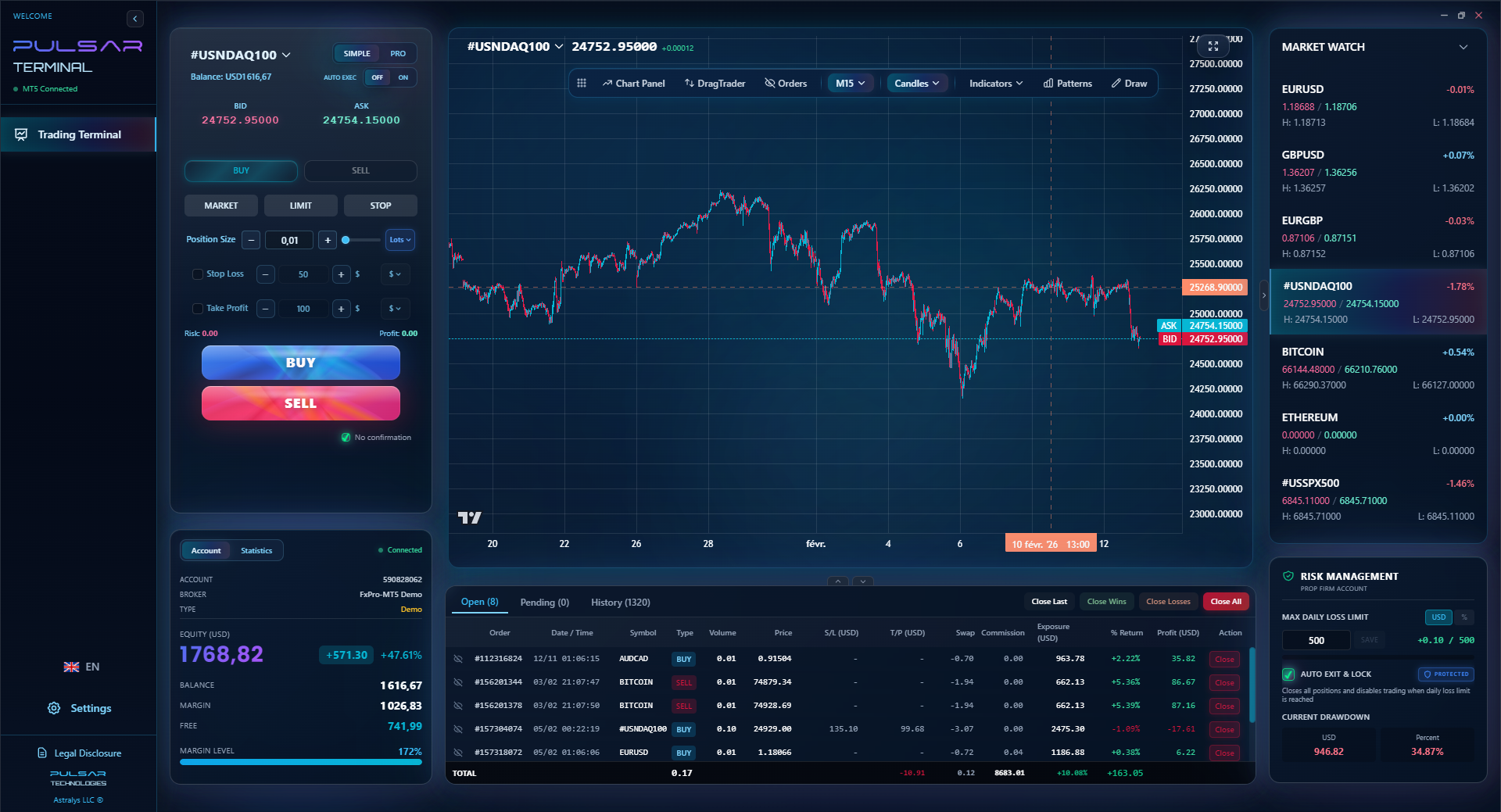
If you're using that $1000 to trade yourself, a tool like Pulsar Terminal that automates risk management and complex order types on MT5 can be a far better investment than any manager's fee.
Pulsar Terminal
Hepsi bir arada MT5 aracı: sürükle-bırak emirler, çoklu TP/SL, trailing stop, grid trading, Volume Profile ve prop firm koruması. Her gün 1.000'den fazla trader tarafından kullanılıyor.
“The math rarely works in your favor on such a small capital base. The fees are proportionally massive.”
Alright, you're stubborn. If you're determined to go the managed route, do this homework. Skip a step, and you're asking for trouble.
-
Verify Regulation: FSCA, FCA, ASIC. Check the license number on the regulator's official website. No license, no discussion.
-
Demand a Full Audit Trail: Ask for at least 3 years of verified, real-time track record (like a Myfxbook link that's 'live' not 'historical'). Anyone can cherry-pick a good month.
-
Dissect the Fee Agreement: Find the high-water mark clause. Understand how frequently fees are calculated and withdrawn. Ask about any hidden fees: withdrawal fees, inactivity fees, etc.
-
Understand Their Strategy: Are they scalping the EUR/USD 50 times a day or taking 4 swing trades a month? High-frequency strategies mean higher spreads eat your returns. Get their average holding period.
-
Talk About Risk: What's their maximum expected drawdown? If they say 'never more than 10%,' they're lying. A 20-30% drawdown is possible even for good managers. What's their worst month ever? If they won't tell you, run.
-
Start Small & Segregated: Even if their minimum is $1000, see if you can start with that exact amount. Ensure your funds are held in a segregated client money account with a top-tier broker like IC Markets or Pepperstone, not in the manager's own company bank account.
💡 Winston'ın İpucu
The most valuable fee you'll ever pay is the 'tuition fee' the market charges you early on. It buys experience no manager can give you.
“The best 'management' you can get for a $1000 account is your own discipline.”
So, are managed forex accounts with a $1000 minimum a good idea? For 95% of you reading this, the answer is a resounding no.
The math rarely works in your favor on such a small capital base. The fees are proportionally massive, the regulatory risks for South Africans are heightened, and the realistic returns are underwhelming. You are paying a high premium for a lottery ticket where the odds are only slightly better than the actual lottery.
Your $1000 (roughly R18,500) is far more powerful as a tool for your own financial education. The journey to becoming a self-sufficient trader is difficult, but the control and knowledge you gain are assets no manager can ever provide or take away. Put that money in a reputable broker, risk R185 per trade (1%), and learn the game yourself. It's harder, but it's honest. And in this business, keeping what's yours is the only victory that truly counts.

Pro Tip: The best 'management' you can get for a $1000 account is your own discipline. Write your rules, follow them without exception, and review every trade. That's a system that pays you for life.
FAQ
Q1Can I really lose all my money in a managed forex account?
Absolutely, yes. Forex trading involves high use, which can magnify losses. The manager is not liable for your losses unless you can prove gross negligence or fraud, which is extremely difficult. Your capital is always at risk.
Q2What's better for a beginner: a managed account or a prop firm challenge?
A prop firm challenge, hands down. You risk a few hundred dollars for the chance to trade a large simulated account. If you pass, you trade the firm's capital and keep most of the profits. It forces you to learn discipline and risk management - skills a managed account denies you. Tools that help with prop firm rules, like daily loss limits, are useful.
Q3Are there any FSCA-regulated managed forex account providers in SA?
Very few legitimate ones for retail clients with a $1000 minimum. Most FSCA-licensed managers cater to high-net-worth individuals with much larger minimums (often $50,000+). The 'managed account' offers targeting small investors are frequently from unregulated offshore entities.
Q4How do performance fees work with monthly withdrawals?
If you make a net profit in a month, the manager's fee is calculated and often withdrawn directly from your account balance the following month. This constant draining of capital can hinder compound growth and adds to your transaction costs from currency conversions back to ZAR.
Q5Is a 60% annual return from a managed account possible?
Possible? In a single year, with high risk, maybe. Sustainable and repeatable over 3-5 years? Almost certainly not. Any manager claiming consistent returns like that is either taking insane risk (meaning a blow-up is coming) or is not showing you a verified track record. Remember, if they were that good, they'd be trading their own multi-million dollar fund, not chasing your $1000.
Q6What's the single biggest red flag for a managed account offer?
Guaranteed profits or a promise of no losses. This is illegal for a reason - it's a lie. The second biggest red flag is pressure to deposit quickly, using phrases like 'limited-time offer' or 'this trade entry window is closing.' Legitimate fund managers do not use car salesman tactics.
Prof. Winston'ın Dersi
Önemli Noktalar:
- ✓Fees can take 40% or more of your gross profits.
- ✓A realistic net return target is 5-10% per year, not per month.
- ✓Always verify FSCA or equivalent offshore regulation.
- ✓Use a $1000 account to learn, not to outsource.
Bu makale ne kadar faydalıydı?
Bir yıldıza tıklayın
Haftalık Trading Analizleri
Ücretsiz haftalık analiz ve stratejiler. Spam yok.
Yazar hakkında
David van der Merwe
Gelişen Piyasalar Yatırımcısı
Johannesburg merkezli, gelişmekte olan piyasa dövizlerinde 11 yıllık deneyime sahip trader. ZAR pariteleri, FSCA düzenlemeli ticaret ve Güney Afrika piyasa analizi uzmanı.
Yorumlar
Risk Uyarısı
Finansal araçlarla işlem yapmak önemli riskler taşır ve tüm yatırımcılar için uygun olmayabilir. Geçmiş performans gelecekteki sonuçları garanti etmez. Bu içerik yalnızca eğitim amaçlıdır ve yatırım tavsiyesi olarak değerlendirilmemelidir. İşlem yapmadan önce her zaman kendi araştırmanızı yapın.
Bunları da beğenebilirsiniz

Cara Trading Forex Sukses: 7 Prinsip dari Trader Profesional
Cara trading forex sukses dengan 7 prinsip trader pro: manajemen modal, disiplin, journal trading, backtest. Data nyata, bukan janji profit palsu.
Jam Trading Forex Terbaik untuk Trader Indonesia: Panduan Lengkap dengan Tabel Waktu
Panduan jam trading forex untuk trader Indonesia. Tabel 4 sesi dunia, jam emas 20:00-00:00, sesi mana yang harus dihindari. Data akurat + tips dari trader berpengalaman.
Top 5 Sàn Forex Uy Tín Nhất 2026: Review Jujur dari Trader Indonesia
Top 5 sàn forex uy tín 2026 untuk trader Indonesia. Review jujur: spread, deposit, withdraw, dukungan lokal. Exness, XM, IC Markets & lebih.
Pulsar Terminal'ı Edinin
Tüm bu hesaplayıcılar MT5 hesabınızdan gerçek zamanlı verilerle Pulsar Terminal'e entegredir.
Pulsar Terminal'ı Edinin