


You've been sold a lie.

David van der Merwe
Gelişen Piyasalar Yatırımcısı ·  South Africa
☕ 10 dk okuma
Neler öğreneceksiniz:
- 1Why Most Traders Blow Up (The 3 Fatal Flaws)
- 2The Core Pillars of an Effective Strategy
- 3Building a South African-Friendly Trading System
- 4A Sample Framework to Adapt (Not Copy)
- 5Costs & The Profit Reality Check for South Africa
- 6Essential Tools & Broker Considerations
- 7Putting It Into Practice (And Evolving)
You've been sold a lie. The 'most effective forex trading strategy' isn't a magical indicator combo you buy for R500. It's not a guru's secret scalping method. The brutal truth is that 69% of forex-only traders lose money. The real strategy is a boring, unsexy system built on rules that protect your capital first. Let's cut through the noise and build a framework that works with the South African market, our 30:1 use limit, and our psychology.
I've seen it a thousand times. A trader opens an account, gets a few lucky wins, and then it all disappears in one bad week. It's not bad luck. It's predictable failure caused by three things.
First, they treat trading like gambling. No plan, just a feeling. They see the ZAR weakening and pile into USD/ZAR without a clear exit. Second, they use insane position sizes. With R10,000, they'll trade 2 lots because their broker allows it, ignoring that a 50-pip move against them wipes out 10% of their account. They don't use a position size calculator because it feels restrictive. Third, they chase losses. A R2000 loss turns into a R5000 loss because they double down to 'get back to even.'
Here's a personal confession. In 2015, I broke every rule. EUR/USD was trending down, and I was short. It reversed hard. Instead of taking my planned 30-pip loss, I moved my stop-loss further away. Then I added another lot to 'average down.' I turned a R1500 loss into a R7200 margin call in under two hours. My broker, Exness at the time, sent the notification, and I just stared at the screen. That was the cost of my education. The strategy failed because I failed the strategy.

Warning: The FSCA's 30:1 use limit exists for a reason. If you're constantly hitting your maximum allowed use, you are almost guaranteed to blow up. use amplifies losses just as fast as profits.
“The primary goal is not to make money. The primary goal is to not lose money.”
Forget searching for a holy grail. An effective strategy is a strong system with these non-negotiable pillars. Miss one, and the whole thing collapses.
Pillar 1: Risk Management is the Strategy
Your primary goal is not to make money. Your primary goal is to not lose money. Every single trade must be defined by its risk before you even think about profit. This means a fixed percentage risk per trade. For beginners in South Africa, I recommend no more than 1% of your account balance. On a R20,000 account, that's R200 risk per trade. This isn't a suggestion; it's the law if you want to survive.
Pillar 2: Defined Edge & Consistency
Your 'edge' is simply a repeatable condition that gives you a statistical advantage. It could be price bouncing off a key support level on the 4-hour chart, or a specific MACD indicator crossover on the 1-hour. The key is it must be clear, testable, and you must trade it every single time it appears. You don't get to skip trades because you're scared, or take trades that don't match your rules because you're bored.
Pillar 3: Psychology & Record Keeping
Your trading journal is more important than your charting software. You must log every trade: entry, exit, why you took it, your emotional state. This is how you find your personal leaks. You'll see patterns like 'I lose most on Monday mornings' or 'I overtrade after a winning day.' Without this data, you're flying blind.

Example: Let's say your edge is a pullback to the 50-day EMA on USD/ZAR on the daily chart. You've backtested 100 instances. It wins 55% of the time, with an average win of R300 and an average loss of R200. That's a positive expectancy. Now, you apply your 1% risk (R200). You trade it 100 times. You're not guessing; you're running a business with known metrics.

💡 Winston'ın İpucu
A strategy is a set of rules to limit your stupidity. The more detailed the rules, the less room there is for your emotions to wreck the plan.
“An effective strategy is a strong system. Miss one pillar, and the whole thing collapses.”
We have unique considerations: ZAR pairs, 30:1 use, and specific broker offerings. Your system must be built for this environment.
Choose Your Battleground: Don't trade everything. Specialize. For most local traders, I suggest focusing on 2-3 major pairs (like EUR/USD or GBP/USD) and maybe one ZAR pair (like USD/ZAR or EUR/ZAR). ZAR pairs are more volatile and have wider spreads, so your strategy must account for that. A scalping strategy on USD/ZAR with a 5-pip target is likely doomed by the spread cost alone.
Timeframes That Make Sense: Match your timeframe to your lifestyle. If you have a day job, don't try to scalp the 5-minute chart. A swing trading approach on the 4-hour or daily chart, checking in twice a day, is far more sustainable. Your strategy must fit your life, or you'll abandon it.
The Entry, Exit, Management Trio:
- Entry: Your clear, rules-based trigger (e.g., 'Buy if price closes above the weekly high with above-average volume').
- Initial Stop-Loss: Always, always placed immediately. This is your 1% risk gate. It's based on market structure (e.g., below the recent swing low), not on how much you're willing to lose.
- Take-Profit & Trade Management: This is where most strategies fall apart. A fixed take-profit is okay. A trailing stop is better. The best approach I've used is a partial closure system. Close 50% of your position at a 1:1 risk-reward ratio, move your stop to breakeven on the remainder, and let it run. This locks in some profit and removes the risk from the trade.
I used this partial closure method on a GBP/USD trade last year. Bought at 1.2650, stop at 1.2620 (30-pip risk). Took half off at 1.2680 (1:1). Moved stop to 1.2650. The pair then rallied to 1.2800. My first half secured R300 profit. My second half, now risk-free, ran for another 120 pips, netting an additional R600. One trade, two outcomes, all psychologically manageable.
“An effective strategy is a strong system. Miss one pillar, and the whole thing collapses.”
Here's a concrete example of a swing trading framework. This is a template, not a plug-and-play solution. You must test and adapt it.
Instrument: EUR/USD (Good liquidity, tight spreads) Timeframe: 4-Hour Chart Core Concept: Trade with the higher-timeframe trend, using pullbacks for entries.
- Trend Filter: Use the 50-period EMA on the Daily chart. Only take trades in the direction of this trend. Price above EMA = look for buys only.
- Entry Signal on 4H: Wait for price to pull back to a key support level (like a previous swing high or a 61.8% Fibonacci retracement) AND show a sign of rejection (e.g., a bullish pin bar or a strong bullish engulfing candle).
- Risk Management: Place stop-loss 15 pips below the low of the pullback. Calculate your lot size so that this distance equals 1% of your account. Use a position size calculator for this.
- Trade Management:
- Target 1 (50% position): 1.5x your risk (e.g., 22.5 pips).
- Once Target 1 hits, move stop-loss on remaining position to your entry price (breakeven).
- Let the second half run, using a trailing stop of 20 pips, or aiming for the next major resistance.
Why This Can Work: It respects the trend, has a clear entry logic, and the management plan protects profits and eliminates risk. The win rate might only be 45-50%, but the risk-reward on winning trades (often 2:1 or more on the runner) creates a positive expectancy.

Pro Tip: Test this framework first on the EUR/USD guide to understand the pair's typical ranges and behavior before risking real money. Then, consider testing it on a ZAR pair, but widen your stop and target distances to account for higher volatility.
💡 Winston'ın İpucu
If you can't write down your exact entry, stop-loss, and take-profit logic in one sentence before you trade, you aren't trading a strategy. You're gambling.
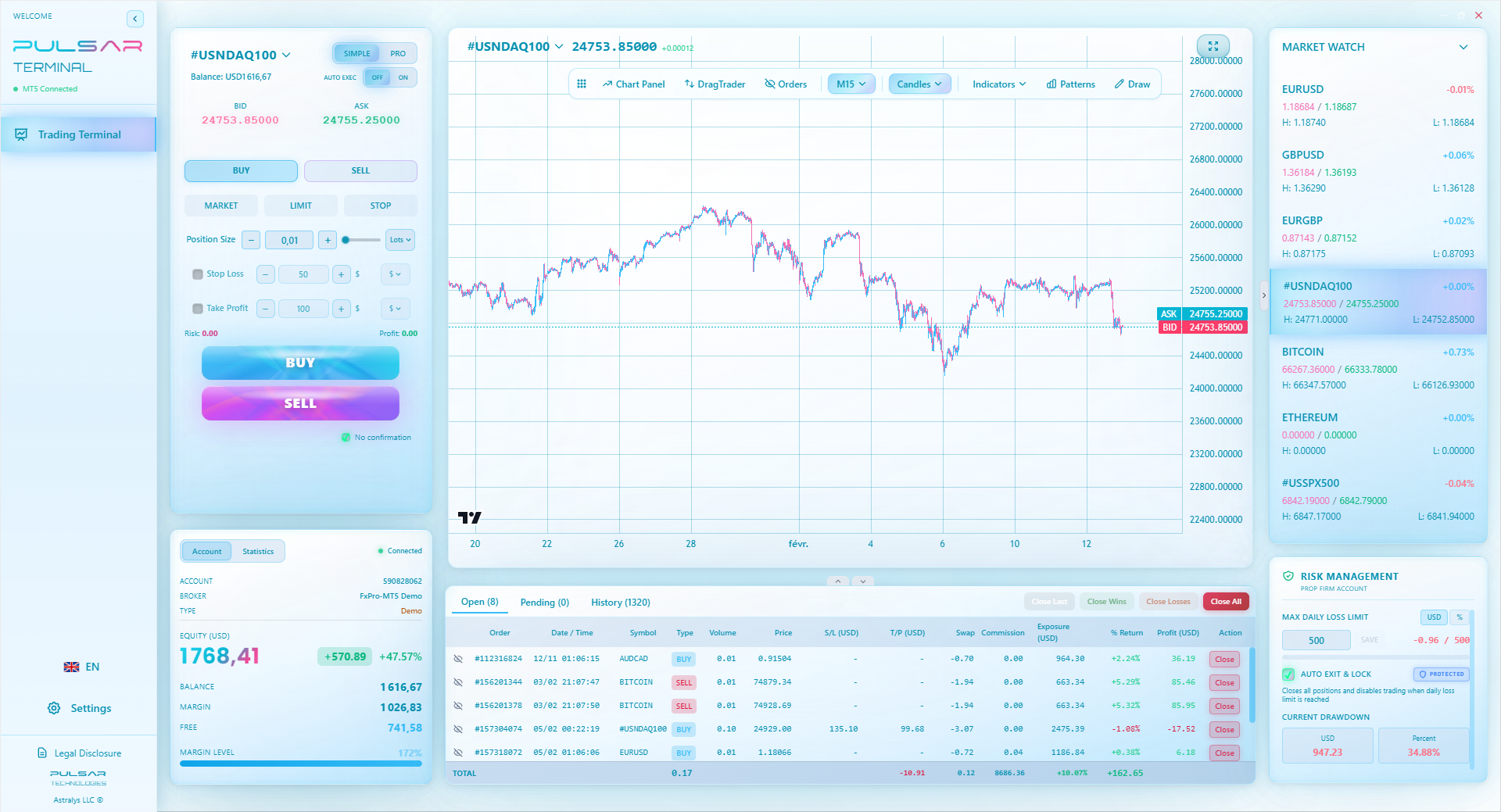
Executing a multi-stage trade management plan with partial closures and trailing stops is complex manually, but tools like Pulsar Terminal automate it directly on your MT5 platform.
Pulsar Terminal
Hepsi bir arada MT5 aracı: sürükle-bırak emirler, çoklu TP/SL, trailing stop, grid trading, Volume Profile ve prop firm koruması. Her gün 1.000'den fazla trader tarafından kullanılıyor.
“Your trading journal is more important than your charting software.”
Let's talk numbers. Your 'effective' strategy is useless if it doesn't account for costs and generate realistic returns.
The Silent Killers (Costs):
- Spread: On USD/ZAR, the spread can be 50-100 pips during volatile sessions. That's R50-R100 gone before you start. A strategy needing a 10-pip profit is impossible here.
- Commission: Brokers like IC Markets or Pepperstone offer raw spreads but charge ~$7 per lot round turn. On a R20,000 account trading 0.5 lots, that's R70 per trade. You must make that back first.
- Swap/Overnight Fees: Holding ZAR shorts overnight often incurs a negative swap (you pay). This eats into swing trade profits.
Realistic Return Expectations: With a R50,000 account, risking 1% (R500) per trade, and a decent strategy with a 1.5:1 average risk-reward:
- If you take 20 trades a month with a 50% win rate.
- 10 losers: 10 x -R500 = -R5000
- 10 winners: 10 x R750 = +R7500
- Gross Profit: R2500
- Now subtract spreads, commissions, and swaps. Your net might be R1500-R2000 per month.
That's a 3-4% monthly return, which is phenomenal in the investing world. Chasing 20% per month is what leads to the margin call. This is the reality of the most effective forex trading strategy: consistent, small, compounded gains.
“Your trading journal is more important than your charting software.”
Your tools should make your strategy easier to execute, not more complicated.
Broker Choice is Critical: You need a broker that is either FSCA-regulated (like some local offerings) or a reputable international broker that accepts South African clients and respects our laws. Regulation is about safety of funds. Look for:
- Low, consistent spreads on your chosen pairs.
- Reliable execution with no requotes.
- Easy ZAR deposits/withdrawals.
I've used XM for years for their variety of account types and good customer support for SA clients. But do your own research based on your strategy's needs.
Trading Platform Features: Beyond basic charts, look for:
- Easily set multiple take-profits and stop-losses. This is key for the partial closure management plan.
- Good charting tools to draw support/resistance and Fibonacci levels.
- Economic calendar integrated so you can avoid high-impact news events if your strategy requires it.
Keep Indicators Simple: You only need a few. A moving average for trend, horizontal lines for support/resistance, and maybe one momentum oscillator like the RSI indicator for confluence. More indicators just give you more conflicting signals.
💡 Winston'ın İpucu
The market doesn't care about your monthly bills. Trading to 'make R5000 for rent' is a guaranteed way to lose R5000. Trade the charts, not your expenses.
“Chasing 20% per month is what leads to the margin call.”
Knowledge is useless without action. Here's your launch sequence.
Step 1: Demo Trade for 3 Months Minimum. Not 2 weeks. Three full months. Trade your chosen framework through different market conditions (ranging, trending, volatile). Your goal is not profit, but to execute your rules flawlessly 100 times in a row.
Step 2: Fund a Small Live Account. Start with an amount you can afford to lose completely - R5000, for example. The psychological pressure is different. Your goal now is to make 10 consecutive trades following your plan, regardless of outcome.
Step 3: Analyze and Refine Weekly. Every Sunday, review your journal. Are you following rules? Where are losses coming from? Is your stop-loss placement too tight? Tweak one small thing at a time.
The Evolution: No strategy works forever. Markets change. The XAU/USD guide will show you gold behaves differently to currencies. Your system must be adaptable. Maybe you add a volume filter, or you adjust your take-profit ratios. The core pillars (risk management, consistency) never change, but the tactical rules can.
The most effective forex trading strategy is the one you understand, trust, and can execute mechanically, even when your gut is screaming at you to do the opposite. It's a system that survives the bad days so you can compound the good ones. That's the only edge that matters.
FAQ
Q1What is the single most important part of a forex trading strategy?
Risk management. Specifically, defining and sticking to a maximum loss per trade (like 1% of your account). A good entry can make you money, but poor risk management will destroy your account. It's the foundation everything else is built on.
Q2Can I make R10,000 a day trading forex in South Africa?
Theoretically, yes. Realistically, it's a path to ruin. To make R10,000 in a day with a sensible 1% risk, you'd need a R1,000,000 account and a perfect trade. Chasing daily targets forces overtrading and excessive risk. Focus on consistent monthly returns of 3-5%, which are extraordinary when compounded.
Q3Is 30:1 use from the FSCA enough to make money?
More than enough. In fact, it's a protective gift. Most blow-ups happen with use of 100:1 or more. With 30:1, you can still control significant positions, but it forces slightly more sensible position sizing. Professional traders often use far less.
Q4How many pairs should I trade at once?
Start with one major pair (e.g., EUR/USD) until you are consistently profitable with your system for 3 months. Adding more pairs dilutes your focus. Each pair has its own 'personality' - master one before adding another.
Q5How long does it take to become profitable?
Assume 1-2 years of dedicated learning, demo trading, and small-live trading. It's a skill like any other. The first year is usually about not losing money. The second year is about making consistent, small gains. Anyone promising faster results is selling a fantasy.
Q6Should I trade ZAR pairs or major pairs?
Beginners should stick to major pairs (EUR/USD, GBP/USD, USD/JPY). They have tighter spreads, more predictable liquidity, and endless free analysis. USD/ZAR and other ZAR pairs are more volatile with wider spreads, making them trickier to trade effectively without experience.
Q7Do I need expensive software or courses?
No. Everything you need is available for free: a demo account from a good broker, free charting software (MT4/MT5), and the discipline to study price action and keep a journal. Expensive courses often repackage free information. Invest in books and your own screen time first.
Prof. Winston'ın Dersi
Önemli Noktalar:
- ✓Risk 1% or less of your account per trade.
- ✓Define your edge with one clear, testable condition.
- ✓Use a partial closure plan (take 50% profit at 1:1 R:R).
- ✓Expect 3-5% monthly returns, not 5% daily.
- ✓Demo trade for 3 months before going live.
Bu makale ne kadar faydalıydı?
Bir yıldıza tıklayın
Haftalık Trading Analizleri
Ücretsiz haftalık analiz ve stratejiler. Spam yok.
Yazar hakkında
David van der Merwe
Gelişen Piyasalar Yatırımcısı
Johannesburg merkezli, gelişmekte olan piyasa dövizlerinde 11 yıllık deneyime sahip trader. ZAR pariteleri, FSCA düzenlemeli ticaret ve Güney Afrika piyasa analizi uzmanı.
Yorumlar
Risk Uyarısı
Finansal araçlarla işlem yapmak önemli riskler taşır ve tüm yatırımcılar için uygun olmayabilir. Geçmiş performans gelecekteki sonuçları garanti etmez. Bu içerik yalnızca eğitim amaçlıdır ve yatırım tavsiyesi olarak değerlendirilmemelidir. İşlem yapmadan önce her zaman kendi araştırmanızı yapın.
Bunları da beğenebilirsiniz

Cara Trading Forex Sukses: 7 Prinsip dari Trader Profesional
Cara trading forex sukses dengan 7 prinsip trader pro: manajemen modal, disiplin, journal trading, backtest. Data nyata, bukan janji profit palsu.
Jam Trading Forex Terbaik untuk Trader Indonesia: Panduan Lengkap dengan Tabel Waktu
Panduan jam trading forex untuk trader Indonesia. Tabel 4 sesi dunia, jam emas 20:00-00:00, sesi mana yang harus dihindari. Data akurat + tips dari trader berpengalaman.
Top 5 Sàn Forex Uy Tín Nhất 2026: Review Jujur dari Trader Indonesia
Top 5 sàn forex uy tín 2026 untuk trader Indonesia. Review jujur: spread, deposit, withdraw, dukungan lokal. Exness, XM, IC Markets & lebih.
Pulsar Terminal'ı Edinin
Tüm bu hesaplayıcılar MT5 hesabınızdan gerçek zamanlı verilerle Pulsar Terminal'e entegredir.
Pulsar Terminal'ı Edinin