


If you think checking Nedbank's forex rates is just for tourists buying dollars, you're missing a huge piece of the trading puzzle.

David van der Merwe
Gelişen Piyasalar Yatırımcısı ·  South Africa
☕ 9 dk okuma
Neler öğreneceksiniz:
If you think checking Nedbank's forex rates is just for tourists buying dollars, you're missing a huge piece of the trading puzzle. I used to ignore bank rates, focusing only on broker charts, until a missed arbitrage opportunity cost me a potential 1.8% gain on a large ZAR/USD move. Nedbank's rate history isn't just a price list; it's a reflection of local market pressure, regulatory constraints, and institutional sentiment that can give you an edge. Let's break down what this history actually means for your trading, how to read between the lines of their fees, and why every ZAR trader should have this data on their radar.
Nedbank's posted rates aren't pulled from thin air. As an Authorised Dealer for the South African Reserve Bank (SARB), their rates are built on a foundation of the interbank market rate, plus their own risk management and a hefty serving of fees. The key thing most traders miss? This rate includes the bank's spread and commission upfront. It's not a pure benchmark like the spot rate you see on your EUR/USD guide chart.
Historically, their rates have shown less volatility during off-peak South African hours (like late-night SAST) because their pricing models incorporate longer-term hedging. I've noticed that during local market opens (9am SAST) and around major South African data releases (like CPI or SARB announcements), the gap between Nedbank's sell rate and the interbank mid-rate can widen by 0.5% to 1% almost instantly. That's the bank's risk premium kicking in.

Example: On a day with high ZAR volatility, the interbank USD/ZAR might be 18.50. Nedbank's rate to sell you USD might be 18.85. That 0.35 difference isn't just a spread; it's a 1.89% effective cost covering their commission, operational risk, and profit.
For a trader, this history is a sentiment indicator. A sustained period where Nedbank's buy rate for USD is consistently higher than their sell rate suggests strong local demand for foreign currency - a potential warning sign of Rand weakness or capital flight pressures. It's a piece of fundamental data most retail traders completely overlook.

💡 Winston'ın İpucu
A bank's desperate need for a currency is shown in the price they're willing to pay for it, not the one they sell it at. Watch the buy rate history more closely.
This is where the rubber meets the road. Nedbank's fee structure is a masterclass in layered costs. If you're using bank services for funding, withdrawing profits, or managing a business account, these fees directly impact your bottom line. Let's get specific with the numbers as of early 2025.
For physical cash, the commissions are brutal. Buying foreign banknotes costs you 2.6% (min R145). Selling them back? That's 4.2% (min R145). So, a round trip for travel cash can easily wipe out over 6% of your value before you even leave the country. I learned this the hard way years ago, converting leftover Euros back to ZAR and watching a meaningful chunk vanish.
For electronic transfers, the costs are more nuanced but still significant. A digital outgoing international payment costs 0.63% (min R205, max R750). Add the flat SWIFT fee of R119.76, and you're looking at a fixed cost structure that hurts small transfers more. An analysis by Monito in late 2022 found the total cost of a R1,500 wire transfer could be around 25%. That's catastrophic for small-scale arbitrage or profit repatriation.
The Foreign Currency Account (FCA) Angle
This is Nedbank's best product for traders and businesses. The monthly fee is zero, and the minimum opening balance can be as low as 1 unit of currency online. You can hold USD, EUR, GBP, and others. The kicker? Interest rates vary wildly. A USD account might pay 3.20%, while holding Israeli Shekels pays 0%. This creates a hidden opportunity cost. If you're parking trading profits in an FCA, you need to factor in the interest differential against the ZAR, not just the exchange rate. Transfers between your own Nedbank accounts are free, which is useful for moving between ZAR and FCA buckets.

Warning: Never forget the international currency conversion fee of up to 2.75% for card transactions abroad. If you're using a South African card to fund an international broker (not recommended due to Exchange Control Regulations), this fee is on top of the broker's own deposit fee. It's a quick way to start a trade 3% in the hole.
“A round trip for physical cash can wipe out over 6% of your value before you even leave the country.”
You can't understand Nedbank's rates or any forex activity in SA without knowing the rules. The SARB's Exchange Control Regulations are the bedrock. They're designed to manage capital flows and protect the Rand. Nedbank operates under the Currency and Exchanges Manual for Authorised Dealers (the AD Manual).
For you, the individual trader, the key numbers are your allowances:
- Single Discretionary Allowance: R1 million per calendar year. You can move this offshore without a tax clearance certificate. This is your first port of call for funding an international trading account, though using it for speculative forex trading is a grey area - the allowance is intended for investment, travel, or gifts.
- Foreign Investment Allowance: R10 million per year. This requires a Tax Compliance Status (PIN) from SARS. This is more relevant for larger-scale investment.
On the trading side, the Financial Sector Conduct Authority (FSCA) regulates the brokers. They mandate client fund segregation, which is non-negotiable for safety. There's no national use cap, but reputable FSCA-regulated brokers like those we review (Exness review, IC Markets review) typically offer sensible use. A critical recent change? In late 2025, the SARB tightened rules for non-residents taking South African-source income offshore. They now need SARS tax compliance proof. This can create bottlenecks and affect liquidity for certain currency pairs involving ZAR.

Pro Tip: Always keep records of your international transfers. If you ever need to bring profits back, SARS and the banks will want to see the paper trail proving the original capital left legally. I keep a simple spreadsheet logging date, amount, allowance used, and reference number.
💡 Winston'ın İpucu
The 30-day rule on cash reconversion is a trap for the impatient tourist, not the strategic trader. Never hold physical forex as a 'trade'.
This is a crucial distinction. Nedbank provides a retail foreign exchange service. A forex broker provides speculative trading on margin. Comparing their rates is like comparing the price of buying a car to the price of renting one for a day.
| Feature | Nedbank (Forex Service) | FSCA-Regulated Forex Broker (e.g., Tickmill, FxPro) |
|---|---|---|
| Primary Purpose | Currency conversion for travel, trade, investment | Speculative trading on price movements |
| Pricing | All-in rate (includes commission & spread) | Raw market spread + possible commission |
| use | None (you deliver full amount) | Typically 50:1 to 500:1 on majors |
| Cost for $10,000 Trade | ~R290-R750 + % fee (e.g., ~R630+) | As low as $1-$3 (spread only on ECN) |
| Speed of Execution | Slower (bank processing) | Instant (market execution) |
| Ability to Short | No | Yes |
Nedbank's history is about the cost of owning physical or electronic foreign currency. A broker's rate history is about the moment-to-moment price of betting on that currency's movement. The broker's spread on USD/ZAR might be 0.05% (a few pips), while Nedbank's effective cost is 0.63% minimum. For active trading, brokers are the only viable platform. For moving large sums in or out of the country as part of your overall capital management, Nedbank's services and their rate history become relevant. Use a position size calculator based on broker spreads, not bank rates.
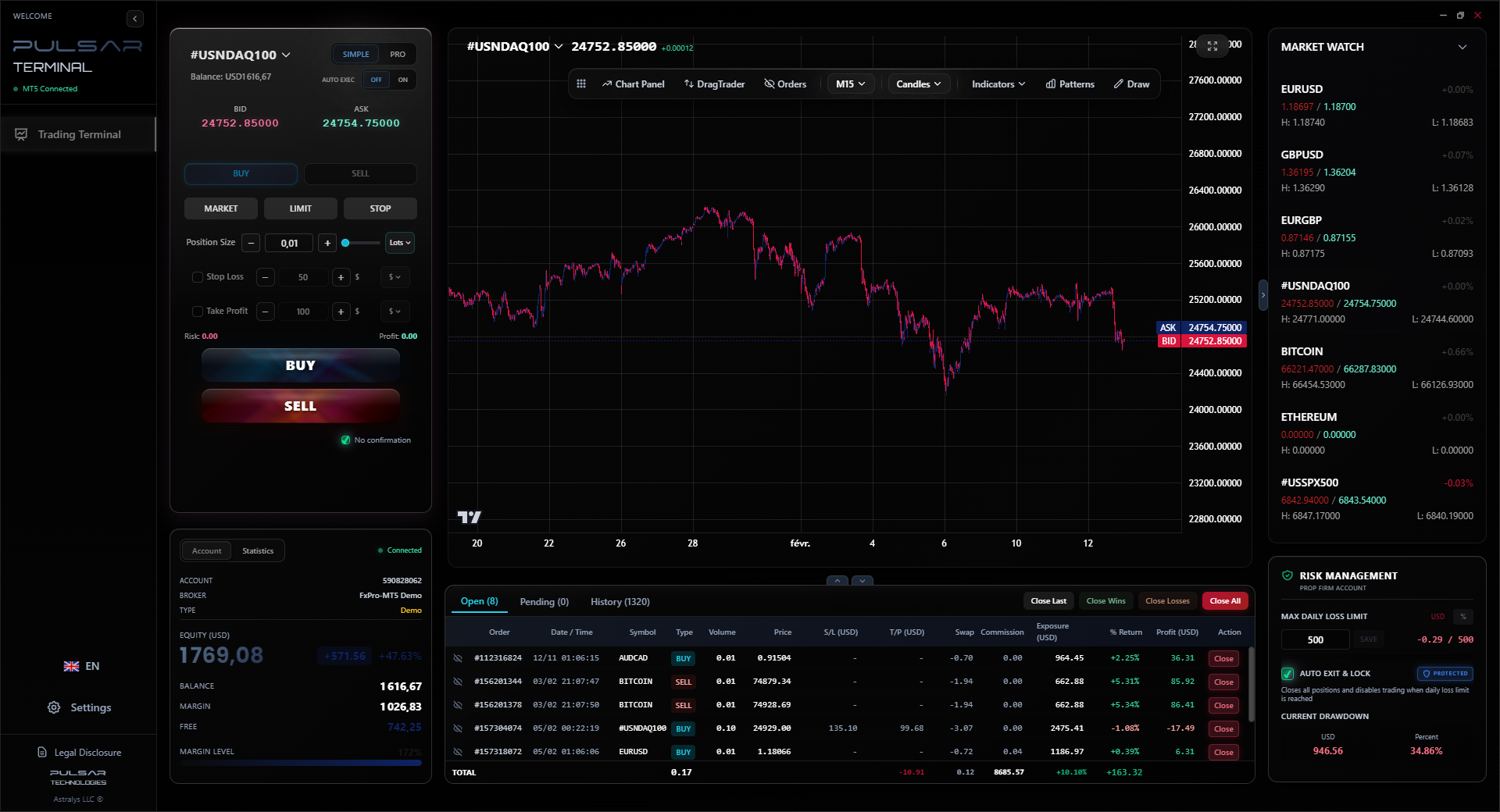
Managing multiple trades and risk parameters across different accounts is complex, but tools like Pulsar Terminal streamline this with drag-and-drop orders and automated stop-loss management directly on your MT5 platform.
Pulsar Terminal
Hepsi bir arada MT5 aracı: sürükle-bırak emirler, çoklu TP/SL, trailing stop, grid trading, Volume Profile ve prop firm koruması. Her gün 1.000'den fazla trader tarafından kullanılıyor.
“Trading from South Africa means managing the global market of your broker and the local framework of SARB.”
Nedbank's historical rates, when viewed over time, are a proxy for domestic currency stress. During the peak of 'Nenegate' in December 2015, the gap between the bank's buy and sell rates for major currencies widened dramatically. That wasn't just increased volatility; it was the bank pricing in unprecedented hedging costs and the risk of regulatory intervention.
Fast forward to recent developments (2024-2026). South Africa's forex reserves hit record highs (over $81 billion in Feb 2026). In theory, strong reserves should stabilize the Rand and reduce risk premiums in bank rates. However, post-Budget 2026, inflation risk shifted to import costs (oil, freight). When this happens, you'll see it in Nedbank's forward rate pricing for currencies like USD and EUR before it fully plays out in the spot market your broker shows.
I use this as a contrarian indicator sometimes. If Nedbank's sell rate for USD is at a massive premium and local news is screaming about a Rand crash, but my technical analysis on USD/ZAR shows RSI indicator divergence and weakening momentum, it can signal a sentiment extreme. The crowd buying USD at the bank counter is often the last wave of panic, not the first. It's not a precise entry signal, but it adds colour to the swing trading thesis.
Nedbank's own corporate moves also matter. Their January 2026 offer to acquire a majority stake in NCBA Group in East Africa signals a strategic focus on African markets. This could mean over time, their rates for African currencies (like KES, TZS) might become more competitive, offering new pairs for consideration beyond the standard majors.
💡 Winston'ın İpucu
Your R1 million allowance is your lifeline to global markets. Using it to chase a 2% arbitrage between a bank and a broker is like using a diamond to cut glass.
So, what do you actually do with all this?
- Use the Right Tool for the Job: Fund your live trading account with a reputable, FSCA-regulated broker. Do not try to trade through a bank's forex service. The costs will destroy you. Use Nedbank's services only for the final movement of capital in/out of the country, within your allowances.
- Monitor for Extremes: Bookmark Nedbank's forex rates page. You don't need to check it daily. Glance at it during periods of high ZAR volatility. A persistently wide buy/sell spread is a data point confirming underlying market stress.
- Factor in All Costs: If you're bringing profits home, model the total cost: the broker's withdrawal fee, the receiving bank fee, and the exchange rate. Sometimes, leaving profits in the foreign currency with your broker (if they offer accounts in USD/EUR) or in a Nedbank FCA is more efficient than converting back and forth. Calculate the breakeven.
- Understand the Limits: Remember the 30-day rule for reconverting foreign cash. If you withdraw cash from an overseas ATM, that physical currency must be converted back within 30 days of return. This kills any thought of holding physical forex as a short-term trade.
- Respect the Regulations: Your R1 million discretionary allowance is precious. Don't waste it on poorly planned transfers. Have a clear purpose for moving capital offshore, whether it's for a larger trading account, investing in international assets, or diversifying savings. And always, always get your Tax Compliance Status PIN if you plan to use the R10 million investment allowance.
Trading successfully from South Africa means managing two environments: the global, liquid market of your broker, and the local, regulated framework of SARB. Nedbank's forex rates history sits in the intersection of those two worlds. It's not a crystal ball, but it's a valuable gauge of local pressure that can help you make more informed decisions, especially when trading the Rand.
FAQ
Q1Can I use Nedbank's forex rates to find trading opportunities?
Not directly for entry/exit points. The rates are too slow and cost-heavy for speculation. However, significant, sustained deviations in their buy/sell spreads can indicate extreme local sentiment, which can be a useful secondary factor in your broader market analysis for pairs like USD/ZAR or EUR/ZAR.
Q2What's the cheapest way to get foreign currency through Nedbank?
For electronic funds, using a Foreign Currency Account (FCA) and making a digital transfer is usually cheapest, avoiding the high cash commissions. For larger amounts, the percentage-based fee becomes relatively smaller. Never use their travel card or cash service for amounts over a few thousand Rand if you can avoid it - the percentages are too high.
Q3How does Nedbank's rate for USD/ZAR compare to my broker's rate?
Nedbank's rate will always be worse (you'll buy USD higher, sell USD lower). Their rate includes a large built-in spread and commission. Your broker shows a much tighter market spread, often just a few pips. For a $10,000 equivalent transaction, the cost difference can easily be hundreds of dollars.
Q4I'm with a prop firm. How do these rules affect me?
If you're a South African resident trading for a prop firm based offshore, your profit payouts are considered foreign-source income. Repatriating those profits falls under your single discretionary allowance (R1m) or investment allowance (R10m). Keep careful records of all payouts as proof for SARS and the bank when bringing funds home.
Q5Can I open a Nedbank FCA to hold my trading profits in USD?
Yes, absolutely. It's a smart move to avoid constant conversion fees. You can open one with a low minimum via their app. Just be aware the interest paid (e.g., ~3.20% on USD) is likely lower than the interest you'd pay on a margin loan for a scalping strategy, so it's for storage, not growth.
Q6What happens if I exceed my annual foreign exchange allowance?
Exceeding your allowance without the proper SARS documentation is a breach of Exchange Control Regulations. The bank will block the transaction, and you could face penalties from the SARB. It's not worth the risk. Plan your capital movements within the limits.
Prof. Winston'ın Dersi
Önemli Noktalar:
- ✓Bank forex rates include a 0.6% - 4.2% premium you never see on a broker.
- ✓Your R1 million annual allowance is your key to global trading capital.
- ✓Physical currency must be converted back within 30 days of returning.
- ✓Use Foreign Currency Accounts (FCAs) to store profits, not cash.
- ✓Wide bank buy/sell spreads signal local market stress, not always a trade.
Bu makale ne kadar faydalıydı?
Bir yıldıza tıklayın
Haftalık Trading Analizleri
Ücretsiz haftalık analiz ve stratejiler. Spam yok.
Yazar hakkında
David van der Merwe
Gelişen Piyasalar Yatırımcısı
Johannesburg merkezli, gelişmekte olan piyasa dövizlerinde 11 yıllık deneyime sahip trader. ZAR pariteleri, FSCA düzenlemeli ticaret ve Güney Afrika piyasa analizi uzmanı.
Yorumlar
Risk Uyarısı
Finansal araçlarla işlem yapmak önemli riskler taşır ve tüm yatırımcılar için uygun olmayabilir. Geçmiş performans gelecekteki sonuçları garanti etmez. Bu içerik yalnızca eğitim amaçlıdır ve yatırım tavsiyesi olarak değerlendirilmemelidir. İşlem yapmadan önce her zaman kendi araştırmanızı yapın.
Bunları da beğenebilirsiniz

Cara Trading Forex Sukses: 7 Prinsip dari Trader Profesional
Cara trading forex sukses dengan 7 prinsip trader pro: manajemen modal, disiplin, journal trading, backtest. Data nyata, bukan janji profit palsu.
Jam Trading Forex Terbaik untuk Trader Indonesia: Panduan Lengkap dengan Tabel Waktu
Panduan jam trading forex untuk trader Indonesia. Tabel 4 sesi dunia, jam emas 20:00-00:00, sesi mana yang harus dihindari. Data akurat + tips dari trader berpengalaman.
Top 5 Sàn Forex Uy Tín Nhất 2026: Review Jujur dari Trader Indonesia
Top 5 sàn forex uy tín 2026 untuk trader Indonesia. Review jujur: spread, deposit, withdraw, dukungan lokal. Exness, XM, IC Markets & lebih.
Pulsar Terminal'ı Edinin
Tüm bu hesaplayıcılar MT5 hesabınızdan gerçek zamanlı verilerle Pulsar Terminal'e entegredir.
Pulsar Terminal'ı Edinin