


Here's a fact that might surprise you: over 70% of retail traders in Singapore use brokers that aren't actually regulated by the Monetary Authority of Singapore (MAS).

Daniel Harrington
İçerik Editörü
☕ 11 dk okuma
Neler öğreneceksiniz:
- 1MAS Regulation: Your First and Last Filter
- 2The Real Costs: It's More Than Just the Spread
- 3Who's Actually Worth Your Time? A Broker Rundown
- 4Platforms & Execution: Where the Rubber Meets the Road
- 5Getting Money In & Out: The SGD Reality
- 6Pitfalls Every Singapore Trader Should Avoid
- 7Your Action Checklist: How to Choose
Here's a fact that might surprise you: over 70% of retail traders in Singapore use brokers that aren't actually regulated by the Monetary Authority of Singapore (MAS). They're trading on licenses from other jurisdictions, thinking they've got the same protection. Spoiler: they don't. The local rules here are unique, especially the 5% minimum margin rule that caps your use at 20:1. Getting this wrong doesn't just cost you a trade, it can put your entire capital at risk. Let's break down exactly how to navigate the Singapore broker scene, cut through the marketing fluff, and find a platform that actually works for your strategy.
Forget spreads, forget platforms, forget bonuses. The very first thing you check is the MAS license. If a broker isn't on the MAS Financial Institutions Directory, walk away. It's that simple. I learned this the hard way early in my career, depositing with a well-marketed 'international' broker only to find withdrawal delays and unresponsive support when things got volatile. The peace of mind a local license provides is worth every pip.
The MAS isn't playing games. Their core mandate is investor protection, and that translates into specific, non-negotiable rules for online forex trading brokers. Client funds must be segregated in top-tier Singapore banks. That means your money isn't sitting in the broker's operating account where it could vanish if they go under. They also enforce strict capital adequacy requirements, so the broker has to have serious skin in the game.
The 20:1 use Cap
This is the big one that trips up traders from other regions. Back in October 2019, MAS raised the minimum margin requirement from 2% to 5%. In plain English? The maximum use you can get on forex pairs is 20 times your capital. So for a standard lot (SGD 100,000), you need at least SGD 5,000 in margin. Compare that to jurisdictions where 500:1 is common, and you see why your position sizing strategy needs a complete rethink here. It forces discipline, which isn't a bad thing, but it does limit certain high-frequency scalping strategy approaches that rely on ultra-high use.

Warning: Many global brokers will happily accept Singaporean clients under their offshore licenses (like ASIC or FCA) and offer higher use. This is a regulatory grey area. You are technically trading with an overseas entity, and while your funds might be protected under that jurisdiction's rules, you lose the direct recourse and speed of resolution that dealing with an MAS-licensed entity provides.

💡 Winston'ın İpucu
The MAS 5% margin rule is your friend. It forces a level of position sizing that most traders only learn after blowing up two accounts. Use it as your built-in risk governor.
Broker ads scream about 'tight spreads' and 'zero commission,' but that's only part of the story. The true cost of trading in Singapore has several layers, and if you don't account for all of them, your profit calculations are just fantasy.
Let's talk numbers. On a major pair like EUR/USD, you can find raw spreads starting from 0.0 pips on a commission-based account with brokers like Pepperstone or IC Markets. But you'll pay a commission per lot, usually around USD 7 round turn. On a standard account, the spread might be 0.6 to 1.2 pips with no commission. You need to do the math based on your trade volume. For my typical 2-lot EUR/USD guide swing trades, the commission-based account usually works out cheaper.
Then there's the overnight financing, or swap. For SGD-denominated pairs, the formula is pretty standard: 2.5% + SORA for longs, 2.5% - SORA for shorts. SORA is the Singapore Overnight Rate Average. If you're holding positions for more than a day, this can add up or even work in your favor. I once held a short AUD/SGD position for three weeks during a rate divergence play, and the positive swap paid for my entire month's data subscription.
Other sneaky fees:
- Inactivity Fees: After 6-12 months of no trades, some brokers will charge you SGD 10-50 per month. Read the fine print.
- Currency Conversion: If your account is in SGD but you trade USD pairs, the broker will apply a conversion spread, often around 0.5%. This can silently eat into your profits on every single trade.
- Withdrawal Fees: Many MAS brokers offer one free local bank (GIRO) transfer per month. After that, or for instant methods, fees apply.

Example: Let's compare two scenarios for a 1-lot EUR/USD trade held for 2 days.
| Cost Type | Broker A (Raw Spread + Comm) | Broker B (Wider Spread, No Comm) |
|---|---|---|
| Spread | 0.2 pips (USD 2) | 1.0 pips (USD 10) |
| Commission | USD 7 (round turn) | USD 0 |
| Swap (2 days) | ~USD -1.50 | ~USD -1.50 |
| Total Cost | ~USD 10.50 | ~USD 11.50 |
| Swap cost varies daily. This is why you need a good position size calculator that includes all these factors. |
“If a broker isn't on the MAS Financial Institutions Directory, walk away. It's that simple.”
Based on regulation, platform stability, and cost structures, here are the main players for serious traders in Singapore. This isn't about who has the flashiest ads, but who delivers where it counts.
Saxo Bank & Swissquote: The institutional heavyweights. If you have a six-figure account and value deep liquidity, research, and a vast product range (beyond just forex), these are top-tier. Their platforms are strong, but the cost of entry (minimum deposit) and overall fees are higher. This is for the 'private banking' style of trading.
IG (IG Asia Pte Ltd): The all-rounder with a strong local presence. MAS-licensed, excellent educational resources, and a proprietary platform that's actually quite good. Spreads are competitive, and they offer a huge range of markets. I've used IG for index CFDs alongside forex. Their customer support, based locally, is responsive.
Interactive Brokers (IBKR): The king of low-cost, direct market access for stocks, but their forex offering is primarily for currency conversion for equity trades, not for speculative forex spot trading. Their Trader Workstation (TWS) is a beast with a steep learning curve. Not my first choice for a pure forex focus.
International Brokers with Local Entities: This is where most active retail traders end up. Brokers like Pepperstone and IC Markets have built massive global reputations on tight spreads, reliable MT4/MT5 execution, and support for automated trading. They accept Singapore clients, but you'll be onboarded under their Australian (ASIC) or other global licenses, not a specific MAS one. You trade with their international entity. The trade-off? You often get access to their raw pricing and lower costs, but you're subject to their global terms, which may include higher use than MAS allows. It's a conscious choice you have to make.
My personal setup? I use a local MAS broker (IG) for my core, longer-term swing trading account where capital safety is paramount. For more active strategies, I use an international broker for their pricing and platform tools. You have to split your risk.
A broker can have the best license and the lowest costs, but if their platform freezes during the NFP report or their execution is slow, you're dead in the water. This is the most practical part of choosing online forex trading brokers.
MetaTrader 4/5: Still the industry standard, especially for algo traders. Most brokers offer it. The key difference is in how they connect you to liquidity. An ECN/STP broker will give you faster, more direct execution than a market maker. Look for brokers that publish their average execution speeds (under 50ms is good) and requote percentages (should be near 0%).
cTrader: Gaining popularity for its clean interface and transparent, direct market access (DMA) model. If you're a manual discretionary trader who likes a chart-centric workflow, cTrader is fantastic. Brokers like Pepperstone offer it.
Proprietary Platforms (IG, Saxo): These can be incredibly powerful, with integrated news, advanced charting, and screening tools built in. The downside is you're locked into that broker's environment.
The real test is during volatility. I remember during a sudden CHF move a few years back, my primary broker's platform lagged by over 5 seconds. My stop-loss order sat in a queue while the price blew right through it, resulting in a loss 30% larger than planned. I immediately opened an account with a broker known for strong infrastructure (XM review often highlights their platform stability) and now split my orders.

Pro Tip: Before funding a live account, open a demo. Don't just click around. Test it during the Asian open (8 am SGT) and the London/New York overlap (8-10 pm SGT). Place market orders, set stop-losses, and see if the execution matches your expectations. This simple step saved me from two brokers with terrible slippage.
💡 Winston'ın İpucu
Always calculate your 'all-in' cost per trade: spread, commission, and estimated swap if holding overnight. A strategy that looks profitable at 1-pip cost dies at a 3-pip cost.
“The true cost of trading in Singapore has several layers, and if you don't account for all of them, your profit calculations are just fantasy.”
This seems basic, but funding friction is a real morale killer. In Singapore, you want a broker that supports seamless SGD deposits and withdrawals.
Best Method: Local Bank Transfer (GIRO/FAST). This is almost always free for deposits and for at least one withdrawal per month. The funds usually clear within a few hours. This should be your default.
Credit/Debit Cards & E-Wallets: Neteller, Skrill, and card payments are instant but often come with fees (1-2% on the broker or processor side). They're useful for topping up quickly, but I wouldn't use them for large transfers. Also, some brokers have stricter withdrawal rules if you deposit with a card (they might only refund to the same card).
Currency Conversion Trap: This is critical. If you deposit SGD into a USD-denominated account, the broker will convert it at their rate, which includes a markup. Always opt for a multi-currency account or an SGD-denominated trading account if available. It keeps your accounting clean and saves on hidden conversion costs every time you trade a non-SGD pair.
A common mistake is not planning for withdrawals. Some brokers take 2-5 business days to process a bank withdrawal. Factor that into your cash flow management. I keep a small operational buffer in my trading account so I'm never forced to withdraw under time pressure.
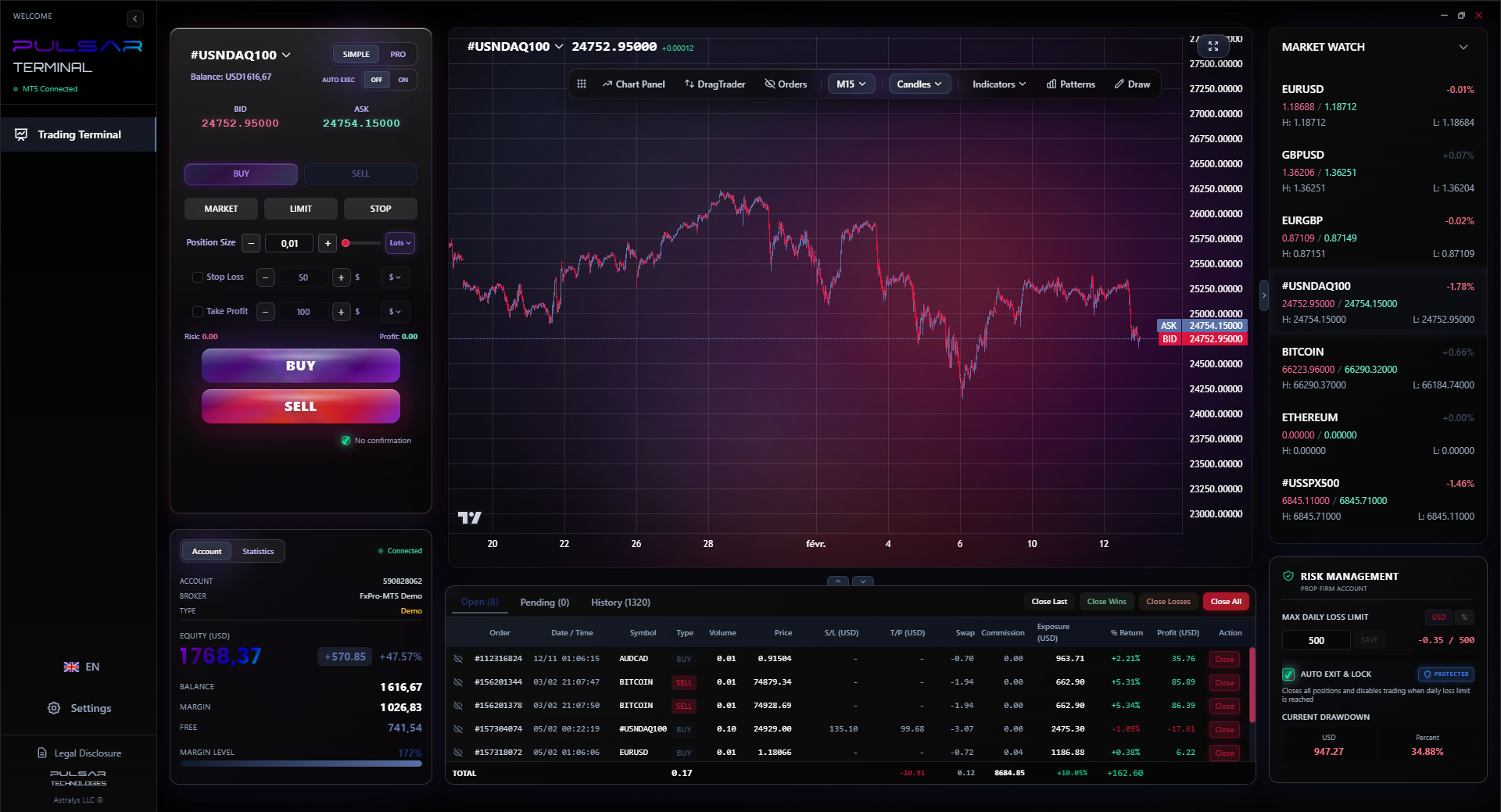
Managing multiple trades and complex exits under pressure is a huge challenge, which is why tools like Pulsar Terminal that bring advanced order management to MT5 are so valuable for Singapore traders.
Pulsar Terminal
Hepsi bir arada MT5 aracı: sürükle-bırak emirler, çoklu TP/SL, trailing stop, grid trading, Volume Profile ve prop firm koruması. Her gün 1.000'den fazla trader tarafından kullanılıyor.
After 12 years and coaching hundreds of traders locally, I see the same mistakes repeated. Let's skip the theory and get brutally honest.
1. Chasing Offshore use: The siren song of 500:1 use from an unregulated broker is strong. I've seen guys blow S$10,000 accounts in a morning trying to make it big with high use on XAU/USD guide. The MAS 20:1 cap is there for a reason. It feels limiting, but it's saving you from yourself. If you can't make money with 20:1, you won't make it with 500:1, you'll just lose it faster.
2. Ignoring the Tax Question. The general rule is that capital gains from forex are not taxed in Singapore. However, if the IRAS deems your trading to be a business (based on frequency, organization, and purpose), profits could be considered income. Keep clean, organized records of all your trades. I know a full-time trader who had to hire an accountant to argue his case with IRAS because his trading volume was so high. It was resolved in his favor, but it was stressful.
3. Overlooking the Total Cost of Trading. As we covered, it's not just the spread. That overnight swap on a long-term short JPY position? It can be a constant drain. Use your broker's cost calculator for every new pair you trade.
4. Not Having a Plan for a Margin Call. With 5% margin, a 5% move against you wipes out your collateral. Your broker's system will automatically close your positions, often at the worst possible price. Your job is to manage risk so you're never in a position where the system has to make that decision for you. Use stop-losses religiously. A hard lesson from my second year trading: I was short USD/JPY and left for dinner without a stop, convinced it would drop. A geopolitical headline spiked it, and I got the dreaded margin call email. My account was halved. Never again.
“The best broker for you is the one that becomes invisible, a reliable tool that lets your strategy shine.”
Don't get paralyzed by analysis. Work through this list.
- Regulation First: Check MAS directory. Decide: Pure MAS license or reputable international broker (ASIC, FCA)?
- Cost Analysis: For your typical trade size and holding period, calculate the all-in cost (spread + commission + swap) on a demo account for at least 10 trades.
- Platform Test: Use the demo during volatile periods. Is the chart smooth? Do orders execute quickly? Can you easily set a trailing stop or a breakeven order?
- Funding/Withdrawal: Confirm SGD account option, local bank transfer details, and withdrawal processing times.
- Instrument Check: Do they offer the specific pairs or CFDs you trade? If you like trading Singapore stocks as CFDs or the SGX Nifty, not all brokers have them.
- Support: Contact their support with a technical question via live chat and email. Gauge the response time and knowledge. Try it at 11 pm SGT.
Start small. Fund the account with an amount you're willing to lose entirely. Run your strategy for a full month. Only then consider moving more capital over. The best online forex trading brokers for you is the one that becomes invisible, a reliable tool that lets your strategy shine, not a constant source of frustration.
💡 Winston'ın İpucu
Your broker's customer support is part of your risk management. Test them with a complex question on a demo before you go live. Slow support during a crisis is a liability.
FAQ
Q1Can I use international brokers like Exness or XM in Singapore?
Yes, you can. Brokers like Exness review and XM review actively accept Singapore clients. However, you will be trading under their global licenses (like CySEC or FSA), not under MAS regulation. This means you get their global terms, which may include higher use, but you forfeit the specific investor protections and direct recourse offered by an MAS-licensed entity. It's a trade-off between conditions and local regulatory oversight.
Q2What is the minimum deposit for forex trading in Singapore?
It varies wildly. Some international brokers have minimums as low as USD 50. MAS-regulated brokers like Saxo might require SGD 10,000 or more. For most serious retail traders, a good starting point is between SGD 500 to SGD 2,000. Remember, with 5% margin, SGD 1,000 controls a SGD 20,000 position. Start with an amount that allows for proper risk management without causing emotional stress on every pip definition move.
Q3Are forex trading profits taxable in Singapore?
Generally, no. Forex trading profits are typically viewed as capital gains, which are not taxed in Singapore. However, if the Inland Revenue Authority of Singapore (IRAS) determines you are trading as a business (based on frequency, volume, and organization), they could classify profits as taxable income. It's rare for retail traders, but if you trade full-time with large, frequent volumes, keep impeccable records and consider consulting a tax professional.
Q4Why is my use capped at 20:1 with a Singapore broker?
This is a direct rule from the Monetary Authority of Singapore (MAS). To protect retail investors, they mandate a minimum 5% margin requirement (100%/5% = 20x use). This rule, active since October 2019, applies to all MAS-licensed brokers. It's designed to prevent the excessive losses that can occur with very high use. If you see a broker offering more than 20:1 to a Singapore resident, they are not operating under an MAS license.
Q5What's the difference between ECN and Market Maker brokers in Singapore?
An ECN (Electronic Communication Network) broker connects your order directly to other participants in an interbank market. You typically pay a commission but get raw spreads. A Market Maker sets their own prices and may take the other side of your trade. In Singapore, most reputable brokers, whether MAS or ASIC-regulated, use an STP/ECN model. The key is transparency: look for brokers that disclose their execution model and have low requote rates.
Q6Which is better for beginners: MT4, MT5, or a proprietary platform?
For a complete beginner in Singapore, I'd lean towards a broker with a good proprietary platform (like IG's) that integrates education, news, and simple charting. It's more guided. Once you're serious about technical analysis or automation, move to MT4/MT5. MT4 is simpler and has more custom indicators for forex. MT5 handles more asset types. Don't get bogged down; you can learn any of them. Start with the platform your chosen broker offers as its primary, stable solution.
Prof. Winston'ın Dersi
Önemli Noktalar:
- ✓MAS regulation is non-negotiable for capital safety.
- ✓Maximum use is 20:1 due to 5% margin rule.
- ✓Real costs include spread, commission, and swap fees.
- ✓Test platform execution during market volatility.
- ✓Use local SGD bank transfers to avoid fees.
Bu makale ne kadar faydalıydı?
Bir yıldıza tıklayın
Haftalık Trading Analizleri
Ücretsiz haftalık analiz ve stratejiler. Spam yok.
Yazar hakkında
Daniel Harrington
İçerik Editörü
The Trading Mentor içerik direktörü. Karmaşık ticaret kavramlarını anlaşılır kılma tutkusuna sahip deneyimli trader. Küresel konuları, stratejileri ve platform rehberlerini kapsar.
Yorumlar
Risk Uyarısı
Finansal araçlarla işlem yapmak önemli riskler taşır ve tüm yatırımcılar için uygun olmayabilir. Geçmiş performans gelecekteki sonuçları garanti etmez. Bu içerik yalnızca eğitim amaçlıdır ve yatırım tavsiyesi olarak değerlendirilmemelidir. İşlem yapmadan önce her zaman kendi araştırmanızı yapın.
Bunları da beğenebilirsiniz

Cara Trading Forex Sukses: 7 Prinsip dari Trader Profesional
Cara trading forex sukses dengan 7 prinsip trader pro: manajemen modal, disiplin, journal trading, backtest. Data nyata, bukan janji profit palsu.
Jam Trading Forex Terbaik untuk Trader Indonesia: Panduan Lengkap dengan Tabel Waktu
Panduan jam trading forex untuk trader Indonesia. Tabel 4 sesi dunia, jam emas 20:00-00:00, sesi mana yang harus dihindari. Data akurat + tips dari trader berpengalaman.
Top 5 Sàn Forex Uy Tín Nhất 2026: Review Jujur dari Trader Indonesia
Top 5 sàn forex uy tín 2026 untuk trader Indonesia. Review jujur: spread, deposit, withdraw, dukungan lokal. Exness, XM, IC Markets & lebih.
Pulsar Terminal'ı Edinin
Tüm bu hesaplayıcılar MT5 hesabınızdan gerçek zamanlı verilerle Pulsar Terminal'e entegredir.
Pulsar Terminal'ı Edinin