


Here's a fact that might surprise you: a study of classic pivot points in the Nifty 50 found a win rate around 62%, but the average gain per trade was just 0.16%.

Rajesh Sharma
Kıdemli Forex Analisti ·  India
India
☕ 12 dk okuma
Neler öğreneceksiniz:
- 1What Are Pivot Points, Really?
- 2Setting Up Your Charts the Right Way
- 3The Core Trading Rules & Setups
- 4Risk & Money Management: This is Non-Negotiable
- 5Indian Market Specifics & Regulations
- 6Common Mistakes I've Made (So You Don't Have To)
- 7Taking It Further: Combining With Other Tools
- 8Your Action Plan to Get Started Today
Here's a fact that might surprise you: a study of classic pivot points in the Nifty 50 found a win rate around 62%, but the average gain per trade was just 0.16%. That's the reality of this popular tool. It's not a magic crystal ball, but when you know how to use it, a pivot point trading strategy becomes one of the most reliable frameworks for spotting intraday support and resistance. I've used pivots for over a decade, and they've saved me from bad entries more times than I can count. Let's break down how they work in our market, with all its unique rules and costs.
Think of a pivot point as the market's center of gravity for the day. It's a single price level, calculated from yesterday's action, that traders use as a reference. The idea is simple: if price is above the pivot, sentiment is bullish. If it's below, sentiment is bearish. From that central pivot, we calculate a series of support and resistance levels (S1, S2, R1, R2, etc.). These become the day's potential turning points.
Most platforms like Zerodha Kite or Upstox Pro will calculate these for you automatically. But you should know the classic formula. It's dead simple:
Pivot Point (PP) = (Yesterday's High + Yesterday's Low + Yesterday's Close) / 3
Then you get:
- Resistance 1 (R1) = (2 x PP) - Yesterday's Low
- Support 1 (S1) = (2 x PP) - Yesterday's High
- Resistance 2 (R2) = PP + (Yesterday's High - Yesterday's Low)
- Support 2 (S2) = PP - (Yesterday's High - Yesterday's Low)

Example: Let's say Reliance Industries yesterday had a High of ₹2,950, a Low of ₹2,890, and closed at ₹2,930. PP = (2950 + 2890 + 2930) / 3 = 2923.33 R1 = (2 * 2923.33) - 2890 = 2956.66 S1 = (2 * 2923.33) - 2950 = 2896.66
These levels aren't hard walls. Think of them as zones where price is likely to pause, reverse, or at least see a reaction. The real skill is in how you trade those reactions.
There are other calculation methods too - Fibonacci, Camarilla, Woodie's. I've tried them all. For Indian equities and indices, the classic formula has always felt the most natural. The others can get you into trouble by placing levels too close together in our sometimes-volatile market.

💡 Winston'ın İpucu
The central Pivot Point (PP) is a sentiment magnet. Price consolidating above it suggests underlying strength; consolidating below it shows weakness. Use it as a filter, not just a level.
First, you need a platform that lets you see these levels clearly. Almost every Indian broker's platform has them. In Kite, you just click the 'Indicators' button and search 'Pivot Points'. Make sure you select 'Classic' and set it to 'Daily' timeframe. This is crucial. The calculation must be based on the previous trading day's session.
I keep my charts clean. I have the candlesticks, volume, and my pivot levels. That's it for this strategy. Cluttering your screen with 10 other indicators will just confuse the signals. I use a 5-minute or 15-minute chart for scalping strategy entries around pivots, and a 30-minute or hourly to see the broader intraday trend.
A Note on Session Times
Remember, our market has pre-open (9:00-9:15 AM), normal session (9:15 AM-3:30 PM), and post-close. Your pivot points are calculated using the normal session's High, Low, and Close. Ignore the pre-open auction prices. The 3:30 PM closing price is the one that matters.

Warning: If there's a huge gap up or down at the open - say, after a budget announcement - those pivot levels can become less relevant immediately. Price might blow straight through S1 or R1. Have a plan for gap days; sometimes it's better to wait 30 minutes for the dust to settle.
“Pivot points are guides, not commands. In a strong trend, price will smash through them like they're not even there.”
This is where we move from theory to practice. A pivot point trading strategy gives you clear rules. Here are the two setups I use most.
Setup 1: Trading the Bounce (The Reversal Play) This is the classic. Price approaches a support (S1, S2) or resistance (R1, R2) level. You look for signs of rejection - a pin bar, a bullish/bearish engulfing pattern, or just a slowdown in momentum. Then you enter in the direction of the bounce, targeting the next pivot level or the central PP.
- Long at Support: Wait for price to touch or slightly pierce S1. Look for a bullish candle closing above S1. Place your buy order with a stop loss just below the low of that rejection candle. Your target is the PP or R1.
- Short at Resistance: Wait for price to touch R1. Look for a bearish candle closing below R1. Sell with a stop above the high, target PP or S1.
Setup 2: Trading the Breakout (The Momentum Play) Sometimes, a level breaks with conviction. If price slices through R1 with strong volume and closes well above it, the next target is often R2. The same logic applies to breakdowns below support.
The key is confirmation. Don't jump in just because price ticked through a level. I got burned doing that early on. Wait for the candle to close beyond the level on your chosen timeframe (5-min or 15-min). It's slower, but it's safer.

Pro Tip: Combine pivots with one momentum oscillator. I like the RSI indicator. If price is at S1 and the RSI is below 30 (oversold), it adds conviction to a potential bounce. At R1 with RSI above 70, it warns of a potential reversal. It's a simple filter that cuts out weak signals.
You can have the best pivot point strategy in the world, and poor risk management will still wipe you out. Here’s the Indian context you must factor in.
1. Position Sizing: Never risk more than 1-2% of your trading capital on a single trade. If your account is ₹100,000, your max risk per trade is ₹1,000-₹2,000. Use a position size calculator religiously. Our brokerage structure makes this easier with flat fees.
2. The Real Cost of a Trade: Let's do the math on a ₹100,000 intraday trade with a popular discount broker.
- Brokerage: ₹20 (flat)
- STT: 0.025% on sell = ₹25
- Exchange Charge: ~0.003% = ₹3
- SEBI Fee: ₹10 per crore = ₹1
- GST: 18% on (₹20+₹3+₹1) = ₹4.32
- Total Cost: ~₹53.32 per side (buy and sell).
You need to make at least ₹107 just to break even on the round trip. Your profit target must be significantly wider than your costs and your spread definition. Aiming for a 0.1% gain (₹100) is pointless; you'd lose after costs.
3. Stop Losses: Your stop loss should be placed at a level that, if hit, proves your trade idea wrong. If buying at S1, the trade is wrong if S1 breaks and price heads to S2. Place the stop below S1. The distance between your entry and stop defines your risk per share. That distance, multiplied by your position size, must equal your pre-defined max risk (that 1-2%).
Ignoring this is how you get a margin call. I learned this the hard way in 2015. I was right on direction using pivots on Bank Nifty, but my position was too big. A normal 50-point whip against me triggered a margin shortfall, and my broker squared off my position right before it reversed. I lost ₹18,000 on a trade that would have been a winner.
💡 Winston'ın İpucu
On expiry days, pivot levels on the Nifty or Bank Nifty can get stretched and violated due to frantic option hedging. Tread carefully and use wider stops.
“Your profit target must be wider than your total trading costs, or you're just donating to the broker and the government.”
Trading in India isn't just about charts. You're playing in a field with specific rules, and SEBI is constantly changing them. Here’s what matters for a pivot point trader in 2026.
Algo Trading Rules (Critical Update): If you want to automate your pivot point strategy, listen up. SEBI's new framework is fully mandatory from April 1, 2026. Every algorithm must be registered and approved by the exchange. Brokers are now legally responsible for all algo orders. For most retail traders, the key limit is the 10 orders per second threshold. If your automated system stays below that, you might not need formal registration (check with your broker). But API access is now tightly controlled with static IP whitelisting and 2FA. This isn't the wild west anymore.
Asset Classes Where Pivots Work Well:
- Nifty 50 / Bank Nifty Futures: Excellent liquidity, clear levels. My bread and butter.
- Liquid Equity Stocks: Reliance, TCS, HDFC Bank. Avoid illiquid small-caps.
- USD/INR Futures: Pivots work on currencies too. Check out our EUR/USD guide for core principles that apply here.
What You Can't Do: Remember, SEBI regulations now explicitly prohibit brokers from offering guaranteed returns. Anyone selling you a "90% success rate pivot point system" with a promise of fixed income is breaking the rules. The success comes from your discipline, not a magical formula.
Choosing a broker that supports your style is key. For manual trading with good charts, Zerodha or Upstox are solid. If you're leaning towards automation or need strong API access under the new rules, look at brokers like Exness for forex or IC Markets for their tech stack, though their primary offerings are for international markets. For pure Indian equities, check your broker's specific API and algo policy documents.
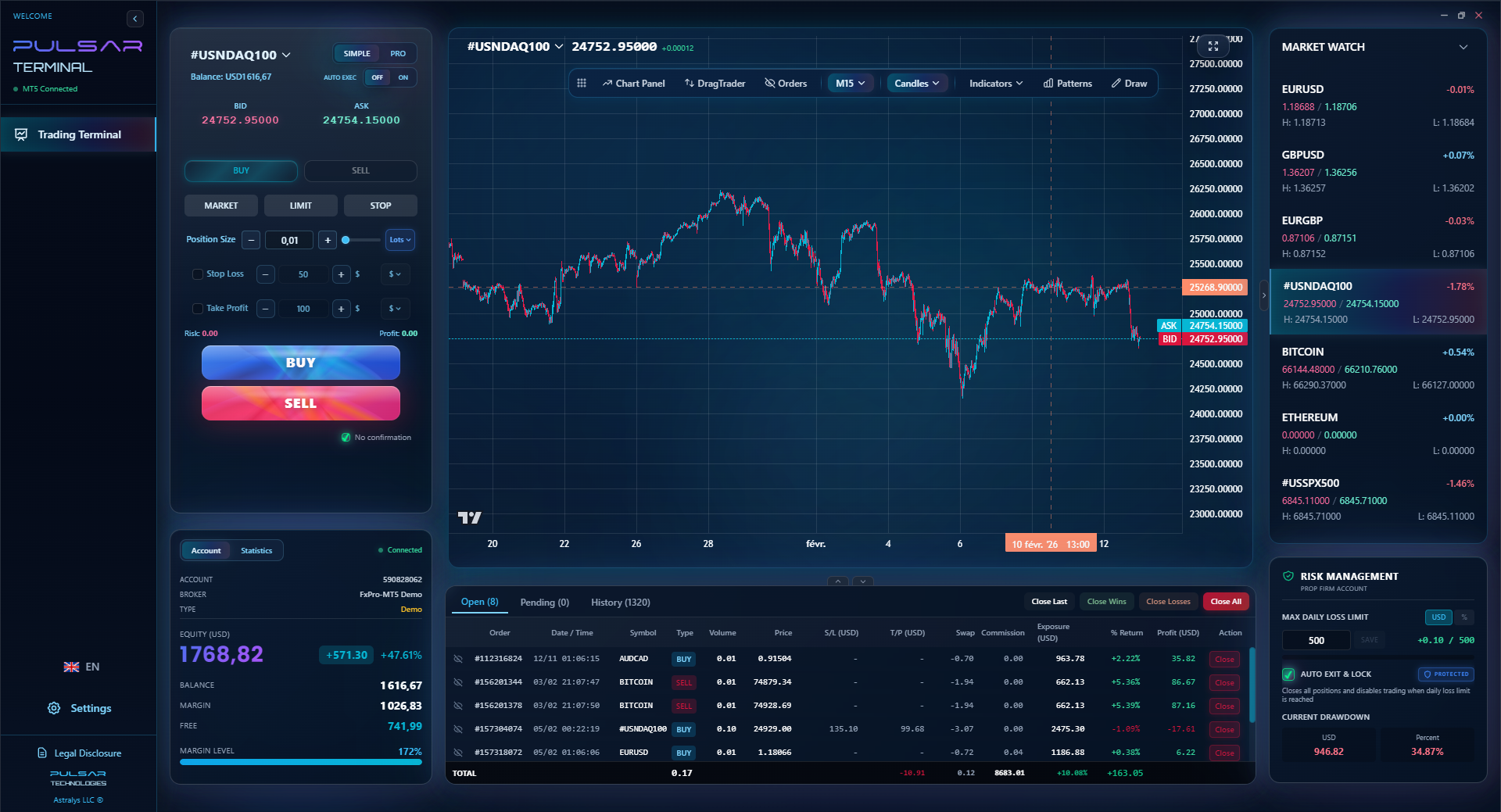
Managing multiple trades around pivot levels is complex, but tools like Pulsar Terminal let you set multi-level take-profits and trailing stops directly on your MT5 chart, automating your exit strategy.
Pulsar Terminal
Hepsi bir arada MT5 aracı: sürükle-bırak emirler, çoklu TP/SL, trailing stop, grid trading, Volume Profile ve prop firm koruması. Her gün 1.000'den fazla trader tarafından kullanılıyor.
Let me be brutally honest about where I've gone wrong with pivots.
1. Treating Them as Holy Orders: S1 is not a force field. In a strong bearish trend, price will smash through S1, then S2, like they're not even there. I once kept buying "support" at S1, S2, and S3 in a crashing stock, averaging down. I turned a small ₹5,000 loss into a ₹35,000 disaster. Pivots are guides, not commands. Always respect the higher timeframe trend.
2. Ignoring Volume: A bounce at S1 on tiny volume is a weak bounce. It will likely fail. A breakout above R1 on surging volume is likely real. Volume confirms the price action at these key levels. Don't skip this check.
3. Chasing the Middle: The most confusing price action is around the central Pivot Point (PP). Price often chops around there. I've taken terrible trades trying to guess the next direction from the PP. My rule now: I don't take new reversal trades if price is within 0.2% of the PP. I wait for it to commit to a side.
4. Forgetting Time Decay in Options: If you're trading Bank Nifty options using pivot levels, remember that time decay (theta) is your enemy. A correct directional call that takes too long to play out can still lose money. Pivot strategies often work best for futures or swing trading equities, where time isn't a direct cost.
Stick to the major levels (S1, R1, PP) most of the time. S2 and R2 come into play only on very high volatility days. Simplifying your focus improves decision-making.
“The real skill isn't in calculating the levels; it's in managing your reaction when price gets there.”
Once you're comfortable with the basics, you can layer pivot points with other concepts to refine your edge.
Pivots + Moving Averages: This is a powerful trend filter. I plot a 20-period exponential moving average (EMA) on my intraday chart. My rule: I only take long trades at pivot support if price is above the 20 EMA. I only take short trades at pivot resistance if price is below it. This keeps you trading in the direction of the intraday momentum.
Pivots as Profit Targets: Use pivot levels for your profit targets on other strategies. For example, if you buy a stock based on a MACD indicator crossover, your first logical profit target could be the daily R1 level. It gives you a objective exit point instead of guessing.
Weekly and Monthly Pivots: For positional trades, calculate weekly pivots (using last week's High, Low, Close) and monthly pivots. These become major support/resistance zones. A stock approaching its monthly R1 level is at a potentially significant turning point. I used weekly R1 as a take-profit zone for a XAU/USD guide trade last year, banking a tidy 3.5% gain.
The goal is to make pivots part of your trading language. They provide a common-sense structure to the market's chaos. After a while, you'll just see the market through these levels.
💡 Winston'ın İpucu
If R1 and S1 are both broken convincingly in the same session, it's a sign of a volatile, trendless day. Step aside. The pivot point framework works best in ranging or gently trending markets.
Don't overcomplicate this. Here's a simple 5-step plan.
- Pick One Instrument: Start with Nifty Futures or a single liquid stock like Infosys. Master one thing.
- Paper Trade for Two Weeks: Don't use real money. Every morning, note down the pivot levels. Watch how price reacts to them. Mark where you would have entered and exited. See if you'd be profitable after costs.
- Define Your Rules: Write down your exact setup. "I will buy only if price touches S1, the 5-min RSI is below 35, and a bullish candle closes above S1. Stop loss at S1 - 0.3%. Target at PP." Writing it down removes emotion.
- Start Small: When you go live, start with a tiny position size. Your goal for the first month is to execute your plan perfectly, not to make money. A ₹500 profit following your rules is a bigger win than a ₹5,000 profit from a lucky gamble.
- Review Your Trades: Every evening, look at your trades. Did you follow your rules? Did you miss a setup? Was your stop loss logic sound? This review process is how you improve.
Finally, remember that no strategy works all the time. A good pivot point trading strategy will give you an edge over many random entries, but it requires patience. Some days the market will respect every level perfectly. Other days it will ignore them completely. Your job is to manage risk on the bad days so you have capital left for the good ones. Good luck.
FAQ
Q1Which pivot point formula is best for Indian markets?
For most Indian traders starting out, the Classic formula is the most reliable and widely watched. It's calculated from the previous day's normal session high, low, and close. While Fibonacci or Camarilla pivots have their followers, the Classic levels often become self-fulfilling because so many participants are watching the same numbers on platforms like Zerodha Kite.
Q2Can I use pivot points for swing trading in India?
Absolutely. While commonly used for intraday, you can calculate weekly or monthly pivot points for swing trading. Use the previous week's or month's high, low, and close. These levels act as major support and resistance zones for positional trades. A stock bouncing from a monthly S1 level can be a strong signal for a multi-week hold.
Q3How do I account for brokerage and taxes in my pivot point targets?
This is critical. Your profit target must be wider than your total trading costs. For an intraday trade, you need to cover brokerage (e.g., ₹20), STT, exchange charges, and GST. This often totals ₹50-₹100 per round trip. If your target from S1 to PP is only ₹150, your net gain is tiny. Always factor in at least ₹75-₹100 of costs when setting targets, otherwise the trade isn't worth the risk.
Q4Do pivot points work on Bank Nifty and Nifty options?
They work on the underlying index (Bank Nifty/Nifty Futures), which then influences the options prices. However, trading options adds complexity like time decay and implied volatility. It's often cleaner to apply your pivot point strategy to the futures contract itself. If trading options, use the pivot levels on the futures chart to decide your strike prices and direction.
Q5What timeframe chart should I use with pivot points?
Use multiple timeframes. Use the daily chart to plot your pivot levels. Then, use a lower timeframe like 15-minute or 30-minute to identify the intraday trend and a 5-minute chart for precise entry signals. This multi-timeframe analysis helps you trade in the direction of the intraday momentum, not against it.
Q6Are automated pivot point strategies allowed under SEBI's new algo rules?
Yes, but with strict conditions. As of April 1, 2026, any automated strategy must be registered and approved by the exchange if it places more than 10 orders per second. For most retail traders manually automating a few pivot-based orders, you may fall under the threshold. However, you must use your broker's approved API with features like static IP whitelisting. Always check with your specific broker for their compliance requirements.
Q7Why did my trade fail even though price bounced perfectly from S1?
This happens. Common reasons: 1) You ignored the overall market trend (e.g., buying S1 in a strong bearish Nifty trend). 2) There was no volume confirmation on the bounce. 3) A major news event overrode the technical level. 4) Your profit target was too narrow, and price reversed before hitting it. This is why risk management (stop loss) is essential for every single trade.
Prof. Winston'ın Dersi
Önemli Noktalar:
- ✓Classic Pivot Formula uses yesterday's H, L, C.
- ✓Factor in ₹75-100 costs per intraday trade.
- ✓Wait for candle close confirmation at levels.
- ✓Never risk more than 2% of capital per trade.
- ✓SEBI's 10-orders-per-second algo threshold is key.
Bu makale ne kadar faydalıydı?
Bir yıldıza tıklayın
Haftalık Trading Analizleri
Ücretsiz haftalık analiz ve stratejiler. Spam yok.
Yazar hakkında
Rajesh Sharma
Kıdemli Forex Analisti
Hindistan ve Güney Asya piyasalarında 10 yılı aşkın deneyim. NSE döviz türevleriyle başlayıp uluslararası forex'e geçiş yaptı. USD/INR ve gelişmekte olan piyasa pariteleri uzmanı.
Yorumlar
Risk Uyarısı
Finansal araçlarla işlem yapmak önemli riskler taşır ve tüm yatırımcılar için uygun olmayabilir. Geçmiş performans gelecekteki sonuçları garanti etmez. Bu içerik yalnızca eğitim amaçlıdır ve yatırım tavsiyesi olarak değerlendirilmemelidir. İşlem yapmadan önce her zaman kendi araştırmanızı yapın.
Bunları da beğenebilirsiniz

Cara Trading Forex Sukses: 7 Prinsip dari Trader Profesional
Cara trading forex sukses dengan 7 prinsip trader pro: manajemen modal, disiplin, journal trading, backtest. Data nyata, bukan janji profit palsu.
Jam Trading Forex Terbaik untuk Trader Indonesia: Panduan Lengkap dengan Tabel Waktu
Panduan jam trading forex untuk trader Indonesia. Tabel 4 sesi dunia, jam emas 20:00-00:00, sesi mana yang harus dihindari. Data akurat + tips dari trader berpengalaman.
Top 5 Sàn Forex Uy Tín Nhất 2026: Review Jujur dari Trader Indonesia
Top 5 sàn forex uy tín 2026 untuk trader Indonesia. Review jujur: spread, deposit, withdraw, dukungan lokal. Exness, XM, IC Markets & lebih.
Pulsar Terminal'ı Edinin
Tüm bu hesaplayıcılar MT5 hesabınızdan gerçek zamanlı verilerle Pulsar Terminal'e entegredir.
Pulsar Terminal'ı Edinin