


Here's the brutal truth most Nigerian trading 'gurus' won't tell you: you can have a 70% win rate and still lose money.

Olumide Adeyemi
Batı Afrika Yatırım Öncüsü ·  Nigeria
☕ 9 dk okuma
Neler öğreneceksiniz:
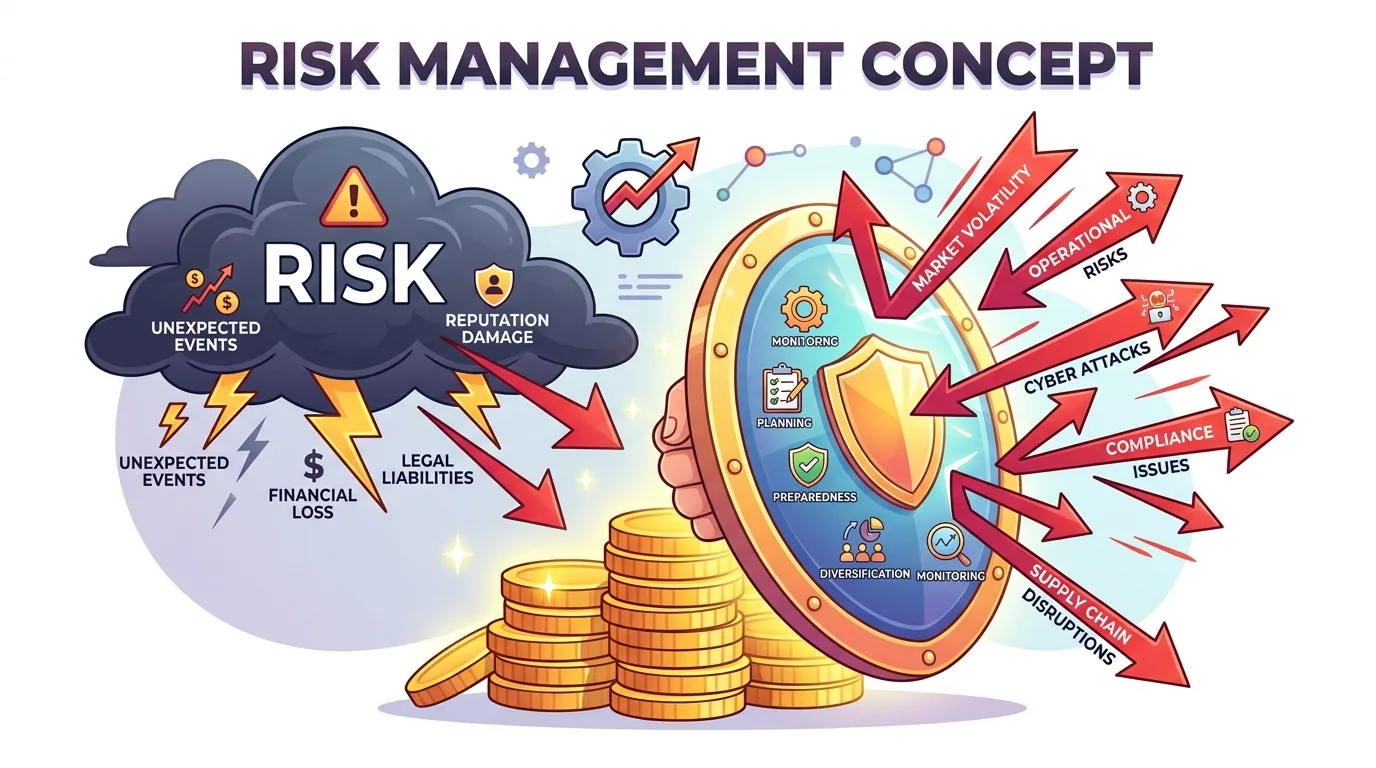
Here's the brutal truth most Nigerian trading 'gurus' won't tell you: you can have a 70% win rate and still lose money. I've seen it happen. The secret isn't some magical indicator from a paid group. It's the boring, unsexy math of position sizing. Most traders here fixate on entries and ignore the one thing that keeps them in the game. This guide will set the record straight. We're going to talk about how much of your capital to risk on a single trade, why it's non-negotiable, and how to make the calculations so simple you'll never skip them again.
Let's get this out of the way. Your entry point is maybe 10% of the battle. The other 90% is risk management, and the king of risk management is position sizing. I don't care if you're trading EUR/USD on Exness or trying your hand at XAU/USD. If you're risking 10% of your account on a whim because the chart 'looks good,' you're not a trader. You're a gambler waiting for a margin call.
I learned this the hard way. Early in my career, I nailed a perfect setup on GBP/JPY. My analysis was spot-on. I risked about 8% of my account because I was so confident. The trade went my way initially, then reversed violently on some unexpected news. I watched a single trade wipe out two weeks of careful gains. That sting never leaves you. It taught me that being right about direction means nothing if your bet size is suicidal.
Your position size is your primary control lever. It determines how much you can lose (your risk) and how much you stand to gain (your reward). Everything else - your fancy scalping strategy, your swing trading plans - rests on this foundation. A solid position sizing strategy turns emotional gambling into a calculated business.

Warning: The most common mistake in Nigeria? Funding a $100 account and trying to trade 1.0 lots because a YouTuber does it. They have a $50,000 account. You don't. Your position size must be relative to your capital, not theirs.

💡 Winston'ın İpucu
If you can't instantly state your exact maximum loss in Naira before clicking 'buy,' you're not trading. You're donating.
This is the golden rule for retail traders, especially when you're starting. Never risk more than 1% of your trading capital on a single trade.
For a 100,000 Naira account, that's 1,000 Naira. Not per pip, but the total maximum loss you're willing to accept if the trade hits your stop loss. This rule isn't about limiting profits; it's about survival. It ensures a string of losses (which will happen) doesn't cripple your account.
How the 1% Rule Works in Practice
Let's say your account is $500 (roughly 700,000 Naira at current rates).
- 1% of $500 is $5.
- You find a setup on EUR/USD. You place your stop loss 25 pips away from your entry.
- Your maximum risk per trade is $5.
- Therefore, your risk per pip must be $5 / 25 pips = $0.20.
- On a standard lot (100,000 units), 1 pip = $10. On a mini lot (10,000 units), 1 pip = $1. On a micro lot (1,000 units), 1 pip = $0.10.
- To risk $0.20 per pip, you'd need to trade 2 micro lots (0.02 standard lots). This gives you $0.20 per pip. 25 pips x $0.20 = your $5 max risk.

Example:
- Account: $500
- 1% Risk: $5
- Stop Loss Distance: 30 pips
- Pip Risk Calculation: $5 / 30 pips = ~$0.166 per pip.
- Lot Size: Trade 0.016 lots (1.6 micro lots). Most platforms allow this.
This math protects you. If you take ten losing trades in a row (it happens), you're down 10%, not 50% or 100%. You live to trade another day. As you gain consistency, some traders adjust to 2%, but I'd stick with 1% for your first year, minimum. Check your broker's specifics in our XM review or IC Markets review to see their minimum lot sizes.
“A rigid lot size is a doomed strategy. Your position size must change with every single trade.”
Stop guessing. Let's build a trade from scratch. We'll use a 400,000 Naira account (about $285).
Step 1: Determine Your Account Risk (1%). 1% of 400,000 Naira = 4,000 Naira. Let's convert to USD for the forex pair. ~$5.70.
Step 2: Find Your Stop Loss in Pips. You're looking at USD/NGN (or a major like USD/CAD). You decide your stop loss should be 40 pips away from your entry based on your analysis. Never place a stop arbitrarily; base it on market structure.
Step 3: Calculate Your Risk Per Pip. Max Risk ($5.70) / Stop Loss Pips (40) = $0.1425 per pip.
Step 4: Figure Out the Pip Value for Your Lot Size. For USD-based pairs where USD is the quote currency (like EUR/USD), standard lot pip value is ~$10. But for pairs like USD/NGN or USD/CAD, the math changes if your account is in USD. Let's keep it simple with EUR/USD.
- Micro Lot (0.01): Pip Value = ~$0.10
- Mini Lot (0.10): Pip Value = ~$1.00
- Standard Lot (1.00): Pip Value = ~$10.00
Step 5: Determine Your Lot Size. You need a pip value of $0.1425. A micro lot gives you $0.10. A bit small. 0.02 lots (2 micro lots) gives you $0.20 per pip. That's slightly above your risk.
The Correct Answer: You need 0.01425 standard lots. Just type 0.014 or 0.01 into your platform. Slightly under-risking is always safer than over-risking.
This is where a good position size calculator becomes useful. You input account balance, risk %, stop loss in pips, and it spits out the lot size. Do this for every single trade, no exceptions. Your trading platform's order window should not be a place for guesswork.

Pro Tip: Your stop loss distance is the most variable part of this equation. A tight stop on a volatile pair like GBP/JPY means a larger position size for the same risk. A wider stop on a steady EUR/USD guide trend means a smaller position. Let the market tell you where the stop goes, then size accordingly.

We have unique challenges here. Recognizing them is half the fight.
Mistake 1: Ignoring Currency Conversion. You have a Naira account but trade USD pairs. You must constantly convert to know your true 1% risk. If your 500,000 Naira account drops to 450,000 Naira, your 1% risk is now 4,500 Naira, not 5,000. Recalculate every time you update your balance.
Mistake 2: Chasing 'Quick Balance' with Over-use. Brokers like Exness or Pepperstone offer high use (1:1000, 1:500). This is a tool, not a mandate. use amplifies your buying power, not your wisdom. Using 1:1000 use on a full position is a guaranteed account killer. use lets you trade sensible position sizes (like 0.01 lots) with less margin, not trade 1.0 lots with a $100 account.
Mistake 3: No Stop Loss, No Calculation. 'God is in control' is not a risk management strategy. If you don't have a predetermined stop loss, you cannot calculate a position size. You're flying blind. The trade decides your risk, not you. Always, always define your stop first.
Mistake 4: Position Sizing Based on Feelings. 'This trade feels really good, I'll risk 3%.' Or worse, 'I'm in a drawdown, I need to risk 5% to get back fast.' This is the fast track to zero. Your position size is a cold, mathematical output. Remove emotion. Use the calculator.
The Fix: Make a pre-trade checklist. 1) Chart analysis. 2) Define Entry, Stop Loss, Take Profit. 3) Input data into your position size calculator. 4) Execute the trade at the calculated size. No deviations.
💡 Winston'ın İpucu
Your first calculation each morning shouldn't be for a trade. It should be: 'What is 1% of my current balance?' Write it on a sticky note.
“Your gut is a liar. The math is truth.”
One size does not fit all. A 50-pip stop on Gold (XAU/USD) is tight. A 50-pip stop on a major forex pair might be wide. You must adjust.
Forex Majors (EUR/USD, GBP/USD): Generally lower volatility. Your stop loss might be 20-40 pips in a calm market.
Forex Exotics & USD/NGN: Can be jumpy. Spreads are wider. You need a wider stop, which means a smaller position size for the same dollar risk. If your usual stop is 30 pips on EUR/USD but 80 pips on USD/NGN, your lot size on USD/NGN must be roughly one-third to keep risk equal.
Gold (XAU/USD): Moves in dollars, not pips. A $15 stop is common. If your risk is $10 per trade, and your stop is $15 away, your position size must be such that a $15 move equals a $10 loss. That means a position size of 0.66 micro lots? Let's do it: ($10 risk) / ($15 stop) = 0.666. If 1 micro lot (0.01) of gold has a pip value of ~$0.10 (but it's per dollar move)... it's easier to use a calculator built for CFDs. The principle is identical: (Account Risk) / (Stop Distance in Points) = Position Size.
Indices & Stocks: Even more variance. You must know the point value of the instrument. The core formula remains your anchor. Check our XAU/USD guide for more on trading gold specifically.
The lesson: Your stop loss distance is dynamic. Your risk percent (1%) is fixed. Therefore, your position size must change with every single trade. A rigid lot size is a doomed strategy.

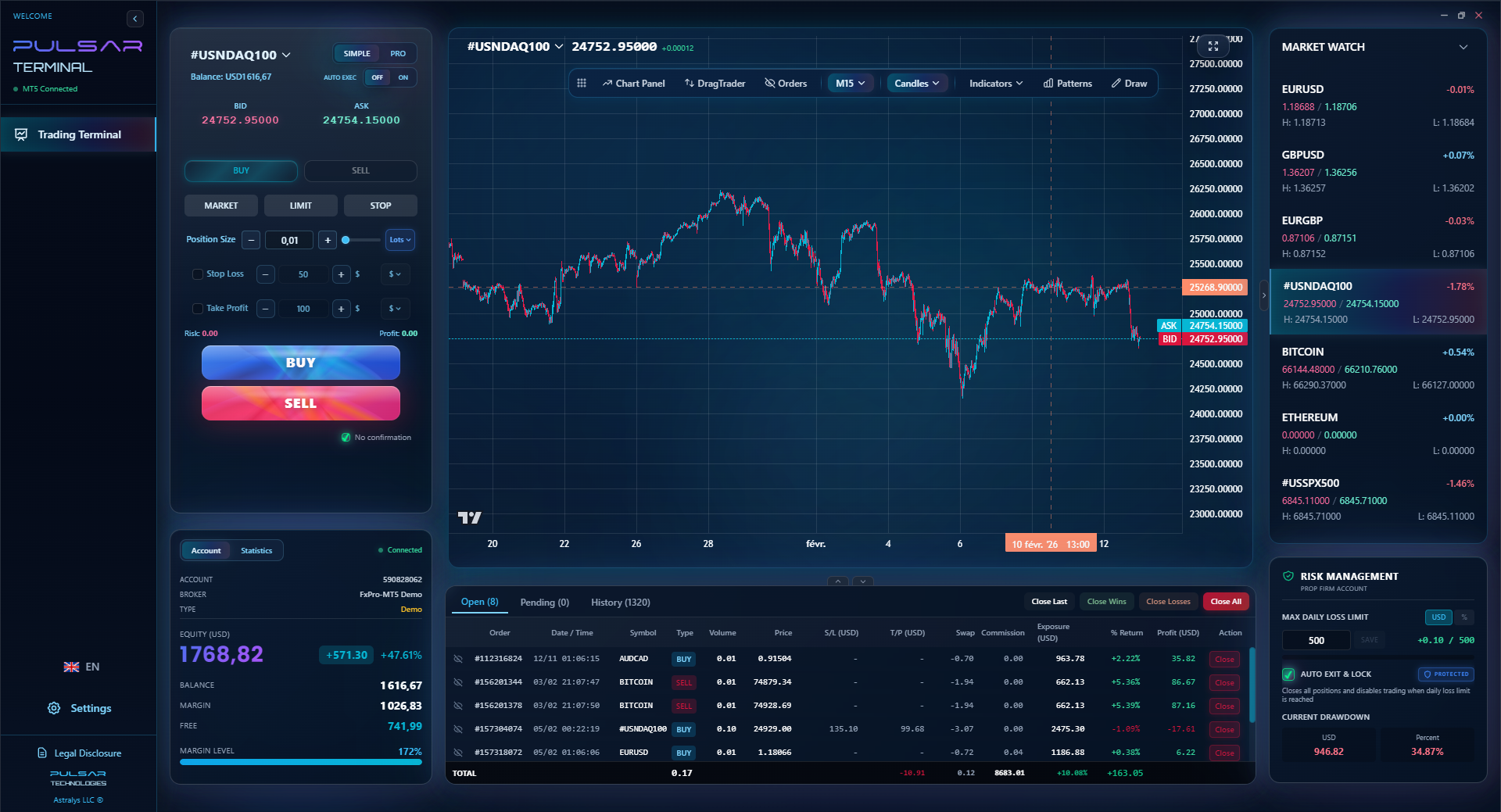
Manually calculating lot sizes for every volatile instrument is a chore; Pulsar Terminal's trade panel can display risk in percentage terms right on your MT5 chart, so you can adjust your lot size visually to hit your exact 1% target.
Pulsar Terminal
Hepsi bir arada MT5 aracı: sürükle-bırak emirler, çoklu TP/SL, trailing stop, grid trading, Volume Profile ve prop firm koruması. Her gün 1.000'den fazla trader tarafından kullanılıyor.
Willpower fails. Systems win. You need to automate this process so you can't cheat.
1. Use a Trading Calculator: Bookmark a good online one or use MT4/MT5's built-in tools. Many brokers have them on their site. Inputs: Account Balance, Currency, Risk %, Stop Loss in Pips, Pair. Output: Lot Size. Do this before every order.
2. The Trading Journal Mandate: Your trade journal must have columns for: Planned Risk %, Planned Risk (USD/NGN), Stop Loss (Pips), Calculated Lot Size, Actual Lot Size. If 'Actual' deviates from 'Calculated,' you need a red flag and a reason.
3. Embrace the Boredom: Proper position sizing is boring. It prevents the emotional rollercoaster. You won't get that huge, account-doubling win in a day. But you also won't get the soul-crushing loss. Trading is a marathon of consistent, small gains protected by rigorous risk management.
The Psychological Hump: The hardest part is placing a trade with a 'small' position when you're super confident. You'll think, 'Just this once, I'll go bigger.' That's the devil talking. Every single professional trader I know has a rigid rule. They follow it even when their gut screams otherwise. Your gut is a liar. The math is truth.
Pro Tip: When you're on a losing streak, the temptation is to increase size to recover. Do the opposite. If you've lost 10% of your account, your capital is now lower. Your 1% risk in dollar terms is smaller. You should be trading smaller, not larger, to preserve what's left. This is counter-intuitive but essential.
FAQ
Q1Can I risk 2% or 5% if I have a small account in Nigeria?
Absolutely not. That's the fastest way to turn a small account into a zero account. A small account means you need to be more conservative, not more reckless. Risking 5% means 20 losing trades wipe you out. With a small account, your goal is survival and gradual growth through consistency, not a lottery win. Stick to 1%.
Q2How do I calculate position size when my account is in Naira but I'm trading USD pairs?
Convert everything to a single currency for the calculation. 1) Take your Naira balance. 2) Convert it to USD using a current, reliable rate. 3) Calculate 1% of that USD amount. This is your max risk in USD. 4) Proceed with the standard calculation using your stop loss in pips for the USD pair. Update this conversion weekly or whenever you deposit/withdraw.
Q3What if my broker's minimum lot size is bigger than my calculated position size?
This means your account is undercapitalized for that broker's terms. You have two choices: 1) Deposit more funds so that your 1% risk equals or exceeds the risk of the minimum lot size with a sensible stop loss. 2) Find a broker that offers micro (0.01) or nano lots. Many brokers catering to global retail clients do. Check our broker reviews for minimum trade sizes.
Q4Does position sizing apply to prop firm challenges?
It's even more critical. Prop firms have strict daily and overall loss limits. A single oversized trade can blow your challenge instantly. You need to calculate your position size based on the challenge account size (e.g., $100,000) and their maximum allowed loss (e.g., 5% = $5,000). Your per-trade risk should be a fraction of that, like 0.5% of the challenge account. Discipline here is everything.
Q5How does use affect my position size calculation?
It doesn't, directly. use affects how much margin is required to open a position. Your position size calculation is based on your account balance and risk percentage, independent of available use. High use is dangerous because it tempts you to use a position size that is too large for your account. Ignore the maximum use; calculate your size based on the 1% rule first.
Q6Should I adjust my position size if I'm adding to a winning trade?
This is an advanced technique. If you pyramid into a trend, each new entry should be treated as a separate trade with its own stop loss and a fresh 1% risk calculation based on your current account balance. Never let your total risk on all open positions for one idea balloon beyond 2-3% of your capital. It's easy to over-expose yourself on a single move.
Prof. Winston'ın Dersi
Önemli Noktalar:
- ✓Never risk more than 1% of capital per trade.
- ✓Calculate position size *after* setting your stop loss.
- ✓Convert all balances to one currency for calculations.
- ✓High use is for margin efficiency, not larger bets.
Bu makale ne kadar faydalıydı?
Bir yıldıza tıklayın
Haftalık Trading Analizleri
Ücretsiz haftalık analiz ve stratejiler. Spam yok.
Yazar hakkında
Olumide Adeyemi
Batı Afrika Yatırım Öncüsü
Nijerya'nın en aktif forex eğitmenlerinden biri. Lagos'tan 8 yıllık ticaret deneyimi. Afrika'lı trader'lar için düşük sermaye stratejileri ve prop firma yarışmaları uzmanı.
Yorumlar
Risk Uyarısı
Finansal araçlarla işlem yapmak önemli riskler taşır ve tüm yatırımcılar için uygun olmayabilir. Geçmiş performans gelecekteki sonuçları garanti etmez. Bu içerik yalnızca eğitim amaçlıdır ve yatırım tavsiyesi olarak değerlendirilmemelidir. İşlem yapmadan önce her zaman kendi araştırmanızı yapın.
Bunları da beğenebilirsiniz

Cara Trading Forex Sukses: 7 Prinsip dari Trader Profesional
Cara trading forex sukses dengan 7 prinsip trader pro: manajemen modal, disiplin, journal trading, backtest. Data nyata, bukan janji profit palsu.
Jam Trading Forex Terbaik untuk Trader Indonesia: Panduan Lengkap dengan Tabel Waktu
Panduan jam trading forex untuk trader Indonesia. Tabel 4 sesi dunia, jam emas 20:00-00:00, sesi mana yang harus dihindari. Data akurat + tips dari trader berpengalaman.
Top 5 Sàn Forex Uy Tín Nhất 2026: Review Jujur dari Trader Indonesia
Top 5 sàn forex uy tín 2026 untuk trader Indonesia. Review jujur: spread, deposit, withdraw, dukungan lokal. Exness, XM, IC Markets & lebih.
Pulsar Terminal'ı Edinin
Tüm bu hesaplayıcılar MT5 hesabınızdan gerçek zamanlı verilerle Pulsar Terminal'e entegredir.
Pulsar Terminal'ı Edinin