


I remember my first prop firm evaluation for options.

James Mitchell
Kıdemli Yatırım Analisti
☕ 12 dk okuma
Neler öğreneceksiniz:
- 1What Exactly Is a Prop Firm for Options?
- 2The Regulatory Maze (And Why It Matters to You)
- 3The Real Numbers: Fees, Splits, and the 10% Club
- 4Navigating the Options-Specific Rulebook
- 5How to Pick the Right Firm for Your Options Style
- 6Platforms & Execution: Where the Rubber Meets the Road
- 7The Final Verdict & Your Action Plan
I remember my first prop firm evaluation for options. I was trading SPY puts, feeling clever with a defined-risk spread. I hit my profit target early, but instead of closing, I got greedy and adjusted the trade. One unexpected news headline later, and I'd blown through the daily loss limit on a $50,000 simulated account. Poof. $199 evaluation fee gone, just like that. That sting taught me more about prop firm psychology than any winning trade ever did. The promise is huge: trade a firm's capital, keep most of the profits, and your personal risk is capped at the challenge fee. But in the options world, with its unique Greeks and volatility, the game changes. Let's break down what you're really signing up for.
At its core, a proprietary trading firm gives you a pool of their money to trade. You're not a customer depositing cash; you're a contractor proving you can manage risk. If you're profitable, you get a cut - often 70% to 90%. If you lose, you're out the evaluation fee, but your personal bank account isn't on the line beyond that.
For options, this is a double-edged sword. The use is built into the instrument itself. You don't need 100:1 use like in forex; a single call option can give you control of 100 shares for a fraction of the cost. This makes options a natural fit for the prop model, but it also means the risk parameters are different. Firms aren't just watching your P&L; they're watching your delta, your theta decay, and how you handle gamma risk around earnings.
Most firms operate as 'educational services' with simulated accounts during the evaluation. This legal gray area has let them flourish, but the winds are changing. The SEC has been trying to expand who qualifies as a 'dealer,' which could force more prop firms to register. A court shot down one attempt in late 2024, but the regulatory pressure isn't going away. For you, the trader, this means the firm you sign up with today might have a different structure tomorrow.

Warning: That 'simulated' account during your challenge? It's not Monopoly money. The firm's risk systems treat it as real. A sudden vol spike can trigger a stop-out just as fast as a live trade. I learned this the hard way trying to get cute with NVDA weekly options.

💡 Winston'ın İpucu
The daily loss limit is your new best friend and worst enemy. It protects the firm, but it also protects you from yourself. Your first trading goal each day should be to avoid hitting it, not to make a million.
You can't just ignore the legal stuff. It directly affects which firms survive, how they handle your money, and what rules you have to follow.
The SEC's Moving Target
In early 2024, the SEC passed rules to label more active trading firms as 'dealers,' requiring SEC and FINRA registration. That would mean stricter capital rules and oversight. But in November 2024, a federal judge threw those rules out, saying the SEC overstepped. As of early 2025, the appeal is withdrawn. It's a win for the prop firm industry... for now. This back-and-forth creates uncertainty. A firm built on a shaky regulatory model could vanish overnight.
The FINRA Loophole (For Now)
Here's the key: because you're trading the firm's capital in a simulated environment during the eval, classic rules like the Pattern Day Trader (PDT) rule don't apply. A retail broker would restrict you if your account is under $25k. A prop firm can let you trade 100 contracts a day on a $10k account. This is the main attraction.
CFTC vs. SEC Turf
What you're trading dictates who's watching. Stock options (like SPY, AAPL)? That's SEC/FINRA territory. Index futures options (like /ES or /MES)? That falls under the CFTC. Many prop firms stick to futures options because the CFTC has clearer rules for proprietary trading. If a firm only trades its own money and doesn't hold client funds, it can often avoid direct registration. This is why you'll see many firms focused on /ES options rather than SPY.

Pro Tip: Always check what instruments a firm allows for options. Some only allow broad indices (/ES, /NQ), some allow commodities (/GC for gold), and very few allow single-stock options due to the higher idiosyncratic risk. Your favorite XAU/USD gold strategy might need to be adapted to /GC options.
“The 80% split suddenly looks more like 65% after self-employment taxes.”
Let's talk money. The marketing says 'get funded fast!' The reality involves some careful math.
Evaluation Fees: The Price of Admission This is your only real cash risk. It's all over the map:
- Budget Tier: As low as $17 for a tiny $2,000 account (Goat Funded Trader).
- Standard Tier: $69 to $150 for accounts from $10k to $100k (common at firms like FXIFY).
- Premium Tier: Maverick Trading charges a whopping $7,000 lifetime membership plus a $5,000 'risk deposit' and a $199 monthly fee. They're an outlier, targeting serious career traders.
I once did a $99 challenge for a $25k account. Passed it, then realized the profit target to get a first payout was so high it would take months of perfect trading. That $99 was a lesson in reading the fine print.
Profit Splits: It's a Scale, Not a Promise The split you see advertised (e.g., 'up to 90%') is usually the maximum. You often start lower.
| Typical Profit Split Structure | |
|---|---|
| Starting Split | 70% to 80% for you |
| Scale-Up Trigger | e.g., 3 profitable months, or $50k cumulative profit |
| Scaled Split | 85% to 90% for you |
| Elite Tier | Rare, but some offer 95%-100% for proven stars |
The Harsh Stat: Industry data suggests only about 10% of evaluation participants ever get funded. The firms make their money from the 90% who fail and re-buy challenges. Your job is to be in the 10%.
Payouts & Taxes When you get paid, it's typically via bank wire, PayPal, or Wise. Here's the critical part: you're a contractor. The firm will send you a 1099 form (if you're in the US). You are responsible for paying income tax and self-employment tax (about 15.3%) on your share of the profits. That 80% split suddenly looks more like 65% after taxes. Always use a position size calculator that factors in your post-tax profit goals, not just the gross.
💡 Winston'ın İpucu
When comparing profit splits, always calculate the split *after* the firm's profit target is met. An 80% split after a $2,000 monthly target is worse than a 70% split with no target.
This is where prop trading options diverges from trading your own account. The rules are designed to protect the firm's capital from blow-ups, and they can be brutal.
Daily Loss Limits: The Dream Killer This is the most common fail point. It's not just a trailing drawdown. It's a hard stop for the day. If your account is $50k with a 5% daily loss limit ($2,500), and a trade moves against you at 3 PM, hitting that $2,500 loss, you're done. No revenge trading, no hoping for a reversal. Account frozen until tomorrow. This rule single-handedly prevents the kind of catastrophic loss that wipes out retail accounts, but it requires immense discipline.
Position Limits & Concentration Rules You won't be able to YOLO the entire account on one earnings play. Firms limit:
- Maximum Capital per Trade: Often 5-10% of account size.
- Maximum Delta Exposure: Your total portfolio delta might be capped.
- Overnight Holdings: Many firms restrict or penalize holding short-dated options overnight due to gamma risk. This kills a lot of scalping strategies that rely on quick day trades.
The 'Simulated' Reality Remember, during your challenge, you're trading in a simulated environment. The fills you get might not perfectly match the live market, especially on wide-bid/ask options. I've seen traders fail because they based their strategy on instantly filling a 10-lot at the mid-price, which just doesn't happen in reality. Once funded, you may graduate to a live account with a partner broker like Tradovate or through an IC Markets partnership, where execution is real.

Example: Let's say you have a $100k account with a 5% max trade size rule. You want to buy SPY call options. The rule means you can only allocate $5,000 of the firm's capital to this trade. If SPY is at $500, and a call option is $5.00, that's 10 contracts ($5 * 100 shares * 10 contracts = $5,000). You can't just buy 50 contracts because you 'have a feeling.' The rule stops you.
“Only about 10% of evaluation participants ever get funded. Your job is to be in the 10%.”
Not all prop firms are created equal for options traders. You need to match their rules to your strategy.
For the Scalper: If you're in and out of trades in minutes, you need a firm with:
- Low minimum trading days (so you can pass the eval quickly).
- No restrictions on lot sizes for futures options (like /MES).
- A platform with direct market access and hotkeys. Think NinjaTrader or Sierra Chart integration.
For the Swing Trader / Volatility Seller: If you sell premium and manage positions over days/weeks, look for:
- Relaxed or no rules on overnight holdings.
- Higher daily loss limits (e.g., 6-7%), as your risk is defined but positions can gap.
- Allows strategies like credit spreads or iron condors.
- A platform like ThinkorSwim or Interactive Brokers for advanced options analytics.
Key Due Diligence Questions:
- What's the real profit target? Is it a one-time target to get funded, or a monthly target to get paid?
- How are options priced for margin? Do they use SPAN margin (standard for futures) or a rigid rule?
- What's the payout frequency? Bi-weekly? Monthly? And what's the minimum payout threshold?
- Read the reviews, but be skeptical. Look for consistent complaints about payout delays or rule changes mid-challenge. A solid Exness review or Pepperstone review focuses on execution; a prop firm review should focus on fairness and consistency.
My personal mistake? I picked a firm great for forex swing trading but terrible for options. Their platform was clunky, and the delay on options quotes made precise entry impossible. I wasted two months before quitting.
💡 Winston'ın İpucu
Your edge isn't just in picking direction. In a prop firm, your edge is in managing positions within their rulebook. Practice that more than your entry signals.
Your edge lives or dies on the platform. For options, you need more than just a basic chart.
The Big Three for Serious Options Traders:
- ThinkorSwim (by Charles Schwab): The gold standard for US options analytics. Incredible for visualizing risk, probability curves, and strategy backtesting. Some firms have direct partnerships.
- NinjaTrader: Dominant for futures and futures options. Excellent for automated trading and level II data. Many futures-focused prop firms use this.
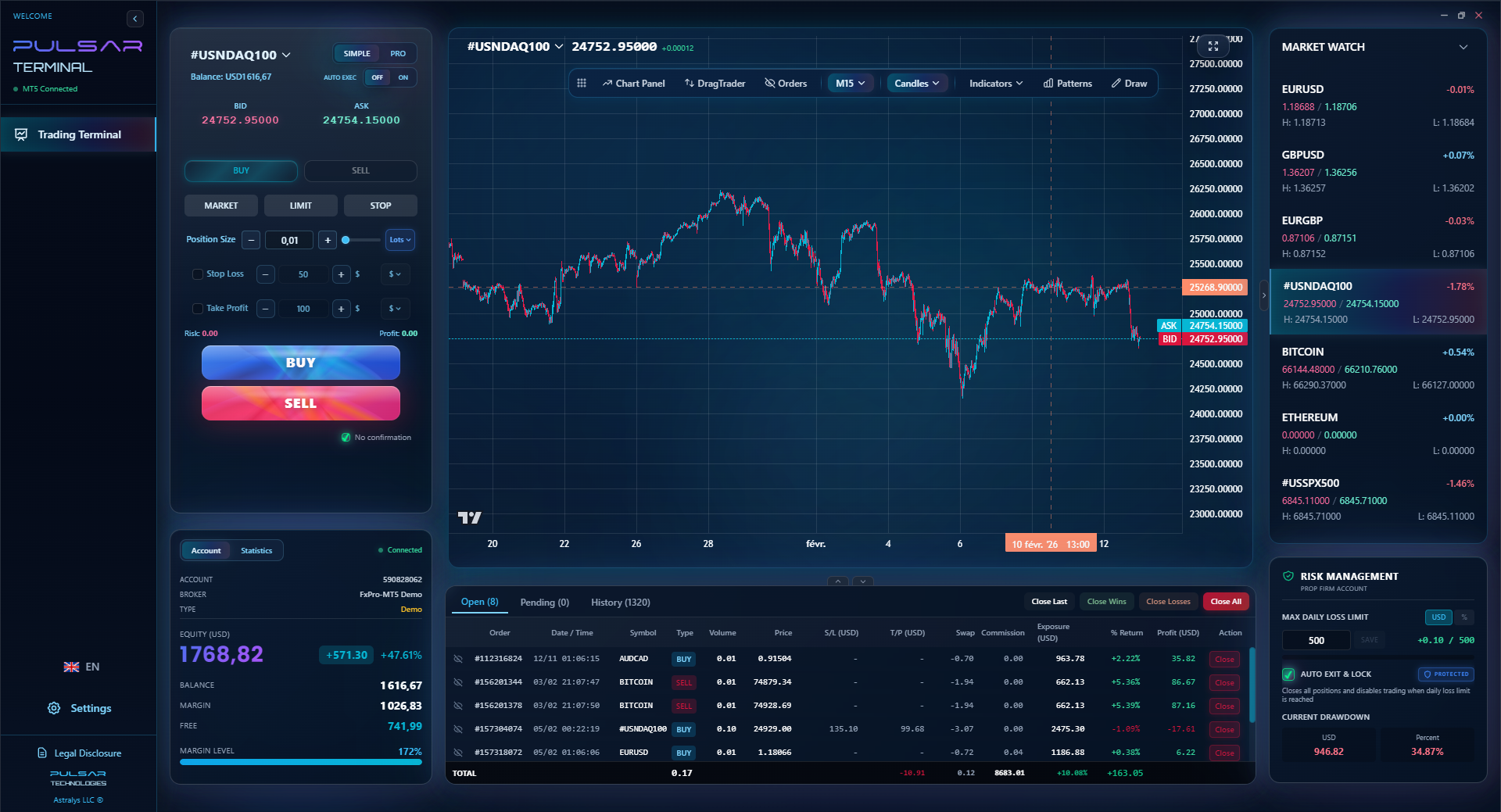
- MetaTrader 5 (MT5): More common for forex prop firms, but MT5 does support some futures/options. Its native options tools are weak, which is why add-ons like Pulsar Terminal are game-changers for MT5 users, adding advanced order types and risk management features the base platform lacks.
Execution Quality: Prop firms often have institutional connections, so once you're live, your fills on liquid products (like /ES options) should be good. But during the eval, you might be in a simulated environment with 'theoretical' fills. Ask the firm: "Do eval trades go to a live market simulator, or is it a simple last-price model?" The difference matters.
Why Tools Like Pulsar Terminal Are a Secret Weapon Managing multiple options legs under prop firm rules is stressful. You need to set stop-losses for the entire position, not just one leg. A tool that lets you drag-and-drop a multi-leg bracket order with a trailing stop on the net position can save you from a manual error that breaches your daily limit. Automating your breakeven moves is crucial when you can't watch the screen every second.
Managing complex options positions under strict prop firm rules is easier with a tool like Pulsar Terminal, which lets you set multi-leg bracket orders and trailing stops directly on MT5.
Pulsar Terminal
Hepsi bir arada MT5 aracı: sürükle-bırak emirler, çoklu TP/SL, trailing stop, grid trading, Volume Profile ve prop firm koruması. Her gün 1.000'den fazla trader tarafından kullanılıyor.
“This isn't gambling; it's an audition for a funded seat.”
Is a prop firm for options trading right for you? Maybe. It's not a golden ticket; it's a high-stakes job interview with a unique set of tools and handcuffs.
Who It's GREAT For:
- Traders with a proven, rule-based strategy but lack personal capital.
- Traders who need the structure of hard loss limits to overcome emotional trading.
- Those wanting access to institutional-grade platforms and data without the high personal account minimums.
Who Should AVOID It:
- Beginners still learning what delta and theta are. You'll just donate your evaluation fee.
- Traders with a strategy that requires holding high-gamma options through news events.
- Anyone who chafes under strict rules. This is a military academy, not a free-for-all.
Your 3-Step Action Plan:
- Paper Trade THEIR Rules: Before spending a dime, take your strategy and trade it in a simulator while following the target firm's exact rules (daily loss limit, max position size, no overnight holds). Do this for a full month. If you can't be profitable with their handcuffs on, you won't pass the eval.
- Start Small: Your first eval shouldn't be the $100k account. Buy the smallest, cheapest challenge. The goal is to learn the firm's systems and pass. You can always scale up later. Losing a $35 fee hurts less than losing a $500 one.
- Treat It Like a Business From Day One: Track every trade. Know your win rate, profit factor, and average win/loss. The prop firm will have all this data. You should too. This isn't gambling; it's an audition for a funded seat.
The bottom line? A prop firm can be an incredible launchpad. It gave me the capital to make profits I only dreamed of with my own money. But it demanded a level of discipline I didn't know I had. It forced me to respect every single pip definition of risk. If you're ready for that, it might just be your path forward.
FAQ
Q1Can I trade options on stocks like Tesla or Apple with a prop firm?
It's rare. Most prop firms restrict options trading to broad-based indices (like S&P 500 via /ES or SPY equivalents) or major futures contracts (/GC for gold, /CL for oil). Single-stock options carry too much idiosyncratic risk (earnings, news) for their risk models. Always check the firm's allowed instruments list first.
Q2How are options positions margined in a prop firm account?
It depends. For futures options (like /ES), they typically use the standard SPAN margin system, which is risk-based. For stock index options, they might use a portfolio margin model or a simple rule like 'max risk per trade = premium paid + 20%.' You must ask the firm for their specific methodology, as it directly impacts your buying power and position sizing.
Q3Do prop firm rules like 'no weekend holding' apply to long-dated options?
Often, yes. The rule is usually about holding any position over the market close, not the expiration date. A LEAP option expiring in 6 months is still a position you hold overnight. Some firms make exceptions for certain strategies or account sizes, but you should assume the rule applies unless explicitly stated otherwise in writing.
Q4What happens if I pass the evaluation but then have a losing month?
You typically don't get 'un-funded.' Instead, you just don't get a payout for that month. However, you must stay above the firm's trailing drawdown or maximum loss threshold. If your losses drag your account equity below that threshold (e.g., 10% down from the starting funded balance), your funded account can be suspended or terminated. The challenge is getting funded; the job is staying funded.
Q5Are prop firm profits considered capital gains or ordinary income?
In the U.S., you're a contractor, not an investor in the account. Your profit share is reported on a 1099-MISC or 1099-NEC as ordinary income. This means you pay income tax rates plus self-employment tax (roughly 15.3%), not the lower long-term capital gains rates. Plan your tax savings accordingly.
Q6Can I use automated trading or bots with a prop firm for options?
Some firms allow it, especially those built on platforms like NinjaTrader that support automation. However, the bot must still operate within all the firm's risk rules (daily loss, position size). You are 100% responsible for its actions. Most firms prohibit 'grid trading' or martingale-style bots that increase risk after a loss, as they can quickly breach loss limits.
Prof. Winston'ın Dersi
Önemli Noktalar:
- ✓Daily loss limits are non-negotiable. Plan every trade around them.
- ✓Profit splits are often tiered. Read the scaling rules.
- ✓Taxes hit profit shares as ordinary income, not capital gains.
- ✓Platform choice is critical. Don't assume MT4 works for options.
Bu makale ne kadar faydalıydı?
Bir yıldıza tıklayın
Haftalık Trading Analizleri
Ücretsiz haftalık analiz ve stratejiler. Spam yok.
Yazar hakkında
James Mitchell
Kıdemli Yatırım Analisti
New York merkezli, 9 yılı aşkın trading deneyimine sahip. Başlıca USD paritelerine, prop firma yarışmalarına ve ABD düzenleyici ortamına odaklanıyor.
Yorumlar
Risk Uyarısı
Finansal araçlarla işlem yapmak önemli riskler taşır ve tüm yatırımcılar için uygun olmayabilir. Geçmiş performans gelecekteki sonuçları garanti etmez. Bu içerik yalnızca eğitim amaçlıdır ve yatırım tavsiyesi olarak değerlendirilmemelidir. İşlem yapmadan önce her zaman kendi araştırmanızı yapın.
Bunları da beğenebilirsiniz

Cara Trading Forex Sukses: 7 Prinsip dari Trader Profesional
Cara trading forex sukses dengan 7 prinsip trader pro: manajemen modal, disiplin, journal trading, backtest. Data nyata, bukan janji profit palsu.
Jam Trading Forex Terbaik untuk Trader Indonesia: Panduan Lengkap dengan Tabel Waktu
Panduan jam trading forex untuk trader Indonesia. Tabel 4 sesi dunia, jam emas 20:00-00:00, sesi mana yang harus dihindari. Data akurat + tips dari trader berpengalaman.
Top 5 Sàn Forex Uy Tín Nhất 2026: Review Jujur dari Trader Indonesia
Top 5 sàn forex uy tín 2026 untuk trader Indonesia. Review jujur: spread, deposit, withdraw, dukungan lokal. Exness, XM, IC Markets & lebih.
Pulsar Terminal'ı Edinin
Tüm bu hesaplayıcılar MT5 hesabınızdan gerçek zamanlı verilerle Pulsar Terminal'e entegredir.
Pulsar Terminal'ı Edinin