


Here's the uncomfortable truth most 'gurus' won't tell you: if you're an Indian resident trading EUR/USD on an offshore broker like Exness or IC Markets, you're likely breaking the law.

Rajesh Sharma
Kıdemli Forex Analisti ·  India
India
☕ 11 dk okuma
Neler öğreneceksiniz:
- 1What an 'RBI Alert' Actually Means (It's Not a Warning, It's a Line in the Sand)
- 2The Only Legal Forex Framework for Indian Retail Traders
- 3The Offshore Broker Trap: Why It's So Seductive and So Dangerous
- 4The Real Costs: Fines, Jail, and Financial Ruin
- 5How to Trade Legally (And Actually Make It Work)
- 6My Biggest Mistake (And How I Unwound It)
- 7The Future: Will the Rules Ever Change?
Here's the uncomfortable truth most 'gurus' won't tell you: if you're an Indian resident trading EUR/USD on an offshore broker like Exness or IC Markets, you're likely breaking the law. I learned this the hard way, not from a textbook, but from a cold sweat when I first understood the RBI's power. This isn't about scare tactics, it's about survival. The RBI alert list isn't a suggestion, it's a legal boundary. In this guide, I'll walk you through exactly what RBI alert forex trading means for you, the narrow path of legal trading, and the massive consequences of stepping outside it.
When the Reserve Bank of India publishes an alert list, they're not just giving you a heads-up. They're publicly naming and shaming entities they consider unauthorized Electronic Trading Platforms (ETPs). Think of it as a 'Do Not Touch' list with legal force behind it.
As of late 2025, that list had 95 names on it, including platforms like Fusion Markets and Nord FX. But here's the critical part the RBI states clearly: the list is not exhaustive. Just because your broker's name isn't there today doesn't mean it's approved. Their absence offers zero legal protection. This fundamentally changes how you choose a broker. You can't just check a list, you have to understand the framework.
The alert system exists because of the Foreign Exchange Management Act (FEMA) of 1999. FEMA isn't a set of guidelines, it's the law of the land for all foreign exchange transactions. The RBI's alerts are its enforcement mechanism, pointing out who they believe is facilitating violations. Ignoring this is like seeing a 'Danger: Minefield' sign and deciding to go for a stroll because you don't see any explosions yet.

Warning: Using an international broker not on the alert list is a common, and dangerous, misconception. The RBI's stance is that offering forex derivatives (like CFDs on currency pairs) to Indian residents without being registered with SEBI and using Indian exchanges is itself unauthorized. The list just highlights the worst offenders.

💡 Winston'ın İpucu
The first rule of capital preservation is legal safety. A 100% return on an illegal trade is a 100% risk of total loss plus fines. Always trade inside the fence.
Let's cut through the noise. For you, as a retail trader in India, legal forex trading is a very specific, narrow corridor. It's not the wild west of global markets. It's a regulated exchange.
The What: Permitted Instruments
You are legally allowed to trade currency derivatives - specifically futures and options - on the currency pairs that include the Indian Rupee (INR). The main ones are USD/INR, EUR/INR, GBP/INR, and JPY/INR. These trade on the National Stock Exchange (NSE), the Bombay Stock Exchange (BSE), and the Metropolitan Stock Exchange (MSEI).
You can also trade a few cross-currency futures contracts (like EUR/USD, GBP/USD) on these exchanges, but these are exchange-traded derivatives, not the spot forex you see on MT5. The liquidity and trading hours are different.
The How: The Only Legal Path
You must use a SEBI-registered stockbroker in India. Full stop. This means brokers like Zerodha, ICICI Direct, HDFC Securities, Angel One, or Upstox. You open a trading and demat account with them, just like for stocks, and access the currency derivatives segment of the NSE, BSE, or MSEI.
Your funds are in INR, in an Indian bank account, with all transactions happening within the Indian financial system. This is the complete, legal loop. Any other loop - sending money overseas to an IC Markets or XM account to trade EUR/GBP - is outside this framework.

Example: A legal trade: Buying 1 lot of USD/INR futures on the NSE through your Zerodha account. An illegal trade: Depositing ₹50,000 via Skrill to an offshore broker to sell AUD/JPY on MT5. The first is a regulated derivative on an Indian exchange. The second is a prohibited overseas speculative activity.
“The RBI alert list isn't a suggestion, it's a legal boundary.”
I get it. The allure is powerful. I felt it too. Around 2015, I was frustrated with the limited pairs on Indian exchanges. I wanted to trade the setups I saw on Gold (XAU/USD) and the major crosses. The marketing from international brokers was everywhere: tight spreads, massive use, the MT4/MT5 platform I loved, and seemingly easy sign-up.
I opened an account with a well-known offshore broker (not on any alert list at the time). The process was smooth. Funding was a bit clunky but worked. For a few months, I was scalping the EUR/USD guide and having a great time. I even turned a $1,000 deposit into $1,800. I felt clever, like I'd found a loophole.
Then I had a withdrawal. It took three weeks, required absurd documentation, and came with hefty fees. That's when the reality hit. I had zero recourse. SEBI couldn't help me. The RBI's rules were what I had technically circumvented. If the broker decided to freeze my account or manipulate prices, I'd have no one to call. The profit was meaningless because the foundation was sand.
The real costs aren't just the spreads or commissions. They are:
- Legal Risk: You are personally liable under FEMA.
- Zero Protection: No Investor Protection Fund, no SEBI grievance redressal.
- Funding Hassles & Risk: Using international wire transfers or payment gateways for prohibited activity can flag your bank account.
- Tax Complexity: Accounting for profits/losses in a foreign currency from an illegal activity is a nightmare.
Many of these brokers, like Exness or Pepperstone, are legitimate in their home jurisdictions. But in the eyes of Indian law, for an Indian resident, they are facilitating a violation. The spread definition doesn't matter if the entire activity is off-limits.
This is where we move from theory to cold, hard numbers. The penalties for violating FEMA and RBI rules are not a slap on the wrist. They are designed to be punitive and deterrent.
Let's talk about the monetary penalties. The fine can be up to ₹10,000 for each day the violation continues. Let that sink in. Not a one-time fee. A daily accrual. If the value of the illegal forex transaction isn't easily determined, the penalty can be up to ₹2 lakh, plus that ₹10,000 daily fine. In some cases, it can be three times the amount involved in the violation.
Imagine you send $10,000 (roughly ₹8.3 lakh) abroad under the Liberalised Remittance Scheme (LRS), claiming it's for education, but you use it to fund a forex account. If caught, you could face a penalty of ₹25 lakh (3x the amount) plus daily penalties. Your life's savings, gone.
Then there's imprisonment. Under Section 13(1C) of FEMA, you can face jail time of up to five years. This isn't for bankers or large corporations, this applies to individuals.
Finally, confiscation. Any funds, profits, or assets linked to the illegal trading can be seized. The RBI and Enforcement Directorate have these powers. I once spoke to a trader who had his bank account frozen and a lien placed on a fixed deposit during an investigation. It took him two years and significant legal fees to clear his name, even though charges were eventually dropped. The stress was unimaginable.
The LRS limit is $250,000 per financial year, but it explicitly cannot be used for speculative forex trading or margin trading with offshore brokers. Using it for that purpose is a direct violation. The recent increase in the Tax Collected at Source (TCS) threshold to ₹10 lakh is for permitted investments, not this.
💡 Winston'ın İpucu
Master one liquid, legal instrument like USD/INR futures. Depth of knowledge in one market beats shallow knowledge of twenty illegal ones. Specialization is a force multiplier.
“Your profit is meaningless if the foundation of your trade is sand.”
Okay, so the legal path seems limited. But let me tell you, trading USD/INR futures on the NSE can be just as profitable, if not more, than chasing exotic pairs. You just need to adjust your approach. This is where real trading skill comes in, not just hunting for unregulated use.
Mastering the INR Pairs
USD/INR is one of the most liquid currency futures contracts in the world. It has clear trends driven by macro factors: RBI policy, oil prices, FDI flows, and the US Fed. You don't need 50 pairs, you need to master one. I shifted my focus to USD/INR and EUR/INR exclusively for my legal Indian account. I learned their rhythms, their typical pip definition moves during RBI announcements, and their correlation to the Nifty.
I apply the same swing trading principles I used on majors. For instance, I might use a break of a key weekly level on USD/INR, confirmed by a divergence on the daily RSI indicator, to enter a position I hold for several days. The volatility is there if you know where to look.
Strategy and Mindset Shift
Forget about 500:1 use. Exchange-traded derivatives have sensible use (often 10:1 to 20:1 margin), which forces better risk management. You must become a better analyst, not just a use junkie. This improved my overall trading dramatically. I started using a strict position size calculator for every single trade, something I was sloppy with before.
Platforms like Kite (Zerodha) or Angel Broking's app are excellent. They provide all the charts, indicators, and tools you need. You won't have Expert Advisors (EAs) for automated trading, but that forces you to understand price action, which is a good thing.

Pro Tip: The best edge in legal Indian forex trading is understanding local fundamentals. Track RBI MPC meeting dates, inflation prints, and the USD/INR forward premium. This is information many international traders ignore, giving you a localized advantage on the very pairs you're allowed to trade.
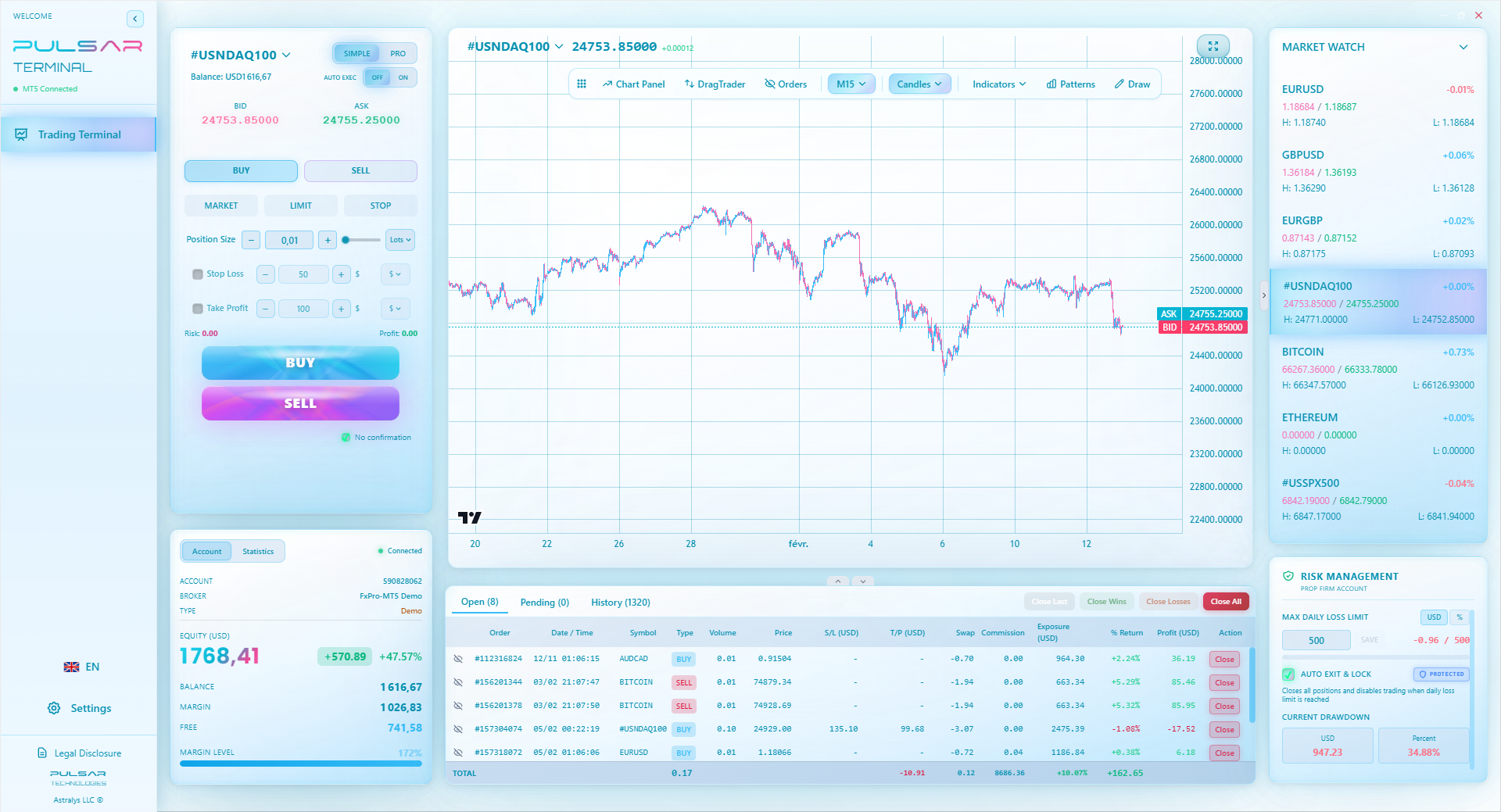
When trading USD/INR futures on a platform like Zerodha, managing multiple targets and a trailing stop manually is clunky; Pulsar Terminal brings advanced MT5-style order management, like drag-and-drop multi-TP/SL and auto-trailing stops, directly to your exchange trading workflow.
Pulsar Terminal
Hepsi bir arada MT5 aracı: sürükle-bırak emirler, çoklu TP/SL, trailing stop, grid trading, Volume Profile ve prop firm koruması. Her gün 1.000'den fazla trader tarafından kullanılıyor.
I need to be honest about a major error. Even after I understood the rules intellectually, I kept a small offshore account 'just for fun.' It was about $500. I told myself it was insignificant, a test environment. This was my psychological loophole.
In early 2023, that account was with a broker that later appeared on an RBI alert list. While my account was tiny, the panic was real. I immediately requested a full withdrawal. The process was delayed. For two months, I had this low-grade anxiety in the back of my mind every time I read financial news. Had I triggered some flag? Would my primary bank account get scrutinized?
The money eventually came back, minus fees. The total financial loss was about $50. The emotional and mental cost was far higher. I had violated my own rule: don't play in the grey area.
The recovery was simple in action, hard in discipline: I closed every single offshore account. I transferred all my trading capital to my SEBI-regulated broker. I committed to only trading USD/INR and Nifty futures. I doubled down on learning volume analysis and market profile techniques for the NSE, tools that work brilliantly on exchange-traded data. My trading became calmer, more focused, and , more consistently profitable because I wasn't looking over my shoulder.
If you have offshore accounts, I'm not judging you. I've been there. But make a plan to wind them down. Withdraw your funds. The peace of mind you'll gain is worth more than any potential gain from an illegal trade. The risk of a margin call is one thing, the risk of a legal notice is another beast entirely.
“The skills you develop trading legally are 100% transferable. The fines and jail time from trading illegally are not.”
This is the million-dollar question. Looking at the trend, the regulations are tightening, not loosening. The April 2026 tightening of forex derivative rules for residents is a clear signal. The RBI's primary mandate is financial stability and managing the rupee, not enabling retail speculative trading.
The proliferation of unauthorized ETPs and the rise of social media 'trading gurus' promoting them have put the RBI on high alert. Their response has been to publish more alerts, not open doors.
Could a regulated onshore spot forex market emerge someday? Possibly, but it would be heavily circumscribed - low use, strict KYC, and likely through the existing exchanges. It wouldn't be the global MT5 buffet. For the foreseeable future, the legal landscape is what it is.
Your energy is better spent mastering the arena that exists, rather than hoping for a new one to open. The skills of risk management, technical analysis, and emotional discipline you develop trading USD/INR futures are 100% transferable. If the rules do change one day, you'll be a seasoned pro with a clean legal record, ready to adapt. The trader who survives and thrives is the one who respects the boundaries of the game they're actually in.
FAQ
Q1Is forex trading completely illegal in India?
No, it's not illegal. It's strictly regulated. Retail Indian traders can legally trade currency futures and options (derivatives) on specific INR pairs (like USD/INR) and a few cross-currency pairs, but only through SEBI-registered brokers on Indian exchanges like the NSE or BSE. Trading spot forex or CFDs on international platforms like MT4/MT5 with offshore brokers is prohibited.
Q2What happens if I trade with a broker on the RBI alert list?
You are engaging in an unauthorized activity under FEMA. You risk severe penalties including heavy daily fines (up to ₹10,000 per day), a penalty up to three times the amount involved, imprisonment up to 5 years, and confiscation of funds. You also have zero legal protection or recourse if the broker scams you or refuses a withdrawal.
Q3Can I use the Liberalised Remittance Scheme (LRS) to fund an international trading account?
Absolutely not. The LRS (limit $250,000/year) is for permitted purposes like travel, education, and gifts. Explicitly using it for margin trading or speculative forex trading with overseas platforms is a violation of FEMA rules and can lead to the full range of penalties, including account freezes and prosecution.
Q4Are brokers like Zerodha and Upstox legal for forex?
Yes, they are the only legal way for retail traders. They are SEBI-registered brokers that provide access to the currency derivatives segments of Indian stock exchanges. You trade USD/INR futures, not spot forex, in a fully regulated, domestic environment.
Q5I have an account with an international broker not on the alert list. Is it safe?
No. The RBI's alert list is not exhaustive. The regulator's position is that any platform offering forex trading services to Indian residents without being registered in India is unauthorized. 'Not being on the list' offers no legal safety. You are still breaking the law and assuming all the financial and legal risks.
Q6What's the difference between trading USD/INR on NSE and trading it on an offshore platform?
On the NSE, you are trading a standardized futures contract on a regulated Indian exchange. Your broker is Indian, your money stays in India, and you are fully compliant. On an offshore platform, you are likely trading a CFD or spot contract with an unregulated entity overseas, which is prohibited. The instrument, counterparty risk, and legal standing are completely different.
Prof. Winston'ın Dersi
Önemli Noktalar:
- ✓Legal forex in India is exchange-traded derivatives only (NSE, BSE).
- ✓Penalties include ₹10k daily fines + 3x the amount + 5 years jail.
- ✓The RBI Alert List is non-exhaustive. Absence ≠ approval.
- ✓Master USD/INR futures. One legal pair mastered is enough.
Bu makale ne kadar faydalıydı?
Bir yıldıza tıklayın
Haftalık Trading Analizleri
Ücretsiz haftalık analiz ve stratejiler. Spam yok.
Yazar hakkında
Rajesh Sharma
Kıdemli Forex Analisti
Hindistan ve Güney Asya piyasalarında 10 yılı aşkın deneyim. NSE döviz türevleriyle başlayıp uluslararası forex'e geçiş yaptı. USD/INR ve gelişmekte olan piyasa pariteleri uzmanı.
Yorumlar
Risk Uyarısı
Finansal araçlarla işlem yapmak önemli riskler taşır ve tüm yatırımcılar için uygun olmayabilir. Geçmiş performans gelecekteki sonuçları garanti etmez. Bu içerik yalnızca eğitim amaçlıdır ve yatırım tavsiyesi olarak değerlendirilmemelidir. İşlem yapmadan önce her zaman kendi araştırmanızı yapın.
Bunları da beğenebilirsiniz

Cara Trading Forex Sukses: 7 Prinsip dari Trader Profesional
Cara trading forex sukses dengan 7 prinsip trader pro: manajemen modal, disiplin, journal trading, backtest. Data nyata, bukan janji profit palsu.
Jam Trading Forex Terbaik untuk Trader Indonesia: Panduan Lengkap dengan Tabel Waktu
Panduan jam trading forex untuk trader Indonesia. Tabel 4 sesi dunia, jam emas 20:00-00:00, sesi mana yang harus dihindari. Data akurat + tips dari trader berpengalaman.
Top 5 Sàn Forex Uy Tín Nhất 2026: Review Jujur dari Trader Indonesia
Top 5 sàn forex uy tín 2026 untuk trader Indonesia. Review jujur: spread, deposit, withdraw, dukungan lokal. Exness, XM, IC Markets & lebih.
Pulsar Terminal'ı Edinin
Tüm bu hesaplayıcılar MT5 hesabınızdan gerçek zamanlı verilerle Pulsar Terminal'e entegredir.
Pulsar Terminal'ı Edinin