


On May 5th, 2024, the RBI's new hedging rules kicked in, and the USD/INR futures market went quiet for a second.

Rajesh Sharma
Kıdemli Forex Analisti ·  India
India
☕ 10 dk okuma
Neler öğreneceksiniz:

On May 5th, 2024, the RBI's new hedging rules kicked in, and the USD/INR futures market went quiet for a second. I was watching the order book on NSE, and the usual retail flow just dried up. A lot of guys who thought they were 'trading' suddenly realized they were just speculating without a real business exposure - and that's now illegal. That moment crystallized the entire Indian forex scene: it's a tightly controlled sandbox, not the wild west of global markets. If you're looking for an 'RBI forex trading platform list,' you're asking the wrong question. The right question is: how do you trade currencies legally here without getting your bank account frozen or losing your shirt? I've seen both happen.
Let's get this straight first. The Reserve Bank of India maintains an 'Alert List' of unauthorized entities. As of late 2025, it had nearly 100 names on it. This is not a secret directory of offshore brokers you can try. It's a public shaming list and a legal warning. If you send money to a platform on that list, you are violating the Foreign Exchange Management Act (FEMA), 1999.
I learned this the hard way early on. Back in 2018, I funded an account with a slick international broker (not on today's list, but similar). The trades went fine for a few months. Then I tried to withdraw a 2.5 lakh rupee profit. Radio silence. Followed by a nightmare of customer service tickets and, eventually, a total loss. The RBI doesn't protect you there. You have zero recourse.

Warning: Platforms like XM, JustMarkets, or FxPro might accept Indian clients and advertise low minimum deposits (like $1 or $5). Many of them appear on the RBI's Alert List. Using them is illegal for retail forex trading. The low spread they advertise is the bait; the potential for a frozen withdrawal or legal notice is the trap.
The legal framework is built on one principle: all forex transactions must go through the authorized dealer channel. For trading, that means SEBI-registered brokers on Indian exchanges. Full stop. Searching for an 'RBI forex trading platform list' to find a backdoor is a surefire way to lose money and potentially face penalties.

“The RBI Alert List isn't a secret directory of offshore brokers; it's a public shaming list and a legal warning.”
So, what can you actually do? You can trade currency derivatives on Indian exchanges. This isn't the spot forex you see on YouTube. It's futures and options contracts, traded on the National Stock Exchange (NSE) or Bombay Stock Exchange (BSE).
The Four Legal Currency Pairs
You're restricted to INR-based pairs. These are your playground:
- USD-INR
- EUR-INR
- GBP-INR
- JPY-INR
There are also cross-currency futures (like EUR/USD, GBP/USD) on the NSE, but they are settled in Indian Rupees. You're not touching actual euros or dollars.
The Real 'Platform List': SEBI-Registered Brokers
Your platform is the trading terminal provided by a SEBI-registered stockbroker. Here's the real list you should care about:
| Broker | Key Feature for Currency Derivatives |
|---|---|
| Zerodha | Kite platform, very popular for retail |
| Angel One | strong platform, strong research |
| HDFC Securities | Integration with banking services |
| ICICI Direct | Another major bank-backed broker |
| Upstox | Competitive pricing |
| 5paisa | Low-cost model |
| Kotak Securities | Full-service offering |
| Motilal Oswal | Strong advisory focus |
These brokers are your gateway. You open a trading and demat account, fund it in INR, and use their software to trade derivatives on the NSE or BSE. This is the only RBI-approved path for speculative currency trading.
The New Hedging Rule (The May 5th Change)
This is critical. Since May 5, 2024, you can only trade currency derivatives up to $100 million equivalent if you have a valid underlying contracted exposure. Are you an exporter waiting for USD payments? A student with future fee payments? That's a hedge. If you're just betting on rupee direction with no real business need, you're technically not allowed. This has massively changed the game for many so-called traders. It's why understanding position size calculator tools is more about risk management than ever, because your legal trades are now under a microscope.

💡 Winston'ın İpucu
The RBI's regulations are a risk management tool you didn't know you had. That 1:10 use cap has saved more Indian accounts than any trading strategy ever could.
“Your platform is the trading terminal provided by a SEBI-registered stockbroker. That's the only list that matters.”
The Indian regulatory framework is designed to protect you from yourself, which also means it limits your upside. Let's talk numbers.
use is Capped at 1:10. Forget the 1:500 you see advertised offshore. Here, for authorized dealers, the max is 1:10. For exchange-traded derivatives, the use is effectively set by the exchange-mandated margin. For a USDINR futures contract, the margin might be around 3-5% of the contract value, which is roughly 1:20 to 1:33 use - still sane compared to global standards, but enough to blow up an undisciplined account. I once saw a client ignore margin calls on a GBP/INR position during a Brexit headline spike. The broker squared off his position, and he lost 80% of his capital in an hour. A margin call here isn't a suggestion; it's an automatic execution.
Transaction Costs are Getting Transparent. In December 2025, the RBI drafted a circular demanding full disclosure of all costs: remittance fees, conversion charges, the actual forex rate spread, everything. This is good. On exchanges, you pay brokerage (often a flat fee per lot), exchange charges, stamp duty, and GST. It's not just the spread definition you see on screen.
Taxation: Short-term capital gains from these trades are taxed at your applicable income tax slab rate. There's no 10% flat rate for all forex trading - that's a common misconception. You need to add it to your total income. I set aside 30% of any profitable trade immediately into a separate account. It's not my money; it's the government's.

Example: Trading one lot of USDINR futures (1000 USD). Brokerage: ₹20 per lot. Exchange Transaction Charge: ~₹5.25. SEBI Charge: ₹0.5. Stamp Duty: ₹0.01 per ₹10,000 turnover. GST: 18% on brokerage. Your cost to enter and exit is about ₹60-70, not counting the bid-ask spread on the exchange. You need the price to move by at least 2-3 pips just to break even on a round turn.
“Your platform is the trading terminal provided by a SEBI-registered stockbroker. That's the only list that matters.”
This is one area where India is world-class. Funding your legal trading account is instant and cheap.
- UPI (PhonePe, Google Pay): This is the king. Transfer from ₹500 to ₹5 lakh instantly from your bank to your broker. It's seamless. I fund my Zerodha account this way seconds before market open if I need to.
- NetBanking (HDFC, SBI, etc.): Works with IMPS. ₹100 to ₹2 lakhs, done in minutes.
- Credit/Debit Cards: Possible, but often have international transaction fees (3-5%) if processed overseas. I avoid it.
Withdrawals are just as fast back to your linked bank account. The key difference from offshore brokers? The money never leaves the Indian banking system. It's traceable, legal, and safe. If you're trying to use Skrill or Neteller to fund an offshore account, you're already on the wrong side of FEMA. The ease of UPI is a gift - use it for the right platforms.
💡 Winston'ın İpucu
If your trading strategy only works with 1:100 use and 24/5 markets, it's not a strategy. It's a gambling addiction dressed in a chart. The Indian framework forces you to find real edges.
“Betting against the RBI's intention to support the rupee is a career-ending move. I've seen it fail for 12 years.”
You can't scalp the 1-minute chart on USD/INR like you can on EUR/USD. The market depth is different, and the trading hours are 9 AM to 5 PM. You need to adapt.
Swing Trading the INR Pairs: This is the most viable approach. Use daily charts. The RBI's own interventions, oil price flows, and FDI news drive these pairs. I had a good swing trading run on USD/INR in 2023, buying at 81.80 and selling at 83.20 over three weeks based on Fed vs RBI policy divergence. The move was slow and fundamental, perfect for this market.
Using Indicators on Exchange Data: The MACD indicator or RSI indicator works on NSE futures charts just like anywhere else. But volume is key. The liquidity in the last hour is very different from the first hour. You need to watch the order book on your broker terminal.
The Prop Firm Loophole (Be Careful): Some prop firms offer challenges where you trade simulated global forex pairs. If you pass, they give you a funded account (their overseas capital). You keep a share of profits. This is a legal gray area. You're not deploying your own money overseas, but you are engaging with an overseas entity. The RBI hasn't explicitly blessed this. I know traders doing it, but it's not without risk. If you go this route, risk management is non-negotiable. Tools that automate stop-losses and trailing stops become essential, as the volatility is the real global market.

Pro Tip: Focus on USD/INR. It has the deepest liquidity, the tightest spreads on the exchange, and the most predictable (relatively) drivers. The other INR pairs can get illiquid. A 10-pip spread on GBP/INR can kill a trade before it starts.

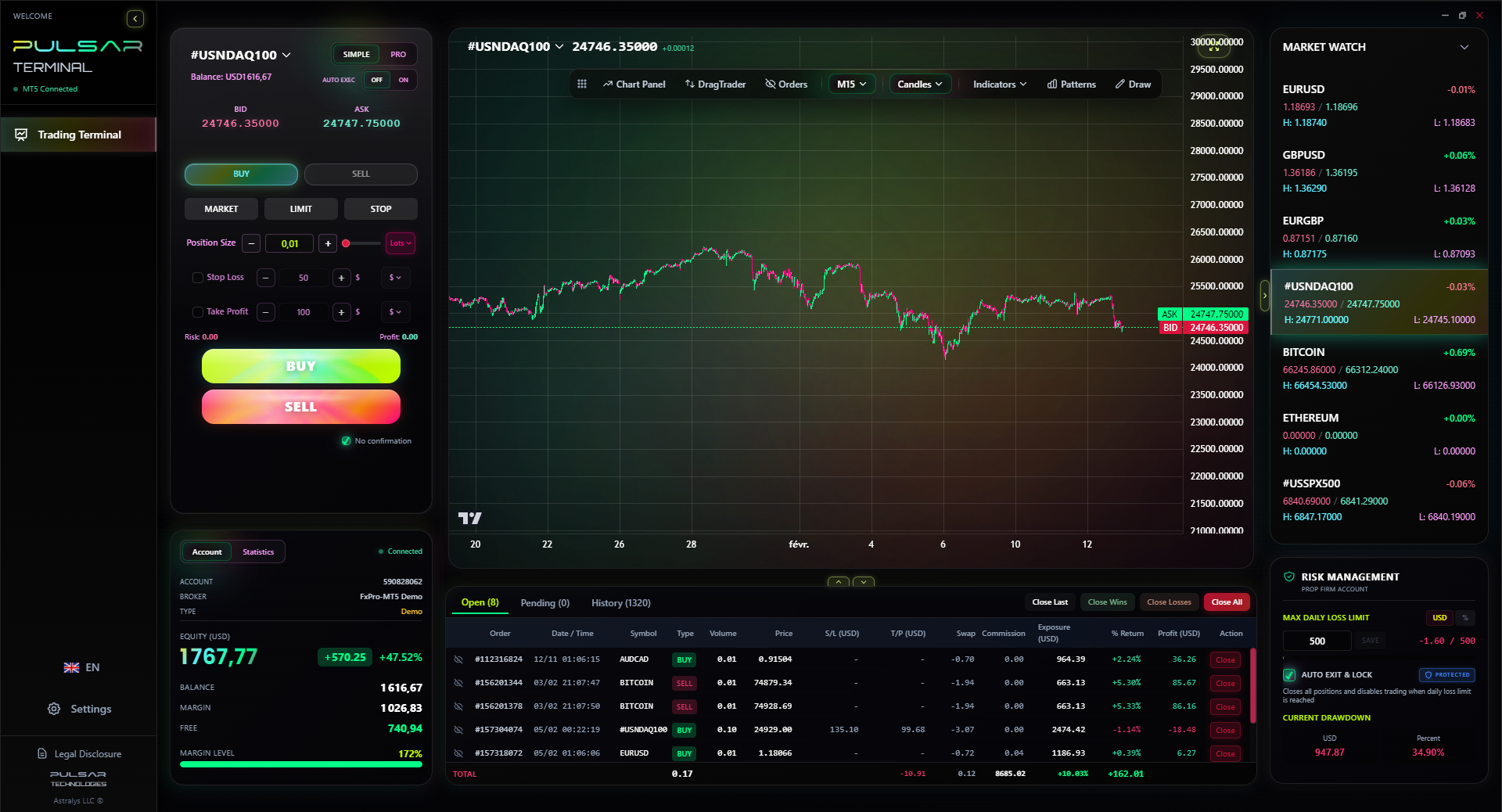
When adapting strategies to India's unique market hours and rules, a tool that lets you quickly set multi-level take-profits and stop-losses on your MT5 terminal can help you execute disciplined swing trades without constant screen watching.
Pulsar Terminal
Hepsi bir arada MT5 aracı: sürükle-bırak emirler, çoklu TP/SL, trailing stop, grid trading, Volume Profile ve prop firm koruması. Her gün 1.000'den fazla trader tarafından kullanılıyor.
“Betting against the RBI's intention to support the rupee is a career-ending move. I've seen it fail for 12 years.”
The RBI isn't static. Their recent actions show a clear intent: curb speculation and stabilize the rupee.
- April 2026 - NDF Ban: Banks are now prohibited from offering rupee NDF contracts to residents or non-residents. Why? To kill offshore speculative betting against the rupee and bring all flow onshore where they can see it. This increases the importance of the onshore futures market.
- February 2026 - Draft for Authorized Persons: They're proposing more flexibility for banks and authorized dealers to hedge and make markets. This could eventually trickle down to better liquidity for you.
- January 2025 - Rupee Trade Promotion: They're easing rules to use INR in global trade. Long-term, this could increase international demand for rupee hedging, deepening our markets.
All these moves point in one direction: more control, more onshoring, and a clear disdain for speculative 'hot money.' Your trading strategy must respect this macro reality. Betting against the RBI's intention to support the rupee is a career-ending move. I've seen it fail for 12 years.
💡 Winston'ın İpucu
Your biggest edge in India is patience. While offshore gamblers get wiped out on 5-minute gold spikes, you can build a real position in USDINR over weeks based on actual economics. Slow money often beats fast noise.
“The Indian forex market is a protected garden. You must play by its strict rules or step into a minefield.”
- Forget the global 'RBI forex trading platform list' fantasy. The legal list is the list of SEBI brokers above.
- Open an account with Zerodha, Angel One, or your preferred SEBI broker. Stick to USD-INR, EUR-INR, GBP-INR, JPY-INR futures/options.
- Respect the hedging rules. If you have no underlying exposure, understand you're in a regulatory gray zone after the May 5th change. Keep positions small.
- Use the brilliant Indian payment system (UPI) for funding. Never try to wire money internationally for trading.
- Adjust your strategy. Think in terms of swings and fundamentals, not 5-minute charts. Study the EUR/USD guide for macro drivers, as they heavily influence EUR/INR.
- Manage risk like your financial life depends on it. Because in this limited, regulated environment, a single blow-up can take you out of the game with no other legal avenues to trade.
The Indian forex market is a protected garden. It can be profitable, but you must play by its strict rules. The moment you look for a backdoor, you're stepping into a minefield where the house - the RBI - always wins.
FAQ
Q1Can I legally trade forex with international brokers like XM or Exness in India?
No. The RBI explicitly prohibits resident individuals from trading on international Electronic Trading Platforms (ETPs) for forex transactions. Many such brokers appear on the RBI's Alert List of unauthorized entities. Using them violates FEMA, risks fund safety, and offers no legal protection.
Q2What is the maximum use allowed for forex trading in India?
Under FEMA, use for authorized dealers is capped at a maximum ratio of 1:10. For retail traders on exchanges, the effective use is determined by the exchange-mandated margin requirements, which typically range from 3% to 5% for major INR pairs, translating to roughly 1:20 to 1:33. This is far lower than the 1:100 or 1:500 offered by illegal offshore platforms.
Q3Which currency pairs can I legally trade as an Indian resident?
You can only trade INR-based currency derivatives on Indian exchanges. The four main pairs are USD-INR, EUR-INR, GBP-INR, and JPY-INR. The NSE also offers cross-currency futures (like EUR/USD), but these are settled in Indian Rupees, not the actual foreign currency.
Q4What are the tax implications on profits from trading currency derivatives?
Profits from trading currency derivatives are treated as 'Business Income' or 'Speculative Business Income' if you don't have an underlying exposure. You must add these profits to your total annual income, and they are taxed at your applicable income tax slab rate. There is no separate flat tax rate for forex trading profits. Maintain detailed records of all trades for ITR filing.
Q5What is the RBI's Alert List?
The RBI's Alert List is a public list of entities (including websites, platforms, and companies) that are NOT authorized to deal in forex or operate electronic trading platforms in India. It is a warning list for residents. Transacting with these entities is illegal. You should check this list periodically, but better yet, only use SEBI-registered brokers.
Q6How do I fund my legal trading account with a SEBI broker?
Use domestic payment methods only. Unified Payments Interface (UPI) via PhonePe or Google Pay is the fastest and most efficient, allowing instant transfers. NetBanking (IMPS) is also widely used. Do not use international credit/debit card payments or wire transfers (like SWIFT) to fund a trading account, as this may raise red flags related to FEMA.
Q7What changed with the RBI's hedging rules in May 2024?
Effective May 5, 2024, the RBI mandated that individuals can only enter into forex derivative contracts (like futures and options) involving the rupee up to $100 million equivalent if they have a valid underlying contracted exposure (e.g., import/export contracts, future foreign currency fees). This rule aims to restrict purely speculative trading and requires users to declare their underlying exposure.
Prof. Winston'ın Dersi
Önemli Noktalar:
- ✓Legal trading is only via SEBI brokers on NSE/BSE.
- ✓You're restricted to 4 major INR pairs (USD, EUR, GBP, JPY).
- ✓use is effectively capped below 1:33.
- ✓Funding must use UPI/NetBanking, not international transfers.
- ✓New hedging rules require a valid underlying exposure.
Bu makale ne kadar faydalıydı?
Bir yıldıza tıklayın
Haftalık Trading Analizleri
Ücretsiz haftalık analiz ve stratejiler. Spam yok.
Yazar hakkında
Rajesh Sharma
Kıdemli Forex Analisti
Hindistan ve Güney Asya piyasalarında 10 yılı aşkın deneyim. NSE döviz türevleriyle başlayıp uluslararası forex'e geçiş yaptı. USD/INR ve gelişmekte olan piyasa pariteleri uzmanı.
Yorumlar
Risk Uyarısı
Finansal araçlarla işlem yapmak önemli riskler taşır ve tüm yatırımcılar için uygun olmayabilir. Geçmiş performans gelecekteki sonuçları garanti etmez. Bu içerik yalnızca eğitim amaçlıdır ve yatırım tavsiyesi olarak değerlendirilmemelidir. İşlem yapmadan önce her zaman kendi araştırmanızı yapın.
Bunları da beğenebilirsiniz

Cara Trading Forex Sukses: 7 Prinsip dari Trader Profesional
Cara trading forex sukses dengan 7 prinsip trader pro: manajemen modal, disiplin, journal trading, backtest. Data nyata, bukan janji profit palsu.
Jam Trading Forex Terbaik untuk Trader Indonesia: Panduan Lengkap dengan Tabel Waktu
Panduan jam trading forex untuk trader Indonesia. Tabel 4 sesi dunia, jam emas 20:00-00:00, sesi mana yang harus dihindari. Data akurat + tips dari trader berpengalaman.
Top 5 Sàn Forex Uy Tín Nhất 2026: Review Jujur dari Trader Indonesia
Top 5 sàn forex uy tín 2026 untuk trader Indonesia. Review jujur: spread, deposit, withdraw, dukungan lokal. Exness, XM, IC Markets & lebih.
Pulsar Terminal'ı Edinin
Tüm bu hesaplayıcılar MT5 hesabınızdan gerçek zamanlı verilerle Pulsar Terminal'e entegredir.
Pulsar Terminal'ı Edinin