


Here's a brutal truth most gurus won't tell you: over 90% of new traders in South Africa blow their first account.

David van der Merwe
Gelişen Piyasalar Yatırımcısı ·  South Africa
☕ 8 dk okuma
Neler öğreneceksiniz:

Here's a brutal truth most gurus won't tell you: over 90% of new traders in South Africa blow their first account. It's not because they can't pick a direction. It's because they treat their trading capital like a casino chip, not a finite resource. The difference between a hopeful punter and a professional isn't the win rate, it's how they handle the losses. This guide is about building a fortress around your ZAR so you can survive long enough to let your edge work.
Forget finding the perfect entry for a second. Your primary job as a trader isn't to be right. It's to not be catastrophically wrong. I learned this the hard way back in 2012. I nailed a short on EUR/ZAR during the Eurozone crisis. My analysis was spot-on. But I got greedy, used way too much use, and a sudden, sharp retracement triggered a margin call before the trend resumed. I was right on the market, but bankrupt on my account. That's the paradox.
In South Africa, we face unique volatility. Pair the rand's famous mood swings with global news, and you've got a recipe for gaps that can skip right past your stop loss. Good risk management is what lets you sleep at night when the US Fed speaks at 2 AM our time. It turns trading from a stressful gamble into a manageable business with known costs. Think of each trade as a business expense. You're investing a small, calculated amount of capital (your risk) for a potential return. Sometimes the expense is just a cost of doing business - a loss.

Warning: The biggest mistake I see? Traders adjusting their stop loss wider after entering a trade to 'give it room.' You're not giving it room, you're changing your business plan mid-meeting and approving a larger budget for a failing project. Don't do it.
You've heard it: never risk more than 1-2% of your account on a single trade. It sounds simple. Yet, when I chat with local traders at seminars, most admit they've broken it, especially when 'recovering' from a loss. Let's make it concrete for a R20,000 account.
- 1% Risk: R200 per trade.
- A Bad Day (5 losses): R1,000 down. You're bruised, not broken.
- Ignoring the Rule (10% risk): R2,000 per trade.
- That Same Bad Day: R10,000 gone. Half your account. Panic sets in.
How to Calculate Your Position Size
This is where math saves you from emotion. You need three numbers:
- Your account balance in ZAR (e.g., R25,000).
- Your risk percentage (e.g., 1% = R250).
- The distance in pips from your entry to your stop-loss.
Let's say you're buying USD/ZAR at 18.5000 and your stop loss is at 18.4800. That's a 200 pip risk. Now, what's a pip worth? For USD/ZAR, a standard lot (100,000 units) move of 1 pip is roughly R10. But you don't need to do this manually. Use a position size calculator. Plug in your numbers: Account=R25,000, Risk%=1, Stop Loss Pips=200. It will tell you the exact lot size to trade so that if price hits your stop, you lose exactly R250, not a cent more.
I keep a calculator open on my second screen for every single trade. It removes all guesswork. This discipline alone will put you ahead of 80% of retail traders.

Example: Trading GBP/ZAR? The pip value changes with the rate. If GBP/ZAR is at 23.00, one pip on a standard lot is about R15.40. A 150-pip stop loss means each lot risks R2,310. For a 1% risk on a R50k account (R500), you could only trade 0.21 lots. This math keeps you safe.

💡 Winston'ın İpucu
A losing trader focuses on the prize. A winning trader focuses on the exit. Before you think about how much you'll make, know exactly how much you can afford to lose.

“Your primary job as a trader isn't to be right. It's to not be catastrophically wrong.”
Placing a stop-loss isn't admitting defeat. It's writing a pre-nup before the marriage. You're defining the worst-case scenario upfront. The problem with exotic pairs like USD/ZAR or EUR/ZAR is their spread. You might see a 50-100 pip spread during volatile news. Placing a stop 20 pips away is suicide - you're already in a huge hole the moment you enter.
Rule of Thumb: Your stop should be at least 2-3 times the typical spread for that pair at that time of day. Check your broker's specs. If USD/ZAR has a 80 pip spread with Exness during London open, your trade needs room to breathe - maybe a 200-250 pip minimum stop.
The Risk/Reward Ratio is Your Compass
A 1:1 risk/reward ratio means you're aiming to make as much as you're risking. I aim for a minimum of 1:1.5. Why? Because you can be wrong half the time and still break even or profit.
- Risk: 100 pips (R1000)
- Reward: 150 pips (R1500)
- Win 4 trades, lose 6: (4 x R1500) - (6 x R1000) = R0. You broke even with a 40% win rate.
This is the power of positive expectancy. It's why I'm a fan of swing trading for these pairs - it gives the trade enough space to achieve a good reward. Chasing 10-pip profits on the rand pairs is a sure way to get eaten by spreads and slippage.
Your take-profit shouldn't be a random number either. Place it at a logical technical level: a previous swing high, a key Fibonacci extension, or a major resistance zone. Let the market structure guide your greed.

South African brokers, like IC Markets or Pepperstone, can offer use up to 1:500 for forex majors. That's like being handed a Lamborghini when you only have a learner's license. It's not a tool for making more money; it's a tool for amplifying risk.
Here’s how use murders accounts: Let's say you have R10,000. With 1:100 use, you control R1,000,000 in the market. A mere 1% move against you (100 pips on most pairs) wipes out your entire capital. On USD/ZAR, a 1% move happens more often than you think.
My Personal Rule: I never use more than 1:10 use for my actual traded position size. Even if my broker gives me 1:200, I calculate my lot size based on my 1% risk rule, which effectively uses a tiny fraction of the available use. High use is for flexing, not for surviving. Treat it like a safety limit on a machine, not a target to hit.

Pro Tip: When you open an account, immediately set your maximum use to a sane level (like 1:20 or 1:30) in your client portal if the broker allows it. It's a forced sanity check that prevents a moment of madness during a volatile spike.
💡 Winston'ın İpucu
Volatility isn't your enemy if you've sized correctly. It's the impatient trader with an oversized position who gets shaken out. Let the market be wild; you stay measured.

“High use is for flexing, not for surviving. Treat it like a safety limit on a machine, not a target to hit.”
The charts don't care about your rent. Your biggest risk factor sits between your chair and your keyboard. I've broken my own rules after three consecutive losses, doubling down to 'get back to even.' It never works. It just digs a deeper hole.
Two Tactics That Saved Me:
- The Daily Loss Limit: This is non-negotiable. Mine is 3% of my account. If I lose R900 on a R30,000 account in a day, I shut it down. Walk away. The goal is to prevent a terrible day from becoming a catastrophic week. This is especially critical if you're trying to pass a prop firm challenge, where a single bad day can disqualify you.
- The Trading Journal: Not just a log of trades. I record my emotional state for each entry. 'Felt FOMO after missing the first move,' or 'Entered out of boredom.' Reviewing this weekly shows you your destructive patterns. You'll start to see that your worst trades often come from a specific emotional trigger.
Sometimes the best trade is no trade at all. If you're tired, stressed about something else, or the market is just choppy and unclear, preserving capital is a win. A flat equity curve is better than a downward-sloping one.

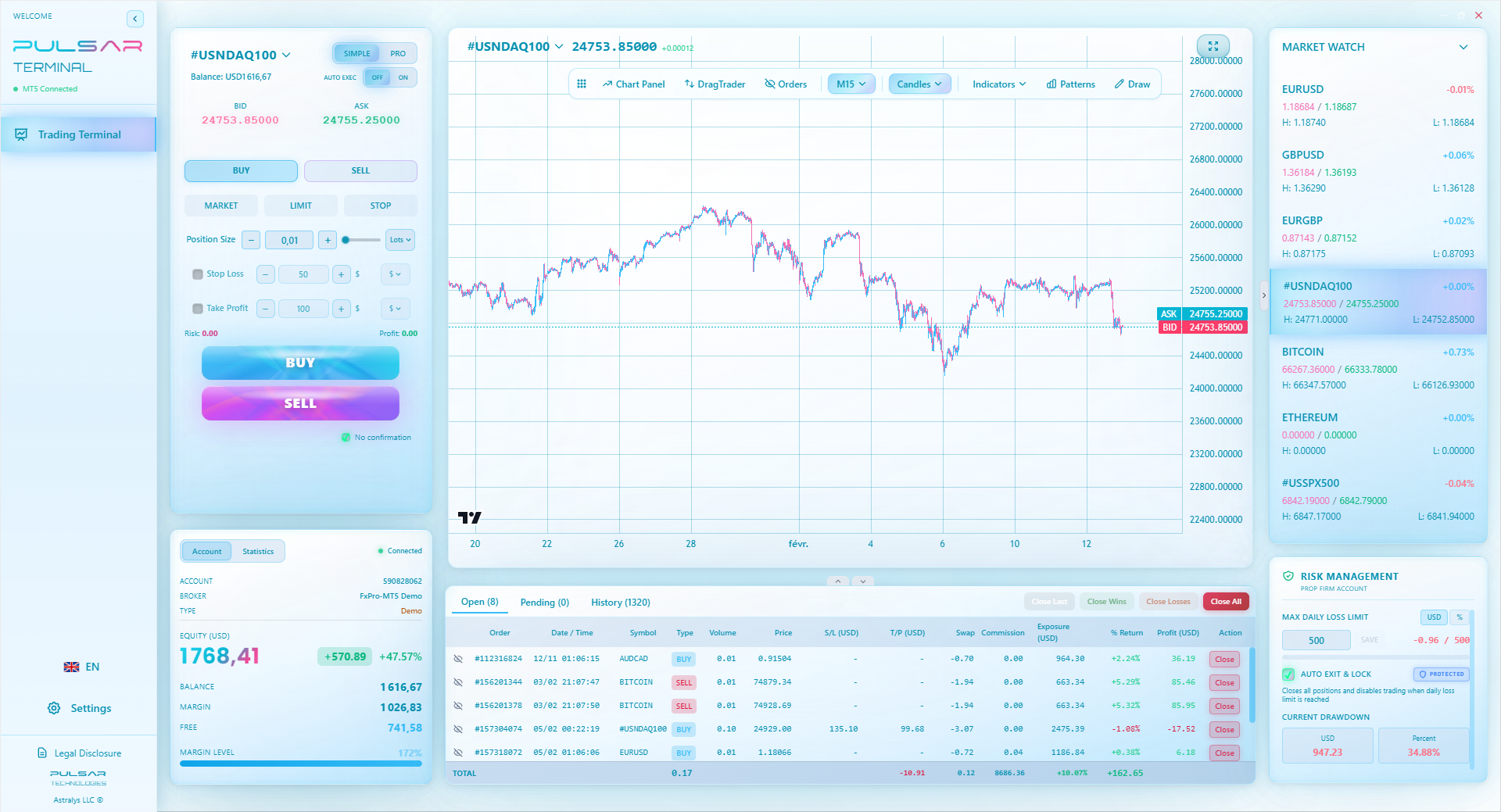
Sticking to a daily loss limit is a core discipline, and Pulsar Terminal's prop firm daily loss protection feature can automatically halt your trading if you hit your predefined threshold, enforcing the rule even when your emotions won't.
Pulsar Terminal
Hepsi bir arada MT5 aracı: sürükle-bırak emirler, çoklu TP/SL, trailing stop, grid trading, Volume Profile ve prop firm koruması. Her gün 1.000'den fazla trader tarafından kullanılıyor.
Theory is useless without execution. Print this out and stick it next to your screen.
Before Every Trade:
- Is this trade part of my planned strategy, or am I chasing? (Be honest).
- Have I calculated my position size using a position size calculator?
- Is my stop-loss placed at a technically logical level, NOT just an arbitrary number?
- Is my risk/reward ratio at least 1:1.5?
- Am I risking more than 1% of my current account balance?
- Have I checked for major news events (SA Reserve Bank, US Non-Farm Payrolls) that could cause a gap?
Daily/Weekly Review:
- Did I hit my daily loss limit? If yes, I stopped.
- What was my largest losing trade this week? Why did it happen?
- What was my largest winning trade? Can I replicate the conditions?
- Is my account drawdown below 5% from its last peak?
This routine turns risk management from a concept into a habit. It becomes as automatic as checking your mirrors before you drive.
Finally, remember that your broker is a tool in this process. I've found brokers like XM offer good negative balance protection (so you can't lose more than you deposit), which is a basic safety net. But no broker will manage risk for you. That's your job, and it's the most important one you have.
💡 Winston'ın İpucu
Your trading plan is a contract with your future self. Breaking your risk rules is stealing from your own financial future. Don't be your own thief.
FAQ
Q1Is 1% risk per trade really enough to make money in South Africa?
It's enough to keep you in the game, which is the first step to making money. Consistent 1% risks with a positive strategy compound over time. Aiming for 5-10% monthly returns is realistic with good risk management. Chasing 50% months usually ends in 100% losses.
Q2How do I handle the wide spreads on ZAR pairs with my stop loss?
You must factor the spread into your risk. If the spread is 80 pips, your stop needs to be placed far enough away so the spread doesn't consume most of your risk buffer. Consider trading smaller positions on wider stops, or focus on trading during London/NY overlap when spreads on majors like EUR/USD are tightest.
Q3What's the biggest risk management mistake new SA traders make?
Using excessive use because it's available. They see they can control R500,000 with R10,000 and don't understand that a small move can wipe them out. They confuse buying power with smart capital allocation.
Q4Should I use a trailing stop loss?
Trailing stops can be great for locking in profits on a strong trend, but be careful in ranging markets - you'll get whipped out. I prefer to manually move my stop loss to breakeven once the trade is in profit by 1.5x my initial risk, then trail a fixed stop behind key support/resistance levels.
Q5How does risk management differ for scalping vs. swing trading?
For scalping strategy, your risk per trade is smaller (e.g., 0.5%), but you take more trades. The stop-losses are much tighter, so spread and execution speed are critical. For swing trading, you risk the standard 1-2% but on fewer trades with wider stops and higher profit targets. The core principle - controlling your loss per trade - remains the same.
Q6My broker offers 'guaranteed stop losses.' Are they worth the extra cost?
In South Africa, with our potential for gap risk (like after a SARB interest rate decision), they can be a valuable insurance policy, especially for larger positions. You pay a wider spread for them. Weigh the cost against the potential gap risk for that specific trade. For most routine trades, a standard stop is fine.
Prof. Winston'ın Dersi
Önemli Noktalar:
- ✓Never risk more than 1% of capital per trade.
- ✓Set a daily loss limit of 2-3% and walk away.
- ✓Use a position size calculator for every entry.
- ✓Aim for a minimum 1:1.5 risk/reward ratio.
- ✓use amplifies risk, not just returns.
Bu makale ne kadar faydalıydı?
Bir yıldıza tıklayın
Haftalık Trading Analizleri
Ücretsiz haftalık analiz ve stratejiler. Spam yok.
Yazar hakkında
David van der Merwe
Gelişen Piyasalar Yatırımcısı
Johannesburg merkezli, gelişmekte olan piyasa dövizlerinde 11 yıllık deneyime sahip trader. ZAR pariteleri, FSCA düzenlemeli ticaret ve Güney Afrika piyasa analizi uzmanı.
Yorumlar
Risk Uyarısı
Finansal araçlarla işlem yapmak önemli riskler taşır ve tüm yatırımcılar için uygun olmayabilir. Geçmiş performans gelecekteki sonuçları garanti etmez. Bu içerik yalnızca eğitim amaçlıdır ve yatırım tavsiyesi olarak değerlendirilmemelidir. İşlem yapmadan önce her zaman kendi araştırmanızı yapın.
Bunları da beğenebilirsiniz

Cara Trading Forex Sukses: 7 Prinsip dari Trader Profesional
Cara trading forex sukses dengan 7 prinsip trader pro: manajemen modal, disiplin, journal trading, backtest. Data nyata, bukan janji profit palsu.
Jam Trading Forex Terbaik untuk Trader Indonesia: Panduan Lengkap dengan Tabel Waktu
Panduan jam trading forex untuk trader Indonesia. Tabel 4 sesi dunia, jam emas 20:00-00:00, sesi mana yang harus dihindari. Data akurat + tips dari trader berpengalaman.
Top 5 Sàn Forex Uy Tín Nhất 2026: Review Jujur dari Trader Indonesia
Top 5 sàn forex uy tín 2026 untuk trader Indonesia. Review jujur: spread, deposit, withdraw, dukungan lokal. Exness, XM, IC Markets & lebih.
Pulsar Terminal'ı Edinin
Tüm bu hesaplayıcılar MT5 hesabınızdan gerçek zamanlı verilerle Pulsar Terminal'e entegredir.
Pulsar Terminal'ı Edinin