


I was staring at my screen on a Tuesday morning in 2023, ready to short USD/ZAR at 18.75.

David van der Merwe
Gelişen Piyasalar Yatırımcısı ·  South Africa
☕ 12 dk okuma
Neler öğreneceksiniz:
- 1What the Hell is a Spread, Really?
- 2The Rand and Ruin: Spread Costs for South African Traders
- 3FSCA Rules, use, and How They Squeeze Your Spread
- 4How to Stop the Spread From Eating Your Lunch
- 5South African Broker Spreads: A Realistic Comparison
- 6When Spreads Lie: Slippage, Requotes, and the Dark Side
- 7The Bottom Line for Your Bottom Line
I was staring at my screen on a Tuesday morning in 2023, ready to short USD/ZAR at 18.75. The spread was normally 5 pips. That day, it blew out to 28 pips. Twenty-eight. My planned 1% risk position suddenly carried a 5.6% upfront cost just to get in. I didn't take the trade. The market moved 200 pips in my favour without me. That moment, more than any winning trade, burned the importance of understanding spread in forex trading into my brain. For us trading with Rand-based accounts, it's not just a theoretical cost, it's the difference between a profitable month and donating to your broker.
Let's cut through the broker marketing. The spread is the difference between the price you can buy at (ask) and the price you can sell at (bid). It's not a fee you see deducted, it's baked into the price from the moment you open a trade. If EUR/USD is quoted as 1.0850 / 1.0852, the spread is 2 pips. You buy at 1.0852, and the price immediately needs to move above 1.0852 for you to be in profit.
Think of it like buying a car. The dealer's bid (what they'll pay for your old car) is low. Their ask (what they'll sell you a new one for) is high. That difference is their profit. In forex, the broker or liquidity provider is the dealer. For major pairs like EUR/USD, this spread is tiny, often below 1 pip on good ECN accounts. For our local favourite, USD/ZAR, it's a different story. Liquidity is thinner, so the dealer's margin is wider to cover their risk.
There are two main types: fixed and variable. Fixed spreads stay the same regardless of market chaos. They're comforting but usually wider on average. Variable spreads tighten when markets are liquid and calm, and widen dramatically during news events or off-hours. I've seen EUR/ZAR spreads jump from 14 pips to over 50 during a SARB interest rate announcement. If you're using a scalping strategy, that kind of move will obliterate your edge.

Warning: A 'zero spread' account is almost always a marketing trick. It usually means they charge a higher commission per lot instead. Your total cost of trading (spread + commission) is what matters. Always ask for that figure.

💡 Winston'ın İpucu
A spread isn't a fee, it's a distance. Your trade must cross that entire distance before it even starts working for you. Plan your journey accordingly.
“For us trading with Rand-based accounts, the spread isn't just a theoretical cost, it's the difference between a profitable month and donating to your broker.”
This is where it gets real for us. Trading ZAR pairs is a unique beast. You're dealing with an emerging market currency, which means higher volatility and, consequently, wider spreads. This isn't a minor detail, it's a central pillar of your risk management.
Let's talk numbers. On a good day with a decent FSCA-regulated broker like Pepperstone or IC Markets, you might see:
- EUR/USD: 0.1 to 0.9 pips
- USD/ZAR: 5 to 8 pips
- EUR/ZAR: 12 to 18 pips
Now, translate that to Rands. One pip on USD/ZAR is roughly R5.40 on a standard lot (100,000 units) at a rate of 18.00. A 5-pip spread on that trade costs you R27 just to open it. On a R10,000 account aiming for 2% risk (R200), that spread alone eats 13.5% of your risk budget before the market even moves. You need the market to move 5 pips in your favour just to break even on the trade cost.
I learned this the hard way early on. I was swing trading GBP/ZAR, putting on positions with a 200-pip stop loss. The spread was 15 pips. My analysis was right more often than not, but the sheer cost of entry meant my winners were smaller and my losers were bigger. The spread was silently skewing my risk-reward ratio into unprofitability. I had to switch to trading the majors (EUR/USD, GBP/USD) and only use USD/ZAR for specific, high-conviction setups where I could afford the wider cost.
How Brokers Make Money From You
Brokers have two main models. The 'market maker' or dealing desk model often uses wider, fixed spreads as their primary revenue. They may take the other side of your trade. The 'ECN/STP' model routes your order to liquidity providers and charges a small commission per lot, offering razor-thin spreads. For active traders, the ECN model is almost always cheaper in the long run. Check our deep dives on brokers like IC Markets review or Pepperstone review to see their specific pricing structures.

Example: Trade: Buy 1 standard lot USD/ZAR at 18.5000 Spread: 5 pips (so you buy at 18.5005) Pip Value: ~R5.41 Immediate Cost: 5 pips * R5.41 = R27.05 This R27 is gone the second you click 'Buy'. The market must rise to 18.5010 for you to be up R5.41.
“Your primary opponent in forex trading is not the market, it's your costs. And the spread is the biggest, most consistent cost you face.”
The Financial Sector Conduct Authority (FSCA) doesn't directly regulate spreads, but their rules massively influence your cost of trading. The big one is the 30:1 use cap for retail traders, in place since 2021.
Here's the connection: Lower use means you need more capital to control the same position size. If you're under-capitalised, you might be tempted to trade exotic pairs like ZAR crosses where the volatility feels like it offers bigger opportunities. But these pairs have the widest spreads. You're combining high inherent cost with high volatility, a surefire way to blow an account. The use cap is there to protect you, but it forces you to be smarter about position sizing and pair selection. Always use a position size calculator that factors in the spread.
The FSCA also mandates client fund segregation, which is non-negotiable. If your broker isn't FSCA-licensed, you're not just risking wider spreads from a shady operation, you're risking your entire deposit. I only ever use FSCA-regulated brokers or top-tier international ones that explicitly accept South African clients. The peace of mind is worth a fraction of a pip.
Remember, you are not allowed to speculate against the Rand with local brokers. This means you can't short ZAR pairs with a South African-regulated broker. This pushes many traders to international brokers for ZAR trading, where you must be extra vigilant about regulation and spreads. Also, SARS wants its share. Your net trading profits are taxable income, so after all those spread costs are deducted, you still owe tax on what's left.
💡 Winston'ın İpucu
If you can't state your trade's total cost (spread + commission) in Rands before you click 'buy', you're not trading, you're gambling with an unknown vig.
“Your primary opponent in forex trading is not the market, it's your costs. And the spread is the biggest, most consistent cost you face.”
You can't eliminate spread, but you can manage it from a position of strength.
1. Trade During Liquid Hours. The London (10:00 SAST) and New York (16:00 SAST) overlaps are golden. Spreads on majors are at their tightest. Avoid trading exotic pairs like EUR/ZAR on weekends or after 20:00 SAST, the spreads become punitive.
2. Choose Your Account Type Wisely. Are you a high-volume trader? A raw spread ECN account with a commission will be cheaper. Do you trade infrequently with smaller sizes? A standard account with a slightly higher spread but no commission might work out better. Do the math based on your typical trade size.
3. Factor Spread Into Your Risk-Reward. This is the most important step most beginners miss. If your strategy needs a 1:2 risk-reward, and the spread on USD/ZAR is 5 pips, you must add those 5 pips to your risk side of the equation. If your stop loss is 20 pips away, your real risk is 25 pips. Your take-profit must then be 50 pips away plus the 5-pip spread to get true 1:2. So you need a 55-pip profit target. This changes everything.
4. Be Wary of News Trading. I used to love trading Non-Farm Payrolls. Then I got filled with a 15-pip spread on EUR/USD during the announcement. The volatility is high, but so is the cost. Most news trades are a gamble on the spread widening against you.
5. Consider the Majors. I know trading the Rand feels patriotic, but look at the numbers. A 0.9 pip spread on EUR/USD versus a 5 pip spread on USD/ZAR. For your capital and sanity, sometimes the best ZAR trade is no ZAR trade. Focus on instruments where you have a clear edge, not just familiarity. Our EUR/USD guide breaks down why it's the most traded pair for good reason.

Pro Tip: Before you enter any trade, look at the live spread being quoted, not the 'typical' spread on the broker's website. If it's double the usual size, walk away. The market is telling you it's unstable.
“A 5-pip spread on USD/ZAR can eat 13.5% of a careful risk budget before the market even moves.”
Don't believe the 'from' spreads on homepage banners. Here's a blunt, real-world look at what you can expect from some popular brokers for South Africans. These are average spreads during London hours, based on my experience and tracking over the last year.
| Broker (FSCA Regulated) | Account Type | Avg. EUR/USD Spread | Avg. USD/ZAR Spread | Key Note for ZA Traders |
|---|---|---|---|---|
| Tickmill | Raw/Pro | 0.11 pips (+ $3 commission) | ~5.5 pips | Excellent raw costs, but factor in the commission. Good for active traders. |
| IC Markets | Raw Spread | 0.10 pips (+ $3.5 commission) | ~5.0 pips | Consistently tight pricing, great execution. A favourite for a reason. |
| FP Markets | Standard | 1.3 pips | ~7.0 pips | Reliable all-rounder. The standard account is commission-free, easier for beginners. |
| Plus500 | CFD Account | 1.3 pips | ~8.0 pips | Spread-only, user-friendly platform. But you can't trade spot forex, only CFDs. |
| XM | Zero Account | 0.8 pips | ~6.5 pips | Low minimum deposit ($5), good for starting out. |
| Khwezi Trade | Standard | N/A (ZAR focus) | From 0.4 pips | Local FSCA OTC provider. Min deposit R500. Tight ZAR spreads, but remember you can't short the Rand with them. |
Notice something? The brokers with the tightest spreads on majors (Tickmill, IC Markets) use a commission model. The spread-only brokers have a higher baseline. There's no free lunch. Your job is to calculate the total cost per lot based on your trading volume. Also, note that Exness review shows they offer local deposits but aren't FSCA-regulated, which is a significant risk factor many overlook for the sake of convenience.
A personal story: I ran a small experiment, trading the same EUR/USD scalping strategy on a standard account (1.6 pip spread) and an ECN account (0.2 pip + commission). Over 50 trades, the net profit on the ECN account was 23% higher, even after commissions. The spread was literally consuming a quarter of my potential profit.
💡 Winston'ın İpucu
The most expensive spread is the one you didn't notice. It's the silent partner in every losing trade, taking its cut first.
“A 5-pip spread on USD/ZAR can eat 13.5% of a careful risk budget before the market even moves.”
The quoted spread is the best-case scenario. The real cost often comes from what happens when you click the button.
Slippage is when you get filled at a worse price than you expected. During high volatility, your market order to buy USD/ZAR at 18.5000 might fill at 18.5030. That's 3 pips of negative slippage, added to the spread. Good brokers have minimal slippage. Bad ones have it constantly.
Requotes are a dealer's way of saying 'the price you wanted is gone, here's a new one.' It's common with fixed-spread market makers during fast markets. It's infuriating and often results in you missing the trade or getting a worse price. I'd take a variable spread with instant execution over a fixed spread with requotes any day.
How to Protect Yourself:
- Use Limit Orders. Instead of a market order, set a limit order at the price you want. You won't get slippage, but you also might not get filled if the price never touches your level.
- Check Economic Calendars. Don't place trades right before major data releases. The spread will widen, and slippage will happen.
- Understand Your Broker's Model. An ECN/STP broker has less conflict of interest - they make money on volume, not your loss. They have no reason to manipulate spreads or cause requotes. A market maker might.
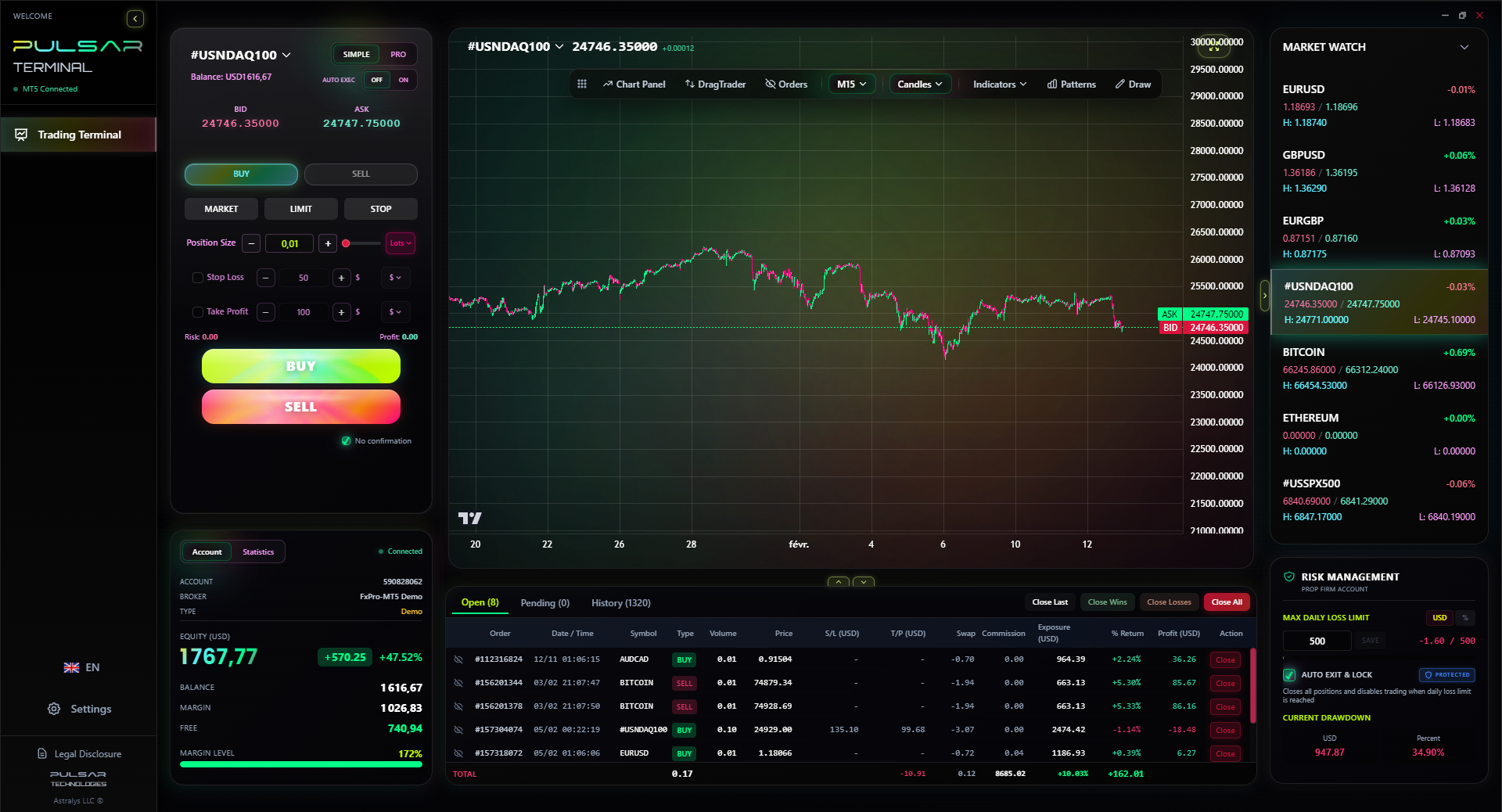
The spread is the visible cost. Slippage and poor execution are the hidden taxes. A broker with a 0.5 pip wider spread but perfect execution is often better than one with a tight spread that slips you 2 pips on every entry. This is where tools that enhance MT5 execution, like Pulsar Terminal, become valuable for serious traders looking to lock in precise entries and manage exits efficiently.
Managing the hidden costs of trading, like slippage on entries, is where precise order tools in Pulsar Terminal give you back control directly on your MT5 charts.
Pulsar Terminal
Hepsi bir arada MT5 aracı: sürükle-bırak emirler, çoklu TP/SL, trailing stop, grid trading, Volume Profile ve prop firm koruması. Her gün 1.000'den fazla trader tarafından kullanılıyor.
“The brokers with the tightest spreads on majors use a commission model. The spread-only brokers have a higher baseline. There's no free lunch.”
Here’s the truth I wish someone had told me when I started: Your primary opponent in forex trading is not the market, it's your costs. And the spread is the biggest, most consistent cost you face. It's a relentless drip-feed from your account to your broker's coffers.
For South African traders, this is amplified. Our home currency pairs are expensive to trade. The FSCA's use limits mean we need to be precise with our capital. Chasing volatile exotics with wide spreads is a recipe for turning R10,000 into R5,000 very quickly.
Your action plan:
- Know your numbers. Calculate the total cost (spread + commission) in Rands for your typical trade size.
- Factor it into every single trade plan. Your stop loss is not where you place it, it's where you place it plus the spread.
- Trade liquid pairs during liquid times. Save the ZAR trades for when you have a crystal-clear edge and can absorb the 5-15 pip entry fee.
- Choose a broker based on total cost & execution, not just the advertised spread. Regulation (FSCA) is non-negotiable.
The spread isn't your enemy if you understand it. It's just a toll on the road to your target. But if you ignore it, you'll keep arriving with an empty tank. Now go check the live spread on your platform. Really look at it. That's the first price of admission for your next trade. Make sure you can afford it.
FAQ
Q1What is a good spread for a South African forex trader?
It depends on the pair. For EUR/USD, anything under 1.0 pip on a standard account or under 0.3 pips on a raw account (plus commission) is competitive. For USD/ZAR, a spread of 5-7 pips is standard during active hours. A 'good' spread is one where the total cost doesn't wreck your risk-reward ratio. If your average profit target is 20 pips, a 10-pip spread is terrible.
Q2Why is the spread on USD/ZAR so much wider than on EUR/USD?
Liquidity. EUR/USD is the most traded financial instrument in the world. Banks and institutions are constantly buying and selling, creating a deep, liquid market with tiny bid-ask differences. USD/ZAR is an exotic pair with far less trading volume. Market makers and liquidity providers charge a wider spread to compensate for the higher risk and cost of holding the less-liquid Rand.
Q3Can I trade forex with zero spread in South Africa?
Not truly zero. Some brokers offer 'zero spread' accounts, but they charge a commission per lot traded instead. Your total cost of trading (spread + commission) is what matters. Often, these accounts are cheaper for high-volume traders but can be more expensive for those trading small sizes infrequently. Always calculate the total cost in Rands.
Q4Does the FSCA regulate the spreads brokers can charge?
No. The FSCA ensures brokers are financially sound, segregate client funds, and treat customers fairly, but they do not cap spreads. Spreads are determined by market liquidity and broker competition. The FSCA's main impact is the 30:1 use cap, which indirectly affects how much spread cost you can afford relative to your account size.
Q5When is the worst time to trade due to wide spreads?
Avoid these times: 1) During major economic news releases (like US Non-Farm Payrolls, SARB rate decisions). 2) In the hour after major markets close (e.g., after New York closes at 22:00 SAST). 3) On weekends if your broker offers weekend trading - spreads are often massively widened. 4) During illiquid holiday periods.
Q6Should I use a fixed or variable spread account?
For most traders, variable is better. You get the benefit of tight spreads during normal market conditions. Fixed spreads sound safe but are usually set wider on average to protect the broker, and you often face requotes in fast markets. Variable spreads with instant execution (like on ECN models) provide better overall value.
Q7How do I calculate the real cost of a spread in Rands?
First, find the pip value. For USD/ZAR, a standard lot (100,000 units) has a pip value of roughly R5.40 (100,000 * 0.0001). If the spread is 5 pips, your cost is 5 * R5.40 = R27. Use a position size calculator to do this automatically for your trade size and pair.
Prof. Winston'ın Dersi
Önemli Noktalar:
- ✓Calculate spread cost in Rands for every trade.
- ✓Add the spread width to your stop-loss distance for true risk.
- ✓Trade ZAR pairs only with high-conviction, wide-target setups.
- ✓Choose ECN/STP brokers for volume, standard for infrequent trades.
- ✓Avoid trading during news and illiquid hours at all costs.
Bu makale ne kadar faydalıydı?
Bir yıldıza tıklayın
Haftalık Trading Analizleri
Ücretsiz haftalık analiz ve stratejiler. Spam yok.
Yazar hakkında
David van der Merwe
Gelişen Piyasalar Yatırımcısı
Johannesburg merkezli, gelişmekte olan piyasa dövizlerinde 11 yıllık deneyime sahip trader. ZAR pariteleri, FSCA düzenlemeli ticaret ve Güney Afrika piyasa analizi uzmanı.
Yorumlar
Risk Uyarısı
Finansal araçlarla işlem yapmak önemli riskler taşır ve tüm yatırımcılar için uygun olmayabilir. Geçmiş performans gelecekteki sonuçları garanti etmez. Bu içerik yalnızca eğitim amaçlıdır ve yatırım tavsiyesi olarak değerlendirilmemelidir. İşlem yapmadan önce her zaman kendi araştırmanızı yapın.
Bunları da beğenebilirsiniz

Cara Trading Forex Sukses: 7 Prinsip dari Trader Profesional
Cara trading forex sukses dengan 7 prinsip trader pro: manajemen modal, disiplin, journal trading, backtest. Data nyata, bukan janji profit palsu.
Jam Trading Forex Terbaik untuk Trader Indonesia: Panduan Lengkap dengan Tabel Waktu
Panduan jam trading forex untuk trader Indonesia. Tabel 4 sesi dunia, jam emas 20:00-00:00, sesi mana yang harus dihindari. Data akurat + tips dari trader berpengalaman.
Top 5 Sàn Forex Uy Tín Nhất 2026: Review Jujur dari Trader Indonesia
Top 5 sàn forex uy tín 2026 untuk trader Indonesia. Review jujur: spread, deposit, withdraw, dukungan lokal. Exness, XM, IC Markets & lebih.
Pulsar Terminal'ı Edinin
Tüm bu hesaplayıcılar MT5 hesabınızdan gerçek zamanlı verilerle Pulsar Terminal'e entegredir.
Pulsar Terminal'ı Edinin