


Here's a hard truth: over 80% of retail traders lose money.

Olumide Adeyemi
Batı Afrika Yatırım Öncüsü ·  Nigeria
☕ 11 dk okuma
Neler öğreneceksiniz:
- 1What Exactly Is a Stop Hunt? (It's Not What You Think)
- 2Why Stop Hunts Feel So Common for Nigerian Traders
- 3How to Spot a Stop Hunt Before It Hits You
- 4Practical Strategies: How to Avoid Being the Target
- 5Brokers, Regulation, and the Stop Hunt Question in Nigeria
- 6The Mental Game: Don't Let the Hunt Hunt Your Mind
- 7Can Indicators Like RSI or MACD Help?
- 8Putting It All Together: Your Survival Checklist
Here's a hard truth: over 80% of retail traders lose money. A big chunk of those losses happen right at the moment you think you're being safe - when your stop-loss gets hit. The price taps your level, reverses, and leaves you wondering if the market has a personal vendetta against you. In Nigeria, where we're trading with our hard-earned Naira, that feeling hits different. I'm going to show you what's really happening. It's not magic, it's not a conspiracy - it's a stop hunt. And once you learn its patterns, you can stop being the prey.
Most new traders hear 'stop hunt' and picture a villain in a suit, manually moving the EUR/USD chart to steal their $50. It's more subtle, and honestly, more mechanical than that.
A stop hunt is when price moves rapidly to a level where a large number of stop-loss orders are known to be clustered, triggers them, and then reverses direction. The goal isn't to 'get you' personally. The goal is liquidity. Big banks and institutions need to fill their massive orders. To do that efficiently, they need a pool of opposing orders to trade against. Your stop-loss, along with thousands of others, provides that liquidity.
Think of it like this: the market is a river. Your stop-loss is a small rock on the riverbed. A stop hunt is a temporary surge of water just strong enough to dislodge that rock and every other rock like it, before the current settles back to its normal flow. The surge wasn't about your rock. It was about clearing the path.

Warning: Don't fall into the trap of blaming every losing trade on a malicious stop hunt. Sometimes, you're just wrong. The key is learning to distinguish normal price rejection from a deliberate liquidity grab.
I learned this the hard way in 2018. I was short on GBP/JPY, with a tight stop-loss just above a round number at 150.00. The price spiked to 150.07, took me out, and immediately crashed 90 pips. I was furious, blaming my broker. Later, reviewing the volume profile, I saw the enormous volume spike on that wick. It wasn't my broker. It was the market 'hunting' for all the stops like mine to fuel the next big move down.
It's not your imagination. As a retail trader, especially one starting out, you're statistically more likely to have your stops placed in the most obvious spots. Combine that with how we trade in Nigeria, and the trap is set.
The Naira and Liquidity Pools
We often trade with smaller capital. This leads to using tighter stop-losses to manage risk, which naturally get placed near obvious technical levels - right where the big players expect them. Also, when trading through international brokers like Exness or IC Markets, our orders are part of a global liquidity pool. A stop hunt in London or New York session will sweep up Nigerian traders' orders just the same.
The Psychology of Round Numbers
Look at your old trades. How many stops did you place at neat numbers like 1.1000 on EUR/USD or 1800 on gold? Almost everyone does it. In Lagos, we call it 'sharp sharp' trading - wanting clean, easy numbers. The market knows this. The most vicious stop hunts occur at these psychological levels and at the edges of clear support or resistance zones.
Broker Execution and Spreads
During high volatility, the spread can widen. If your stop is a market order (which it usually is), you might get filled at a worse price than you set. A broker with consistently tight spreads, like Pepperstone, can mitigate this, but it doesn't make the hunt disappear. It just means your execution within the move is cleaner.
The real issue is predictability. If I can guess where you put your stop, so can the algorithms used by institutional desks. Your job is to become less predictable.

💡 Winston'ın İpucu
The market's favorite trick is the false move. If a breakout looks too easy and too obvious, it probably is. That's the trap being set.
“The psychological damage of a stop hunt is often worse than the financial loss. It breeds paranoia.”
You can't prevent stop hunts, but you can see them coming. They leave fingerprints. Here’s what to look for on your charts.
The False Breakout/Breakdown: This is the classic sign. Price makes a sharp, seemingly strong move beyond a key level (like a trendline or a previous high), but the move lacks follow-through. The candle closes back on the other side of the level, often leaving a long wick. That wick is the hunting ground.
Spike on Low Timeframe, Rejection on High: You might see a scary spike on your 5-minute or 15-minute chart that takes you out. Switch to the 1-hour or 4-hour chart. If that spike is just a tiny wick and the larger timeframe candle shows a clear rejection (like a pin bar or doji), you've likely witnessed a hunt. I use this cross-timeframe analysis constantly.
Volume is the Tell: This is the most important clue, but you need the right tools. A genuine breakout should come with increasing volume. A stop hunt often shows a sharp volume spike on the move to the stop zone, followed by a quick drop in volume as price reverses. Platforms like TradingView or advanced tools that show order flow can help here.
Context is King: Is the hunt happening right before a major news event (like US NFP or a CBN announcement)? Or right at the London open (7 AM our time)? These are prime times for liquidity runs. A move that happens in the dead of the Asian session (late night for us) is less likely to be a significant hunt.

Example: Let's say Gold (XAU/USD) has strong support at $2,150. You go long, placing your stop-loss at $2,148. Price dips sharply to $2,147.50, triggers a flood of stops, then rockets to $2,165 within the hour. That move down to $2,147.50 on high speed and volume, with an immediate reversal, is the textbook hunt. For more on trading gold, check our XAU/USD guide.
Now, the actionable part. How do you trade in a world where this happens? You don't fight it. You adapt.
1. Hide Your Stops (The Most Important Rule)
Stop placing your stop-losses at the obvious spots. If everyone is putting stops 10 pips below a swing low, put yours 12 or 15 pips below. Or, even better, 5 pips below. Be unpredictable. Use volatility to your advantage. A tool like the Average True Range (ATR) indicator can help. Instead of a fixed 20-pip stop, use 1.5x the ATR. This places your stop in a less crowded area.
2. Use Mental Stops (With Discipline!)
This is advanced and requires iron discipline. You don't place a physical stop order with your broker. You note your stop level on your trading plan and manually exit if price hits it. This prevents your order from being in the market queue. But be warned: This is dangerous if you lack self-control. A slippage during news can be far worse than a hunted stop.
3. Trade with the Hunt, Not Against It
This is a more advanced concept. If you identify a key level where you think stops are clustered, you can place a pending order beyond that level, anticipating the reversal. For example, if support is at 1.0750 on EUR/USD, you place a buy limit order at 1.0740, expecting the hunt to dip below support, trigger stops, and reverse into your order. This is high-risk and requires precise confirmation.
4. Position Size is Your Best Defense
This is non-negotiable. If your position size is too large, even a small hunt will blow through your stop and cause significant pain. Use a position size calculator religiously. Never risk more than 1-2% of your account on a single trade. This way, if you do get hunted, it's a minor setback, not a disaster that leads to a margin call.
My biggest mistake early on was ignoring this. I once risked 5% on a EUR/USD scalping trade. A 15-pip hunt wiped out two weeks of careful profits. I never made that error again.
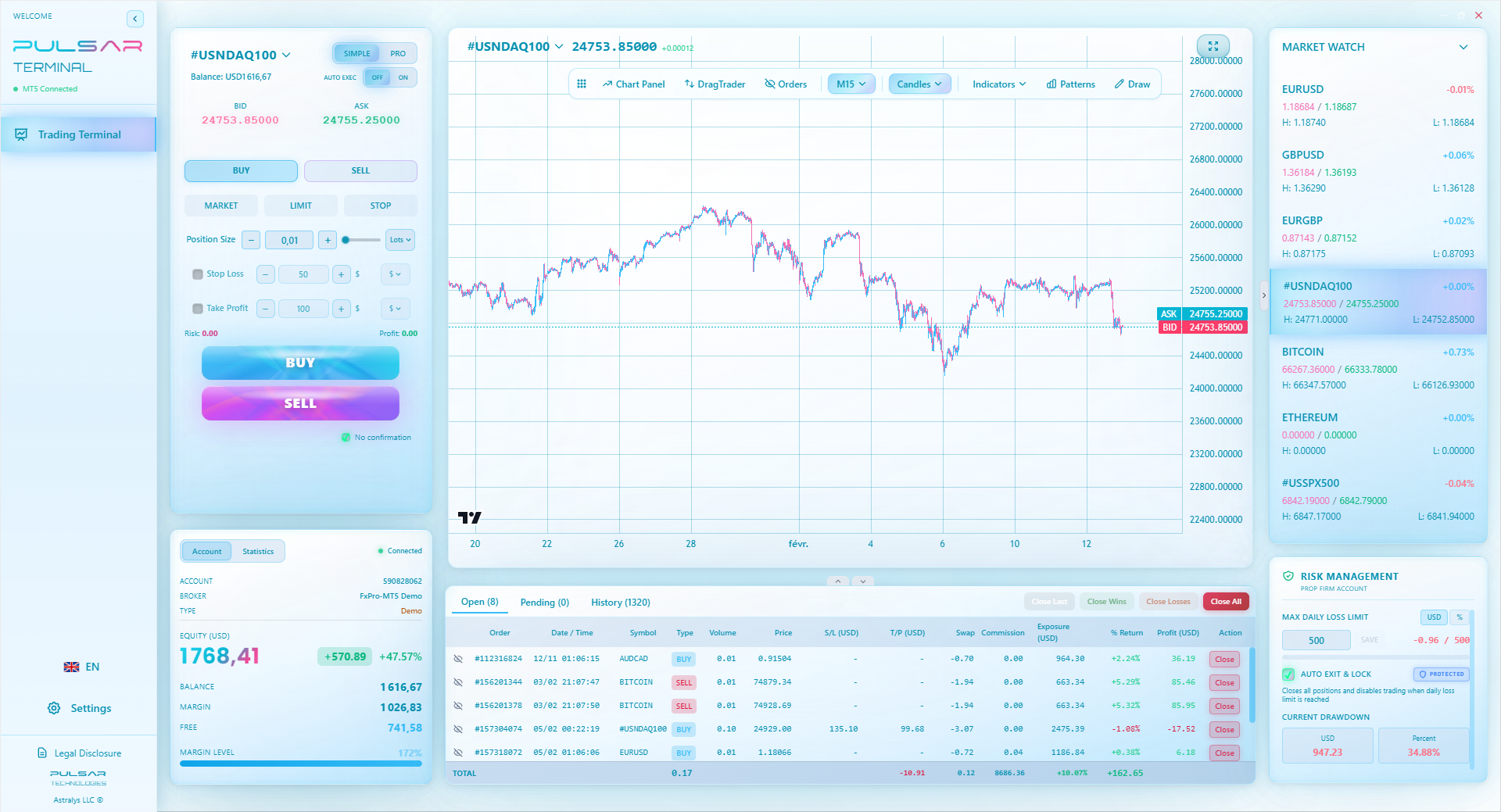
Managing multiple trades and complex stop strategies during volatile hunt periods is much easier with a tool that lets you drag and modify orders directly on your chart.
Pulsar Terminal
Hepsi bir arada MT5 aracı: sürükle-bırak emirler, çoklu TP/SL, trailing stop, grid trading, Volume Profile ve prop firm koruması. Her gün 1.000'den fazla trader tarafından kullanılıyor.
“If I can guess where you put your stop, so can the algorithms used by institutional desks.”
Let's talk locally. You'll hear guys at computer villages or on WhatsApp groups screaming about 'broker manipulation.' What's the real deal?
Nigerian traders are primarily served by international brokers regulated abroad (FCA, CySEC, ASIC) and a few with local presence. The new SEC powers under the ISA 2025 aim to bring more oversight, but the core protection against broker-side manipulation comes from their primary international regulator.
A properly regulated broker like XM or IC Markets makes money from spreads and commissions, not from your losses. They have no incentive to manually hunt your $200 stop. Their liquidity providers (the big banks) might create the market conditions for a hunt, but that's different from your broker cheating you.
How to choose a broker to minimize pain:
- Tight, Stable Spreads: Look for raw spread accounts. A hunt during spread widening can cause massive slippage. Brokers known for tight spreads protect you from this secondary effect.
- No Dealing Desk (NDD/ECN) Execution: This means your order is passed directly to the interbank market. It generally provides fairer execution than a broker who might be taking the other side of your trade.
- Transparency: Can they provide details on their liquidity providers? Good brokers will.
The hunt is a market phenomenon, not a broker scam. Choosing a reputable broker ensures you're experiencing the real market, not a corrupted version of it. Always check our detailed broker reviews before funding an account.
💡 Winston'ın İpucu
Your stop-loss isn't a suggestion. It's a law. A hunted stop that saves you 80% of your capital is a victory, not a defeat. The trader who survives to trade another day always wins in the end.
The psychological damage of a stop hunt is worse than the financial loss. It breeds paranoia and revenge trading.
You'll start seeing hunts everywhere. You'll move your stops wider out of fear, only to get hit by a normal reversal. You'll start avoiding using stops altogether - a surefire path to blowing up your account. I've been in this spiral.
The fix is in your journal. When you get stopped out and price reverses, don't just curse. Go back and analyze it. Was it a hunt (false break, high volume wick)? Or was your analysis simply wrong (price broke the level and kept going)?
Accept that a certain percentage of your losses will be to these liquidity moves. It's a cost of doing business, like a taxi driver paying for fuel. Factor it into your expectancy. If your strategy is sound, the profits from your good trades will cover these 'hunt losses' and more.

Pro Tip: After a suspected hunt, wait. Don't jump back in immediately out of anger or FOMO (Fear Of Missing Out). The best entries often come after the market has settled post-hunt. Let the emotional traders get chopped up, then you can step in with a clear plan.
This patience is what separates a consistent swing trader from a perpetually frustrated one.
“Accept that a certain percentage of your losses will be to liquidity moves. It's a cost of doing business.”
Classic indicators like RSI and MACD are lagging. They tell you what just happened. By the time RSI shows oversold on a hunt, you're already stopped out.
However, they can provide confluence for the reversal after the hunt. For example, if price makes a false breakdown (hunt) and then the 1-hour RSI shows a strong bullish divergence, that strengthens the case for the reversal being real and not just another fakeout.
More useful are tools that visualize market structure:
- Volume Profile: Shows where most trading activity occurred. A 'low volume node' below support is a prime hunt target - price can move through it quickly.
- Market Profile: Similar concept, popular in institutional trading.
- Order Flow Tools: Show the balance of buy and sell orders at different prices. These are more advanced but can directly show liquidity pools.
Don't rely on a single indicator to save you. Use price action and volume as your primary guides, and let indicators play a supporting role in confirming the market's story after the key move has happened.
Here’s your action plan starting today:
- Audit Your Stops: Look at your last 20 trades. How many stops were at obvious round numbers or tight against support/resistance? Commit to being less predictable.
- Respect Position Size: Before every trade, calculate your risk. Use that position size calculator. Make 1% risk your religion.
- Switch Timeframes: When you get stopped out, immediately check the higher timeframe. Was it a blip or a real break? This will calm your emotions and improve your analysis.
- Embrace the Hunt: Change your mindset. A stop hunt is not a personal failure. It's a market mechanism. When you see one, note the level. That level is now a strong support/resistance zone because all the weak hands (stops) have been cleared out.
- Choose Your Broker Wisely: Opt for transparency and tight spreads. It won't stop hunts, but it will ensure you get fair execution within the market's moves.
Remember, the goal isn't to never get stopped out. That's impossible. The goal is to ensure that when you do, it's part of a controlled risk plan, and you understand why it happened. That understanding turns a frustrating loss into a valuable lesson that builds your edge. Now go look at your charts. You'll start seeing the patterns you never noticed before.
FAQ
Q1Is stop hunting illegal in Nigeria?
There's no specific law in Nigeria that names and bans 'stop hunting.' It's considered a controversial market practice. However, the SEC's strengthened powers under the new ISA 2025 aim to promote overall market fairness and transparency, which could indirectly discourage the most egregious forms of market manipulation. As a trader, your protection comes more from choosing brokers regulated by strict international authorities like the FCA or ASIC.
Q2What's the best stop-loss strategy to avoid stop hunts?
The best strategy is to avoid placing stops at obvious, crowded levels. Don't put your stop 5 pips below a round number or a clear swing low. Use volatility-based measurements like the ATR indicator to set your stop in a less predictable place. For example, set your stop at 1.5x the 14-period ATR away from your entry. This places it beyond where most retail traders' tight stops will be clustered.
Q3Do all brokers engage in stop hunting?
No. Reputable, well-regulated brokers do not manually hunt their clients' stops. They profit from spreads and commissions. The phenomenon of stop hunting is driven by the collective action of large liquidity providers (big banks and funds) in the broader market, not by your broker targeting you. Choosing a trustworthy broker ensures you are exposed to the real market, not a manipulated one.
Q4Can I use a stop hunt to my advantage?
Yes, with experience. Advanced traders sometimes place pending buy limit orders just below a major support level (or sell limits above resistance), anticipating that a hunt will sweep the area before reversing. This is a high-risk, high-reward strategy that requires strong confirmation (like a clear price action reversal pattern) and should only be done with very small position sizes initially.
Q5How do I know if it was a stop hunt or just a normal loss?
Look for the signs: a very fast, sharp move that breaks a key level but immediately reverses, closing back beyond the level (a false break). Check the volume - a hunt often has a sharp volume spike on the move. Finally, look at the higher timeframe. If the move that stopped you out is just a tiny wick on the 4-hour chart, it was likely a liquidity grab, not a genuine trend change.
Q6Should I stop using stop-losses because of hunting?
Absolutely not. Not using a stop-loss is the fastest way to lose your entire account. A stop hunt might cause a small, planned loss. A runaway trend without a stop can cause a catastrophic loss. The solution is to use smarter stop placement, not to abandon risk management altogether.
Prof. Winston'ın Dersi
Önemli Noktalar:
- ✓Hide stops away from obvious round numbers & swing points.
- ✓Never risk more than 1-2% of capital on a single trade.
- ✓A false breakout with a long wick is a classic hunt signature.
- ✓Check the higher timeframe to confirm a hunt vs. a real break.
- ✓Choose brokers with tight spreads & NDD execution.
Bu makale ne kadar faydalıydı?
Bir yıldıza tıklayın
Haftalık Trading Analizleri
Ücretsiz haftalık analiz ve stratejiler. Spam yok.
Yazar hakkında
Olumide Adeyemi
Batı Afrika Yatırım Öncüsü
Nijerya'nın en aktif forex eğitmenlerinden biri. Lagos'tan 8 yıllık ticaret deneyimi. Afrika'lı trader'lar için düşük sermaye stratejileri ve prop firma yarışmaları uzmanı.
Yorumlar
Risk Uyarısı
Finansal araçlarla işlem yapmak önemli riskler taşır ve tüm yatırımcılar için uygun olmayabilir. Geçmiş performans gelecekteki sonuçları garanti etmez. Bu içerik yalnızca eğitim amaçlıdır ve yatırım tavsiyesi olarak değerlendirilmemelidir. İşlem yapmadan önce her zaman kendi araştırmanızı yapın.
Bunları da beğenebilirsiniz

Cara Trading Forex Sukses: 7 Prinsip dari Trader Profesional
Cara trading forex sukses dengan 7 prinsip trader pro: manajemen modal, disiplin, journal trading, backtest. Data nyata, bukan janji profit palsu.
Jam Trading Forex Terbaik untuk Trader Indonesia: Panduan Lengkap dengan Tabel Waktu
Panduan jam trading forex untuk trader Indonesia. Tabel 4 sesi dunia, jam emas 20:00-00:00, sesi mana yang harus dihindari. Data akurat + tips dari trader berpengalaman.
Top 5 Sàn Forex Uy Tín Nhất 2026: Review Jujur dari Trader Indonesia
Top 5 sàn forex uy tín 2026 untuk trader Indonesia. Review jujur: spread, deposit, withdraw, dukungan lokal. Exness, XM, IC Markets & lebih.
Pulsar Terminal'ı Edinin
Tüm bu hesaplayıcılar MT5 hesabınızdan gerçek zamanlı verilerle Pulsar Terminal'e entegredir.
Pulsar Terminal'ı Edinin