


You've heard the stories: a Japanese trader turning millions into billions through relentless, short-term trades.
Rajesh Sharma
Kıdemli Forex Analisti ·  India
India
☕ 10 dk okuma
Neler öğreneceksiniz:
- 1Who Was Takashi Kotegawa and What Was His Method?
- 2The Core Principles of the Kotegawa Strategy
- 3The Indian Reality: SEBI Rules and Costs That Change Everything
- 4Adapting the Strategy for Indian Markets: A Practical Blueprint
- 5Brokers, Platforms, and Execution
- 6Psychological Pitfalls and How to Survive
- 7Final Verdict: Is It Worth It in India?

You've heard the stories: a Japanese trader turning millions into billions through relentless, short-term trades. Takashi Kotegawa's legendary status is built on a strategy of pure, high-frequency scalping. But here's the real question: can you, sitting in Mumbai or Delhi, actually use his methods in the Indian market? Forget the hype. Let's strip it down to the cold, hard reality of SEBI regulations, transaction taxes, and whether this style can survive outside of Japan's unique environment. I've tried similar approaches here, and let me tell you, it's a different ball game.
Takashi Kotegawa wasn't a fund manager or a long-term investor. He was a predator. His entire philosophy revolved around one thing: exploiting short-term, irrational market moves for small, frequent gains. He'd often buy during sharp, panic-induced sell-offs in highly liquid stocks, hold for minutes (sometimes seconds), and exit with a profit. He rarely, if ever, held positions overnight. This isn't investing; it's tactical hunting.
His core principles were brutal simplicity: strict discipline, obsessive risk management, and an almost robotic focus on technical patterns signaling overreaction. He wasn't looking for 100% returns on a trade. He was looking for 0.5%, 1%, maybe 2%, but doing it dozens of times a day. The power was in the compounding frequency, not the home-run swing. Think of it as a refined, highly disciplined form of scalping strategy, but with a specific focus on volatility spikes.

Warning: Don't confuse this with gambling. Kotegawa's edge was his discipline and risk controls. Without those, you're just a gambler with a fancy strategy name. I learned this the hard way early on, chasing losses until my account was a shadow of itself.
1. Trade the Panic, Not the Trend
Kotegawa's signature move was buying when everyone else was selling in a blind panic. He looked for stocks with high liquidity that had experienced a sudden, sharp drop on high volume - often due to bad news or general market fear. His bet was that the sell-off was overdone. He'd step in, catch the bounce, and get out. This requires nerves of steel and a predefined plan. You're not buying because you 'like the company'; you're buying because the chart shows exhaustion.
2. Microscopic Risk Management
This is non-negotiable. Every trade had a tight stop-loss. The potential loss on any single trade was tiny compared to his account size. The goal was to survive a string of losses and let the winners cover them. In Kotegawa's world, a blown account from one bad trade is the ultimate amateur move. You must use a position size calculator religiously. I once ignored my own rule on a Nifty 50 stock, thinking 'it has to bounce.' It didn't. That one trade wiped out a week's careful profits.
3. Speed and Liquidity Are King
His strategy only works in highly liquid instruments. In Japan, that meant major stocks and indices. In India, you're looking at Nifty 50 stocks, Bank Nifty constituents, or the index futures themselves. Illiquid small-caps will kill you with wide spreads and slippage, eating your microscopic profits before you even start. The spread definition isn't just a term; it's your enemy in this game.
4. Technical Triggers, Not Fundamentals
He used simple technical tools to identify entry points: oversold readings on indicators like the RSI indicator, support levels on volume profiles, and candlestick patterns showing buying pressure after a drop. The fundamental reason for the drop was irrelevant. The chart's reaction was everything.

💡 Winston'ın İpucu
The market's greatest fear is your clearest signal. But remember, a falling knife has no handle until it's stuck in the table. Wait for the handle to form - that's the volume dry-up.
“You're not buying because you 'like the company'; you're buying because the chart shows exhaustion.”
Here’s where the fantasy meets the bureaucratic wall. Kotegawa operated in a different regulatory environment. In India, SEBI has built a fortress around algorithmic and high-frequency trading (HFT). If you want to emulate his speed, you need to understand the locks on the door.
The Algo Trading Wall (As of April 2026): SEBI now requires pre-approval for all algorithmic strategies, including those using AI/ML. Every algo gets a unique 'Algo-ID' for tracking. Crucially, the threshold for what's considered 'algo' is low: more than 10 orders per second in a market segment triggers mandatory registration. Even below that, you need a generic ID. You can't just code a bot in your bedroom and connect via an open API anymore. APIs are locked down to whitelisted IPs with 2FA, and everything must run on your broker's infrastructure.
What This Means For You: Pure, automated Kotegawa-style HFT is off the table for the retail trader. You can't compete with institutional systems on speed. Your edge must come from discretion and manual execution within a systematic framework. You're a sniper, not a machine gunner.
The Profit-Killing Cost Structure: This is the silent assassin for a small-profit strategy. Let's break down a hypothetical ₹1,00,000 intraday trade in a Nifty stock:
| Charge | Application | Approx. Cost on ₹1 Lac Trade |
|---|---|---|
| Brokerage (Discount) | Per Order | ₹20 (flat) |
| Securities Transaction Tax (STT) | 0.025% on Sell | ₹25 |
| Exchange Charge | Varies by exchange | ~₹5 |
| SEBI Turnover Fee | 0.0001% | ₹0.10 (negligible) |
| GST | 18% on Brokerage + Ex. Charge | ~₹4.50 |
| Total Approx. Cost | Per Round Turn | ~₹54.60 |
See the problem? Your trade needs to make at least 0.055% just to break even on costs. For a Kotegawa-style 0.5% target, costs eat over 10% of your profit. Do that 20 times a day, and you're giving away a fortune. This makes the strategy exponentially harder than in a near-zero-cost environment.
So, is it impossible? No. But you need a serious adaptation. You won't be Takashi Kotegawa. You'll be his distant, cost-conscious cousin.
Step 1: Choose Your Battlefield Wisely Stick to the most liquid playgrounds: Nifty Futures, Bank Nifty Futures, or the top 10-15 Nifty stocks by volume. The spreads are tightest here. Trying this on a mid-cap is financial suicide. The liquidity in something like Reliance or HDFC Bank is your best friend.
Step 2: Shift from Seconds to Minutes Forget 10-second holds. Aim for 5-minute to 30-minute holds. You're looking for the same panic-dip setups, but on a slightly higher timeframe. Use the 5-minute or 15-minute chart. Look for a sharp red candle on high volume, followed by a slowing of selling pressure (lower volume on subsequent down candles, or a hammer/pin bar forming). That's your potential entry signal. Combine this with a 5-period RSI dipping below 30.
Step 3: Redefine Profit Targets with Costs in Mind Your minimum viable profit target must be at least 0.3% to 0.5% net after all costs. With our ₹54 cost on a ₹1 lac trade, 0.3% is ₹300 gross, ₹246 net. That's your floor. Use a 1:1.5 or 1:2 risk-reward ratio. If your stop-loss is 0.2% (₹200), aim for a 0.4% (₹400) profit. This forces quality over quantity.

Pro Tip: Use a platform that allows for multi-TP/SL orders. Set your main target, but also set a partial close at 0.3% to guarantee you cover costs. Let the runner go for the full target. Managing trades like this is key to making the math work.
Step 4: Master One Setup Don't chase every wiggle. Master one specific chart pattern: the 'Panic Dip to Key Support.' Find a stock that's in a general uptrend on the daily chart. Wait for it to pull back sharply intraday to a clear support level (previous day's low, a moving average like the 20 EMA) on high volume. When the selling volume dries up at that level, that's your cue. I nailed this on Infosys last quarter. Bought at ₹1480 after a morning panic sell, sold at ₹1495 thirty minutes later. Small, clean, and it paid for my costs ten times over.
💡 Winston'ın İpucu
Your P&L is a scoreboard, but your trade log is the coach. If you're not reviewing every entry and exit, especially the losers, you're just practicing superstition, not strategy.
“Pure, automated Kotegawa-style HFT is off the table for the retail trader in India. You're a sniper, not a machine gunner.”
Your broker and platform are your weapons. Choose wrong, and you're bringing a knife to a gunfight.
For Trading Indian Equities/Indices: You need a domestic, SEBI-registered broker with a strong, fast platform and ultra-low costs.
- Zerodha (Kite): The industry benchmark for a reason. Clean interface, reliable, and the ₹20/order pricing is as good as it gets. Their charts and tools are sufficient for this adapted strategy.
- Angel One: Another solid contender with competitive pricing and a good platform.
- Avoid full-service brokers like ICICI Direct or HDFC Sec for this style. Their percentage-based brokerage will murder your profits.
For Trading Global Markets (Forex, Gold): If you want to apply the principles to instruments like EUR/USD or XAU/USD, you'll need an international broker. Look for:
- Raw Spread Accounts: Brokers like Pepperstone or IC Markets offer spreads from 0.0 pips on major pairs, which is crucial for scalping.
- MetaTrader 5 (MT5): The preferred platform for this kind of technical work. It's far more powerful than most Indian broker platforms.
Execution is Everything: Use limit orders to enter, not market orders. Slippage on a market order during volatility can instantly invalidate your tight risk parameters. Set your stop-loss and take-profit the moment you enter the trade. No 'I'll watch it' nonsense. Emotion has no place here.
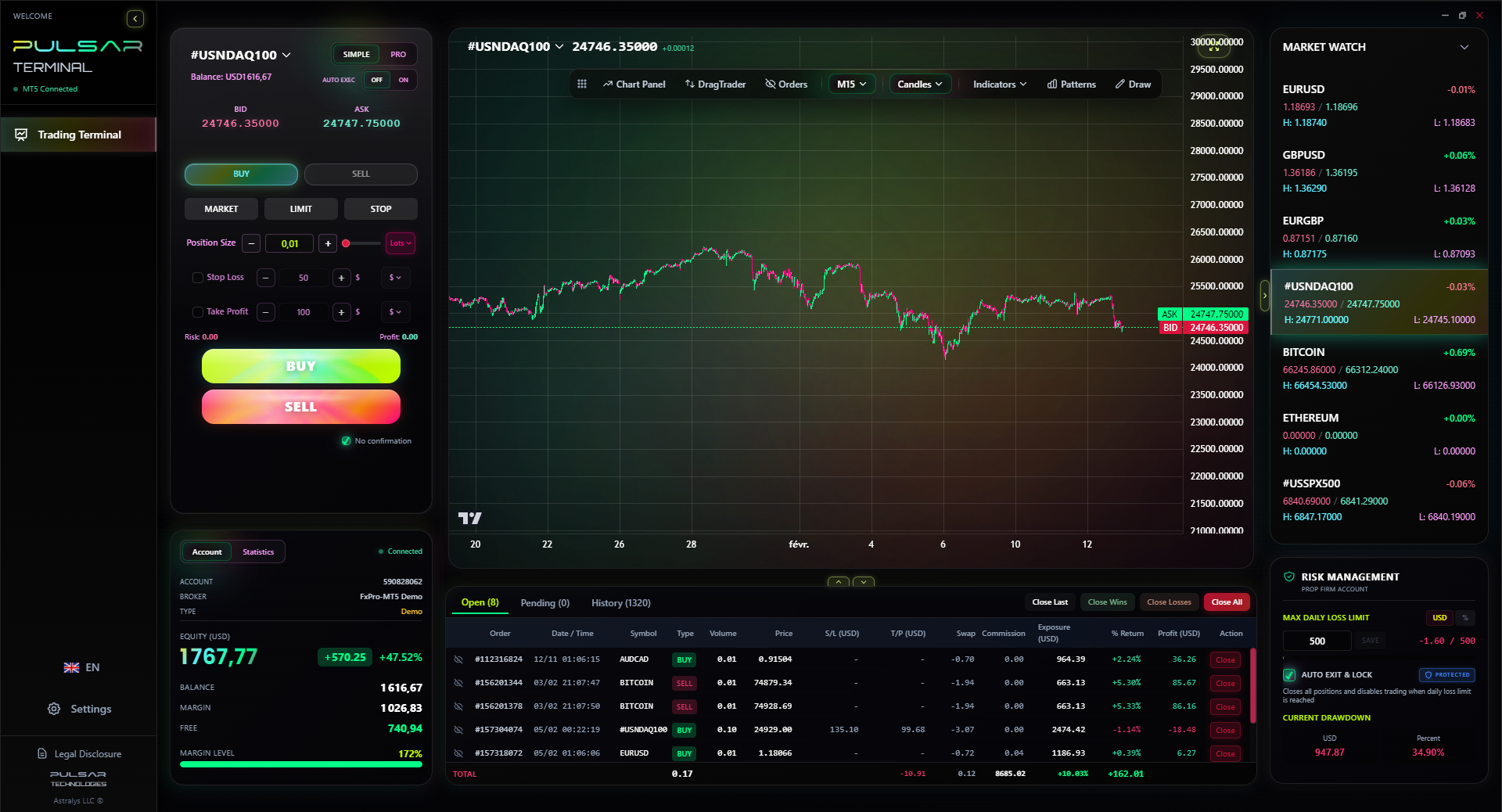
Manually managing multiple take-profit levels and trailing stops on volatile intraday trades is stressful; Pulsar Terminal automates these advanced order types directly within your MT5 platform, letting you trade the Kotegawa method with precision, not panic.
Pulsar Terminal
Hepsi bir arada MT5 aracı: sürükle-bırak emirler, çoklu TP/SL, trailing stop, grid trading, Volume Profile ve prop firm koruması. Her gün 1.000'den fazla trader tarafından kullanılıyor.
This strategy is 80% psychology. You will have losing streaks. Five, six, seven losses in a row. Your brain will scream at you to double down, to hold a loser 'just until it comes back,' to abandon the system. This is where you separate the pros from the blown accounts.
The Two Deadly Sins:
- Averaging Down: Adding to a losing intraday trade is a one-way ticket to a margin call. Your stop-loss is sacred. If it hits, you're wrong. Get out. Period.
- Turning a Scalp into a 'Investment': Your 30-minute trade is now a 3-day hold because it went against you. You've just violated every rule. You're no longer trading the Kotegawa method; you're hoping and praying.
My Survival Routine: After three consecutive losses, I shut down the platform for the day. No exceptions. The urge to 'win it back' is overpowering and illogical. Go for a walk. The market will be there tomorrow. This single rule has saved me more money than any indicator ever could.
Also,, track every trade. Not just P&L, but your entry rationale, your emotional state. You'll start to see patterns in your failures. Maybe you trade worse before lunch. Maybe news events make you jumpy. This self-awareness is your ultimate edge.
💡 Winston'ın İpucu
In India, STT isn't a fee; it's a business partner who takes their cut before you see a rupee. Build your entire profit model with them at the table.
“After three consecutive losses, I shut down the platform for the day. No exceptions. This single rule has saved me more money than any indicator ever could.”
Can you apply the Takashi Kotegawa trading strategy in India? Yes, but in spirit, not in exact replica. The pure, hyper-fast, hundreds-of-trades-a-day version is dead on arrival thanks to SEBI's algo rules and our transaction cost structure.
However, the core philosophy is timeless: exploit short-term fear with strict discipline. The adapted version - fewer, higher-quality trades on liquid instruments with calculated profit targets that account for STT and brokerage - can absolutely work. It's a grind. It's demanding. It requires a level of emotional control that most people simply don't have.
It's not a get-rich-quick scheme. It's a professional skill you hone over years. Start with a tiny position size. Paper trade the setup for a month. Get the rhythm. Understand how costs affect your bottom line. Only then consider real money.
For me, blending his panic-buying principle with a more structured swing trading approach on longer timeframes yielded better results with less stress. But for those wired for the intraday battle, this adapted Kotegawa framework is a valid, though brutally difficult, path. Just know what you're signing up for.

FAQ
Q1What is the main difference between Kotegawa's original strategy and applying it in India?
The two biggest differences are speed and cost. In Japan, Kotegawa could execute dozens of automated trades per second. In India, SEBI's algo trading regulations (especially the 10-orders-per-second threshold and mandatory pre-approval) make that impossible for retail. Secondly, Indian costs like Securities Transaction Tax (STT) and brokerage add a significant per-trade overhead, meaning each trade needs a larger minimum profit to be viable, changing the risk-reward math completely.
Q2Which Indian stocks are best for this adapted strategy?
Only the most liquid large-caps. Focus on the top 10-15 stocks in the Nifty 50 by average daily volume - names like Reliance Industries, HDFC Bank, ICICI Bank, Infosys, and TCS. Their tight bid-ask spreads and high liquidity are essential to minimize slippage, which is a major profit killer in a strategy aiming for small percentage gains.
Q3How much capital do I need to start?
Realistically, you need enough capital so that your position size covers transaction costs without needing a huge percentage move. With a typical ₹54 round-turn cost, trading a single lot of Nifty Futures (capital requirement ~₹1.2 lakhs) means a 0.05% move covers costs. For stocks, a minimum of ₹2-3 lakhs is advisable to properly diversify and size positions while keeping costs a small fraction of your target profit. Never start with money you can't afford to lose.
Q4Is this strategy considered algorithmic trading by SEBI?
If you are manually clicking to place each trade, no. The moment you use any software, script, or API to automate the generation or placement of orders, you cross into SEBI's regulatory framework for algo trading. As of 2026, any system placing more than 10 orders per second per segment requires formal registration and approval. Manual execution of a systematic plan is the safe route for retail traders.
Q5How do I manage taxes on profits from this intraday style?
Intraday trading profits in India are taxed as 'Speculative Business Income' under the Income Tax Act. You must add them to your total income, and they are taxed at your applicable slab rate (up to 30%). You can offset them against intraday trading losses from the same year. You must maintain detailed records of all trades for ITR filing. If your total trading turnover exceeds ₹10 crore in a year, a tax audit is mandatory.
Q6Can I use this strategy on international Forex markets with an Indian account?
Yes, many international brokers like Pepperstone or IC Markets accept Indian clients for trading Forex and CFDs. This allows you to apply the strategy to more liquid, 24-hour markets like EUR/USD with lower transaction costs (often just the spread). However, you must ensure the broker is reputable and you understand the tax implications for trading international assets from India.
Prof. Winston'ın Dersi
Önemli Noktalar:
- ✓Exploit panic, but only after the volume screams exhaustion.
- ✓STT & brokerage define your minimum viable profit target.
- ✓10 orders per second is the regulatory line in the sand.
- ✓Liquidate after 3 consecutive losses without review.
Bu makale ne kadar faydalıydı?
Bir yıldıza tıklayın
Haftalık Trading Analizleri
Ücretsiz haftalık analiz ve stratejiler. Spam yok.
Yazar hakkında
Rajesh Sharma
Kıdemli Forex Analisti
Hindistan ve Güney Asya piyasalarında 10 yılı aşkın deneyim. NSE döviz türevleriyle başlayıp uluslararası forex'e geçiş yaptı. USD/INR ve gelişmekte olan piyasa pariteleri uzmanı.
Yorumlar
Risk Uyarısı
Finansal araçlarla işlem yapmak önemli riskler taşır ve tüm yatırımcılar için uygun olmayabilir. Geçmiş performans gelecekteki sonuçları garanti etmez. Bu içerik yalnızca eğitim amaçlıdır ve yatırım tavsiyesi olarak değerlendirilmemelidir. İşlem yapmadan önce her zaman kendi araştırmanızı yapın.
Bunları da beğenebilirsiniz

Cara Trading Forex Sukses: 7 Prinsip dari Trader Profesional
Cara trading forex sukses dengan 7 prinsip trader pro: manajemen modal, disiplin, journal trading, backtest. Data nyata, bukan janji profit palsu.
Jam Trading Forex Terbaik untuk Trader Indonesia: Panduan Lengkap dengan Tabel Waktu
Panduan jam trading forex untuk trader Indonesia. Tabel 4 sesi dunia, jam emas 20:00-00:00, sesi mana yang harus dihindari. Data akurat + tips dari trader berpengalaman.
Top 5 Sàn Forex Uy Tín Nhất 2026: Review Jujur dari Trader Indonesia
Top 5 sàn forex uy tín 2026 untuk trader Indonesia. Review jujur: spread, deposit, withdraw, dukungan lokal. Exness, XM, IC Markets & lebih.
Pulsar Terminal'ı Edinin
Tüm bu hesaplayıcılar MT5 hesabınızdan gerçek zamanlı verilerle Pulsar Terminal'e entegredir.
Pulsar Terminal'ı Edinin