


Here's a statistic that should sober you up: over 80% of retail traders lose money.

David van der Merwe
Gelişen Piyasalar Yatırımcısı ·  South Africa
☕ 10 dk okuma
Neler öğreneceksiniz:
Here's a statistic that should sober you up: over 80% of retail traders lose money. In South Africa, with our unique volatility and regulatory quirks, I'd argue that number is even higher for the unprepared. There's no magic manual called 'The Black Book of Forex Trading,' but after 12 years in the trenches, I can give you the next best thing: the collected, often painful, wisdom you won't find in a broker's marketing brochure. This is the stuff they don't teach you, the lessons paid for in real Rands.
Everyone tells you to trade with an FSCA-regulated broker. Good advice. But most traders think the FSCA stamp is a safety net that catches them when they blow up their account. It's not. Let's get real about what regulation actually means for you, sitting in Johannesburg or Cape Town.
The FSCA's main job is market integrity and stopping outright fraud. The 30:1 use cap for retail clients? That's them trying to stop you from vaporizing your capital in 30 seconds. The client money segregation rules? That's to prevent your broker from running off to Mauritius with your deposit. It doesn't mean your trades are insured. If you make a bad call on USD/ZAR and get a margin call, the FSCA won't be writing you a cheque.
The Licensing Lowdown
You must check the FSP number. Don't just look for the logo on a website. Go to the FSCA's website and punch it in. I've seen 'regulated' brokers whose license is for 'financial advice' not for issuing CFDs. Big difference. A proper FSCA license for forex means they're authorized as an OTC Derivatives Provider. Brokers like Khwezi Trade (proudly local) and the South African arms of Exness or XM will have this clearly stated.
The Offshore 'Loophole' – A Double-Edged Sword
Here's a local secret many exploit: while the FSCA caps use at 30:1 for its directly regulated entities, many international brokers (who also hold FSCA licenses) offer their global accounts with use up to 1:500 or even 1:1000. You're technically trading under their offshore entity's rules. Is it legal? Usually, yes. Is it wise? That's the real question. Higher use magnifies both gains and losses. I've used it for precise scalping setups, but for your main account? It's a shortcut to the poorhouse if you don't have iron-clad discipline.
Brokers advertise 'tight spreads' and 'low commissions.' It's a shell game. Your total cost of trading is what matters, and in South Africa, we get hit with a few extra fees.
Let's break down a typical trade on EUR/USD with a R100,000 account:
| Cost Type | Standard Account (e.g., Plus500) | Raw/ECN Account (e.g., Tickmill) |
|---|---|---|
| Spread | ~1.3 pips | ~0.1 pips |
| Commission | R0 | ~$3 per side ($6 round turn) |
| Effective Cost per Lot | 1.3 pips (≈ R170) | 0.7 pips (≈ R92 + R110 commission*) |
| Best For | Beginners, infrequent traders | High-volume, active traders |
*Commission converted at ZAR 18.50/$. Note: The 'raw' account is cheaper per trade but only if you're trading size.

Warning: The ZAR Conversion Killers. This is the silent account drain. If your account is in USD and you deposit in Rands, you pay a conversion fee (often 1-2%). If you trade USD/ZAR, you might pay a conversion on the profit/loss. The solution? Use a broker offering a ZAR-denominated account. HFM and Khwezi Trade do this well. It simplifies everything for SARS, too.
Then there's the swap. Holding a USD/ZAR short (betting against the Rand) overnight? You're likely paying a hefty negative swap because of South Africa's higher interest rates. I once held a trade for a week, made 200 pips, and gave back 30% of it in swap fees. It was a brutal lesson in trade timing.
Inactivity fees are another one. Leave your account dormant for 3-6 months? That'll be R500-R1500, please. Read the fine print.

💡 Winston'ın İpucu
Your first R10,000 profit is the most dangerous. It convinces you you're a genius. That's when you start doubling your lot size and lose it all in three trades. Stay humble.
“The FSCA's use cap isn't there to limit your profits; it's there to limit your ability to bankrupt yourself before lunch.”
USD/ZAR isn't just a currency pair; it's a rollercoaster with local news, global risk sentiment, and commodity prices all screaming in the cabin. Trading it requires a different mindset than trading EUR/USD.
Liquidity & Spreads: It's less liquid than majors. Spreads can widen dramatically during local market opens (8-9 AM SAST) and around major South African economic announcements (CPI, SARB rate decisions). I've seen spreads jump from 50 pips to over 200 pips in seconds during a SARB announcement. If you're in a trade, use wide stops or stay out entirely.
What Moves the Rand?
- Risk On/Risk Off: The ZAR is an 'emerging market proxy.' When global investors are hungry for yield, they buy ZAR. When they panic, they sell it first. Watch the S&P 500 and the VIX index as much as you watch local news.
- Commodities: We're a resource economy. Strong gold and platinum prices often support the Rand. A slump can hammer it.
- Local Politics & Policy: Budget speeches, Eskom crises, corruption headlines – they all matter. The Rand is a sentiment gauge for the country.

Pro Tip: Don't try to scalp USD/ZAR on a 1-minute chart. The spread will eat you alive. It's a swing trading pair. Look for daily or 4-hour chart setups. And always, always use a position size calculator. A 100-pip move on this pair is a different monetary value than on EUR/USD.
Forget about keeping this a secret. SARS is getting sophisticated. As of 2026, they have better data-sharing with banks and financial institutions. They can and will connect the dots between your EFTs to a broker and your lifestyle.
How are you taxed? This is critical.
- If you trade frequently (opening and closing positions daily/weekly), SARS views this as income from a business. Your net profit (after deducting allowable expenses like data fees, platform fees, a portion of home office costs) is added to your other income and taxed at your marginal rate (up to 45%).
- If you're a long-term 'investor' holding positions for months, it might be considered capital gains. Only 40% of the gain is included in your taxable income, making it vastly more efficient.
The problem? Most active traders are income traders in SARS's eyes. I learned this the hard way in my third year. Made R250,000 in profit, celebrated, and then got a tax bill for over R90,000. I hadn't set aside a cent. Now, I immediately move 30-40% of any quarterly profit to a separate tax holding account.
Record Keeping is Non-Negotiable: You need a log of every trade (date, instrument, entry/exit, P&L), all bank statements showing deposits/withdrawals, and broker statements. A good broker's back-office should provide an annual tax statement. If yours doesn't, find a new broker.
“Trading USD/ZAR without accounting for swap fees is like planning a road trip and forgetting the price of petrol.”
Trading psychology is universal, but we have some unique local flavors that mess with our heads.
The 'Quick Rich' Mentality: With high unemployment and economic pressure, there's a desperate hope that forex is a lottery ticket. It's not. This leads to over-leveraging. Using 1:500 use because you can is a surefire way to turn R5,000 into R0 in an afternoon. I've done it. The dream of replacing your salary overnight will destroy you.
Isolation & Confirmation Bias: You're not in London or New York. It's easy to feel like you're trading in a vacuum, which makes you cling to your own ideas even when the market proves you wrong. You need to actively seek contrary views. Join serious trading communities (not the 'R10,000 today!!!' WhatsApp groups).
Infrastructure Woes: Load-shedding. Your trade plan means nothing if your internet and power cut out. You need a UPS at a minimum. A mobile data hotspot as a backup. I once got stopped out on a winning trade because load-shedding hit and my generator took 90 seconds to kick in. The market didn't wait. Plan for it.
💡 Winston'ın İpucu
The most important line on your chart isn't a trendline. It's your pre-calculated stop-loss level. If you can't define it before you enter, you have no business being in the trade.
Choosing a broker in South Africa isn't about who has the flashiest ads on the rugby broadcast. It's about fit.
The Local vs. International Debate:
- Local (e.g., Khwezi Trade, IFX Brokers): Pros: ZAR accounts, local support, understand SA context. Cons: Platform choice might be limited, international product range smaller.
- International with FSCA license (e.g., IG, AvaTrade, Tickmill): Pros: Often better technology, wider range of instruments (global stocks, indices), strong platforms. Cons: Support might be overseas, currency conversion can bite.
What to Test on a Demo:
- Execution Speed & Slippage: Place market orders during volatile times (like US non-farm payroll). Does the price you get match the click? I've had 5-pip slippage on USD/ZAR with a bad broker.
- Withdrawal Process: This is the real test. Do a small withdrawal first. How long does it take to hit your FNB or Capitec account? Are there hidden fees? A broker that makes withdrawal difficult is a major red flag.
- Platform Stability: Does their MT4/5 server disconnect often? During the EUR/USD ECB announcement, you can't afford a freeze.
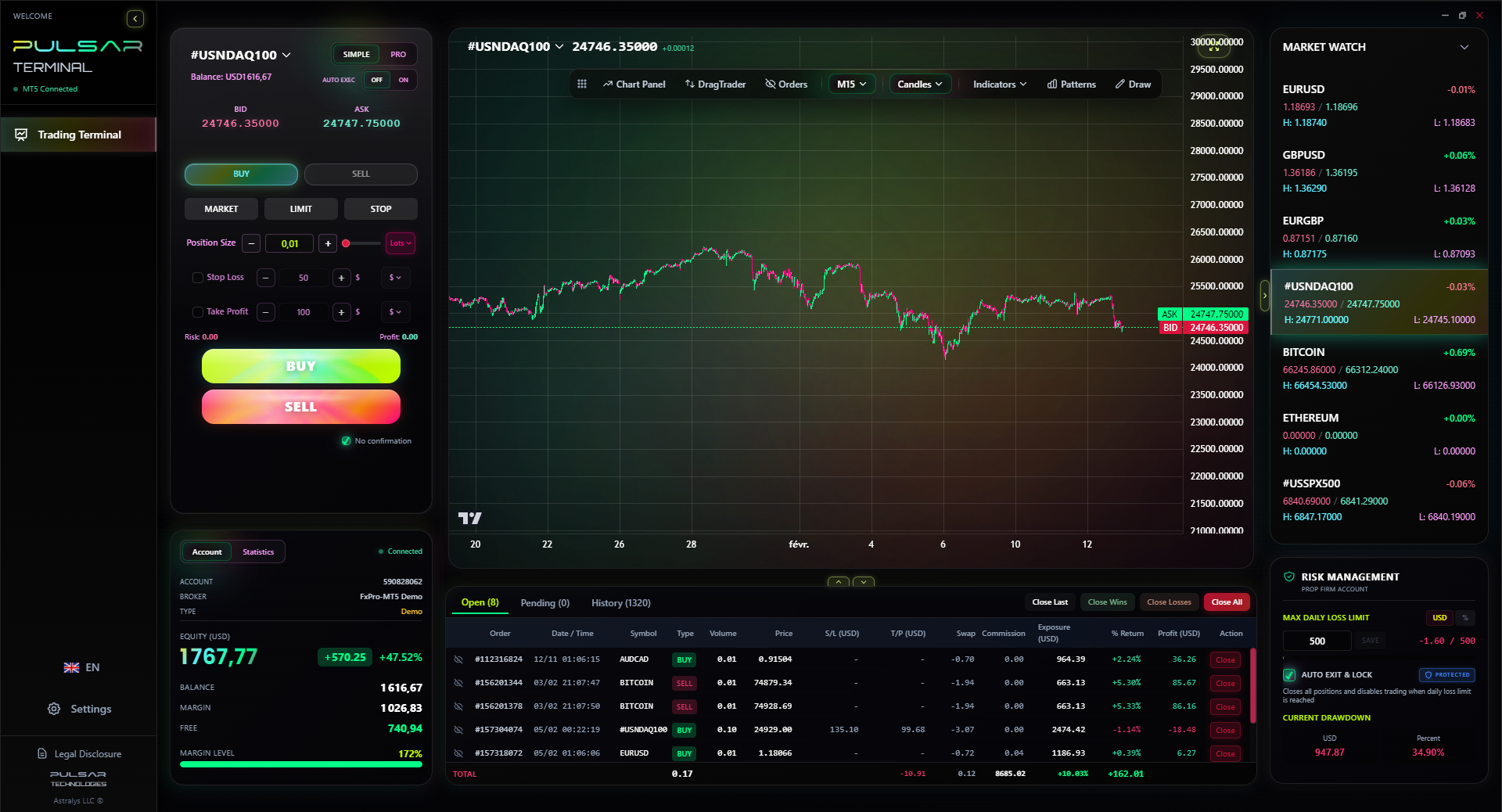
My personal workhorse for analysis is MT5 with a powerful companion tool. Having advanced order types and risk management features at my fingertips is non-negotiable for managing the volatility we face here.
Managing volatile pairs like USD/ZAR requires precise order control, which is where tools like Pulsar Terminal's drag-and-drop orders and multi-TP/SL features on MT5 become essential for any serious South African trader.
Pulsar Terminal
Hepsi bir arada MT5 aracı: sürükle-bırak emirler, çoklu TP/SL, trailing stop, grid trading, Volume Profile ve prop firm koruması. Her gün 1.000'den fazla trader tarafından kullanılıyor.
“SARS isn't interested in your 100-pip win on EUR/USD. They're interested in your net profit for the year, and they will find it.”
You can't just copy a strategy from a YouTube trader in the US. You need to adapt.
Start with One Pair: Master USD/ZAR or EUR/ZAR first. Understand its rhythm. Its average daily range is huge (often 300-500 pips), which is great for swing trades but lethal if you're on the wrong side.
Use Indicators That Cut Through Noise: Forget the fancy stuff. I rely on a core set:
- 200-period Simple Moving Average on the daily chart to define the long-term trend.
- RSI for spotting overbought/oversold conditions within that trend. On USD/ZAR, RSI can stay extreme for longer than you think possible.
- MACD on the 4-hour chart for momentum and potential entry signals.
Backtest with Local Conditions: When you backtest, factor in the wider spreads for ZAR pairs. A strategy that shows a 50-pip profit on EUR/USD might be a 20-pip loss on USD/ZAR after the spread.
The Journal is Your Bible: Write down every trade. Not just "bought USD/ZAR." Write down why (e.g., "Daily chart bullish, retested 200 SMA, 4h MACD crossover"), your emotional state ("Felt rushed because I missed the last move"), and the outcome. Review it weekly. This single habit improved my consistency more than any indicator ever did.
All this information, the rules, the costs, the psychology – it converges on one non-negotiable principle: Preservation of Capital.
Your goal in year one is not to make R1 million. Your goal is to still be trading with most of your starting capital after 12 months. Most fail at this.
This means:
- Risking no more than 1-2% of your account on any single trade. Use a position size calculator every. single. time.
- Having a stop-loss on before you have a profit target. Your stop is not a suggestion; it's an evacuation order.
- Walking away after two consecutive losses. Your judgment is impaired. Go for a braai, watch the Stormers, do anything but place another trade.
The 'black book' isn't a secret list of winning trades. It's the internal ledger of mistakes you've stopped making, the discipline you've built, and the respect you've learned for the market. It's written in Rands and cents, and it's the only book that matters. Start writing yours with small, smart trades, and maybe you'll be one of the few who gets to read it back years later, account still intact.
FAQ
Q1Is forex trading tax-free in South Africa?
Absolutely not. SARS taxes forex trading profits. If you trade actively, it's considered income and taxed at your marginal rate (up to 45%). You must declare your net profits and keep detailed records of all trades, deposits, and withdrawals.
Q2What is the best use to use in South Africa?
Despite brokers offering up to 1:500, the best use is often the lowest you can use while still executing your strategy. For most new traders, sticking to the FSCA's retail cap of 30:1 is a wise discipline. High use is the fastest way to turn a small account into no account.
Q3Can I trade with just R500?
Technically, yes. Some brokers have minimum deposits of R500 or less. But practically, it's almost pointless. After factoring in realistic position sizing and the required risk management (1-2% per trade), you simply can't withstand normal market fluctuations. A R5,000 - R10,000 starting capital is a more realistic minimum to properly learn.
Q4Do I need to pay tax on losses?
No, you only pay tax on net profits. However, trading losses can be carried forward to offset future profits in subsequent tax years, reducing your future tax liability. You must have a solid trade journal and records to prove these losses to SARS.
Q5Which is better for South Africans, MT4 or MT5?
MT5 is the more modern platform with more timeframes, pending order types, and a built-in economic calendar. For trading instruments like XAU/USD (gold) alongside forex, MT5 is superior. However, MT4 is simpler and has more custom indicators available. Most serious local traders are migrating to MT5.
Q6How do I know if a forex 'educator' or signal service is a scam?
If they guarantee profits, show off luxury cars constantly, pressure you to deposit more money, or are not transparent about their own live trading results, run. Legitimate educators focus on risk management and psychology, not get-rich-quick schemes. The FSCA also publishes warnings about unauthorized entities on their website.
Prof. Winston'ın Dersi
Önemli Noktalar:
- ✓Risk max 2% per trade, no exceptions.
- ✓Use ZAR accounts to avoid conversion fees.
- ✓Set aside 35% of profits for tax immediately.
- ✓Trade USD/ZAR on the 4-hour chart or higher.
Bu makale ne kadar faydalıydı?
Bir yıldıza tıklayın
Haftalık Trading Analizleri
Ücretsiz haftalık analiz ve stratejiler. Spam yok.
Yazar hakkında
David van der Merwe
Gelişen Piyasalar Yatırımcısı
Johannesburg merkezli, gelişmekte olan piyasa dövizlerinde 11 yıllık deneyime sahip trader. ZAR pariteleri, FSCA düzenlemeli ticaret ve Güney Afrika piyasa analizi uzmanı.
Yorumlar
Risk Uyarısı
Finansal araçlarla işlem yapmak önemli riskler taşır ve tüm yatırımcılar için uygun olmayabilir. Geçmiş performans gelecekteki sonuçları garanti etmez. Bu içerik yalnızca eğitim amaçlıdır ve yatırım tavsiyesi olarak değerlendirilmemelidir. İşlem yapmadan önce her zaman kendi araştırmanızı yapın.
Bunları da beğenebilirsiniz

Cara Trading Forex Sukses: 7 Prinsip dari Trader Profesional
Cara trading forex sukses dengan 7 prinsip trader pro: manajemen modal, disiplin, journal trading, backtest. Data nyata, bukan janji profit palsu.
Jam Trading Forex Terbaik untuk Trader Indonesia: Panduan Lengkap dengan Tabel Waktu
Panduan jam trading forex untuk trader Indonesia. Tabel 4 sesi dunia, jam emas 20:00-00:00, sesi mana yang harus dihindari. Data akurat + tips dari trader berpengalaman.
Top 5 Sàn Forex Uy Tín Nhất 2026: Review Jujur dari Trader Indonesia
Top 5 sàn forex uy tín 2026 untuk trader Indonesia. Review jujur: spread, deposit, withdraw, dukungan lokal. Exness, XM, IC Markets & lebih.
Pulsar Terminal'ı Edinin
Tüm bu hesaplayıcılar MT5 hesabınızdan gerçek zamanlı verilerle Pulsar Terminal'e entegredir.
Pulsar Terminal'ı Edinin