


Everyone wants a list of the top 10 forex traders in Nigeria.

Olumide Adeyemi
Batı Afrika Yatırım Öncüsü ·  Nigeria
☕ 10 dk okuma
Neler öğreneceksiniz:
- 1The Myth of the "Top 10" List
- 2What Does Success Actually Look Like in Nigeria?
- 3The New Rules: Nigeria's 2025 Regulatory Shift
- 4Brokers, Platforms, and Tools That Actually Work in Nigeria
- 5Trading Strategies That Fit Our Market Rhythm
- 6Pitfalls Every Nigerian Trader Faces (I Fell for #3)
- 7Forget the Top 10. Build Your Own Track Record.
Everyone wants a list of the top 10 forex traders in Nigeria. I get it. You want names, net worths, and a magic formula. Here's the hard truth I learned the long way: that list is mostly marketing. The real figures are private, the 'net worth' claims are often unverified, and chasing someone else's highlight reel nearly blew up my own account. Let's set the record straight. I'll share what actually matters - the lessons from Nigeria's trading scene, the real regulatory changes in 2025, and how to build your own track record, not just follow one.
When I first started trading from Lagos, I was obsessed with finding the gurus. I'd scroll through blogs listing Uche Paragon, Dapo Willis, Ejimi Adegbeye, and others with eye-watering net worth estimates - $16 million, $10 million, you name it. I thought if I could just copy their broker or their supposed strategy, I'd win too.
It was a distraction that cost me money. The reality is, forex trading is a private business. No successful trader I've ever met (and I've met a few in VI and Ikoyi) publishes their live statement for verification. Those net worth figures? They're almost always estimates, sometimes self-reported for branding. The focus on a static list misses the point. The market changes, traders have drawdowns, and yesterday's hero can be tomorrow's cautionary tale.
What you should look for instead is consistent, transparent teaching. Can the person explain a losing trade as well as a winning one? Do they discuss risk management first? That's the real mark of someone who knows what they're doing, not just someone who's good at PR.

Warning: Be deeply skeptical of any 'top trader' who only shows profits. Trading is about managing losses. If they're not showing those, they're selling a fantasy, not a profession.

💡 Winston'ın İpucu
A 'top trader' is just someone who has survived their own worst mistakes longer than most. Your journal is your best tool for survival.
Forget Lamborghinis for a second. In the Nigerian context, with our unique volatility and economic pressures, a successful trader isn't defined by one big win. It's defined by sustainability.
Building a Real Income Stream
Early on, I made a classic mistake. I turned a $500 account into $3,200 in three weeks trading GBP/JPY. I felt like a king. I withdrew nothing, thinking I was the next big thing. The next month, I gave back all those profits and blew the original $500. I hadn't built a system; I'd just caught a lucky wave. Real success here means being able to consistently pull out 5-10% of your account value per quarter to supplement your income or reinvest, without ever threatening your capital. That's more impressive than any screenshot of a balance.
Navigating Local Challenges
Success means knowing how to fund your account reliably despite CBN restrictions. It means understanding that your profit in USD might look great, but if the Naira appreciates sharply like it did in early 2026 (moving from N1,600 to N1,430/$), your purchasing power back home changes. The most successful traders I know have a plan for currency conversion and use domiciliary accounts or regulated fintechs like Grey for transfers. They also factor in the 10% capital gains tax from the start, so a "$1,000 profit" is really a $900 profit after setting aside the taxman's share.
The Mindset Shift
The biggest shift? Moving from a gambler's mindset to a business owner's mindset. Your trading capital is your inventory. You wouldn't risk 50% of your shop's stock on one customer. Why risk 50% of your account on one trade? Using a position size calculator religiously was the single biggest factor that stopped my cycles of boom and bust.
“The obsession with a 'top 10' list fades when you start building something real yourself.”
This is the most critical, non-negotiable part of trading here now. The game changed legally in April 2025. Ignoring this isn't just risky, it's potentially illegal.
The Investments and Securities Act, 2025 (ISA 2025) is a big deal. Before this, online retail forex was in a gray area. Now, it's clear: it's illegal for any platform or entity to offer online forex trading services to Nigerians without being formally registered with the SEC. This is meant to protect you from the shady, unregulated "bucket shops" that popped up everywhere.
What does this mean for you right now?
- Local Platforms: Any Nigerian-based platform you use MUST be SEC-registered. Ask for their registration number. No number, no trade.
- International Brokers: Most of us use brokers regulated abroad like IC Markets or Pepperstone. This is still permitted for Nigerian residents. However, the broker's legitimacy is now your responsibility. You must do your due diligence to ensure they are regulated by a reputable foreign authority (like ASIC in Australia or FCA in the UK). The new law puts the onus on you to avoid unregistered entities.
- Funding Rule Remains: The CBN's rule still stands: you cannot use the official CBN foreign exchange window to fund a trading account. You must use your own existing domiciliary account or personal funds from abroad.
The market itself is transforming. Turnover hit $8.6 billion in 2025, up 56% from 2024. With the new electronic FX matching system and unified exchange rate, volatility in the official market has crashed from 4.58% to 0.53%. This is a more mature, liquid market. Your trading needs to be just as professional.
Let's get practical. Based on my experience and that of traders I trust, here’s what functions smoothly from Lagos, Abuja, or Port Harcourt.
Broker Realities
You need a broker that accepts Nigerian clients, has reliable deposit/withdrawal channels, and offers tight spreads. Here’s a quick comparison of popular choices:
| Broker | Key Feature for Nigerians | Min. Deposit (Approx.) | Good For |
|---|---|---|---|
| IC Markets | Raw spreads, great execution | $200 | Scalping & low-latency trading |
| XM | Extensive educational resources | $5 | Beginners learning the ropes |
| Pepperstone | cTrader platform & Razor account | $0 | Traders who prefer cTrader over MT4/5 |
| Exness | Sometimes offers local deposit options | $10 | Traders wanting multiple local withdrawal methods |
I've personally used IC Markets and Pepperstone for years. The key is their international regulation and the fact that withdrawals to my Verve card or via Skrill usually land within 24-48 hours. Always check the current spread on the pairs you trade, like EUR/USD, before choosing.
Payment Methods That Don't Fail
Bank transfers can be slow. I rely on a mix:
- e-Wallets: Skrill and Neteller are the most consistent. Fund them via card, then transfer to broker.
- Cards: Mastercard and Visa deposits are usually instant. Verve cards work on some platforms.
- Cryptocurrency: An increasing number of brokers accept BTC/USDT deposits. This can be the fastest method, but understand the volatility.

Pro Tip: Before you deposit a large amount, do a test withdrawal of a small sum. This confirms the entire pipeline - broker processing, payment method, and your bank - works smoothly in Nigeria.
💡 Winston'ın İpucu
In Nigeria, your profit target isn't just a price level. It's the price level *minus* spread, commission, bank charges, and 10% tax. Plan for the net, not the gross.
“I burned through $1,000 in a month trying to scalp during Lagos afternoons. The market's rhythm is non-negotiable.”
Copying a London scalping strategy during our low-liquidity hours is a recipe for frustration. You need to adapt.
Volatility Is Your Compass
The Naira pairs (like USD/NGN on the black market, which you can't directly trade but must watch) and commodities like XAU/USD (Gold) are hugely sensitive to local news. CBN policy announcements, FAAC allocations, and even fuel subsidy rumors cause ripples. I don't trade during major CBN press conferences anymore. I got caught in a 500-pip spike on USD/NGN forwards once that triggered a margin call. Now, I wait for the dust to settle.
Swing Trading Nigerian Sessions
Swing trading over 3-5 days aligns better with our market's news flow. I combine higher-timeframe analysis on Daily charts with entries on the 4-Hour chart. For example, if the Daily MACD indicator shows a bullish crossover and price is above a key level, I'll look for a pullback to support on the 4H chart to enter. This avoids the noise of the Lagos midday session.
A Simple, Tested Approach
Here's a basic framework that saved my account:
- Identify the Trend: Use the Daily chart. Only take buy trades if price is above the 89-period EMA. Only take sells if below.
- Wait for a Retracement: On the 4-Hour chart, wait for price to pull back to a key support (for buys) or resistance (for sells).
- Confirm with Momentum: Use the 1-Hour chart and the RSI indicator. Look for RSI reading above 30 (for a buy) or below 70 (for a sell) after being in oversold/overbought territory.
- Manage Risk: Place your stop-loss 1.5x the Average True Range (ATR) away from your entry. Never risk more than 1% of your account.
This isn't glamorous, but it's disciplined. It forces you to trade with the trend, not against it - a lesson I paid for many times over.
Let me be brutally honest about where I've gone wrong, so you might avoid it.
1. The "Funding Trap": You finally save $200. You deposit, trade nervously, and lose $50. You're now down 25% and feel pressured to "make it back fast." This leads to revenge trading and a blown account. Solution: Your first deposit should be money you can afford to lose 100% of. Consider it tuition. The goal of your first $200 isn't to get rich, it's to learn without emotional devastation.
2. Signal Service Scams: "Pay N50,000 monthly for guaranteed signals!" I never paid for one, but a close friend did. The signals worked for a week, then caused five losing trades in a row. The provider vanished. If someone could reliably print money, they wouldn't sell signals for chicken change. They'd be trading.
3. Overtrading in a Thin Market: This was my biggest mistake. I'd try to scalp the EUR/USD during the late Abuja afternoon (2-4 PM WAT). The spreads would widen from 1 pip to 5 pips, and my tight stop-loss would get picked off every time. I'd then re-enter, angry, and lose again. I burned through $1,000 in a month doing this. The lesson? Know your session's liquidity. If you're not trading the London or New York overlap, your strategy must account for wider spreads and false moves.
4. Ignoring Total Cost: You see a 50-pip win and celebrate. But did you account for the spread, commission, and potential bank charges on the withdrawal? That 50-pip win might only be 42 pips after costs. Always calculate your net profit.
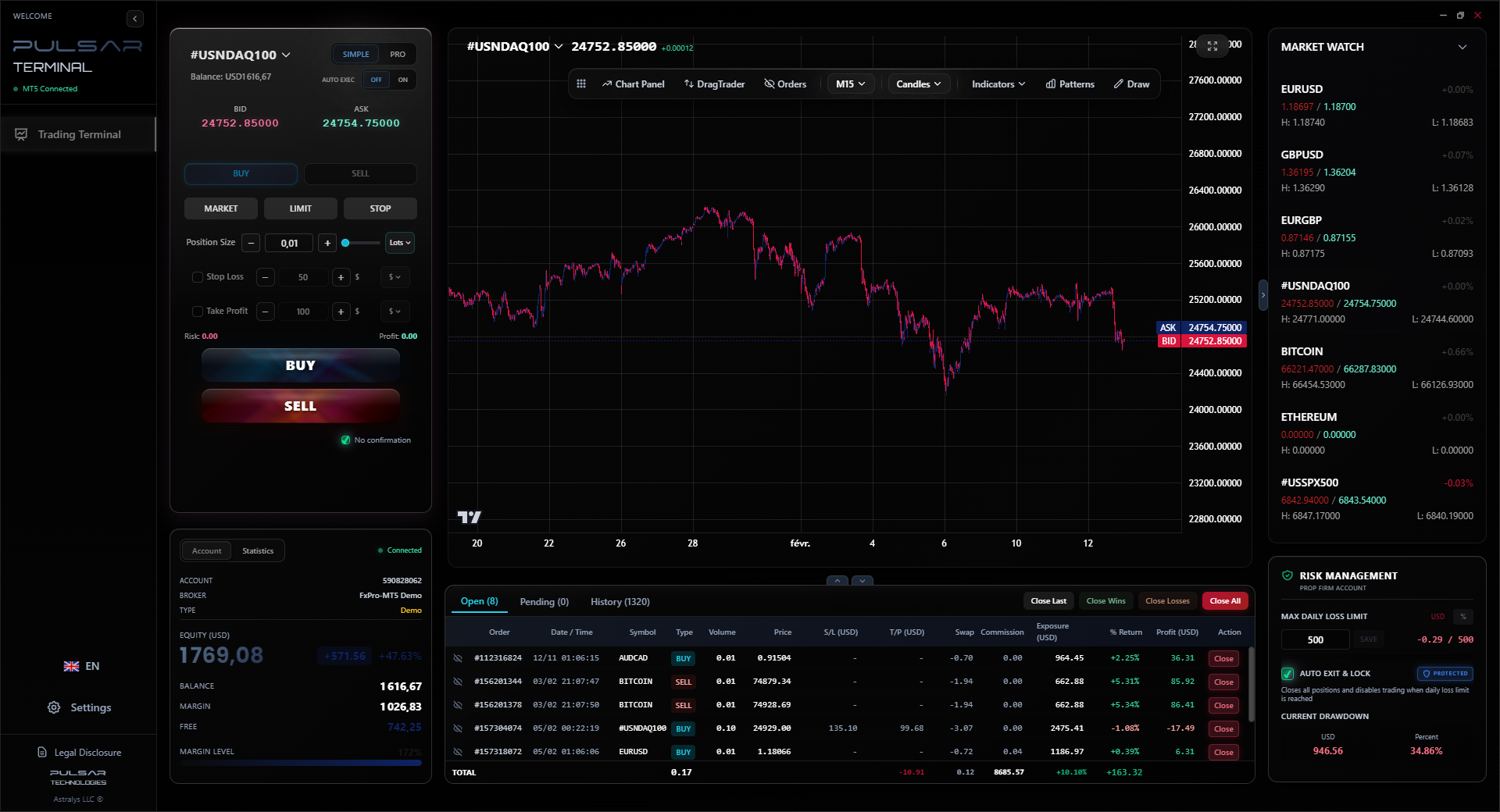
Imposing strict prop-firm-style rules on yourself is the first step, and Pulsar Terminal automates daily loss limits and breakeven stops directly on your MT5 charts to enforce that discipline.
Pulsar Terminal
Hepsi bir arada MT5 aracı: sürükle-bırak emirler, çoklu TP/SL, trailing stop, grid trading, Volume Profile ve prop firm koruması. Her gün 1.000'den fazla trader tarafından kullanılıyor.
“Real success here means being able to consistently pull out profits without ever threatening your capital.”
The obsession with the top 10 forex traders in Nigeria fades when you start building something real yourself. Here's how to start.
Document Everything: Get a journal. Physical or digital. For every trade, note: Entry reason, entry price, stop-loss, take-profit, exit price, P&L, and most importantly, your emotional state. Review it weekly. My journal showed me I lost 80% of my trades entered out of boredom. That was a career-changing insight.
Start with a Prop Firm Mindset: Many prop firms have challenges. They force strict risk rules: max daily loss, max overall loss, no news trading. Impose these on yourself before you ever consider a prop firm challenge. Can you trade for a month without breaking your own rules? If not, you're not ready. Tools that automate these rules are useful for building this discipline.
Measure Progress in Consistency, Not Balance: Don't look at your account balance daily. Look at your weekly win rate and your risk-to-reward ratio. Are you consistently taking trades with at least a 1:1.5 risk/reward? Is your win rate above 40%? These metrics, over 100 trades, tell the true story.
The traders who last in this game - the ones who would genuinely be on any sensible "top" list - aren't the loudest on Instagram. They're the most disciplined in their spreadsheet. They've stopped chasing the list and started building their own. That's the only list that matters.
FAQ
Q1Is forex trading legal in Nigeria?
Yes, forex trading is legal. However, as of April 2025 under the new Investments and Securities Act (ISA 2025), any entity providing online forex trading platform services MUST be registered with the SEC Nigeria. Nigerian traders can still use internationally regulated brokers, but it is your responsibility to ensure they are legitimate.
Q2Who is the richest forex trader in Nigeria?
There is no publicly verifiable answer. Many names like Uche Paragon or Dapo Willis are cited online with estimated net worths, but these figures are rarely audited. In trading, true 'wealth' is sustainable income and preserved capital, which is private. Focus on developing your own verifiable track record instead of chasing unverified claims.
Q3How much do I need to start forex trading in Nigeria?
You can start with as little as $10-$50 with some international brokers like XM or Exness. However, I strongly advise starting with an amount you can afford to lose completely - view it as tuition. A more realistic amount to properly test a strategy with sensible position sizing is $200-$500. Never use money meant for rent or bills.
Q4How do I withdraw my forex profits in Nigeria?
Most international brokers offer withdrawals back to the method you deposited with. The most reliable for Nigerians are e-wallets like Skrill/Neteller or Visa/Mastercard. The funds will arrive in USD in your e-wallet or as a foreign currency credit to your card. You can then convert to Naira through your bank or a licensed fintech service. Remember to account for the 10% capital gains tax.
Q5What is the best time to trade forex in Nigeria?
The best liquidity and tightest spreads occur during the overlap of the London and New York sessions, which is from 1:00 PM to 4:00 PM West Africa Time (WAT). The Asian session (2:00 AM - 8:00 AM WAT) is quieter. Avoid trading major Naira-related news events, as spreads on all pairs can widen dramatically.
Q6Can I use a Nigerian broker?
You can, but you must be extremely careful. Under the new 2025 law, they must be registered with the SEC Nigeria. Ask for their SEC registration number and verify it. Many traders prefer internationally regulated brokers like IC Markets or Pepperstone due to their long track record, tighter regulation, and advanced platforms like MT5.
Prof. Winston'ın Dersi
Önemli Noktalar:
- ✓Verify SEC registration for any local platform (ISA 2025 Law).
- ✓Test withdrawal before large deposits.
- ✓Trade London/NY overlap (1-4 PM WAT).
- ✓Factor in ALL costs: spread, fees, tax.
- ✓Journal every trade, especially the losers.
Bu makale ne kadar faydalıydı?
Bir yıldıza tıklayın
Haftalık Trading Analizleri
Ücretsiz haftalık analiz ve stratejiler. Spam yok.
Yazar hakkında
Olumide Adeyemi
Batı Afrika Yatırım Öncüsü
Nijerya'nın en aktif forex eğitmenlerinden biri. Lagos'tan 8 yıllık ticaret deneyimi. Afrika'lı trader'lar için düşük sermaye stratejileri ve prop firma yarışmaları uzmanı.
Yorumlar
Risk Uyarısı
Finansal araçlarla işlem yapmak önemli riskler taşır ve tüm yatırımcılar için uygun olmayabilir. Geçmiş performans gelecekteki sonuçları garanti etmez. Bu içerik yalnızca eğitim amaçlıdır ve yatırım tavsiyesi olarak değerlendirilmemelidir. İşlem yapmadan önce her zaman kendi araştırmanızı yapın.
Bunları da beğenebilirsiniz

Cara Trading Forex Sukses: 7 Prinsip dari Trader Profesional
Cara trading forex sukses dengan 7 prinsip trader pro: manajemen modal, disiplin, journal trading, backtest. Data nyata, bukan janji profit palsu.
Jam Trading Forex Terbaik untuk Trader Indonesia: Panduan Lengkap dengan Tabel Waktu
Panduan jam trading forex untuk trader Indonesia. Tabel 4 sesi dunia, jam emas 20:00-00:00, sesi mana yang harus dihindari. Data akurat + tips dari trader berpengalaman.
Top 5 Sàn Forex Uy Tín Nhất 2026: Review Jujur dari Trader Indonesia
Top 5 sàn forex uy tín 2026 untuk trader Indonesia. Review jujur: spread, deposit, withdraw, dukungan lokal. Exness, XM, IC Markets & lebih.
Pulsar Terminal'ı Edinin
Tüm bu hesaplayıcılar MT5 hesabınızdan gerçek zamanlı verilerle Pulsar Terminal'e entegredir.
Pulsar Terminal'ı Edinin