


I lost $1,200 in 2018 because I picked a broker based on a flashy Instagram ad.

Olumide Adeyemi
Batı Afrika Yatırım Öncüsü ·  Nigeria
☕ 10 dk okuma
Neler öğreneceksiniz:
I lost $1,200 in 2018 because I picked a broker based on a flashy Instagram ad. The platform froze during a major GBP/USD news event, my stop-loss wasn't honored, and the 'support' number just rang. That trade taught me the hard way that in Nigeria, your broker isn't just a platform, it's your first line of defense. The local regulatory scene is, frankly, a work in progress, which means you're often trusting an international entity with your capital. Getting this choice wrong isn't a minor setback, it's a direct path to losing your entire account. Let's cut through the marketing and look at the top ten forex brokers in Nigeria based on what actually matters: execution, costs, and whether you'll ever see your money again.
Before we talk brokers, you need to understand the ground you're standing on. Forex trading is legal here, but the specific rules for you, the retail trader clicking buttons on MT5, are thin. The Central Bank of Nigeria (CBN) and the SEC are the main players, but their focus is on the big institutional and banking side of things. The CBN's new FX Code and electronic matching system are positive steps for market transparency, but they're aimed at the wholesale level.
This creates a gap. Nigerian-regulated brokers offering OTC forex do exist, but many of the big international names serving Nigerian traders are regulated elsewhere - Cyprus, South Africa, the UK, Australia. That's not inherently bad, but it changes your due diligence. You're evaluating a foreign regulator's track record.
And then there's the taxman. Forget this at your peril: you owe a 10% Capital Gains Tax on all gross forex profits. Not net. Gross. If you make 500,000 NGN in profit, 50,000 NGN belongs to the government. Keep immaculate records. I learned this the expensive way after a profitable quarter, and let's just say the back-and-forth with my accountant was more stressful than any trade.

Warning: The biggest local risk isn't a broker scam; it's the 'fund management' schemes promising guaranteed returns. The SEC has warned about them repeatedly. If an 'investment' platform contacts you promising 5% weekly returns, run. That's a Ponzi, not a trading opportunity.
I don't care about how many 'educational webinars' a broker hosts. I care about the numbers that hit my P&L. Here's the scorecard we used, the same one I use for my own accounts:
The Non-Negotiables
- Regulation & Reputation: Is the entity holding client funds licensed by a reputable authority? Have there been consistent withdrawal complaints over the last two years?
- Execution & Slippage: How does the platform behave during the London open or a Fed announcement? Does your stop-loss become a suggestion?
- Total Cost of Trading: This is the big one. It's not just the advertised spread. It's the spread + commission + any weird overnight financing fees. A 0.0 pip spread with a $7 round-turn commission can be more expensive than a 1.2 pip spread with no commission.
The Nigerian-Specific Essentials
- Naira Deposits & Withdrawals: Do they work with local banks, USSD, or payment processors like Flutterwave or Paystack? What are the processing times and fees? A broker is useless if you can't fund your account.
- use Offered: With local rules less restrictive, many brokers offer high use here - think 1:500, 1:1000, even 1:2000. This is a tool, not a trophy. More on this deadly double-edged sword later.
- Customer Support: Can you get a human on the phone or WhatsApp in a reasonable time? Is the support staff knowledgeable about local payment issues?
We weighted the first three categories (Regulation, Execution, Cost) at 70% of the total score. Local convenience factors made up the remaining 30%.

💡 Winston'ın İpucu
A broker is a toll booth on your road to profits. Your job is to find the one with the lowest toll and the fewest potholes. Don't get emotionally attached to a brand.
“If you need 1:1000 use to make money, your strategy is garbage.”
Here's the list. Remember, 'best' depends on your style. A scalper needs raw speed and cost. A swing trader needs reliability and fair swap rates.
| Broker | Why It's Here | Best For | Key Nigerian Perk |
|---|---|---|---|
| IC Markets | Raw execution speed, true ECN pricing. My go-to for high-volume scalping. | Scalpers, ECN traders. | Local bank transfers, generally low deposit fees. |
| XM | Massive variety of account types, solid all-rounder. Consistent execution. | Beginners to intermediates, strategy testers. | $5 minimum deposit, tons of local deposit options. |
| Exness | Unbeatable for ultra-high use access and very small accounts. | Traders using very high use strategically. | Legendary for smooth Naira withdrawals via many channels. |
| Pepperstone | Top-tier Australian regulation meets excellent Razor account spreads. | Traders prioritizing strong regulation & tight spreads. | Competitive spreads on majors, good support for African clients. |
| FBS | Built a huge following here for a reason: it's accessible and works. | First-time traders, those starting with tiny capital. | Minimum deposit of just $1 (or Naira equivalent). |
| HFM | Another use giant with a strong local presence and lots of promos. | Traders who value local seminars and community. | Offers use up to 1:2000, extensive local payment methods. |
| AvaTrade | User-friendly platforms, great for hands-off strategies like copy trading. | Set-and-forget traders, beginners liking AvaTrade's app. | Fixed spreads can help with cost certainty for new traders. |
| Capital.com | new platform with great risk-management tools and visual learning. | Tech-savvy traders, those who learn visually. | Low average spreads (e.g., 0.64 on EUR/USD). |
| XTB | Professional-grade xStation platform is a joy to use, with zero minimum deposit. | Traders who love a clean, intuitive interface. | $0 minimum deposit, solid market research. |
| InstaForex | Been around forever, offers a staggering range of account options and instruments. | Experimental traders wanting to try exotic pairs. | Accepts deposits as low as $1, very established in the region. |

Example: Let's compare real cost. For a 1-lot (100,000 units) trade on EUR/USD:
- IC Markets (Raw Spread): Spread ~0.0 pips + $7 commission = $7 total cost.
- XM (Standard Account): Spread ~0.8 pips + $0 commission = $8 total cost (0.8 pips * $10 per pip). The difference is minimal, but scale that to 10 trades a day and it adds up. Always use a position size calculator to know your exact risk in Naira before entering.
This is where you get smoked if you're not careful.
The True Cost of a Trade
Look at the spreads in the research briefing. An average of 0.6 pips on EUR/USD is decent. But you must check if the account is commission-free or commission-based. For a scalping strategy, the commission-based account with a near-zero spread is almost always cheaper. For a swing trading style where you hold for days, a slightly wider spread with no commission might work out better, especially when you factor in swap fees (overnight financing). Check the broker's swap rate table for longs and shorts on currencies you trade.
The use Trap
I see new Nigerian traders bragging about 1:1000 use like they've won a prize. It's a suicide pill. Let me be blunt: if you need 1:1000 use to make money, your strategy is garbage. use amplifies losses just as fast as profits. With a 1:1000 use on a $100 account, a 10-pip move against you can wipe out half your capital. Most pros I know rarely use more than 1:50, even when it's available. High use is useful for one thing only: precision position sizing on very small accounts. Even then, it's dangerous.
Deposits & Withdrawals in Naira
This is the practical lifeline. The good brokers on this list have figured it out. You'll typically see:
- Bank Transfer: Direct to a Nigerian bank account. Can take 1-3 business days.
- Card Deposits: Instant with Visa/Mastercard. Withdrawals back to the card are usually smooth.
- Online Payment Processors: Like Flutterwave, Paystack, or others. Often the fastest method.
Always check the broker's website for their current list of accepted payment methods and any fees. A good sign is multiple options. A red flag is only one obscure method.

Pro Tip: Before you deposit a large amount, do a test. Deposit a small sum (like 5,000 NGN), trade it once, then immediately request a withdrawal of the remaining balance. If the withdrawal process is smooth and timely, you have more confidence for larger sums. I do this with every new broker I test.
💡 Winston'ın İpucu
If you're constantly aware of your broker's platform during a trade - whether it's lagging, freezing, or giving weird quotes - you've already lost. The platform should be a pane of glass, invisible.
“Your broker is a utility, not a partner. It should be reliable, cheap, and invisible.”
The Nigerian trading space has its share of predators. Here’s how to spot them.
The Guarantee Gang: Any person, signal group, or 'fund manager' guaranteeing profits or specific weekly returns (e.g., "20% monthly guaranteed") is lying. Forex is risky. Period. The SEC warns about these clowns for a reason.
The Clone Firm: A scam broker copies the website, name, and registration details of a legitimate broker. Always check the regulator's website directly. Don't just click a link from an email or WhatsApp message.
Withdrawal Obstacle Course: Legitimate brokers don't make it hard to get your money. Excuses like "your account needs to be verified again," "the finance department is processing," or demands for unexpected "tax fees" to release funds are massive red flags. A margin call is a market event; a withdrawal block is a broker event.
The 'Too-Good-To-Be-True' Offer: A bonus that's 200% of your deposit with impossible withdrawal conditions. use at 1:5000. Spreads that are half the market average. These are all bait.
My personal rule: I only trust brokers that have been publicly reviewed and discussed by the trading community for years, have clear regulatory info, and don't pressure me with bonuses. The quiet, professional ones are usually the real deal.
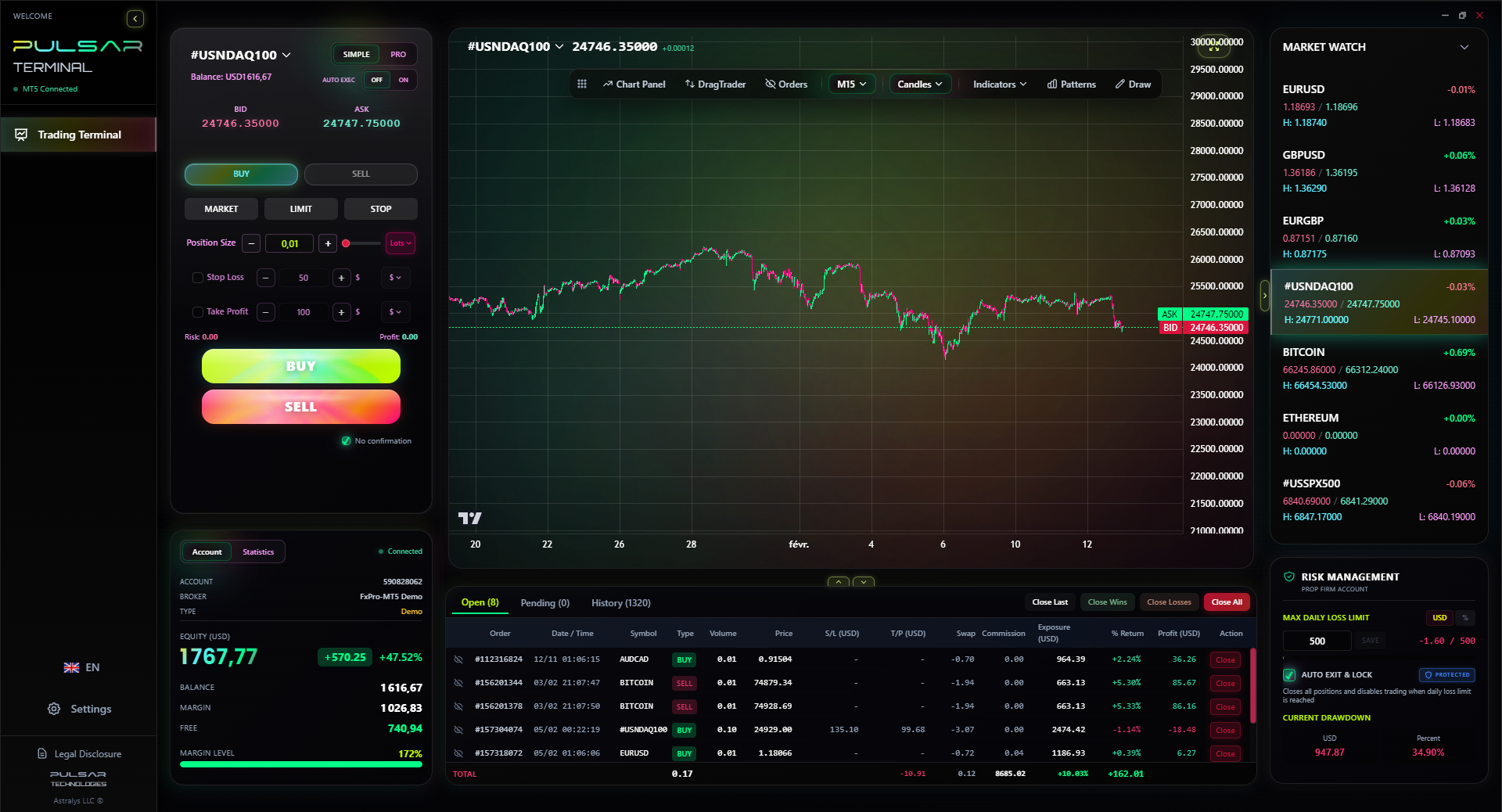
Managing risk across multiple trades is critical with any broker, and tools like Pulsar Terminal automate complex order types and risk management directly on your MT5 platform.
Pulsar Terminal
Hepsi bir arada MT5 aracı: sürükle-bırak emirler, çoklu TP/SL, trailing stop, grid trading, Volume Profile ve prop firm koruması. Her gün 1.000'den fazla trader tarafından kullanılıyor.
Don't just pick the first name on the list. Walk through this.
- Define Your Style: Are you a scalper? Then IC Markets or Pepperstone's Razor account should be top of your list. A beginner? XM or FBS for their low barrier and support. Need high use for a specific, controlled strategy? Look at Exness or HFM.
- Open a Demo Account: Seriously. Don't skip this. Test the platform's speed, see the real spreads during your preferred trading hours, and practice placing and closing trades. Does it feel clunky or smooth? I demo for at least two weeks.
- Test the Support: Send them a pre-sales question via live chat or email. Ask about Naira withdrawal times. See how long they take to respond and how helpful they are. This is a preview of your future life.
- Start Small: Fund your live account with the absolute minimum you need to trade your chosen lot size comfortably. Prove the entire cycle - deposit, trade, withdraw - works before adding more capital.
- Read the Terms: I know, it's boring. But skim the sections on withdrawals, bonuses, and inactivity fees. Know what you're signing up for.
Your broker is a utility, not a partner. It should be reliable, cheap, and invisible. The moment you start thinking about your broker more than your charts, you've chosen wrong. Focus on your strategy, your risk management, and your psychology. Let a good broker handle the rest.
💡 Winston'ın İpucu
The true test of a broker isn't the deposit screen; it's the withdrawal screen. Anyone can take your money. Only the legitimate ones give it back without a fight.
FAQ
Q1Is forex trading legal in Nigeria?
Yes, forex trading is legal for individuals using their own capital. However, the specific online retail trading space is not heavily regulated by Nigerian authorities like the SEC for day-to-day trading activity. Many traders use international brokers regulated abroad.
Q2How do I pay tax on forex profits in Nigeria?
You are subject to a 10% Capital Gains Tax on your gross trading profits. You must declare this income and pay the tax to the Federal Inland Revenue Service (FIRS). Keep detailed records of all your trades, deposits, and withdrawals.
Q3What is the best use for a beginner in Nigeria?
The lowest you can possibly use. Seriously, start with 1:10 or 1:20. The high use (1:500, 1:1000) offered is a major reason new traders blow accounts. use is risk, not a reward. Master your strategy with tiny risk first.
Q4Which broker has the lowest minimum deposit?
Brokers like XTB ($0), FBS ($1), InstaForex ($1), and XM ($5) have very low minimums, making them accessible. But remember, trading with a very small account often leads to misuse of high use. It's better to save up a reasonable stake.
Q5Can I use MT5 with these brokers?
Absolutely. All the brokers listed offer MetaTrader 4 (MT4) and/or MetaTrader 5 (MT5). MT5 is becoming the standard and offers more features. Some, like IC Markets and Pepperstone, also have their own excellent platforms alongside MT5.
Q6How long do withdrawals to my Nigerian bank account take?
With a reputable broker, it typically takes 1 to 3 business days for a bank transfer. Card withdrawals and some e-payment processors can be faster, sometimes within 24 hours. Always check the broker's stated processing times.
Q7What's more important, low spreads or good regulation?
Good regulation is non-negotiable. It's the foundation. You can't enjoy low spreads if your broker disappears with your money. Once you've shortlisted well-regulated brokers, then compare their total trading costs (spread + commission) for your specific trading style.
Prof. Winston'ın Dersi
Önemli Noktalar:
- ✓Prioritize brokers with strong international regulation first.
- ✓Calculate total cost: spread + commission, not just one.
- ✓Test withdrawals with a small sum before large deposits.
- ✓Use use under 1:50, even when 1:1000 is offered.
- ✓Pay your 10% Capital Gains Tax on gross profits.
Bu makale ne kadar faydalıydı?
Bir yıldıza tıklayın
Haftalık Trading Analizleri
Ücretsiz haftalık analiz ve stratejiler. Spam yok.
Yazar hakkında
Olumide Adeyemi
Batı Afrika Yatırım Öncüsü
Nijerya'nın en aktif forex eğitmenlerinden biri. Lagos'tan 8 yıllık ticaret deneyimi. Afrika'lı trader'lar için düşük sermaye stratejileri ve prop firma yarışmaları uzmanı.
Yorumlar
Risk Uyarısı
Finansal araçlarla işlem yapmak önemli riskler taşır ve tüm yatırımcılar için uygun olmayabilir. Geçmiş performans gelecekteki sonuçları garanti etmez. Bu içerik yalnızca eğitim amaçlıdır ve yatırım tavsiyesi olarak değerlendirilmemelidir. İşlem yapmadan önce her zaman kendi araştırmanızı yapın.
Bunları da beğenebilirsiniz

Cara Trading Forex Sukses: 7 Prinsip dari Trader Profesional
Cara trading forex sukses dengan 7 prinsip trader pro: manajemen modal, disiplin, journal trading, backtest. Data nyata, bukan janji profit palsu.
Jam Trading Forex Terbaik untuk Trader Indonesia: Panduan Lengkap dengan Tabel Waktu
Panduan jam trading forex untuk trader Indonesia. Tabel 4 sesi dunia, jam emas 20:00-00:00, sesi mana yang harus dihindari. Data akurat + tips dari trader berpengalaman.
Top 5 Sàn Forex Uy Tín Nhất 2026: Review Jujur dari Trader Indonesia
Top 5 sàn forex uy tín 2026 untuk trader Indonesia. Review jujur: spread, deposit, withdraw, dukungan lokal. Exness, XM, IC Markets & lebih.
Pulsar Terminal'ı Edinin
Tüm bu hesaplayıcılar MT5 hesabınızdan gerçek zamanlı verilerle Pulsar Terminal'e entegredir.
Pulsar Terminal'ı Edinin