


It was March 2023, and my screen was a sea of red.
James Mitchell
Kıdemli Yatırım Analisti
☕ 11 dk okuma
Neler öğreneceksiniz:
It was March 2023, and my screen was a sea of red. An AI scalping bot I’d been testing for six weeks had just executed 47 trades in under two minutes during the FOMC announcement. The result? A $1,872 loss that wiped out three weeks of careful gains. The bot’s logic was flawless on historical data, but it had no concept of a liquidity vacuum. That moment cemented my view on trading advice AI for scalping: it’s a powerful tool, but treating it like a magic money printer is the fastest way to the poorhouse. Let’s cut through the marketing nonsense.
Forget the Terminator. In trading, 'AI' usually means one of three things, and only one is worth your time.
First, you've got the black-box signal services. You pay $99 a month, it texts you 'BUY EURUSD NOW.' You have zero idea why. These are almost always glorified indicator repackagers. I lost $500 testing one that just used a lagging version of the RSI indicator with fancy names.
Second, there are fully automated trading bots. You connect it to your Exness or IC Markets account via API, set a risk percentage, and let it run. This is where most people get slaughtered. The bot doesn't know a news event from a random spike. During the 2022 BOE intervention, a popular grid trading bot I was demo-ing blew a simulated $50k account because it kept 'averaging down' into a market with no bottom.

Warning: Never, ever give a live API key with trading permissions to a third-party bot you haven't extensively backtested yourself. I've seen 'secure' services get hacked.
The third type, and the only one I use, is AI-as-a-research-assistant. This is using machine learning models (like LSTM networks or Random Forests) to scan for micro-patterns in order flow or short-term momentum that a human might miss. You then take that insight and execute the trade yourself. The machine suggests, the human decides. This separation is crucial for survival.
The Regulatory Ghost in the Machine
Here's the kicker many gurus ignore. In the US, if an AI is giving 'personalized investment advice,' the SEC might consider it an investment adviser under the Investment Advisers Act of 1940. That's for the company providing it, not you the user, but it shapes what's available. More immediately, FINRA Rule 3110 means your broker has to supervise algorithmic trading. If your AI bot goes berserk and creates a manipulative spoofing pattern (even accidentally), your broker will shut you down faster than you can say 'margin call.'
I learned this the hard way with an early momentum script on Pepperstone. It placed and canceled too many orders too quickly. Got a polite but firm email from compliance within an hour. The takeaway? Your AI scalping needs a human overseer, both for strategy and for staying on the right side of platform rules.

You can have the best AI model from MIT. If your setup is wrong, you'll lose. Period. This isn't about fancy indicators; it's about infrastructure.
Broker & Account Type: You need a true ECN/RAW account. Scalping on a standard account with a 1.5-pip spread on EUR/USD is a tax on your profits. You're fighting an uphill battle before the trade even starts. Look for brokers that cater to this:
| Broker | Recommended Account | Avg. EUR/USD Spread | Commission (per 100k) | Good For AI? |
|---|---|---|---|---|
| IC Markets | Raw Spread | 0.0 - 0.1 pips | ~$7 round turn | Excellent execution, low latency. |
| Pepperstone | Razor | 0.0 - 0.1 pips | ~$7 round turn | Great cTrader API for automation. |
| XM | Zero | 0.0 - 0.1 pips | ~$7 round turn | Good all-rounder, lower minimum deposit. |
I run all my AI-assisted scripts through an IC Markets Raw account. The difference in slippage versus a cheaper broker is night and day, especially when the AI is chasing a 3-5 pip target.
Hardware & Data: Don't run this off your laptop on Starbucks WiFi. You need a stable, low-latency internet connection. A VPS (Virtual Private Server) located near your broker's servers is a smart $30-$50/month investment. It eliminates your home network lag and lets your scripts run 24/5. For data, you can't feed your AI garbage. If you're building models, you need tick data, not just 1-minute candles. That historical data costs money, but guessing with bad data costs more.
Risk Management FIRST: This is where 90% fail. Your AI might pick entries, but you must define the exits. Use a position size calculator religiously. My rule: No single AI-suggested trade can risk more than 0.5% of my account. For a $10,000 account, that's $50. On a EUR/USD scalp targeting 5 pips, that dictates your position size before you even think about hitting buy.

Pro Tip: Code your maximum daily loss directly into your AI's control panel. If it hits -2% for the day, it should shut off and email you. No arguments. This one habit saved me from a 10% drawdown when a model broke during the Swiss Franc peg removal anniversary volatility.

💡 Winston'ın İpucu
An AI model is only as good as the data it's fed. If you're using free, delayed data to train it, you're building a race car with a map from 1998.
“The goal isn't to replace the trader. It's to augment a disciplined trader with a capability they don't have.”
Real trading advice AI for scalping isn't a product you purchase. It's a process you build. Here's how I approach it.
Step 1: Find Your Micro-Inefficiency. The big trends are picked over. AI can help find tiny, recurring patterns. Maybe it's a specific order flow imbalance that happens in the first 15 minutes of the London-New York overlap. Perhaps it's a 1-minute RSI divergence that only works when the 5-minute MACD indicator is above zero. You define the hypothesis. I once spent a month backtesting a simple idea: does a 5-tick pullback after a 10-tick surge in the XAU/USD offer a high-probability re-entry? The AI helped me parse 6 months of tick data to find the answer was 'yes,' but only between 2-4 AM GMT.
Step 2: Backtest, Then Forward Test. Use a platform like MT5's Strategy Tester or a Python library like Backtrader. But here's the secret: optimization is the devil. If you tweak your AI model to death to fit every squiggle in past data (overfitting), it will fail tomorrow. Test on 2 years of data, validate on 6 months of out-of-sample data you didn't touch during development. Then, run it in a demo account for a full month. No live money until it survives this.
Step 3: The Human Filter. This is your job. The AI gives a signal. You check the filter: Is there major news in 30 minutes? (If yes, ignore signal.) Is the overall market in a crazy trend or totally dead? (Adjust position size.) Is this the 5th signal in an hour? (The bot might be 'chasing' - turn it off.) I have a simple checklist on my desk. The AI can't answer these contextual questions.
Step 4: Execution & Journaling. I execute the trade manually based on the AI's alert. I then record everything: the AI's confidence score, the market condition, the result. This journal is the fuel for improving the next version of the AI. It's a feedback loop, not a set-and-forget system.
I've paid for these lessons so you don't have to.
Pitfall 1: Overfitting the Model. You make a model that's 99% accurate on 2022 data. You run it in 2024 and it loses consistently. Why? You taught it to trade a market that no longer exists. Markets evolve. Your AI must be retrained periodically on recent data, and you must accept that some strategies just die. My first successful scalping model worked for about 9 months before its win rate decayed. I had to let it go.
Pitfall 2: Ignoring Transaction Costs. Every trade costs you the spread + commission. If your AI is scalping for 3 pips and your all-in cost is 1.2 pips, you need a 70% win rate just to break even. Most AI models promising 80%+ wins are lying or not counting costs. Always, always deduct realistic costs in your backtests.
Pitfall 3: The Black Box Trap. If you don't understand why your AI is taking a trade, you can't manage the risk when it's wrong. You'll either exit too early out of fear or let a loser run hoping the 'genius AI' knows something. Insist on interpretability. Can it show you which factors weighted the decision? If not, it's gambling.
Pitfall 4: Neglecting the 'Why Now?' This is the big one. An AI can spot a pattern, but it can't tell you if the pattern is happening because a major bank is hedging or because of a real shift in sentiment. This is where traditional technical analysis and a glance at the economic calendar are irreplaceable. I combine my AI signals with a quick volume profile check. If the signal lines up with a high-volume node, I'm more confident. If it's in a low-volume zone, I might pass or take half a position.

Example: Let's say your AI suggests a long on GBP/USD for a 5-pip target. Your cost is 1 pip. You need a 1:4 risk/reward just to be profitable with a 50% win rate. So your stop loss can't be more than 1.25 pips away (5 pip target / 4 = 1.25). If the normal noise is 3 pips, this trade is statistically doomed before it starts. The AI doesn't know this. You have to.
💡 Winston'ın İpucu
The most important line of code in any trading AI isn't the entry logic. It's the 'IF daily_loss > X, THEN STOP' command. Save your capital to fight another day.
“If you don't understand why your AI is taking a trade, you can't manage the risk when it's wrong. It's gambling.”
Here's what my actual desk looks like when I'm running AI-assisted scalps. No magic, just tools.
The Toolkit:
- Primary Charting Platform: MT5. It's the industry standard for a reason, and most brokers support it. I use it for final execution and manual chart review.
- AI/Research Engine: This is a separate Python script I've built (using libraries like scikit-learn and pandas). It runs on my VPS, analyzes real-time tick data from my broker's API, and looks for my 3-4 predefined patterns.
- Alert System: When the Python script finds a setup, it sends a desktop notification and a text to my phone with the pair, direction, and a suggested entry zone (e.g., 'AUDUSD LONG > 0.66520').
- Risk Dashboard: A simple spreadsheet that tracks my daily P&L, number of trades, and compares AI-suggested wins vs. my manual overrides.
The Daily Workflow:
- Pre-Market (30 mins): I start my Python script and let it warm up. I check the economic calendar. If there's high-impact news within the next 2 hours, I often disable the AI for that period. It's not worth the risk.
- Trading Session: I work on other things (analysis, research). When an alert comes in, I stop. I look at the MT5 chart. Does the price action confirm? Is volume there? I make a go/no-go decision in under 10 seconds. If go, I place the trade manually with a pre-calculated position size and set my stop and target. I use a 1:2.5 risk/reward minimum for these scalps.
- Post-Trade: Win or lose, I log the trade in my journal with a note on why I took it or overrode the AI.
- End of Day: I review the AI's log file. Did it miss any obvious setups I saw? Did it generate any garbage signals? This is how I refine the model.
This workflow turns the AI from a mysterious 'boss' into a tireless intern who's really good at data entry but needs constant supervision.
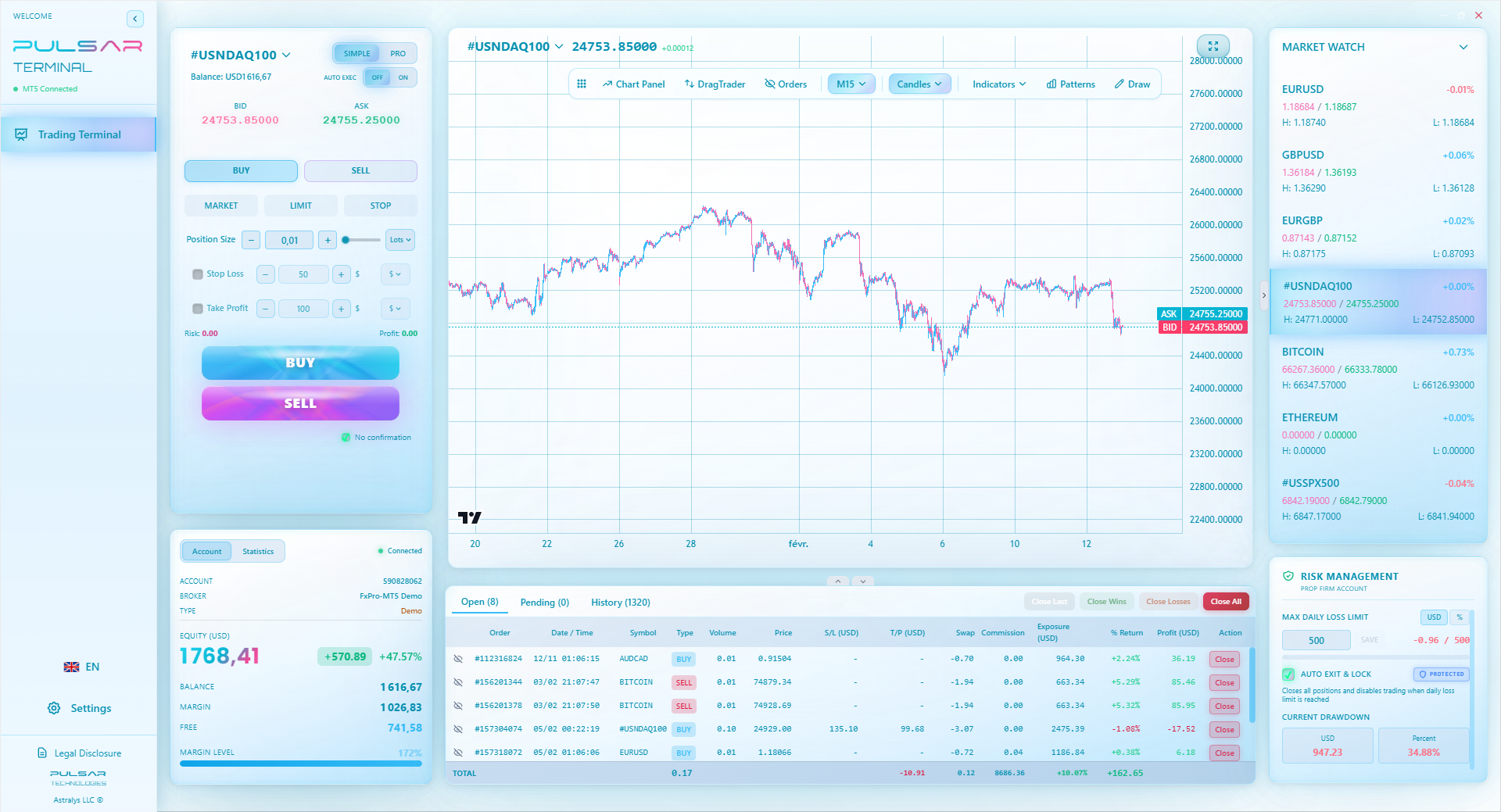
Managing multiple quick scalps manually is a headache, but tools like Pulsar Terminal let you set multi-level take-profits and stop-losses with one click on MT5, so you can focus on the AI's signals, not the order tickets.
Pulsar Terminal
Hepsi bir arada MT5 aracı: sürükle-bırak emirler, çoklu TP/SL, trailing stop, grid trading, Volume Profile ve prop firm koruması. Her gün 1.000'den fazla trader tarafından kullanılıyor.
The regulatory winds are shifting. The SEC and FINRA aren't sleeping on this. In 2024, the SEC proposed rules requiring brokers to eliminate conflicts of interest from their AI tools. For you and me, the retail traders, the main impact will be transparency and limitations.
We'll likely see more brokers being forced to disclose exactly how their built-in 'AI assistants' work and if they're incentivized to generate more commissions. For third-party tools, expect more scrutiny on data privacy and algorithmic accountability. The CFTC's December 2024 advisory was a clear shot across the bow: if you use AI, you're responsible for its compliance.
What does this mean for your trading advice AI for scalping?
- Proprietary models will have an edge. The best tools won't be sold publicly; they'll be used internally by funds or sold as a managed service with heavy compliance oversight.
- Broker execution will become even more critical. As regulators crack down on 'predatory' AI, the advantage will go to those with the fastest, fairest execution on platforms like Pepperstone or IC Markets, not the fanciest signal generator.
- The human-AI hybrid model will dominate. The era of fully autonomous retail trading bots might be curtailed by regulation. The sustainable path is the one I've outlined: AI as a supercharged scanner and calculator, with a seasoned human making the final call, managing risk, and ensuring everything stays within the rules.
The goal isn't to replace the trader. It's to augment a disciplined trader with a capability they don't have: processing vast amounts of micro-data without emotion. Keep that focus, and you can use this technology to gain a real edge. Lose it, and you're just donating money to the market with extra steps.

FAQ
Q1Is AI scalping legal for retail traders in the US?
Yes, using AI to inform your trading decisions is legal. However, you are fully responsible for its actions. If your AI algorithm creates manipulative order patterns (like spoofing) or violates your broker's terms of service (e.g., excessive order cancellations), you can be held liable. Always ensure your strategy complies with FINRA and SEC guidelines on algorithmic trading.
Q2What's a realistic win rate for an AI scalping strategy?
After accounting for spreads and commissions, a very good, sustainable AI-assisted scalping strategy might have a 55-65% win rate. Anyone promising 80%+ is either lying, overfitting past data, or not counting costs. Remember, a 60% win rate with a solid 1:2 risk/reward is extremely profitable. Focus on the overall expectancy, not just the win percentage.
Q3How much money do I need to start AI scalping?
You need enough to overcome costs and volatility. With brokers like XM or IC Markets, you can start a live account with $200-$500. However, I'd strongly advise having at least $2,000-$5,000. This allows for proper position sizing (risking 0.5-1% per trade) and can withstand the inevitable string of losses without triggering a margin call. Don't start live until you've proven the strategy in a demo for a full month.
Q4Can I use AI for scalping on a prop firm challenge?
You can, but be extremely careful. Prop firms have strict rules on drawdown and often ban fully automated trading. Using AI as a signal generator while you execute manually is usually acceptable. The key is their daily loss limit. You must code your AI to stop trading if it hits, say, 80% of that limit. One bad algorithm glitch can fail your $50,000 challenge in minutes.
Q5What's the single biggest mistake beginners make with trading AI?
Trusting it completely. They hand over their API keys to a black-box bot, set it to 'aggressive,' and walk away. The market changes, the bot doesn't adapt, and it blows up the account. The AI is a tool, not a trader. You must be the strategist, risk manager, and final decision-maker.
Q6Do I need to know how to code to use AI for scalping?
To build your own edge, yes, you need some coding knowledge (Python is the standard). If you don't want to code, your options are limited to buying commercial bots (risky) or using broker-provided 'AI tools' (often very basic). The middle ground is learning enough to modify existing open-source scripts or hiring a developer to build your specific idea, but you still need to understand the logic to manage it.
Prof. Winston'ın Dersi
Önemli Noktalar:
- ✓AI is a research assistant, not a portfolio manager.
- ✓Test with tick data, not just candles.
- ✓Code a mandatory daily loss limit first.
- ✓Your edge decays; retrain every 3-6 months.
Bu makale ne kadar faydalıydı?
Bir yıldıza tıklayın
Haftalık Trading Analizleri
Ücretsiz haftalık analiz ve stratejiler. Spam yok.
Yazar hakkında
James Mitchell
Kıdemli Yatırım Analisti
New York merkezli, 9 yılı aşkın trading deneyimine sahip. Başlıca USD paritelerine, prop firma yarışmalarına ve ABD düzenleyici ortamına odaklanıyor.
Yorumlar
Risk Uyarısı
Finansal araçlarla işlem yapmak önemli riskler taşır ve tüm yatırımcılar için uygun olmayabilir. Geçmiş performans gelecekteki sonuçları garanti etmez. Bu içerik yalnızca eğitim amaçlıdır ve yatırım tavsiyesi olarak değerlendirilmemelidir. İşlem yapmadan önce her zaman kendi araştırmanızı yapın.
Bunları da beğenebilirsiniz

Cara Trading Forex Sukses: 7 Prinsip dari Trader Profesional
Cara trading forex sukses dengan 7 prinsip trader pro: manajemen modal, disiplin, journal trading, backtest. Data nyata, bukan janji profit palsu.
Jam Trading Forex Terbaik untuk Trader Indonesia: Panduan Lengkap dengan Tabel Waktu
Panduan jam trading forex untuk trader Indonesia. Tabel 4 sesi dunia, jam emas 20:00-00:00, sesi mana yang harus dihindari. Data akurat + tips dari trader berpengalaman.
Top 5 Sàn Forex Uy Tín Nhất 2026: Review Jujur dari Trader Indonesia
Top 5 sàn forex uy tín 2026 untuk trader Indonesia. Review jujur: spread, deposit, withdraw, dukungan lokal. Exness, XM, IC Markets & lebih.
Pulsar Terminal'ı Edinin
Tüm bu hesaplayıcılar MT5 hesabınızdan gerçek zamanlı verilerle Pulsar Terminal'e entegredir.
Pulsar Terminal'ı Edinin