


Most people think getting cash for a holiday is simple: you walk into Travelex, get your dollars or euros, and you're done.

David van der Merwe
Gelişen Piyasalar Yatırımcısı ·  South Africa
☕ 9 dk okuma
Neler öğreneceksiniz:
- 1What Travelex Actually Is (And Isn't)
- 2Breaking Down the Real Cost
- 3South African Regulations You Must Know
- 4Travelex vs. Forex Trading Brokers: A Brutal Comparison
- 5How to Get the Best Rate Possible
- 6The Biggest Mistake Traders Make
- 7When to Use Travelex & When to Use a Trading Platform
- 8Final Verdict for South Africans
Most people think getting cash for a holiday is simple: you walk into Travelex, get your dollars or euros, and you're done. That's the first mistake. What you're actually doing is making a trade with a massive, built-in spread that would make any retail trader weep. I'm going to show you exactly how Travelex forex rates work, what they're really costing you, and how understanding the mechanics can save you thousands of Rands - whether you're traveling or trading.
Let's clear this up right away. Travelex is not a forex broker. You can't open a MetaTrader account with them and start scalping the EUR/USD. They are an Authorised Dealer with Limited Authority (ADLA), licensed under Tourvest Financial Services and regulated by the South African Reserve Bank (SARB). Their business is physical currency exchange, prepaid travel cards, and international money transfers.
Think of them as a retail shop for cash. When you buy US dollars from them, you're not getting the interbank rate you see on Bloomberg. You're getting that rate plus their markup, which is how they make money. It's a transaction with a guaranteed, hefty fee built into the price. For a trader, this is the equivalent of entering a trade with a 200-pip spread. You're down significantly before you even start.
This distinction is crucial. If you're looking to speculate on currency movements, you need a proper FSCA-regulated broker. If you need physical cash for a trip, that's Travelex's domain. But knowing how they price that cash gives you power.
The advertised Travelex forex rate is a mirage. It doesn't include their commission or other charges, which they say vary. Let's translate that. On April 6, 2026, their GBP/ZAR 'travel money' rate was 21.4770. Research showed that was 1.8% worse than the best rate on the market that day. That 1.8% is your effective cost.
How This Compares to Your Bank
Your bank does the same thing, often worse. Nedbank charges a 2.6% commission to buy foreign notes (minimum R145). Standard Bank's Shyft wallet takes 2.5% to top up by card. They all hide their profit in the spread. So, if you're changing R20,000 into USD, a 2% fee is R400 gone before you've even left OR Tambo.
The Trader's Perspective
In the trading world, we obsess over spreads. A good broker like IC Markets might offer a 0.1-pip spread on EUR/USD. That's a cost of about $0.10 on a standard lot. The 1.8-2.6% fee Travelex and banks charge? On a R20,000 transaction, that's like facing a spread of over 1,800 pips. It's an astronomically bad deal through a trader's lens. The first rule of trading is to manage your costs, because costs are a guaranteed loss. Most people ignore this rule completely when they travel.

💡 Winston'ın İpucu
A spread isn't just a number on a screen. It's the distance between what an asset is worth and what you can buy it for. Travelex's spread is a mile wide. A good broker's is a hair's breadth. Always know which one you're crossing.
“The 1.8% fee Travelex and banks charge? On a R20,000 transaction, that's like facing a spread of over 1,800 pips.”
Trading with Travelex means playing by SARB's rules, not the FSCA's. Get these wrong, and you could face penalties or have your currency confiscated.
- Discretionary Allowance: As a South African resident over 18, you can take out up to R1 million per calendar year for travel, gifts, or study. Under 18s get R200,000. This is a hard cap.
- The 60-Day Rule: You can only buy your foreign exchange up to 60 days before you travel. You can't load up on dollars a year in advance hoping the Rand will weaken.
- The Sell-Back Rule: This one catches people. When you come home, you have 30 days (90 for business travelers) to sell any leftover foreign cash back to an authorized dealer like Travelex. You cannot legally keep it in a drawer for your next trip. They'll buy it back from you, of course, at their rate, which includes another spread.
- Cash Limits: Don't try to take more than R25,000 in Rand notes out of the Common Monetary Area.

Warning: Ignoring the sell-back rule is a common mistake. I've seen traders think they can hold physical USD as a hedge. It's not worth the regulatory risk. If you want to hold forex, use a trading account.
This is where the difference becomes a chasm. Understanding it will change how you view all financial transactions.
| Feature | Travelex (Currency Exchange) | FSCA Forex Broker (e.g., Pepperstone) |
|---|---|---|
| Primary Purpose | Obtain physical currency for travel/payments. | Speculate on currency price movements for profit. |
| Regulator | South African Reserve Bank (SARB). | Financial Sector Conduct Authority (FSCA). |
| Cost Structure | Hidden in the spread (1.8%-3%+). | Transparent: Tight spread (e.g., 0.1 pips) + small commission. |
| Transaction Speed | Minutes for cash, days for transfers. | Milliseconds for trade execution. |
| Product | Physical notes, prepaid cards. | CFDs, futures, spot forex. |
| use | None. You pay R20,000, you get ~$1,070. | Available (e.g., 1:30 for retail). Can magnify gains & losses. |
I learned this the hard way early on. I needed USD for a trading conference in the US. Without thinking, I walked into a bureau de change and paid a ~2.5% fee on R50,000. That was R1,250. At the same time, my trading account with a 0.8-pip spread on EUR/USD cost me maybe $8 (about R150) in fees for a week of active trading. I paid eight times more for a simple currency exchange than for my professional trading activity. It was a stupid, expensive lesson in attention to detail.
The key takeaway? For travel, you're stuck with the cost. For investing or speculating on the Rand's direction, the broker route is infinitely cheaper and more efficient. You can even trade the USD/ZAR pair directly with spreads as low as 0.00667 points with some brokers.
💡 Winston'ın İpucu
Regulatory arbitrage is a real strategy. SARB rules govern your physical cash. FSCA rules govern your digital trades. Use the right tool for the job, and know which rulebook you're playing by.
“I paid eight times more for a simple currency exchange than for my professional trading activity. It was a stupid, expensive lesson.”
You can't eliminate the fee, but you can minimize it. Here’s a tactical approach:
- Shop Around, Instantly: Don't just go to the kiosk in the airport. Use online comparison tools to see Travelex's rate versus banks like Absa or FNB on that specific day. Remember, the rate changes constantly.
- Ask for a 'Better' Rate: If you're exchanging a large amount (say, over R50,000), call Travelex or your bank and ask. They often have a more favorable commercial or negotiated rate they don't advertise. This is like getting a volume discount.
- Consider a Prepaid Card (Carefully): Travelex's Multi-Currency Cash Passport can lock in a rate when you load it. This is a hedge. If you load USD today and the Rand weakens tomorrow, you win. If the Rand strengthens, you lose. You're making a forex decision. Weigh the potential saving against the card's own fees.
- Use Your Trading Knowledge: Watch the EUR/USD and USD/ZAR charts. The Rand often moves with global risk sentiment. If the market is in a panic and the Rand is tanking, that's a terrible time to buy USD for your holiday. If you can, try to time your exchange for a period of relative Rand strength. It's basic swing trading logic applied to a real-world need.

Pro Tip: Never, ever exchange money at the airport departure kiosk unless it's an emergency. Their rates are the worst of the worst. Plan ahead and order online for airport pickup or use a city branch.
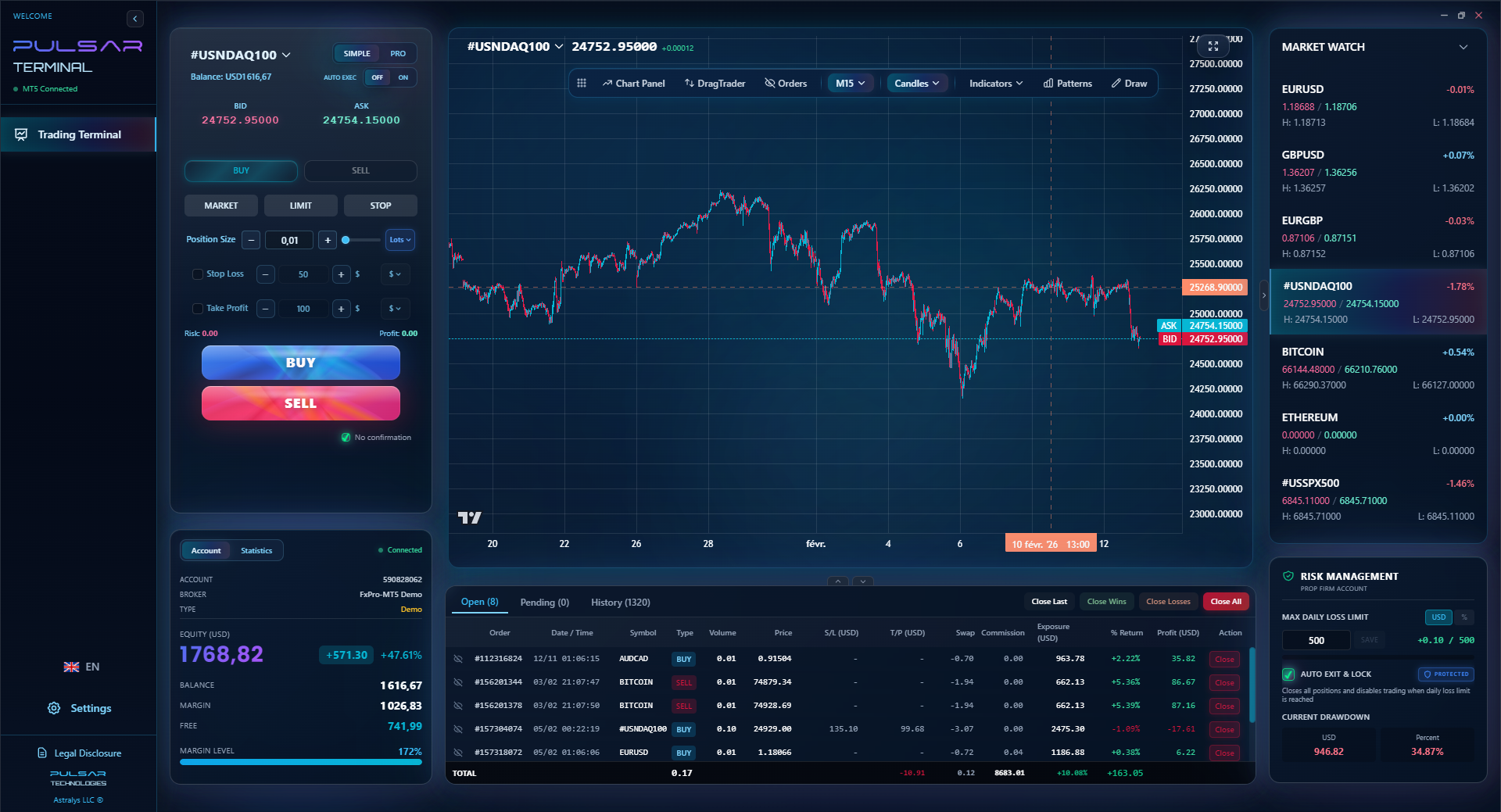
Just as you'd time your holiday forex purchase, precise timing and order management are everything in trading, which is where tools like Pulsar Terminal excel on MT5.
Pulsar Terminal
Hepsi bir arada MT5 aracı: sürükle-bırak emirler, çoklu TP/SL, trailing stop, grid trading, Volume Profile ve prop firm koruması. Her gün 1.000'den fazla trader tarafından kullanılıyor.
Here's the ironic twist. The same trader who will carefully backtest a strategy, use a position size calculator, and set a tight 15-pip stop loss will walk into Travelex and blindly accept a 20,000-pip equivalent cost without a second thought. We compartmentalize. We're sharp in one arena and passive in another.
This lack of consistency is a leak in your personal finances. That R1,000 you overpay for holiday cash is a trading loss you'd analyze for hours. Why don't we analyze the holiday transaction? Because it's not on a chart. It's not in MT5. It feels like 'life admin,' not trading.
I used to be guilty of this. I'd hunt for a 0.1-pip difference between brokers but wouldn't spend 10 minutes comparing Travelex forex rates to my bank's. I was optimizing the wrong thing. The fix is to view every financial exchange - buying dollars, converting investment profits back to ZAR, even paying with a credit card overseas - as a trade. Identify the spread, know your cost, and see if you can improve your entry. This mindset saves money everywhere.
💡 Winston'ın İpucu
The most expensive trade you'll ever make is the one you don't realize you're making. Buying holiday cash is a forex transaction with a terrible risk/reward ratio. Acknowledge it, cost it, and try to improve it.
“The same trader who sets a tight 15-pip stop loss will blindly accept a 20,000-pip equivalent cost at a currency kiosk.”
Knowing the tool for the job is half the battle.
Use Travelex (or your bank) when:
- You need physical foreign banknotes in your hand within the next 60 days.
- You need a prepaid travel card loaded with a specific currency.
- You're sending a telegraphic transfer to pay for an invoice or property abroad and need the regulatory paper trail.
- You're adhering to SARB's allowance and sell-back rules.
Use a Forex Trading Account when:
- You want to profit from movements in the USD/ZAR, EUR/ZAR, or any other pair.
- You want to hedge a future foreign currency expense (e.g., you know you'll need USD in 6 months and think the Rand will weaken).
- You want to hold a foreign currency position long-term without the hassle of physical notes.
- You want access to use, advanced orders, and real-time charts.
If your goal is speculation, a broker like XM or Exness is your venue. The costs are lower, the tools are professional, and the potential returns (and risks) are scaled. Just remember, with use, you can also lose much more than your deposit - a risk that doesn't exist when you're just buying cash from Travelex.
Travelex provides a necessary, regulated service. For getting travel cash, they're a standard option in a market where all the options are expensive. Their rates are typically in the middle of the pack - not the best, not the worst. The real value in understanding Travelex forex rates isn't about choosing them over Absa. It's about becoming an informed consumer of financial products.
You now know that every time you see an exchange rate, there's a hidden spread. You know that 2% fee is a massive, guaranteed loss on the 'trade.' You know the SARB rules better than most travelers. Apply this knowledge. Shop for rates like you'd analyze a currency pair. Time your large exchanges if you can. And for heaven's sake, don't leave it until you're at the airport.
For your actual trading, keep this experience in mind. It's a perfect, everyday example of how the spread is the house's edge. In the markets, your edge comes from your strategy. But the first step to winning is always to reduce the house's edge. Whether that's finding a broker with a 0.0-pip spread or finding a currency dealer 0.3% cheaper, the principle is identical. Pay attention to the details everyone else ignores.
FAQ
Q1Is Travelex the cheapest way to get foreign currency in South Africa?
Not usually. Their rates are often mid-range. On a specific day in 2026, their GBP rate was 0.3% better than the average but 1.8% worse than the best provider. You must compare rates on the day you need to deal. Online platforms and sometimes your own bank (for large amounts) can be cheaper.
Q2Can I use Travelex to trade forex for profit?
No. Travelex is not a forex broker. They are a currency exchange service for physical cash and transfers. To trade forex speculatively, you need an account with an FSCA-regulated broker like those we've reviewed (e.g., IC Markets, Pepperstone).
Q3What happens if I don't sell my leftover foreign cash back within 30 days?
You breach South African Exchange Control Regulations. In theory, you could face penalties. Practically, it makes bringing that cash out on your next trip legally complicated. It's simpler to follow the rule and sell it back, even though you'll pay a small fee on the sell transaction too.
Q4How much Rand can I legally take out of South Africa?
If you're traveling outside the Common Monetary Area (Lesotho, Namibia, Eswatini), you cannot carry more than R25,000 in physical Rand notes. Your foreign currency allowance (up to R1 million per year) is separate and must be purchased from an authorized dealer like Travelex.
Q5Are Travelex's rates the same as the interbank rates I see online?
Absolutely not. The rates you see on financial news sites are interbank wholesale rates. Travelex's rates are retail rates. They add a markup (spread) to the interbank rate to cover their costs and profit. This spread is your cost of doing business with them.
Q6What's the difference between Travelex's spread and a forex broker's spread?
The difference is enormous. A Travelex spread is typically 1.8% to 3% or more, which is equivalent to thousands of pips. A good forex broker's spread on a major pair like EUR/USD can be 0.1 pips or less. The broker's cost is fractions of a percent. This is why speculative trading through a broker is far more cost-effective than trying to 'invest' by holding physical cash.
Prof. Winston'ın Dersi
Önemli Noktalar:
- ✓A retail currency exchange spread is 1.8-3%, a massive guaranteed cost.
- ✓SARB rules limit travel forex to R1m/year with a 30-day sell-back rule.
- ✓Never exchange cash at an airport kiosk; rates are predatory.
- ✓Time your holiday forex like a swing trade during Rand strength.
Bu makale ne kadar faydalıydı?
Bir yıldıza tıklayın
Haftalık Trading Analizleri
Ücretsiz haftalık analiz ve stratejiler. Spam yok.
Yazar hakkında
David van der Merwe
Gelişen Piyasalar Yatırımcısı
Johannesburg merkezli, gelişmekte olan piyasa dövizlerinde 11 yıllık deneyime sahip trader. ZAR pariteleri, FSCA düzenlemeli ticaret ve Güney Afrika piyasa analizi uzmanı.
Yorumlar
Risk Uyarısı
Finansal araçlarla işlem yapmak önemli riskler taşır ve tüm yatırımcılar için uygun olmayabilir. Geçmiş performans gelecekteki sonuçları garanti etmez. Bu içerik yalnızca eğitim amaçlıdır ve yatırım tavsiyesi olarak değerlendirilmemelidir. İşlem yapmadan önce her zaman kendi araştırmanızı yapın.
Bunları da beğenebilirsiniz

Cara Trading Forex Sukses: 7 Prinsip dari Trader Profesional
Cara trading forex sukses dengan 7 prinsip trader pro: manajemen modal, disiplin, journal trading, backtest. Data nyata, bukan janji profit palsu.
Jam Trading Forex Terbaik untuk Trader Indonesia: Panduan Lengkap dengan Tabel Waktu
Panduan jam trading forex untuk trader Indonesia. Tabel 4 sesi dunia, jam emas 20:00-00:00, sesi mana yang harus dihindari. Data akurat + tips dari trader berpengalaman.
Top 5 Sàn Forex Uy Tín Nhất 2026: Review Jujur dari Trader Indonesia
Top 5 sàn forex uy tín 2026 untuk trader Indonesia. Review jujur: spread, deposit, withdraw, dukungan lokal. Exness, XM, IC Markets & lebih.
Pulsar Terminal'ı Edinin
Tüm bu hesaplayıcılar MT5 hesabınızdan gerçek zamanlı verilerle Pulsar Terminal'e entegredir.
Pulsar Terminal'ı Edinin