


Everyone's chasing the 'ultimate forex' strategy, especially here in South Africa where the promise of dollar earnings is so tempting.

David van der Merwe
Gelişen Piyasalar Yatırımcısı ·  South Africa
☕ 10 dk okuma
Neler öğreneceksiniz:
Everyone's chasing the 'ultimate forex' strategy, especially here in South Africa where the promise of dollar earnings is so tempting. I've seen traders blow R50,000 accounts trying to copy YouTube gurus or over-use on USD/ZAR moves. The truth is, the ultimate setup isn't a secret indicator. It's a boring, disciplined system that accounts for our specific market - FSCA use caps, ZAR volatility, and the real cost of trading. Let's cut through the noise and talk about what actually builds consistent returns, not just hope.
Trading from South Africa isn't the same as trading from London or New York. We have unique constraints and opportunities that most generic guides completely ignore. The first thing you need to understand is the regulatory cage we operate in.
The FSCA's 30:1 use cap for retail traders, introduced in 2021, was a game-saver disguised as a limitation. Before that, I saw guys running 500:1 on exotic pairs and getting liquidated in minutes when the rand moved. That 30:1 cap forces you to use proper position size calculator and actually think about risk. It's not a handicap, it's a forced education.
Then there's the ZAR itself. Trading USD/ZAR or EUR/ZAR isn't like trading EUR/USD. The spreads are wider, the liquidity can dry up around local market closes, and political announcements from the SARB or National Treasury can cause gaps. I learned this the hard way in 2022. I had a short USD/ZAR position at R17.80, thinking the trend would continue. A surprise SARB statement on foreign reserves caused a 150-pip gap against me overnight. My stop-loss was useless. That trade cost me R8,000.

Warning: Trading ZAR pairs requires a wider safety margin. If you'd use a 20-pip stop on EUR/USD, consider 40-50 pips for USD/ZAR. The volatility is just different.
Your broker choice is also critical. You can use a local FSCA-regulated broker or an international one that holds an FSCA license. The key is verification. Always check the FSP number on the FSCA's website. I've had clients come to me after losing money with 'brokers' that turned out to be completely unregistered boiler rooms in Sandton. If they're not on the list, don't deposit a cent.
Finally, let's talk about the 800-pound gorilla in the room: taxes. SARS views frequent trading as income, not capital gains. You're taxed at your marginal rate. That means a 30%+ slice of your profits can vanish if you're not prepared. I keep a simple spreadsheet: date, pair, profit/loss in ZAR. My accountant needs it, and it forces me to face my performance monthly, not just when I make a big win.
“The FSCA's 30:1 use cap isn't a handicap, it's a forced education in proper risk management.”
The ultimate forex system isn't a complex algorithm. It's a repeatable, three-part process: a clear edge, ruthless execution, and obsessive review. Most traders fail because they only focus on the first part, hunting for the 'perfect' entry.
Your Edge is in the Routine
Your edge isn't a magical MACD indicator crossover. It's a specific market condition you can identify and trade repeatedly. For me, it's London session breakouts on EUR/USD after a quiet Asian session. I've taken this same setup over 300 times in the last five years. I know its win rate (about 58%), its average risk-to-reward (1:1.8), and, most importantly, when to avoid it (like during an ECB press conference). Find one thing that works and become a master of it. Don't be a jack of all pairs, master of none.
Execution is Everything
This is where dreams die. You see the setup, your heart races, and you either jump in too early, use too much size, or move your stop-loss. You need trading rules written down. Mine are on a sticky note next to my screen:
- Max risk: 1% of account.
- Stop-loss set BEFORE entry.
- No trading after 2 PM SAST unless I'm managing an open trade.
Automation helps. Using a platform that lets you set orders with pre-defined risk removes emotion. I wish I had tools that automated partial closures or trailing stops back when I started; I'd have saved myself from countless 'should-have' moments.
The Review Most Traders Skip
Every Sunday, I review every trade from the past week. Not just the P&L, but the chart. Did I follow my rules? Was the setup valid? I grade myself. This habit, more than any indicator, turned me from a break-even trader into a consistently profitable one. If you're not reviewing, you're just gambling and hoping for a different result.

💡 Winston'ın İpucu
The market doesn't care about your rent. Trade the chart in front of you, not the bill on your desk. Emotional need is the enemy of logical process.
“The ultimate forex system is a repeatable, three-part process: a clear edge, ruthless execution, and obsessive review.”
Let's get specific about money. Your broker's costs are a silent tax on your returns. A difference of 0.5 pips might seem small, but over hundreds of trades, it's the difference between profit and loss.
Based on 2025 data, here’s a quick comparison of some FSCA-regulated brokers relevant to us:
| Broker | Min. Deposit (ZAR Approx.) | Avg. EUR/USD Spread | Key Point for SA Traders |
|---|---|---|---|
| Tickmill | ~R1,800 ($100) | 0.11 pips + commission | Ultra-low raw spreads, good for scalping strategy. |
| XM | ~R90 ($5) | From 0.8 pips | Very low barrier to entry, solid all-rounder. |
| IC Markets | ~R3,600 ($200) | From 0.0 pips | Consistently top-tier execution and tight spreads. |
| Exness | Very Low | From 0.0 pips | Flexible accounts, popular for its conditions. |

Example: Let's do the math. If you trade 10 lots of EUR/USD per month, a 0.2 pip difference in spread costs you $20 monthly ($2 per lot * 10 lots). That's nearly R400 a month, or R4,800 a year, just in extra spread. It adds up fast.
For ZAR pairs, expect much wider spreads. A 'good' spread on USD/ZAR might be 5-8 pips, and on EUR/ZAR, 12-18 pips is normal. This is why your position sizing must be adjusted. A 10-pip stop-loss on these pairs is often unrealistic and will just get you stopped out by market noise.
Also, watch the funding and withdrawal fees. Some international brokers charge hefty international wire fees. Look for brokers with local deposit options (like Ozow, SiD Instant EFT) or fee-free withdrawals. I use a broker that offers free withdrawals to my South African bank account once a month. It saves me R300-400 in banking fees every time.
Remember, the cheapest broker isn't always the best. Reliability during volatile news events (like a budget speech) is priceless. I'd rather pay an extra 0.1 pip knowing my order will be filled without requotes when the USD/ZAR spikes.
“You can be wrong about the market direction 45% of the time and still make money. That's the math of survival.”
This is the core of the ultimate forex mindset. You can be wrong about the market direction most of the time and still make money. I'm serious. My win rate hovers around 55%. I'm wrong 45% of the time. But my average winning trade is 1.8 times bigger than my average loser. That's the math of survival.
The first rule is the 1% rule. Never risk more than 1% of your trading capital on a single trade. For a R20,000 account, that's R200. If your stop-loss is 50 pips away on USD/ZAR, your position size must be small enough that a 50-pip loss equals R200. Ignore this, and a string of 5 losses will cripple your account. I've been there. In 2019, I risked 5% per trade trying to recover losses. Seven losing trades later, my account was down 35%. It took me six months of disciplined 1% trading to get it back.

Pro Tip: Use a stop-loss AND a mental stop. If price moves convincingly past your technical stop level before hitting your actual order, get out. Slippage on exotic pairs can be brutal.
Second, understand correlation. If you're long USD/ZAR and short EUR/USD, you're making the same dollar-strength bet twice. You think you have two trades, but your risk is concentrated. A surprise dollar sell-off will hit both positions hard.
Finally, have a daily loss limit. Mine is 3%. If I lose 3% of my account in a day, I shut down the platform. No revenge trading, no 'one more try.' Tomorrow is another day. This single rule has saved me from my worst emotional impulses more times than I can count. Tools that can help enforce this, like automatic daily loss limits, are worth their weight in gold, especially if you're working with a prop firm challenge where a daily drawdown limit is a hard rule.
💡 Winston'ın İpucu
Your first loss is often your smallest. The moment you move a stop-loss to avoid a R200 loss, you're signing up for a potential R2,000 one. Honour your initial plan.
“You can be wrong about the market direction 45% of the time and still make money. That's the math of survival.”
Trading our home currency can be an advantage if you understand its rhythms. The key is respecting its personality: it's more volatile, less liquid, and driven by local and emerging market flows.
I focus on USD/ZAR. It's the most liquid and has the most predictable patterns. My primary strategy is a simple swing trading approach based on daily chart structure and key support/resistance levels.
Here's a real example from last month:
- The Setup: USD/ZAR had been in a downtrend from R18.90 to R18.10. It then consolidated for a week between R18.10 and R18.30.
- The Trigger: A stronger-than-expected US CPI print came out. The dollar rallied globally. USD/ZAR broke above the R18.30 consolidation high.
- The Trade: I entered a long at R18.32 on the retest of the breakout level. My stop-loss was placed at R18.15 (below the consolidation). My target was the previous swing high near R18.60.
- The Result: Risk: 17 pips (R18.32 - R18.15). Reward: 28 pips (R18.60 - R18.32). A 1:1.65 risk-to-reward. The trade worked, hitting the target in two days.
The psychology is crucial. When USD/ZAR moves, it moves. You will see 50-pip swings in an hour. You must be comfortable with that volatility and not panic-exit. This is why your initial position must be small enough to weather the noise.
Avoid trading around major South African events unless that's your specific edge. Budget speeches, SARB MPC announcements, and local elections can cause chaotic, news-driven spikes that break technical levels. Sometimes the best trade is no trade. I sit out the 2-3 hours around a SARB announcement. The potential reward isn't worth the unpredictable risk.
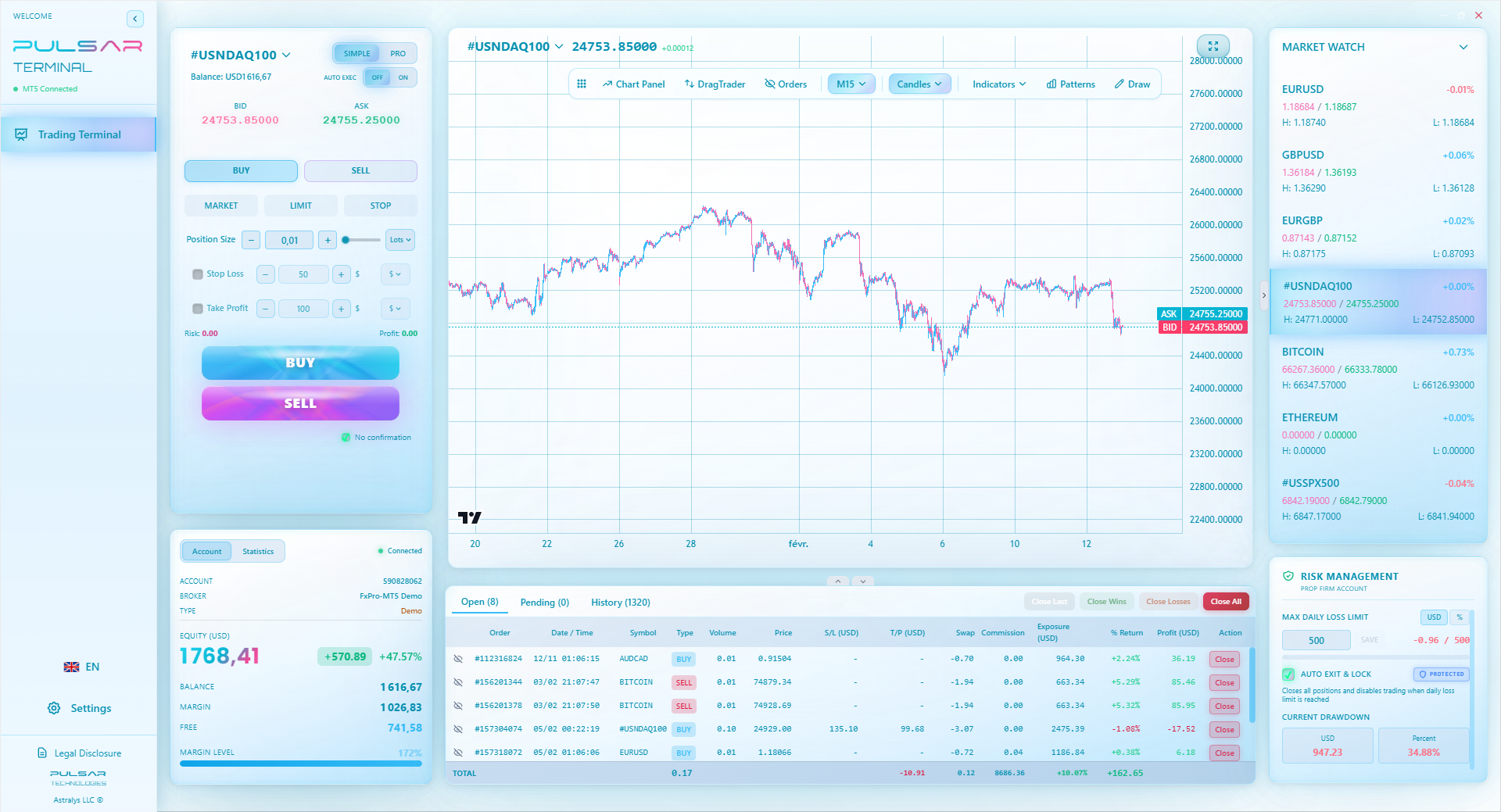
Managing volatile ZAR pairs requires precise order management, which is where a tool like Pulsar Terminal shines by letting you set multi-level take-profits and stop-losses directly on your MT5 charts.
Pulsar Terminal
Hepsi bir arada MT5 aracı: sürükle-bırak emirler, çoklu TP/SL, trailing stop, grid trading, Volume Profile ve prop firm koruması. Her gün 1.000'den fazla trader tarafından kullanılıyor.
“Trading from South Africa isn't about beating the rand; it's about executing your system well, in the market you have.”
We have unique psychological traps here. The first is the 'dollar dream' - seeing every trade as a way to escape rand volatility and build offshore wealth. This leads to over-trading and taking sizes that are too large for your account. You're not trading to 'beat the rand,' you're trading to execute a system well.
The second is community FOMO. WhatsApp groups and Telegram channels are full of 'gurus' posting screenshots of their USD/ZAR wins. It's almost always after the fact. I joined one in 2020. The pressure to follow their calls, which were often high-risk gambles, was intense. I took two trades against my own plan because of it. Both lost. I left the group and my performance improved immediately. Trust your own analysis.
Third is the lack of patience. We want results now. Forex doesn't work like that. Building a R50,000 account to R100,000 with proper 1% risk is a grind. It might take a year or more of consistent work. Chasing 10% returns a week is a surefire path to a margin call.
My advice? Treat trading like a skilled profession, not a lottery. You wouldn't expect to be a qualified engineer after watching a few YouTube videos. Don't expect to be a profitable trader without the same dedication to study, practice, and emotional control. The ultimate forex trader is calm, bored even, and utterly disciplined. The excitement is in the review and the gradual growth, not the adrenaline of the trade.
FAQ
Q1Is forex trading legal and safe in South Africa?
Yes, it's legal and regulated by the FSCA. It's 'safe' only if you use an FSCA-licensed broker, which ensures client fund segregation and adherence to local rules like the 30:1 use cap. Trading with unregulated offshore entities is risky and offers no local legal protection.
Q2What is the best forex broker for South Africans?
There's no single 'best' broker. It depends on your style. For low-cost scalping, look at Tickmill or IC Markets. For beginners with a small budget, XM is a solid start. Always verify their FSCA FSP number first. We have detailed reviews on brokers like Exness and IC Markets to help you compare.
Q3How much money do I need to start trading forex in South Africa?
You can start with very little - some brokers like XM allow deposits from $5 (about R90). However, to trade properly with sensible risk management, I'd recommend a minimum of R5,000-R10,000. This allows you to use small position sizes and survive the inevitable losing streaks without blowing your account.
Q4How are my forex trading profits taxed by SARS?
If you trade frequently, SARS will likely treat your profits as income, taxable at your marginal income tax rate (which can be over 40%). Infrequent, long-term investments might qualify for capital gains tax. You must declare all profits and keep careful records of every trade, deposit, and withdrawal. Consult a tax professional who understands trading.
Q5Why is the spread on USD/ZAR so much wider than on EUR/USD?
Lower liquidity and higher volatility. The EUR/USD is the most traded pair in the world. USD/ZAR is an exotic pair with less trading volume, so brokers charge a wider spread to cover their risk. It's normal to see 5-10 pips versus less than 1 pip for the majors.
Q6Can I use international brokers like Pepperstone or IG from South Africa?
Yes, many international brokers like Pepperstone and IG hold FSCA licenses specifically for their South African clients. This is often the best of both worlds: you get a global broker's technology and pricing, with the security of local regulation. Always check their specific South African entity's license.
Q7What's a realistic monthly return for a disciplined forex trader?
Aim for 2-5% per month, consistently. That's realistic with good risk management. Anyone promising 10%, 20%, or more per month is either lying or taking enormous risk that will eventually wipe them out. Growing a R20,000 account by R400-R1,000 a month is solid, sustainable progress.
Prof. Winston'ın Dersi
Önemli Noktalar:
- ✓Verify your broker's FSCA FSP number. Every time.
- ✓Never risk more than 1% of your capital on a single trade.
- ✓ZAR pairs need wider stops - adjust your position size down.
- ✓Your trading profits are likely taxable income. Keep every record.
- ✓A 2-5% monthly return is realistic; 20% is a fantasy.
Bu makale ne kadar faydalıydı?
Bir yıldıza tıklayın
Haftalık Trading Analizleri
Ücretsiz haftalık analiz ve stratejiler. Spam yok.
Yazar hakkında
David van der Merwe
Gelişen Piyasalar Yatırımcısı
Johannesburg merkezli, gelişmekte olan piyasa dövizlerinde 11 yıllık deneyime sahip trader. ZAR pariteleri, FSCA düzenlemeli ticaret ve Güney Afrika piyasa analizi uzmanı.
Yorumlar
Risk Uyarısı
Finansal araçlarla işlem yapmak önemli riskler taşır ve tüm yatırımcılar için uygun olmayabilir. Geçmiş performans gelecekteki sonuçları garanti etmez. Bu içerik yalnızca eğitim amaçlıdır ve yatırım tavsiyesi olarak değerlendirilmemelidir. İşlem yapmadan önce her zaman kendi araştırmanızı yapın.
Bunları da beğenebilirsiniz

Cara Trading Forex Sukses: 7 Prinsip dari Trader Profesional
Cara trading forex sukses dengan 7 prinsip trader pro: manajemen modal, disiplin, journal trading, backtest. Data nyata, bukan janji profit palsu.
Jam Trading Forex Terbaik untuk Trader Indonesia: Panduan Lengkap dengan Tabel Waktu
Panduan jam trading forex untuk trader Indonesia. Tabel 4 sesi dunia, jam emas 20:00-00:00, sesi mana yang harus dihindari. Data akurat + tips dari trader berpengalaman.
Top 5 Sàn Forex Uy Tín Nhất 2026: Review Jujur dari Trader Indonesia
Top 5 sàn forex uy tín 2026 untuk trader Indonesia. Review jujur: spread, deposit, withdraw, dukungan lokal. Exness, XM, IC Markets & lebih.
Pulsar Terminal'ı Edinin
Tüm bu hesaplayıcılar MT5 hesabınızdan gerçek zamanlı verilerle Pulsar Terminal'e entegredir.
Pulsar Terminal'ı Edinin