


I remember staring at the screen in my Lagos apartment in October 2022, watching GBP/NGN rocket from ₦520 to ₦780 in what felt like minutes.

Olumide Adeyemi
Batı Afrika Yatırım Öncüsü ·  Nigeria
☕ 12 dk okuma
Neler öğreneceksiniz:
- 1Why Charts Matter (Especially in Nigeria)
- 2Candlestick Basics, Decoded Simply
- 3Choosing Your Timeframe: Matching the Nigerian Pace
- 4Key Chart Patterns That Actually Make Money
- 5Adding Indicators Without the Clutter
- 6Managing Risk Right on the Chart
- 7Common Chart Mistakes Nigerian Traders Make
- 8Putting It All Together: Your Chart Routine
I remember staring at the screen in my Lagos apartment in October 2022, watching GBP/NGN rocket from ₦520 to ₦780 in what felt like minutes. My chart was a mess of red and green lines I didn't understand, and I missed the entire move because I was trying to decode what a 'doji' meant while the market was screaming a different story. That moment cost me potential profit and taught me that in Nigeria's fast-moving forex scene, you don't have time for academic theory. You need to understand forex trading charts like you know the route from Yaba to Victoria Island during rush hour - instinctively, with an eye for the shortcuts and potholes.
Here's the truth most trading courses won't tell you: in Nigeria, charts aren't just about price. They're about survival. Our market has unique pressures - CBN policy announcements that hit like a thunderclap, sudden naira liquidity crunches, and the fact that we're trading a currency (the naira) that's often reacting to local politics as much as global economics. A chart shows you the collective fear and greed of every trader, from the guy in Ikoyi with a Bloomberg terminal to the student in Unilag trading on his phone. It filters out the noise from WhatsApp groups and Twitter rumors. When the CBN made that surprise rate hike last year, the USD/NGN chart on the black market pairs told the real story minutes before any news outlet confirmed it. The price spiked, rejected a key level, and collapsed - that was the market voting with its money. Understanding forex trading charts gives you that vote count in real-time.

Warning: Many 'signal sellers' in Nigeria screenshot pretty charts with perfect entries. Remember, a chart showing past data is easy to manipulate. Your job is to read the live chart, not the edited one.
Our market size is no joke either. We're the second-largest retail forex market in Africa. That volume shows up on charts as momentum - when Nigerian traders pile into a USD trade, you can see it in the volume spikes and widening candle ranges. It's a crowd you can either follow or get trampled by.

💡 Winston'ın İpucu
A clean chart is a smart chart. If you can't see the price action for all the indicators and lines, you're not analyzing, you're decorating.
Forget the fancy Japanese names for a second. A candlestick just answers four questions for a specific time period (like 1 hour or 1 day): What did the price open at? What was the high? What was the low? And where did it close? The body shows the open-to-close battle. The wicks (or shadows) show the failed attempts to push price higher or lower.
Let me give you a real example from my trades. On March 15th, I was watching EUR/USD on the 4-hour chart. Price had been dropping, but then a candle formed with a tiny body at the top and a very long lower wick. This is called a hammer. It told me that sellers pushed price way down during that 4-hour period, but buyers fought back hard and closed it near the top. It was a sign of buyer exhaustion. I didn't enter just then (that's a common mistake), but I put it on my watchlist. The next candle was a strong green one closing higher. That was my confirmation. I went long at 1.0730 and rode it to 1.0820. That 90-pip move started with reading one candle correctly.
The Three Candles You Must Know
- The Doji: Open and close are almost the same. It means indecision, a tug-of-war where nobody won. If you see this after a strong trend, pay attention. The trend might be tired.
- The Engulfing Candle: One candle's body completely 'eats' the previous candle's body. A bullish engulfing after a downtrend is a powerful reversal signal. I've caught some of my best Naira pair moves with this.
- The Pin Bar (or Hammer/Shooting Star): A small body with a very long wick in one direction. It shows a rejection. A long lower wick (hammer) means sellers got rejected. A long upper wick (shooting star) means buyers got rejected.

Pro Tip: Don't trade off a single candle in isolation, especially on a low time frame like 1-minute or 5-minute. A hammer on the 1-hour or daily chart carries far more weight because it represents more trading volume and time for that battle to happen.
“Your timeframe is your trading personality. Are you a scalper, weaving through traffic, or a swing trader, patient like a fisherman on the Niger?”
Your timeframe is your trading personality. Are you a scalper, in and out in minutes like an okada weaving through traffic? Or are you a swing trader, holding for days or weeks, like a patient fisherman on the Niger?
- Scalping (1-min to 15-min charts): Fast, intense, and requires total focus. It works with our high use environment but is risky. Spreads eat into profits. If you're using a scalping strategy, you need a broker with razor-thin spreads like IC Markets or Pepperstone.
- Day Trading (1-hour to 4-hour charts): This is my sweet spot. It lets you catch the major London and New York sessions without staring at the screen all night. Most actionable chart patterns form here. It's perfect for trading around CBN news events.
- Swing Trading (Daily to Weekly charts): This is for the calm strategist. You're looking at the broader trend of USD/NGN or GBP/NGN, ignoring the daily noise. This approach is less stressful and often more profitable if you can be patient. Learn more about the mindset for this in our guide to swing trading.
My mistake early on? I used the daily chart for analysis but the 5-minute chart for entry. The mismatch got me stopped out constantly. Now, I use a top-down approach: I find the trend on the daily, wait for a setup on the 4-hour, and fine-tune my entry on the 1-hour. This multi-timeframe analysis is non-negotiable for serious trading.
Patterns are the grammar of the chart's language. They tell you stories about consolidation and breakout.
Support and Resistance: This is the foundation. Support is like a price floor, where buying tends to come in. Resistance is a ceiling, where selling appears. Draw these as horizontal lines where price has reversed before. On USD/NGN, psychological levels like ₦800, ₦900, or ₦1000 often act as major resistance.
Trend Lines: Connect the swing lows in an uptrend or the swing highs in a downtrend. A broken trendline is often the first sign the trend is changing. Simple, but incredibly effective.
The Patterns You'll See Again and Again:
| Pattern | What It Looks Like | What It Usually Means |
|---|---|---|
| Head & Shoulders | Three peaks, middle one highest. | A major trend reversal from up to down is likely. |
| Double Top/Bottom | Two similar peaks or troughs. | Failure to break a level, often leading to a reversal. |
| Triangle | Price coiling in a tighter range. | A period of consolidation before a explosive breakout. |
I got caught in a false breakout on a triangle pattern in Gold (XAU/USD) last year. Price broke upwards, I bought, and it immediately reversed and crashed. Why? I didn't check the higher timeframe trend (it was down) and I didn't wait for the candle to close above the triangle line. A lesson in patience that cost me $250. Now, I always wait for a candle close beyond the pattern boundary. For more on trading gold, check our XAU/USD guide.
These patterns form because of market psychology - fear, greed, and indecision - and that psychology is universal, from New York to Lagos.
💡 Winston'ın İpucu
The most important level on your chart is not where you enter, but where you admit you're wrong. Place your stop-loss first, before you even think about profit.
“Price action is the king. Indicators are the advisors. The king makes the final decision.”
Indicators are helpers, not crystal balls. New traders drown their charts in 10 different indicators, all saying conflicting things. Start with one or two.
- Moving Averages (The Trend Guide): I keep a 50-period and a 200-period Exponential Moving Average (EMA) on my chart. If price is above both, the trend is up. If it's below both, it's down. The 200-EMA is a major dynamic support/resistance line. When price pulls back to it in an uptrend, it's often a good area to look for buys.
- RSI - Relative Strength Index: This measures whether a market is overbought (above 70) or oversold (below 30). The secret isn't just trading when it hits 30 or 70. It's looking for divergence. If price makes a new low but the RSI makes a higher low, it means selling momentum is weakening. That's a powerful hidden buy signal. Our deep dive on the RSI indicator explains this in detail.
- MACD - Moving Average Convergence Divergence: This is great for spotting changes in momentum. When the MACD line (fast) crosses above the signal line (slow), momentum is turning up. I use it more for confirmation than for entry signals.
Here's my rule: Price action (the candles and patterns) is the king. Indicators are the advisors. The king makes the final decision. If your chart is so cluttered you can't see the candles, you've lost the plot.

Example: On a EUR/USD EUR/USD guide trade, price breaks above resistance. That's your primary signal (the king). You then check: Is price above the 50 EMA? (Yes). Is the RI coming up from below 50? (Yes). That's your confirmation from the advisors. Now you have a high-probability setup.
This is where most Nigerian traders fail. They find a great setup but then risk 10% of their account on it. One loss cripples them. Your chart is your risk management blueprint.
Your stop-loss should be placed at a level that, if hit, proves your trade idea wrong. For a buy trade, put it just below the recent swing low or below a key support zone. The distance between your entry and your stop-loss in pips determines your position size. Never decide how much to trade first. Let the chart tell you your risk, then use a position size calculator to figure out how many lots you can afford to lose 1-2% of your account on.
Let's say you're buying USD/NGN at ₦950, with a stop at ₦930. That's a 20 pip risk. If your account is ₦200,000 and you only want to risk 1% (₦2,000), your position size must be calculated so that a 20-pip loss equals ₦2,000. This math keeps you in the game.
Your take-profit should be based on the chart too. Look for the next obvious resistance level. You can also use a risk-reward ratio. I never enter a trade unless I can see a potential profit that's at least 1.5 times my potential loss. A tool that lets you set multiple take-profit levels and move your stop to breakeven automatically can be a game-saver when you're not glued to the screen. Managing these orders manually under pressure is tough.
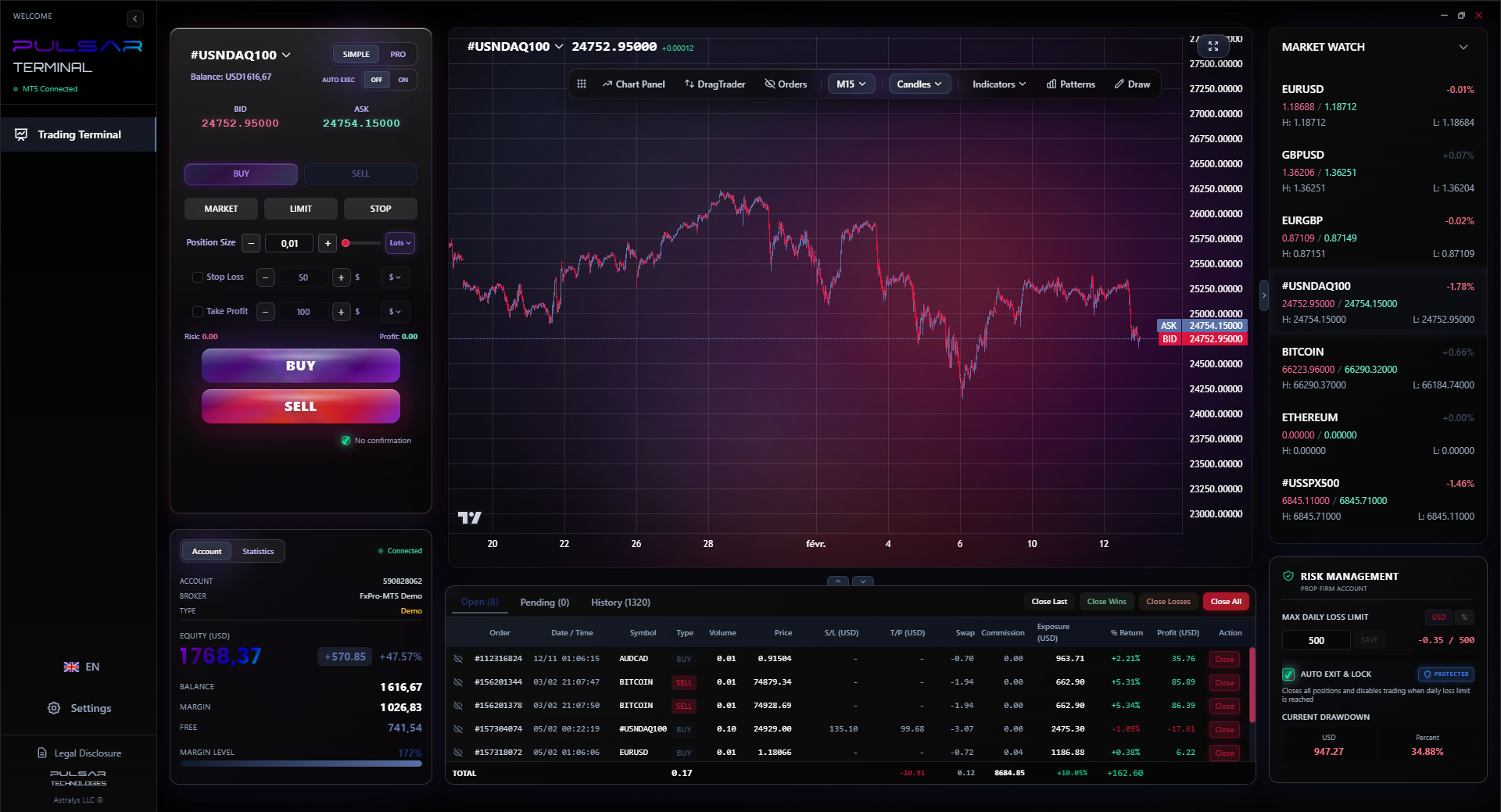
Manually moving stops to breakeven and managing multiple take-profit levels is stressful; a tool like Pulsar Terminal automates this directly on your MT5 chart, so you can trade your plan without hesitation.
Pulsar Terminal
Hepsi bir arada MT5 aracı: sürükle-bırak emirler, çoklu TP/SL, trailing stop, grid trading, Volume Profile ve prop firm koruması. Her gün 1.000'den fazla trader tarafından kullanılıyor.
“The market will give you another chance. It always does. Stop chasing the price.”
I've made these, my friends have made these. Let's avoid them.
- Trading Illiquid Pairs on Low Timeframes: Trying to scalp exotic pairs or minor crosses during off-hours leads to massive slippage and wide spreads. Stick to majors like EUR/USD, GBP/USD, and USD/JPY during the London and New York overlaps.
- Ignoring the Spread: That beautiful hammer pattern on your 1-minute chart means nothing if the spread is 3 pips. Your trade is already 3 pips in the red the second you enter. Always know your broker's typical spread for your chosen pair and timeframe.
- Over-Analyzing During News: When major CBN or US NFP news hits, charts go crazy. Candles have wicks 50 pips long. Don't try to read detailed patterns here. Either stay out, or if you trade, use much wider stops and understand it's pure volatility gambling.
- Chasing the Price: You see a huge green candle on USD/NGN and buy at the very top, fearing you'll miss out. That's a recipe for buying the high. Wait for a pullback or a consolidation. The market will give you another chance. It always does.
- Not Adjusting for use: High use magnifies everything. A small 10-pip move against you on a highly leveraged position can trigger a margin call. Your chart analysis must be sharper, and your risk management stricter, when using 1:500 use versus 1:50.
💡 Winston'ın İpucu
Backtest patterns not by memorizing names, but by asking: 'What were buyers and sellers doing here?' The story is in the wicks and the closes.
Here's my daily routine, honed over years of mistakes.
- Open the Daily Chart: I look at 3-5 major pairs. What's the overall trend? Where are the key support and resistance levels? I draw these zones.
- Drop to the 4-Hour Chart: This is my hunting ground. I look for price approaching those daily zones. Is there a candlestick pattern forming? A pullback to a moving average?
- Check for Confluence: Is there a pattern AND an indicator signal AND a trend alignment? The more reasons the chart gives you, the better the trade.
- Plan the Trade: If I see a setup, I mark my exact entry, stop-loss, and take-profit on the chart. I calculate my position size before I even think about clicking buy.
- Execute and Manage: I place the trade and walk away. I don't watch every tick. I set alerts for my key levels. The chart has given me the plan; my job is to follow it.
Understanding forex trading charts is a skill, like learning a language. You start with basic words (candles), then grammar (patterns), then you learn to have conversations (price action). It takes screen time. Don't just read about it. Open a demo account with a broker like XM or Exness, pull up a chart, and start labeling what you see. Mark every support, circle every hammer, draw every trendline. That's how it becomes second nature. And when the next big move on the Naira pairs happens, you won't be staring confused. You'll be ready.
FAQ
Q1What is the best chart type for beginner forex traders in Nigeria?
Stick with candlestick charts, 100%. They give you the most visual information (open, high, low, close) in a way that's easy to digest. Start on the 1-hour or 4-hour timeframes to avoid the noise of lower timeframes while still seeing enough action.
Q2How many indicators should I have on my forex chart?
As few as possible. Seriously, one or two is plenty. I run with just two moving averages (50 & 200 EMA) and sometimes the RSI. More indicators create confusion and conflict. Master price action and support/resistance first, then add one indicator for confirmation.
Q3Can I rely on free charting software, or do I need to pay?
The free charting on platforms like MetaTrader 4 or 5 is more than enough to start and even to become a professional. Don't fall for the hype of expensive software early on. Your broker's platform (like those from IC Markets or Pepperstone) has all the tools you need. Focus on skill, not tools.
Q4Why do my chart patterns sometimes fail?
They fail because no pattern works 100% of the time. The key is confluence - did the pattern form at a key support/resistance level? Was the overall trend in its favor? Also, you must wait for the candle to CLOSE beyond the pattern boundary to confirm the breakout. Many failures happen because traders jump in on a intra-candle break that gets rejected.
Q5How do I know if a support or resistance level is 'strong'?
Look for two things: 1) The number of times price has touched and reversed from that level (more touches = stronger). 2) The timeframe - a level on the daily or weekly chart is far stronger than one on the 15-minute chart. Also, watch for clusters where a horizontal level aligns with a moving average or a trendline.
Q6Is technical analysis on forex charts even reliable for the Nigerian Naira?
Yes, but with a caveat. Technical analysis works on any liquid market driven by human psychology, which includes Naira pairs. However, for pairs like USD/NGN, be aware that sudden CBN interventions or policy shocks can override any technical setup. Always be more cautious with your position size on local currency pairs due to this event risk.
Prof. Winston'ın Dersi
Önemli Noktalar:
- ✓Master candlesticks before indicators.
- ✓Always use a 1:1.5 minimum risk-reward ratio.
- ✓Trade the 4-hour chart for the best balance.
- ✓Place your stop-loss where your idea is invalidated.
Bu makale ne kadar faydalıydı?
Bir yıldıza tıklayın
Haftalık Trading Analizleri
Ücretsiz haftalık analiz ve stratejiler. Spam yok.
Yazar hakkında
Olumide Adeyemi
Batı Afrika Yatırım Öncüsü
Nijerya'nın en aktif forex eğitmenlerinden biri. Lagos'tan 8 yıllık ticaret deneyimi. Afrika'lı trader'lar için düşük sermaye stratejileri ve prop firma yarışmaları uzmanı.
Yorumlar
Risk Uyarısı
Finansal araçlarla işlem yapmak önemli riskler taşır ve tüm yatırımcılar için uygun olmayabilir. Geçmiş performans gelecekteki sonuçları garanti etmez. Bu içerik yalnızca eğitim amaçlıdır ve yatırım tavsiyesi olarak değerlendirilmemelidir. İşlem yapmadan önce her zaman kendi araştırmanızı yapın.
Bunları da beğenebilirsiniz

Cara Trading Forex Sukses: 7 Prinsip dari Trader Profesional
Cara trading forex sukses dengan 7 prinsip trader pro: manajemen modal, disiplin, journal trading, backtest. Data nyata, bukan janji profit palsu.
Jam Trading Forex Terbaik untuk Trader Indonesia: Panduan Lengkap dengan Tabel Waktu
Panduan jam trading forex untuk trader Indonesia. Tabel 4 sesi dunia, jam emas 20:00-00:00, sesi mana yang harus dihindari. Data akurat + tips dari trader berpengalaman.
Top 5 Sàn Forex Uy Tín Nhất 2026: Review Jujur dari Trader Indonesia
Top 5 sàn forex uy tín 2026 untuk trader Indonesia. Review jujur: spread, deposit, withdraw, dukungan lokal. Exness, XM, IC Markets & lebih.
Pulsar Terminal'ı Edinin
Tüm bu hesaplayıcılar MT5 hesabınızdan gerçek zamanlı verilerle Pulsar Terminal'e entegredir.
Pulsar Terminal'ı Edinin