


I remember my first 'educated' trade after reading three trading books.

David van der Merwe
Gelişen Piyasalar Yatırımcısı ·  South Africa
☕ 9 dk okuma
Neler öğreneceksiniz:
- 1What the UNISA Forex Course Actually Is (And Isn't)
- 2The Real Costs Beyond the R6,480 Tuition
- 3South African Regulations You MUST Know (UNISA Might Not Stress This Enough)
- 4From UNISA Certificate to Live Trading: The Missing Steps
- 5My Verdict: Is the UNISA Forex Course Value for Money?
- 6Alternative Ways to Spend Your R6,480 (If Your Goal is Profitable Trading)
- 7Final Word for South African Traders
I remember my first 'educated' trade after reading three trading books. I went long on EUR/USD at 1.2150 with 2 lots, convinced the technicals were perfect. Two hours later, I was staring at a R4,200 loss after an unexpected Fed comment. The books didn't mention that. That's the gap between theory and reality in trading. When South African traders ask me about the UNISA forex course, that's what I think about: does spending R6,480 on their 'Course in Share and Forex Trading' actually prepare you for the market, or just give you textbook knowledge that gets shredded in real trading?
Let's clear this up first. When people search 'unisa forex', they're usually talking about UNISA's Course in Share and Forex Trading (76988). It's not a degree. It's a short course run through their Centre for Lifelong Learning. For R6,480 (as of late 2023), you get three modules: Introduction to Investments, Share Trading, and finally, Forex Trading.
The material covers the basics: what a pip is, how the market functions, some fundamental and technical analysis. It's structured, academic, and gives you a certificate. That's the value if you need formal recognition for a job in financial services.
Here's what it isn't: a trading mentorship. It won't teach you a specific scalping strategy or how to handle the emotional rush when a trade moves against you. I've seen graduates who could perfectly explain interest rate differentials but then blow an account because they didn't understand how to use a position size calculator with proper risk management.

Warning: Don't confuse course completion with trading competency. Passing the UNISA exam means you understand concepts. It doesn't mean you can consistently extract money from the world's largest financial market. That's a different skill entirely.

💡 Winston'ın İpucu
A certificate proves you can study. A trading journal proves you can learn. Focus on the journal.
The course fee is just your entry ticket. To actually trade, you need capital. This is where most aspiring traders get the math completely wrong.
Broker Minimums vs. Practical Minimums
Yes, brokers like XM or Exness let you open an account with $5 (roughly R70-R150). You can technically trade. But with that size, one pip on EUR/USD might be worth 10 cents. You'd need to make 1,000 pips to buy a decent steak. It's a demo account with real money.
For serious practice where the psychology becomes real, you need meaningful capital. I tell my students to start with an amount they're prepared to lose - call it tuition - but that's large enough to feel. R1,500 to R5,000 is a realistic practice range. If you want to aim for supplemental income, think R5,000 to R20,000 as starting capital. This lets you trade sensible position sizes where a 20-pip stop-loss doesn't wipe you out over a bit of noise.
The Hidden Fees That Eat Returns
Your broker isn't a charity. You pay through the spread (the difference between buy and sell prices) and sometimes commissions. On a major pair like EUR/USD, a good spread might be 0.6 pips. On exotic pairs involving the ZAR, it can be 5-10 pips. That's your cost just to enter the trade.
Then there's the swap rate, or overnight financing fee, if you hold a position past 5 PM New York time. This is based on the interest rate difference between the two currencies. With SARB cutting rates, holding a ZAR-based pair overnight has become cheaper, but it's still a factor for swing trading strategies.

Example: You trade USD/ZAR with a 5-pip spread. You buy at 16.3400, but the sell price is 16.3395. Your trade is already 5 pips in the red before the market even moves. You need the price to move 5 pips just to break even on the trade entry.
“The market doesn't care about your certificate. It only cares about whether your next decision makes or loses money.”
This is critical, and it's where many local traders get into trouble. Trading is legal here, but with strict rules from the Financial Sector Conduct Authority (FSCA) and the South African Reserve Bank (SARB).
First, use is capped at 30:1 for major forex pairs for retail traders. That's an FSCA rule. So forget those offshore brokers advertising 500:1 or 1000:1 to South African clients - if they're offering that, they're likely not properly regulated here, and you have zero protection if they disappear with your money.
Second, exchange controls. You have a Single Discretionary Allowance (SDA) of R1 million per year you can move offshore without tax clearance. For larger sums, there's a Foreign Investment Allowance (FIA) of up to R10 million, but you need a Tax Compliance Status from SARS. You cannot directly speculate against the Rand with a local broker. That's why you trade USD/ZAR through an international broker regulated elsewhere (like the FSCA itself, or ASIC, CySEC).
Always, always verify your broker's license on the FSCA website. In 2025 alone, they issued over a hundred warnings about fake 'signal sellers' and cloned broker sites. Your first line of defense is you. I only recommend brokers with a solid, verifiable track record like IC Markets or Pepperstone for their tight spreads and strong regulation.
Let's say you've passed the UNISA course. You understand what the MACD indicator is. Now what? Here's the brutal transition most aren't prepared for.
Step 1: Demo Trading (But Do It Wrong). Everyone says 'practice on a demo'. Most people do it uselessly. They trade with R500,000 virtual money, taking massive, reckless positions. That teaches nothing. Instead, use your intended real capital amount. If you plan to start with R10,000, fund your demo with R10,000. Trade your actual strategy with realistic position sizes. Track every trade in a journal for at least three months.
Step 2: Backtesting & Strategy Development. The course introduces technical analysis. It doesn't teach you to build a strong system. You need to learn how to backtest a strategy - running it against historical data to see if it ever worked. Does your RSI indicator strategy hold up during a market crash like March 2020? You'll only know by testing.
Step 3: The Live 'Cent Account' Bridge. Before going live with your main capital, use a cent account. One USD cent is one pip. This makes the psychology real - it's real money, but a R100 loss feels like R1. It's the perfect training ground to practice executing your plan under pressure without catastrophic risk. I did this for six months, and it exposed dozens of tiny execution errors I never made in demo.
Step 4: Risk Management as a Religion. This is the single most important thing UNISA's course can't drill into you. You must decide, before every trade: Where is my stop-loss? How much of my capital (I risk 0.5-1.5% max) am I willing to lose on this idea? What is my profit target? This discipline is what separates the 10% who survive from the 90% who get a margin call.
💡 Winston'ın İpucu
The R6,480 question isn't 'Can I afford the course?' It's 'Will this course help me protect and grow my next R6,480 of trading capital?'
“You'll lose some of that starting capital - that's your real tuition fee. The lessons you learn when real money is on the line stick with you forever.”
It depends entirely on your goal.
Who it's GOOD for:
- Someone wanting a formal certificate to strengthen a CV for a bank or financial analyst role.
- A complete novice who needs the absolute basics explained in a structured, academic way.
- A person who values the UNISA brand and wants a foundational understanding before seeking practical training elsewhere.
Who it's NOT for:
- Someone who thinks paying R6,480 will make them a profitable trader. It won't.
- A trader looking for specific, actionable strategies, mentorship, or market insights.
- Anyone on a tight budget who could instead use that money for live trading capital and a few good, practical books or a focused mentorship program.
For the vast majority of aspiring retail traders, the sequence should be: 1) Free online resources for basics, 2) Dedicated demo/cent account practice (3-6 months minimum), 3) A small live account, 4) THEN consider a formal course like UNISA's if you still feel the need for structured theory. Most won't get past step 2, and that's okay - it saves you R6,480 and a lot of frustration.
The market doesn't care about your certificate. It only cares about whether your next decision makes or loses money.
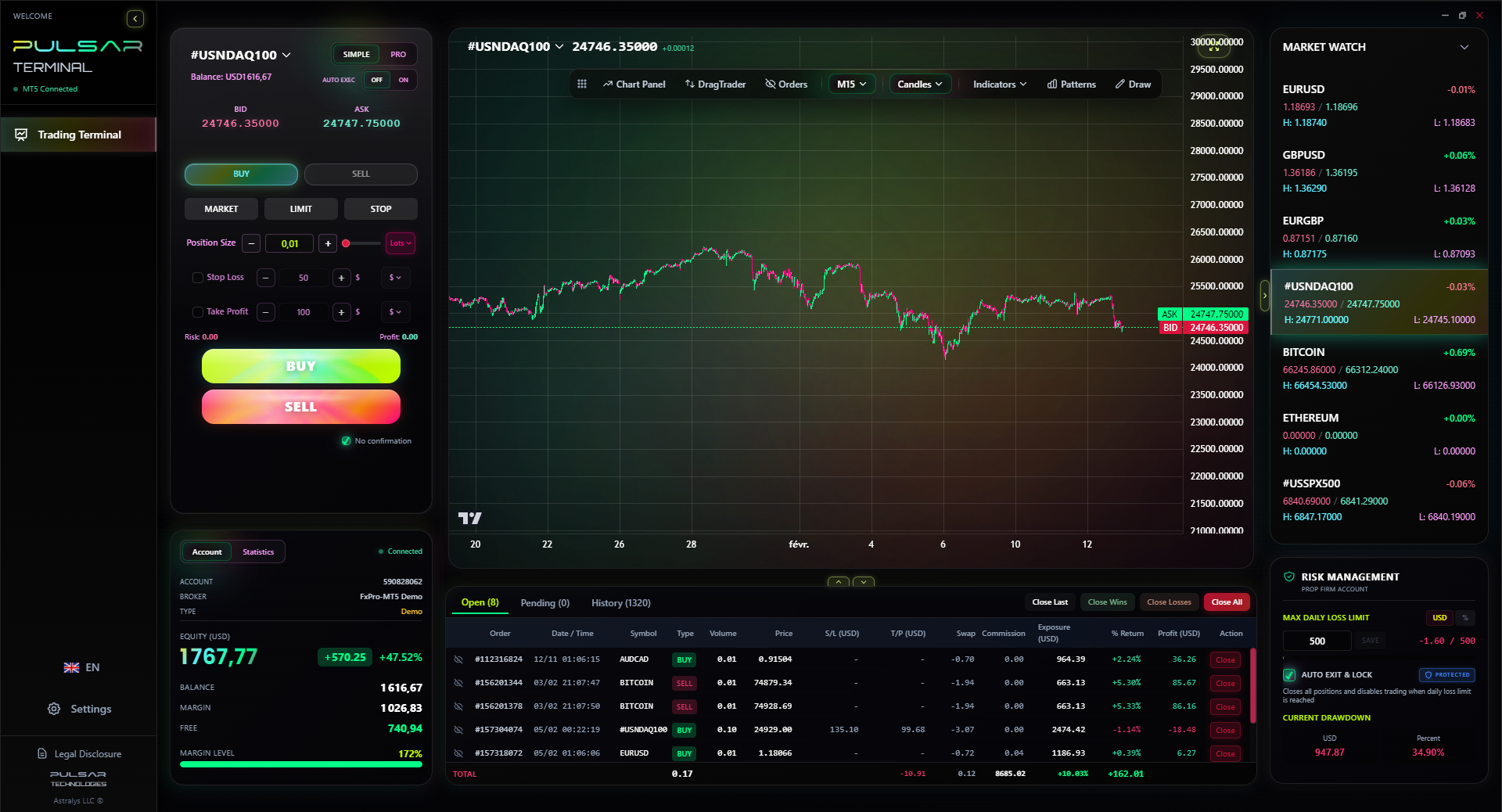
Backtesting and executing a disciplined strategy is key, and tools like Pulsar Terminal streamline this with advanced charting and one-click order management directly on your MT5 platform.
Pulsar Terminal
Hepsi bir arada MT5 aracı: sürükle-bırak emirler, çoklu TP/SL, trailing stop, grid trading, Volume Profile ve prop firm koruması. Her gün 1.000'den fazla trader tarafından kullanılıyor.
If your primary aim is to become a competent trader, not just a certified student of trading, here’s how I’d allocate that same budget.
| Expense Item | Estimated Cost (ZAR) | Purpose |
|---|---|---|
| Initial Trading Capital | R3,500 | Real money for a cent or micro account. The psychological training is irreplaceable. |
| Trading Journal Software | R800/year | To carefully review every decision. Your journal is your best teacher. |
| 2-3 Key Trading Books | R1,000 | Skip the get-rich-quick stuff. Go for classics on market psychology and risk. |
| Charting Platform Data/Add-ons | R1,180 | Perhaps a premium subscription for better data or a useful indicator suite. |
| Total | R6,480 | Every rand is directed at the practical act of trading and reviewing performance. |
This approach is hands-on from day one. You’re paying to learn in the arena, not just read about it. You’ll lose some of that capital - that’s your real tuition fee. But the lessons you learn when real money is on the line stick with you forever. I lost my first R2,000 in three weeks. That loss taught me more about emotional control than any textbook chapter ever could.
Also,, use free tools relentlessly. Learn the intricacies of your chosen instrument, whether it's EUR/USD or XAU/USD. Understand the economic calendar. Build your own watchlists. This self-directed, capital-backed learning curve is what actually builds traders.
💡 Winston'ın İpucu
Your most important teacher won't be at UNISA. It will be the trade you let lose 50 pips against you because you ignored your own stop-loss.
“No university course can give you the grit to stick to a stop-loss when you're convinced the market will turn.”
The UNISA forex course has its place. It provides a formal, structured introduction. But in the trading world, respect isn't given for certificates, it's earned through consistent performance.
The South African market is growing, with over 190,000 active traders and daily volumes in the billions. The Rand had a wild ride, ending 2025 up 13% against the Dollar. Opportunities are there. But the rules are also tightening, with the FSCA actively shutting down shady operators.
Your education needs to be broader than any single course. It needs to cover the hard skills of analysis, the soft skills of psychology, and the non-negotiable discipline of risk management. Start small. Trade a cent account. Get your teeth kicked in with R100, not R10,000. Keep a brutal trading journal. That's the real curriculum.
No university course, UNISA or otherwise, can give you the grit to stick to a stop-loss when you're convinced the market will turn. That only comes from experience, paid for in pips and rands.
FAQ
Q1Does the UNISA forex course guarantee I'll make money trading?
Absolutely not. No credible course can guarantee profits. The course teaches theoretical concepts and market structure. Consistently profitable trading requires practical experience, emotional discipline, and strong risk management, which are skills developed through live trading, not classroom learning.
Q2What is the FSCA use limit for retail forex traders in South Africa?
The Financial Sector Conduct Authority (FSCA) limits use for retail traders to a maximum of 30:1 for major currency pairs. This is a key protective rule. If a broker offers you much higher use (like 500:1), they are likely not properly regulated for the South African market, and your funds may be at risk.
Q3Can I use my R1 million Single Discretionary Allowance (SDA) to fund a forex trading account?
Yes, you can use your annual SDA to move funds offshore to an internationally regulated broker for trading. This is a common method for South African residents. For amounts beyond R1 million, you would need to use the Foreign Investment Allowance (FIA), which requires a Tax Compliance Status from SARS.
Q4Is UNISA's course better than free online resources?
It's more structured and comes with a certificate, which has value for career purposes. However, the core knowledge about pips, spreads, and basic analysis is widely available for free. The main advantage is the formal curriculum; the main disadvantage is the cost (R6,480) and the lack of live trading mentorship.
Q5What is a realistic starting capital for a serious beginner in South Africa?
While you can open an account with R100, that's for familiarization only. For serious practice where you can properly implement risk management, a starting capital of R1,500 to R5,000 is realistic. To aim for meaningful supplemental income, many experienced traders suggest R5,000 to R20,000 as a more practical starting point.
Q6Does the course cover South African exchange control regulations?
While the course provides an introduction to the investment environment, it may not explore deeply into the specific, evolving exchange control regulations set by the South African Reserve Bank (SARB). It is the trader's responsibility to understand the SDA, FIA, and the prohibition on direct Rand speculation with local brokers.
Q7What trading platform should I use after the course?
Prof. Winston'ın Dersi
Önemli Noktalar:
- ✓UNISA's course provides theory, not trading competency.
- ✓Real trading skill costs R6,480 in lost capital, not tuition.
- ✓FSCA use is capped at 30:1 for your protection.
- ✓Start with a cent account to bridge theory and reality.
- ✓Your trading journal is more valuable than any certificate.
Bu makale ne kadar faydalıydı?
Bir yıldıza tıklayın
Haftalık Trading Analizleri
Ücretsiz haftalık analiz ve stratejiler. Spam yok.
Yazar hakkında
David van der Merwe
Gelişen Piyasalar Yatırımcısı
Johannesburg merkezli, gelişmekte olan piyasa dövizlerinde 11 yıllık deneyime sahip trader. ZAR pariteleri, FSCA düzenlemeli ticaret ve Güney Afrika piyasa analizi uzmanı.
Yorumlar
Risk Uyarısı
Finansal araçlarla işlem yapmak önemli riskler taşır ve tüm yatırımcılar için uygun olmayabilir. Geçmiş performans gelecekteki sonuçları garanti etmez. Bu içerik yalnızca eğitim amaçlıdır ve yatırım tavsiyesi olarak değerlendirilmemelidir. İşlem yapmadan önce her zaman kendi araştırmanızı yapın.
Bunları da beğenebilirsiniz

Cara Trading Forex Sukses: 7 Prinsip dari Trader Profesional
Cara trading forex sukses dengan 7 prinsip trader pro: manajemen modal, disiplin, journal trading, backtest. Data nyata, bukan janji profit palsu.
Jam Trading Forex Terbaik untuk Trader Indonesia: Panduan Lengkap dengan Tabel Waktu
Panduan jam trading forex untuk trader Indonesia. Tabel 4 sesi dunia, jam emas 20:00-00:00, sesi mana yang harus dihindari. Data akurat + tips dari trader berpengalaman.
Top 5 Sàn Forex Uy Tín Nhất 2026: Review Jujur dari Trader Indonesia
Top 5 sàn forex uy tín 2026 untuk trader Indonesia. Review jujur: spread, deposit, withdraw, dukungan lokal. Exness, XM, IC Markets & lebih.
Pulsar Terminal'ı Edinin
Tüm bu hesaplayıcılar MT5 hesabınızdan gerçek zamanlı verilerle Pulsar Terminal'e entegredir.
Pulsar Terminal'ı Edinin