


Here's a fact that'll make your wallet hurt: according to Section 24I of our Income Tax Act, SARS can tax you on money you haven't even made yet.

David van der Merwe
Gelişen Piyasalar Yatırımcısı ·  South Africa
☕ 10 dk okuma
Neler öğreneceksiniz:
- 1What Exactly Is an Unrealised Forex Gain?
- 2The South African Tax Hammer: Section 24I
- 3How This Messes With Your Head (And Your Trades)
- 4Practical Strategies to Manage the Unrealised Gain Headache
- 5Brokers, Platforms, and the Local Reality
- 6Costly Mistakes I've Seen (And Made)
- 7The Long Game: When to Get a Pro Involved
Here's a fact that'll make your wallet hurt: according to Section 24I of our Income Tax Act, SARS can tax you on money you haven't even made yet. That's right, an unrealised forex gain - a paper profit on an open trade - isn't just a number on your screen. For over 190,000 South African traders moving more than $2.1 billion, it's a potential tax liability waiting to bite. I've seen traders get blindsided by this, celebrating a green portfolio only to face a tax bill on profits that vanished the next week. Let's break down what this means for your trading and, more importantly, your bank account.
An unrealised forex gain is simple in theory, complicated in practice. It's the profit sitting on an open position that you haven't closed yet. Your EUR/USD buy is up 50 pips? That's an unrealised gain. It's not cash. It's potential cash. The moment you hit that sell button and bank the profit, it becomes realised. That's when most people think the taxman gets interested. In South Africa, they're interested a lot sooner.
Think of it like this: you buy a house for R2 million. A year later, similar houses on your street sell for R2.5 million. You've made a R500,000 unrealised gain. You haven't sold, but your net worth on paper is higher. Now imagine SARS knocking on your door asking for a cut of that R500k. Sounds unfair, right? Welcome to our world with Section 24I.

Warning: Don't confuse this with your broker's margin call calculation. An unrealised gain increases your usable margin, but it's not withdrawable cash until the trade is closed. Chasing these paper profits to avoid a margin call is a rookie mistake I made early on.

💡 Winston'ın İpucu
A paper profit taxed is a real loss of opportunity. Factor the tax drag into your expected return for any trade you plan to hold over a tax year-end.
This is where things get uniquely South African. Forget what you've heard about other countries. Our rules are different, and they're strict.
The Core Principle
Section 24I basically says that both realised and unrealised foreign exchange differences must be included in your taxable income for the year. It treats currency fluctuations as a finance charge. So, at the end of every tax year (February), you must calculate the ZAR value of all your open forex positions. If they show a gain compared to their acquisition value, that paper profit is potentially taxable. Yes, even if you're a swing trader holding for the long term.
What Counts as an "Exchange Item"?
This is the critical loophole and limitation. The law defines an "exchange item" as:
- A unit of foreign currency (like holding USD in your broker account).
- A debt in foreign currency.
- A forward exchange or option contract.
Notice what's NOT explicitly listed? Shares. This means if you're trading CFDs on US stocks (like Apple or Tesla) in USD, the unrealised currency gain on the underlying share value might currently fall outside Section 24I. But the cash balance in your account in USD? That's firmly in scope. The line is blurry, and you need a tax professional.
The Deferral Get-Out Clause (Maybe)
Section 24I(10A) allows deferral of unrealised gains in specific cases, mainly transactions between related parties (like companies in the same group). For the average retail trader working through an international broker like Exness or IC Markets, this deferral likely doesn't apply. You're probably accounting for gains and losses annually.

Example: Let's say on 28 February (tax year-end), you have an open buy position on GBP/USD. You bought at 1.2500, and it's now trading at 1.2700. That's a 200 pip unrealised gain. You must convert that gain, based on the current GBP/ZAR rate, into Rands and declare it as potential income. If the trade turns south in March, you can claim a loss next year. You're effectively taxed on volatility.
“SARS can tax you on money you haven't even made yet.”
Knowing a paper profit could generate a real tax bill does something to your psychology. It creates what I call "tax anxiety" - a hesitation to let winners run because you're mentally accounting for the SARS slice. I've been there. In early 2020, I had a monster short on USD/ZAR from R14.80. By year-end, it was at R17.50, a massive unrealised gain. I spent December stressed, not about the trade, but about the hypothetical tax calculation. I closed it partially in January, just to simplify my life, and left maybe R50k on the table as it went to R18.90. Letting the tax tail wag the trading dog is a costly error.
It also punishes legitimate long-term positions. Why hold a multi-year thematic trade if you're getting taxed on its paper profits every February? This pushes traders towards shorter timeframes and more frequent trading, which increases costs through spreads and commissions. Brokers with tight spreads, like Pepperstone or XM, become even more critical in this environment.

Pro Tip: Separate your trading journal from your tax calculations. Your trading decisions should be based on price action and your system, not the tax calendar. Do the tax math afterwards, in a separate spreadsheet. It's the only way to keep a clear head.
You can't change the law, but you can manage its impact. Here’s what’s worked for me and traders I mentor.
1. The Year-End Portfolio Reset
This is controversial but common. In late January or early February, you deliberately close all open positions. You realise the gains or losses, crystalise the tax event, and then immediately re-enter the trades if your analysis still supports them. It resets your cost base. The downside? You pay spreads twice and might miss a gap move. I did this in 2023 and it cost me about 0.8% of my portfolio value in extra spreads and slippage. A necessary evil for clarity.
2. Segregate Trading Capital
Don't mix your day-to-day savings with your trading account. Have a dedicated, well-capitalised trading account. This way, if you have a large unrealised gain creating a tax liability, you aren't forced to close the trade prematurely to pay SARS. You can pay the tax bill from other funds and let the trade play out. Use a position size calculator religiously to ensure you're never over-exposed to a single position that could create a disproportionate tax problem.
3. Master Partial Closures
Instead of closing a full position, learn to bank profit in stages. If you're up 150 pips on a trade, close 30-50% of it. This realises some gain, provides cash for potential tax, and lets you keep a runner. Managing multiple take-profit levels is a skill. Tools that automate this, like setting a multi-TP order, are useful for removing emotion.
4. Keep Impeccable Records
This is non-negotiable. For every open position at year-end, you need:
- The open date and price.
- The closing price on 28/29 February.
- The ZAR exchange rate on the open date AND on 28 February. Your broker statement won't do this calculation for you. You need a spreadsheet or dedicated software. The time you spend here saves you countless headaches (and potential penalties) later.
💡 Winston'ın İpucu
The market doesn't care about your tax year. Your trading plan shouldn't either. Execute your strategy, then let your accountant handle the SARS problem. Confuse the two at your peril.
“Letting the tax tail wag the trading dog is a costly error.”
Choosing the right broker in South Africa isn't just about spreads and use. It's about operational smoothness with our unique constraints.
FSCA Regulation is Key: Always use a broker regulated by the Financial Sector Conduct Authority (FSCA). It's your basic protection. Major international brokers like AvaTrade, IG, and the ones mentioned earlier have FSCA licenses. A local broker like Khwezi Trade is also an option, offering ZAR accounts and spreads from 0.4 pips.
The ZAR Account Advantage: Many brokers offer ZAR-denominated accounts. This is a huge benefit. It means your deposits, withdrawals, and profit/loss are all in Rands from the start. You avoid the secondary unrealised gain/loss on your USD trading balance sitting in the account. If your base currency is ZAR and you trade a USD-based account, the USD/ZAR movement itself creates a taxable event. A ZAR account simplifies this massively.
Payment Methods Matter: You want easy, cheap funding. Look for brokers supporting local EFT, Ozow (Instant EFT), and maybe Skrill. Withdrawing profits should be straightforward back to your South African bank account.
Platforms: MetaTrader 4 and 5 are the kings here. But the standard MT5 platform is basic for managing complex tax scenarios. You need better trade management tools than what it offers natively.
use: FSCA caps use at 1:500 for forex majors. That's plenty. Anyone offering you 1:1000 or more is likely operating under a different license (like a global entity of Exness or XM). Understand which entity you're signing up with and which regulator applies.
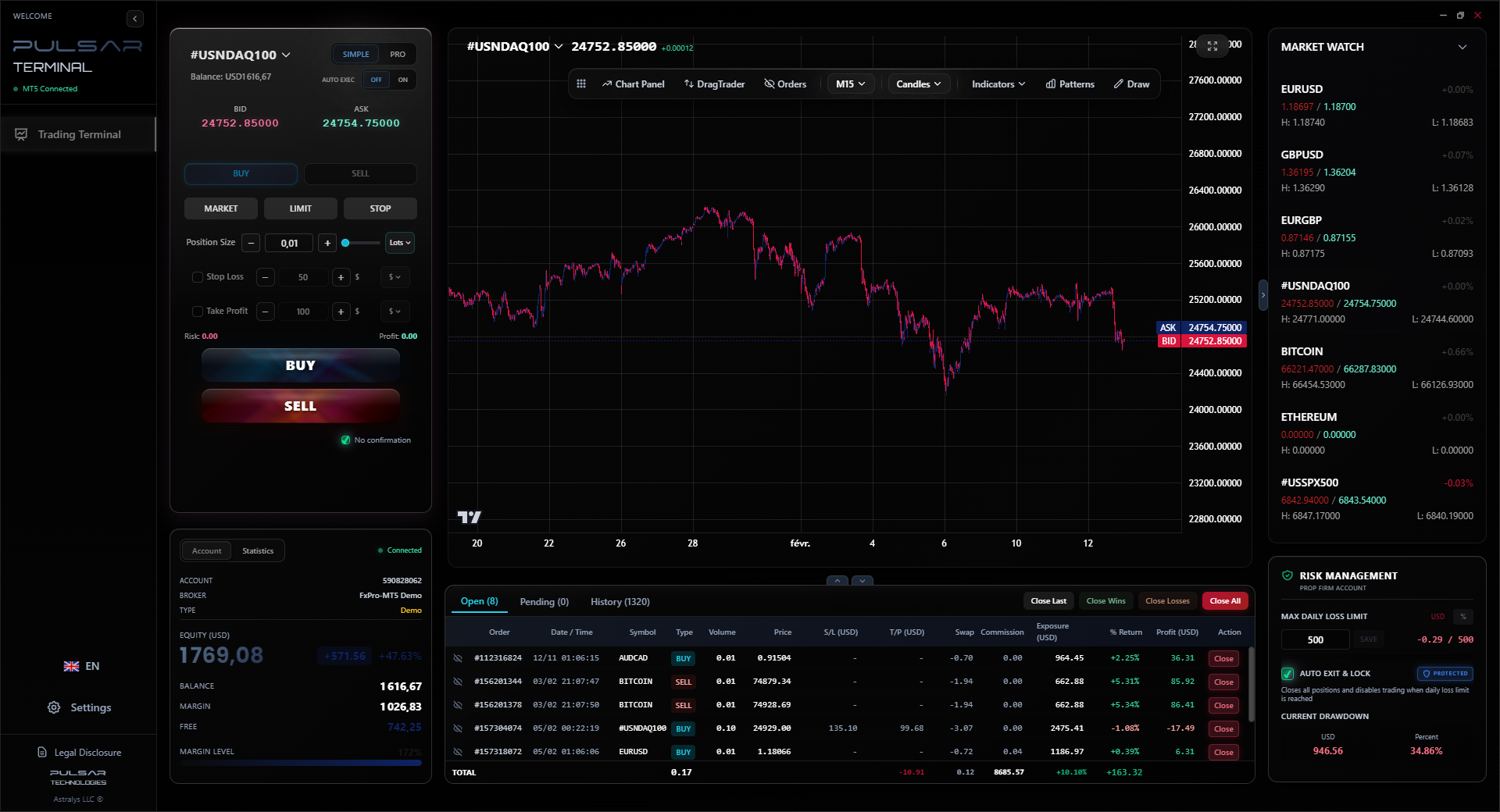
Managing multiple trades and partial closures to realise gains for tax purposes is far simpler with Pulsar Terminal's drag-and-drop order and multi-take-profit tools on MT5.
Pulsar Terminal
Hepsi bir arada MT5 aracı: sürükle-bırak emirler, çoklu TP/SL, trailing stop, grid trading, Volume Profile ve prop firm koruması. Her gün 1.000'den fazla trader tarafından kullanılıyor.
Learn from my scars and empty some wallets I've observed.
Mistake 1: Ignoring It Completely. "SARS will never know." Famous last words. Brokers issue tax certificates. Financial data sharing is increasing. The penalty for omission is 100-200% of the tax evaded. Not worth it.
Mistake 2: Over-Trading to Avoid Year-End Exposure. I once knew a guy who switched to ultra scalping in February, opening and closing dozens of trades a day just so he had no overnight positions. He generated more in spreads and commissions for his broker than he ever would have paid in tax. He also blew his account from stress and poor decisions.
Mistake 3: Not Understanding the Instrument. Remember, Section 24I applies to "exchange items." If you're trading gold (XAU/USD), is that a foreign currency? not. It's a commodity. The unrealised gain on a gold trade might be treated differently. The same logic could apply to oil or indices. But if you're trading the EUR/USD or XAU/USD, you're definitely in the crosshairs. Don't assume - get advice.
Mistake 4: Forgetting About Losses. Unrealised losses are also accounted for under Section 24I. They can be deducted from other unrealised gains or carried forward. A bad year where all your positions are in the red can provide a tax benefit. Track your losses as diligently as your gains.
💡 Winston'ın İpucu
If a law seems designed to trip you up, your edge comes from understanding it better than the next trader. In South Africa, tax knowledge is a trading skill.
“The successful traders aren't the ones who complain about it; they're the ones who understand it, plan for it, and factor it into their edge.”
If you're trading with serious capital (let's say over R250,000), stop trying to be your own tax advisor. The cost of a mistake dwarfs the fee. Find a chartered accountant who specialises in forex trading or financial instruments. They'll help you with:
- Interpretation: Is your specific trading activity even subject to Section 24I? (e.g., CFD on shares vs. spot forex).
- Calculation: The correct application of exchange rates on specific dates.
- Structuring: Should you be trading as an individual, or through a separate legal entity like a private company? The tax rates and rules differ (companies are taxed at 27% on profits, individuals on a sliding scale up to 45%). This decision is huge.
- SARS Engagement: If you get audited (and you might), having a professional who prepared your return is your best defence.
I hired an accountant in my third year of full-time trading. It cost me R15,000 that year. He identified I could structure some of my longer-term holdings differently, saving me an estimated R40,000 in deferred tax. It was the best trade I didn't place on a chart.
, an unrealised forex gain is a feature of the trading landscape here. It's not going away. The successful traders aren't the ones who complain about it; they're the ones who understand it, plan for it, and factor it into their edge. It's another variable in your risk management equation. Master it, and you remove a major source of uncertainty and fear. Ignore it, and it will eventually take a bite out of your capital that no market move ever could.
FAQ
Q1Do I pay tax if my forex trade is in profit but I haven't closed it?
Potentially, yes. Under South Africa's Section 24I, you must include the value of unrealised forex gains on open positions at your tax year-end (end of February) in your taxable income. It's treated as a financial gain, even though you haven't cashed out.
Q2What's the difference between realised and unrealised gain?
A realised gain is profit you've actually banked by closing a trade. The money is in your account. An unrealised gain is a 'paper profit' on a trade that is still open. It fluctuates with the market and isn't cash until you close the position.
Q3Does this tax apply to trading gold or stock CFDs?
It's complex. Section 24I specifically targets "exchange items" like foreign currency and forex contracts. Commodities like gold (XAU/USD) or CFDs on international shares might not fall neatly under this definition for the instrument's value, but the foreign currency in your trading account does. Always consult a tax professional for your specific assets.
Q4Can I avoid this tax by using a ZAR-denominated account?
A ZAR account simplifies things and removes one layer of currency risk. Your profit/loss in Rands is clear. However, if you're trading a foreign currency pair (like EUR/USD), the profit on that trade in Rand terms at year-end is still an unrealised forex gain and likely subject to Section 24I. The account base currency doesn't change the nature of the underlying asset.
Q5What happens if I have an unrealised loss at tax year-end?
The rule works both ways. An unrealised loss can be deducted from other unrealised gains, reducing your taxable amount. If you have a net unrealised loss, it can potentially be carried forward to offset future gains. You must declare it.
Q6Is use offered by brokers like Exness or XM legal in SA?
Brokers regulated by the FSCA, like the South African entities of major brokers, are limited to 1:500 use for retail clients. However, many South Africans sign up with a broker's international entity (e.g., Exness Global) which may offer 1:1000+. This is legal to access, but your regulator of record is not the FSCA, and different tax reporting or consumer protection rules may apply.
Q7What's the single best thing I can do to manage this?
Keep flawless, detailed records of every trade, including the ZAR exchange rate on the day you opened it and on 28 February each year. Use a dedicated spreadsheet or software. This turns a chaotic problem into a simple administrative task.
Prof. Winston'ın Dersi
Önemli Noktalar:
- ✓Section 24I taxes paper profits annually.
- ✓Unrealised gains impact trading psychology negatively.
- ✓Use ZAR accounts to simplify currency risk.
- ✓Hire a pro for capital over R250k.
- ✓Flawless records are your best defence.
Bu makale ne kadar faydalıydı?
Bir yıldıza tıklayın
Haftalık Trading Analizleri
Ücretsiz haftalık analiz ve stratejiler. Spam yok.
Yazar hakkında
David van der Merwe
Gelişen Piyasalar Yatırımcısı
Johannesburg merkezli, gelişmekte olan piyasa dövizlerinde 11 yıllık deneyime sahip trader. ZAR pariteleri, FSCA düzenlemeli ticaret ve Güney Afrika piyasa analizi uzmanı.
Yorumlar
Risk Uyarısı
Finansal araçlarla işlem yapmak önemli riskler taşır ve tüm yatırımcılar için uygun olmayabilir. Geçmiş performans gelecekteki sonuçları garanti etmez. Bu içerik yalnızca eğitim amaçlıdır ve yatırım tavsiyesi olarak değerlendirilmemelidir. İşlem yapmadan önce her zaman kendi araştırmanızı yapın.
Bunları da beğenebilirsiniz

Cara Trading Forex Sukses: 7 Prinsip dari Trader Profesional
Cara trading forex sukses dengan 7 prinsip trader pro: manajemen modal, disiplin, journal trading, backtest. Data nyata, bukan janji profit palsu.
Jam Trading Forex Terbaik untuk Trader Indonesia: Panduan Lengkap dengan Tabel Waktu
Panduan jam trading forex untuk trader Indonesia. Tabel 4 sesi dunia, jam emas 20:00-00:00, sesi mana yang harus dihindari. Data akurat + tips dari trader berpengalaman.
Top 5 Sàn Forex Uy Tín Nhất 2026: Review Jujur dari Trader Indonesia
Top 5 sàn forex uy tín 2026 untuk trader Indonesia. Review jujur: spread, deposit, withdraw, dukungan lokal. Exness, XM, IC Markets & lebih.
Pulsar Terminal'ı Edinin
Tüm bu hesaplayıcılar MT5 hesabınızdan gerçek zamanlı verilerle Pulsar Terminal'e entegredir.
Pulsar Terminal'ı Edinin